In
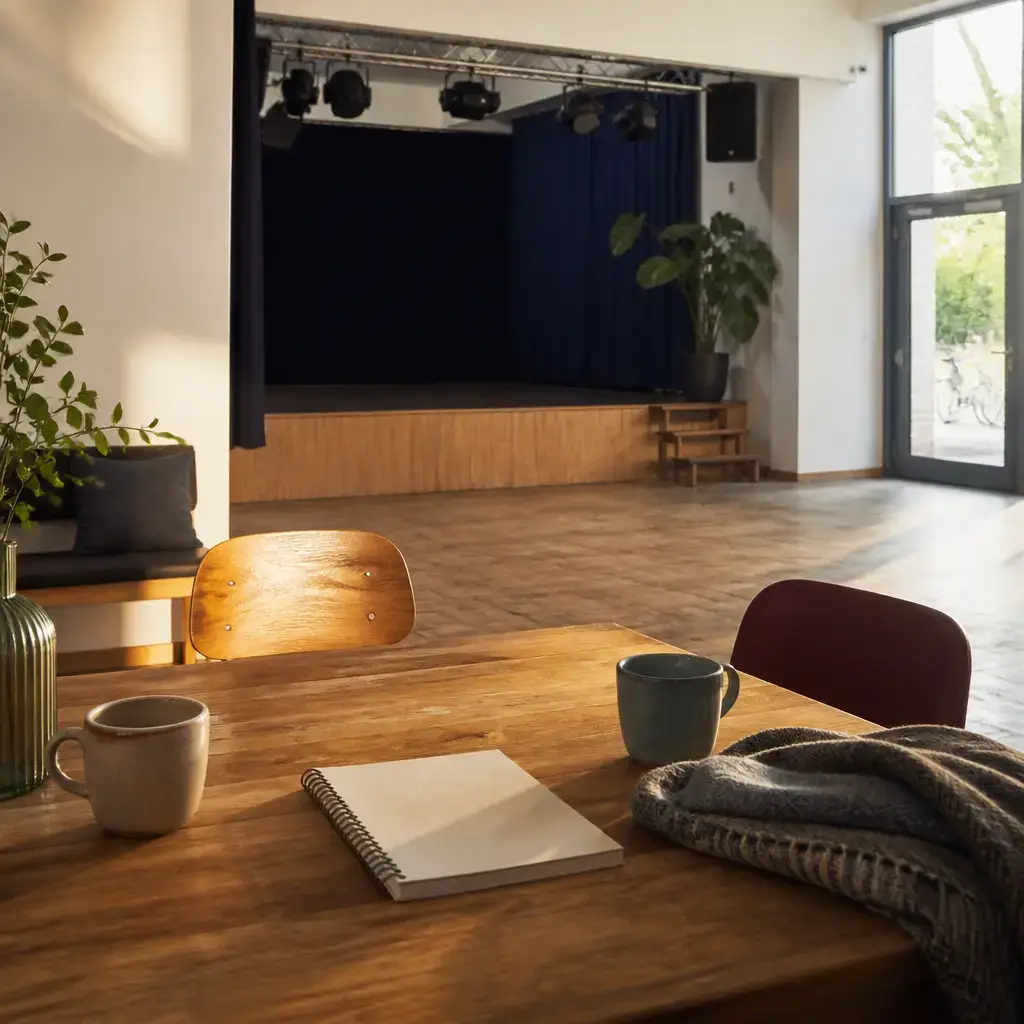
In 'In der Gemeindehalle', this means in and places the event inside the community hall. With a stationary location, 'In' is used with the location phrase. A reusable pattern is 'in der' plus a place.
der
In 'In der Gemeindehalle', 'der' means the and identifies the community hall as the place. Here it is the definite article used with the location phrase after 'In'. The pattern 'in der' is useful for describing a location.
Gemeindehalle
'Gemeindehalle' means community hall, the place where the music event is held. It is a compound word referring to a hall used by the community. In this dialogue, it follows 'In der' to name the location.
gibt
In 'gibt es eine Musikveranstaltung', 'gibt' helps express that there is a music event. It is the exact form of 'geben' used in this fixed existence construction. A reusable pattern is 'gibt es' followed by the thing that exists.
es
In 'gibt es eine Musikveranstaltung', 'es' is the placeholder used in the expression meaning there is a music event. It does not refer to a separate object here. The reusable pattern is 'es gibt' plus a thing or event.
eine
In 'eine Musikveranstaltung', 'eine' means a and introduces one music event. Its form matches the noun phrase used as the event that exists in 'gibt es'. A reusable pattern is 'eine' plus a singular feminine noun.
Musikveranstaltung
'Musikveranstaltung' means music event. It names the event being discussed and follows 'eine' in 'eine Musikveranstaltung'. The same word can be used when naming a music-related event in a plan.
Das
In 'Das klingt interessant', 'Das' means that and refers to the music event just mentioned. It is the subject of the comment about how the event sounds. A reusable pattern is 'Das klingt' followed by an evaluation.
klingt
In 'Das klingt interessant', 'klingt' means sounds, describing the impression the event gives. It is the form of 'klingen' used with the subject 'Das'. The pattern 'klingt interessant' is useful for reacting positively to information.
interessant
'interessant' means interesting and gives the speaker's evaluation of the event. It follows 'klingt' to describe how the information sounds. A reusable pattern is 'Das klingt interessant' when responding to a suggestion or piece of news.
Kann
In 'Kann man einfach hingehen?', 'Kann' asks whether going there is possible. It is the modal verb placed at the beginning because this is a question. A reusable question pattern is 'Kann man ...?' for asking about general possibility.
man
In 'Kann man einfach hingehen?', 'man' means one or people in general rather than a specific person. It makes the question general about attending the event. A reusable pattern is 'man kann' or question form 'Kann man ...?'.
einfach
In 'einfach hingehen', 'einfach' means easily or simply and suggests that attending does not require complicated preparation. It modifies the action 'hingehen'. The pattern 'einfach' plus an action is useful when asking whether something is straightforward.
hingehen
'hingehen' means go there, referring to going to the event. It stays at the end after the modal verb in 'Kann man einfach hingehen?'. A reusable pattern is 'zu einem Ereignis hingehen' for saying that someone goes to an event.
Wir
In 'Wir können die Eintrittskarten ... bekommen', 'Wir' means we and refers to the two friends together. It is the subject of the plan to get the tickets. A reusable pattern is 'Wir können' when suggesting a shared possibility.
können
In 'Wir können ... bekommen', 'können' means can or are able to and presents an available option. It is the modal verb used with 'Wir' and sends the other verb to the end of the clause. The pattern 'Wir können ... bekommen' is useful for proposing how to obtain something.
die
In 'die Eintrittskarten', 'die' means the and introduces the specific tickets needed for the event. Here it is used before a plural noun. A reusable pattern is 'die' plus a known plural item.
Eintrittskarten
'Eintrittskarten' means admission tickets or tickets for entry. These are the items the friends can obtain at the entrance. The phrase 'die Eintrittskarten bekommen' is useful when talking about getting tickets.
am
In 'am Eingang', 'am' means at the and marks the location where the tickets can be obtained. It is the contracted form of 'an dem' in this location phrase. A reusable pattern is 'am' plus a place, such as an entrance or meeting point.
Eingang
'Eingang' means entrance and refers to the place where the friends can get the tickets. It follows 'am' in 'am Eingang'. This word is useful when specifying where people enter or meet at a venue.
bekommen
In 'die Eintrittskarten ... bekommen', 'bekommen' means get or obtain the tickets. It is the verb at the end after the modal verb 'können'. A reusable pattern is 'etwas bekommen' when saying that someone receives or obtains something.
Ich
In 'Ich würde gern mit dir hingehen', 'Ich' means I and identifies the speaker as the person who wants to attend. It is the subject of the wish. A reusable pattern is 'Ich würde gern ...' for expressing a polite wish.
würde
In 'Ich würde gern ... hingehen', 'würde' helps express a wish or a polite intention to go. It is used together with 'gern' and the infinitive 'hingehen'. The reusable pattern 'Ich würde gern' is useful for saying what you would like to do.
gern
In 'würde gern mit dir hingehen', 'gern' means gladly or with pleasure and shows that the speaker would like to go. It works with the verb phrase rather than naming a separate object. The pattern 'würde gern' is commonly used to express a desire politely.
mit
In 'mit dir', 'mit' means with and shows that the speaker wants to go together with the other person. This preposition is used with the following personal form 'dir'. A reusable pattern is 'mit' plus a person or companion.
dir
In 'mit dir', 'dir' means you and refers to one person addressed informally. Its form is used after 'mit' in this phrase. The pattern 'mit dir' is useful when inviting or agreeing to do something together.
wenn
In 'wenn du Zeit hast', 'wenn' means if and introduces the condition for going together. It begins the conditional clause, where the verb appears at the end. A reusable pattern is 'wenn' plus a condition when making a plan.
du
In 'wenn du Zeit hast', 'du' means you and is the informal singular subject of the condition. It identifies the person whose availability matters. The pattern 'du ... hast' is useful when asking about one person's time or possessions.
Zeit
In 'Zeit hast', 'Zeit' means time, specifically available or free time in this plan. Together with 'haben', it describes whether someone is available. The reusable pattern 'Zeit haben' is useful when discussing availability.
hast
In 'wenn du Zeit hast', 'hast' means have and says whether the other person has free time. It is the form of 'haben' used with 'du' and comes at the end of the conditional clause. The pattern 'du hast Zeit' expresses that someone is available.
bringe
In the speaker's statement, 'bringe' means bring and says that the speaker will bring the event information. It is the form used with 'Ich'; the later 'mit' completes the idea of bringing something along. A reusable pattern is 'Ich bringe ... mit' when taking something to a meeting.
Informationen
'Informationen' means information or details about the event. In 'die Informationen zur Veranstaltung', it names what the speaker will bring. The pattern 'Informationen zur Veranstaltung' is useful when discussing event details.
zur
In 'zur Veranstaltung', 'zur' means to the or about the in the relationship between the information and the event. It is the contracted form of 'zu der'. A reusable pattern is 'Informationen zur Veranstaltung' for information concerning an event.
Veranstaltung
'Veranstaltung' means event and refers to the music event the friends plan to attend. In 'zur Veranstaltung', it identifies what the information concerns. This noun is useful when referring to an organized event.
Damit
In 'Damit können wir entscheiden', 'Damit' means with that and refers to the event information just mentioned. It explains what the friends will use to make their decision. A reusable pattern is 'Damit können wir ...' when referring to something that enables an action.
entscheiden
In 'können wir entscheiden', 'entscheiden' means decide and describes choosing the arrival time. It follows the modal verb 'können' in its infinitive form. The pattern 'entscheiden, wann ...' is useful when deciding the time of an action.
wann
In 'entscheiden, wann wir ankommen', 'wann' means when and introduces the question about arrival time. It starts an embedded question rather than a direct question. A reusable pattern is 'entscheiden, wann ...' for choosing when something will happen.
ankommen
In 'wann wir ankommen', 'ankommen' means arrive at the event or meeting place. The exact form follows 'wir' in the embedded question. A reusable pattern is 'wann wir ankommen' when discussing an arrival time.
Lass
In 'Lass uns', 'Lass' introduces a suggestion for a shared action, meaning let us. It is used with 'uns' and the action that the speakers propose. The pattern 'Lass uns' is useful for suggesting something to do together.
uns
In 'Lass uns', 'uns' means us and refers to the speaker and listener as a group. It shows that the suggested action is for both people. A reusable pattern is 'Lass uns' followed by an action.
auch
In 'auch einen Treffpunkt wählen', 'auch' means also or too and adds choosing a meeting place to the existing plan. It modifies the suggested action. The pattern 'auch' plus an additional action is useful when adding one more planning step.
einen
In 'einen Treffpunkt', 'einen' means a and introduces the meeting place the friends will choose. Its form fits the masculine noun as the object of 'wählen'. A reusable pattern is 'einen' plus a masculine object in a phrase such as 'einen Treffpunkt wählen'.
Treffpunkt
'Treffpunkt' means meeting place or meeting point. It is the place the friends want to choose so they can meet easily. The phrase 'einen Treffpunkt wählen' is useful when arranging where to meet.
wählen
In 'einen Treffpunkt wählen', 'wählen' means choose and describes selecting the meeting place. It follows 'Lass uns' as the action being suggested. A reusable pattern is 'einen ... wählen' when selecting one option.
den
In 'den man leicht findet', 'den' refers back to 'Treffpunkt' and introduces the description of that meeting place. It represents the meeting place as the thing that people can find. A reusable pattern is a relative clause beginning with 'den' after a masculine noun.
leicht
In 'leicht findet', 'leicht' means easily and describes how people can find the meeting place. It modifies 'findet' and contributes to the meaning easy to find. The pattern 'etwas leicht finden' is useful when describing something that is easy to locate.
findet
In 'den man leicht findet', 'findet' means finds and describes people locating the meeting place. It is used with the general subject 'man'. The pattern 'man findet' is useful for describing what people can locate.
Ein
In 'Ein klarer Plan', 'Ein' means a and introduces the plan being discussed. It begins the masculine subject phrase. A reusable pattern is 'Ein' plus a singular masculine noun when introducing one thing.
klarer
In 'Ein klarer Plan', 'klarer' means clear and describes the plan as easy to understand. Its ending matches the masculine subject phrase after 'Ein'. The pattern 'ein klarer Plan' is useful when describing an understandable arrangement.
Plan
'Plan' means plan and refers to the agreed arrangement for the evening. It is the subject of 'macht' in the final sentence. The phrase 'Ein klarer Plan' is useful when emphasizing organized preparation.
macht
In 'macht den Abend leichter', 'macht' means makes and describes the effect of the clear plan. It is the form of 'machen' used with the subject 'Ein klarer Plan'. The pattern 'etwas macht ... leichter' is useful for describing something that makes a situation easier.
Abend
In 'den Abend', 'Abend' means evening and refers to the time of the event. It is the part of the plan that becomes easier. The phrase 'den Abend leichter' describes making an evening easier to manage.
leichter
In 'den Abend leichter', 'leichter' means easier and describes the result of having a clear plan. It is the comparative form of 'leicht' used after 'macht'. A reusable pattern is 'macht den Abend leichter' for saying that something simplifies an evening.