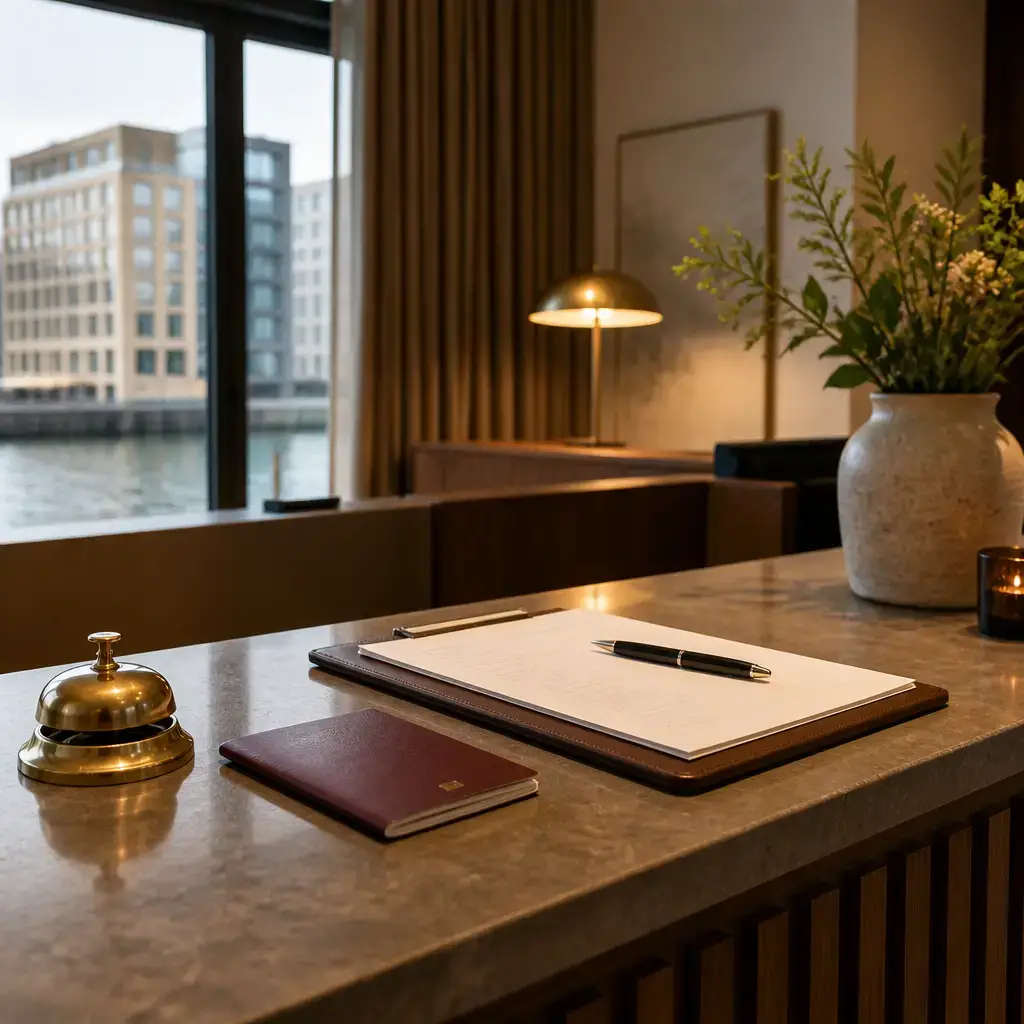
Ich
“Ich” means “I” and identifies the guest as the person who has the reservation. It is used as the subject before “habe”; use it when speaking about yourself in a hotel or service interaction.
habe
“habe” means “have” in “Ich habe hier eine Zimmerreservierung.” It expresses that the speaker has a reservation and appears after “Ich”; reuse it to state that you have something, such as a reservation or document.
hier
“hier” means “here,” referring to this hotel or place. In “Ich habe hier eine Zimmerreservierung,” it locates the reservation at the current place; use it when pointing out that something applies at your present location.
eine
“eine” means “a” before “Zimmerreservierung,” introducing one room reservation. It comes directly before the noun; reuse it before a singular noun when introducing one item.
Zimmerreservierung
“Zimmerreservierung” means “room reservation.” In “Ich habe hier eine Zimmerreservierung,” it names the booking the guest is checking in for; use it when discussing a hotel room booking with reception.
Könnte
“Könnte” helps make “Könnte ich bitte Ihren Reisepass sehen?” a polite request: “Could I please see your passport?” It appears before the subject “ich” and the action “sehen”; use this polite request pattern when asking to see a document.
bitte
“bitte” means “please” and adds politeness to the request for the passport. It appears inside “Könnte ich bitte Ihren Reisepass sehen?”; use it when making a courteous request to staff or another person.
Ihren
“Ihren” means “your” in the formal request “Ihren Reisepass,” referring respectfully to the guest’s passport. It comes directly before “Reisepass”; reuse it with a noun when addressing someone formally about something belonging to them.
Reisepass
“Reisepass” means “passport.” In “Ihren Reisepass sehen,” it is the document the receptionist asks to see; use it when presenting identification at a hotel, border, or other official desk.
sehen
“sehen” means “see” in the request “Könnte ich bitte Ihren Reisepass sehen?” It names the requested action and follows the polite request form; reuse it when politely asking to see an object or document.
ist
“ist” means “is” in “Hier ist er,” introducing the passport as being here. It links the location word “Hier” with “er”; use it to point out that a person or item is present.
er
“er” means “it” here and refers back to the passport in “Hier ist er.” It presents the passport as the item that is here; use it when referring back to a masculine noun already mentioned.
ihn
“ihn” means “it” in “Ich habe ihn schon bereitgelegt,” referring to the passport as the item the speaker has placed ready. It appears after “habe” as the object of the action; use it to refer back to a masculine item being handled.
schon
“schon” means “already,” showing that the passport was placed ready before this moment. In “Ich habe ihn schon bereitgelegt,” it comes before “bereitgelegt”; use it to say that an action has happened earlier than expected or needed.
bereitgelegt
“bereitgelegt” means “placed ready” in “Ich habe ihn schon bereitgelegt.” It describes the passport as prepared and available for the receptionist; use it when explaining that an item has been put somewhere ready for use.
Könnten
“Könnten” helps make “Könnten Sie hier unterschreiben?” a polite formal request: “Could you sign here?” It comes before the formal subject “Sie” and the action “unterschreiben”; use this pattern when politely asking someone to perform an action.
Sie
“Sie” means formal “you” in “Könnten Sie hier unterschreiben?” It addresses the guest respectfully; use it with formal requests to a stranger, customer, employee, or service worker.
unterschreiben
“unterschreiben” means “sign” in the request “Könnten Sie hier unterschreiben?” It names the action requested at the form; use it when asking someone to sign a form or document.
Brauchen
“Brauchen” means “need” in “Brauchen Sie auch meine Unterschrift auf diesem Formular?” The question asks whether the receptionist needs the guest’s signature too; use it to ask formally whether an item or action is required.
auch
“auch” means “also” or “too,” adding the signature as another possible requirement. In “auch meine Unterschrift,” it appears before the item being added; use it when asking whether something is needed in addition to what was already discussed.
meine
“meine” means “my” and identifies “Unterschrift” as belonging to the speaker. It comes directly before the noun; reuse it before a noun when referring to something that belongs to or comes from you.
Unterschrift
“Unterschrift” means “signature.” In “meine Unterschrift auf diesem Formular,” it names the writing the guest may need to provide; use it when discussing signing a form or document.
auf
“auf” means “on” in “auf diesem Formular,” locating the signature on the form. It connects the signature with the document; use it when referring to writing or information placed on a form or page.
diesem
“diesem” means “this” in “diesem Formular,” pointing to the specific form being discussed. It comes directly before “Formular”; reuse it when directing attention to one particular item in the current situation.
Formular
“Formular” means “form.” In “auf diesem Formular,” it names the document on which the guest may sign; use it when completing hotel, administrative, or other official paperwork.
Unten
“Unten” means “at the bottom” in “Unten auf dem Formular reicht.” It indicates the acceptable location for the signature; use it when specifying a lower position on a page or document.
dem
“dem” means “the” in “auf dem Formular,” referring to the specific form already being discussed. It appears directly before “Formular”; reuse it when referring to a particular document known in the conversation.
reicht
“reicht” means “is enough” or “is fine” in “Unten auf dem Formular reicht.” It tells the guest that signing at the bottom is sufficient; use it when confirming that a proposed place, amount, or action is acceptable.
Wo
“Wo” means “where” and starts the question “Wo wird morgen früh das Frühstück serviert?” It asks for a location; use it at the beginning of a question when asking where something happens or is located.
wird
“wird” helps form the question about where breakfast is served in “Wo wird morgen früh das Frühstück serviert?” Together with “serviert,” it asks where the serving takes place; use this structure for a location question about an activity being carried out.
morgen
“morgen” means “tomorrow” in “morgen früh,” specifying the day of the breakfast. It combines with a time expression; use it when arranging or asking about something on the following day.
früh
“früh” means “early” and, in “morgen früh,” refers to tomorrow morning. It narrows down the time of the breakfast; use it after a day expression when referring to an early time or morning period.
das
“das” means “the” before “Frühstück,” identifying the specific breakfast being discussed. It comes directly before the meal name; reuse it when referring to a particular meal known from the situation.
Frühstück
“Frühstück” means “breakfast.” In “das Frühstück serviert,” it is the meal whose serving location the guest asks about; use it when asking about or discussing the first meal of the day at a hotel.
serviert
“serviert” means “served” in “wird ... das Frühstück serviert.” It describes what happens to the breakfast; use it with the corresponding form of “wird” when asking or stating where a meal is served.
Im
“Im” means “in the” in “Im Speisesaal,” giving the location of the breakfast. It is the contracted form of “in dem”; use it before a place when saying that something takes place inside that location.
Speisesaal
“Speisesaal” means “dining room.” In “Im Speisesaal,” it names the hotel room where breakfast is served; use it when directing a guest to the place where meals are eaten.
in
“in” means “in” and begins “in der Nähe der Rezeption,” locating the dining room in relation to reception. It introduces the location phrase; reuse it when describing where something is situated inside or within a place.
der
“der” is the definite article appearing in “in der Nähe der Rezeption.” It introduces the specific nouns in this location phrase; reuse the appropriate article when referring to a known place or area.
Nähe
“Nähe” means “vicinity” or “near” in the location phrase “in der Nähe der Rezeption.” The whole phrase says that the dining room is close to reception; use this pattern when giving a location relative to a nearby place.
Rezeption
“Rezeption” means “reception” or “reception desk.” In “der Rezeption,” it identifies the hotel area used as the reference point for the dining room; use it when asking for or giving directions at a hotel.