Entschuldigung
Entschuldigung is a polite way to say excuse me when getting someone’s attention before asking a question. Use it when addressing a stranger, for example in a station.
wie
In wie komme ich zum Haupteingang?, wie asks how to reach a destination. A common question pattern is wie komme ich zu plus a destination.
komme
Komme means get or come in the question wie komme ich zum Haupteingang?; together, the question asks how to get there. This form is used with ich when asking for directions.
ich
Ich means I and identifies the person asking how to reach the entrance. It commonly appears with a verb in questions about the speaker’s own action.
zum
Zum means to the in zum Haupteingang. It is the contracted form of zu dem and is used before this destination noun.
Haupteingang
Haupteingang means main entrance, the destination being asked about in the station. It can be used after a direction expression such as zum Haupteingang.
Folgen
Folgen means follow in the formal instruction Folgen Sie den gelben Schildern. At the start of this command, it tells a visitor to follow the signs.
Sie
Sie means you in the polite formal form used when addressing an adult or stranger. In Folgen Sie and Nehmen Sie, it addresses the visitor respectfully.
den
Den is the form of the definite article used in den gelben Schildern. Here it introduces the plural signs that are being followed after folgen.
gelben
Gelben means yellow in den gelben Schildern and describes the signs by their color. The form appears between the article and the noun in this phrase.
Schildern
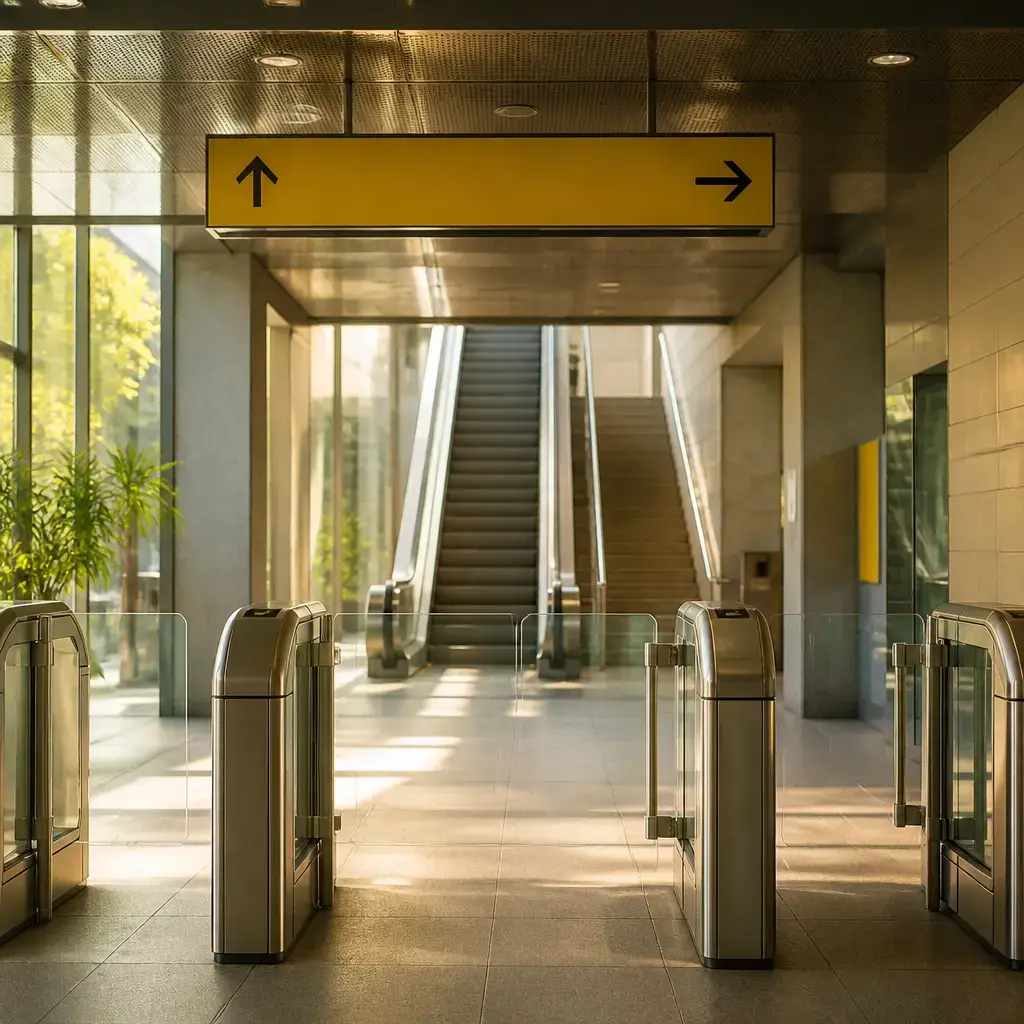
Schildern means signs here, specifically the direction signs in the station. This form is used in den gelben Schildern with folgen; a reusable pattern is den Schildern folgen.
zur
Zur means to the in zur Haupthalle. It is the contracted form of zu der and marks the main hall as the direction or destination.
Haupthalle
Haupthalle means main hall, the area toward which the signs point. It can be used after zur when describing movement toward that hall.
Soll
Soll begins the question Soll ich nach der Ticketkontrolle die Rolltreppe nehmen? and asks whether the speaker should take the escalator. It is used to ask for advice or instructions about an action.
nach
Nach means after in nach der Ticketkontrolle. It marks the point after the ticket check at which the escalator should be taken.
der
Der is the form of the definite article in nach der Ticketkontrolle. Together with nach, it introduces the ticket check as the reference point in time or sequence.
Ticketkontrolle
Ticketkontrolle means ticket check or ticket gate. In nach der Ticketkontrolle, it identifies the station area or point that comes before taking the escalator.
die
Die means the in die Rolltreppe and identifies the escalator being discussed. It appears directly before the noun for this specific station direction.
Rolltreppe
Rolltreppe means escalator. In die Rolltreppe nehmen and Nehmen Sie die Rolltreppe, it is the means of getting upstairs.
nehmen
The lowercase form nehmen completes Soll ich ... die Rolltreppe nehmen? and means take. The capitalized form Nehmen begins the formal instruction Nehmen Sie die Rolltreppe.
oben
Oben means upstairs or above. In nach oben it describes the direction of travel, while at the start of Oben kann man den Schildern leichter folgen it refers to the upstairs area.
und
Und means and and links the two instructions in Nehmen Sie die Rolltreppe nach oben und biegen Sie dann rechts ab. It shows that the actions should be carried out in sequence.
biegen
Biegen is the verb part meaning turn in biegen Sie dann rechts ab. Together with ab, it gives the direction to turn; a reusable pattern is biegen Sie plus a direction plus ab.
dann
Dann means then and places the turn after taking the escalator upstairs. It is useful for ordering one direction after another.
rechts
Rechts means to the right or right in biegen Sie dann rechts ab. It specifies the direction of the turn after going upstairs.
ab
Ab completes the direction expression biegen ... ab and indicates turning off in that direction. It is separated from biegen in the sentence because the two parts occur apart.
Ist
Ist begins Ist der Haupteingang weit von hier? and asks whether the entrance is far away. The lowercase form ist also appears in Von dort ist es nur ein kurzer Fußweg.
weit
Weit means far in weit von hier and describes the distance from the current location. A common pattern is weit von plus a place.
von
Von means from in von hier and Von dort. It marks the place used as the starting point for describing distance or location.
hier
Hier means here and refers to the speaker’s current location in weit von hier. Use it when identifying the place where the speaker is now.
dort
Dort means there and refers to a previously indicated place in Von dort. It is used to describe the starting point of the short walk.
es
Es means it in Von dort ist es nur ein kurzer Fußweg. Here it helps form the statement that the route from there is only a short walk.
nur
Nur means only or just and limits the length described in nur ein kurzer Fußweg. It emphasizes that the walk is not long.
ein
Ein means a in ein kurzer Fußweg and introduces one short walk or footpath. It commonly appears before a singular noun in this kind of description.
kurzer
Kurzer means short in ein kurzer Fußweg and describes the walk as limited in length. The form appears between ein and Fußweg in this phrase.
Fußweg
Fußweg means a walk or footpath, the distance from the indicated place to the entrance. It is used in the expression ein kurzer Fußweg to describe a short walk.
Dieser
Dieser means this in Dieser Bahnhof and points to the station where the speakers are. It is useful when identifying a specific nearby place.
Bahnhof
Bahnhof means station and identifies the building whose layout is confusing. It can be used after Dieser when referring to this particular station.
bisschen
Bisschen means bit or little in ein bisschen verwirrend. The expression ein bisschen softens the description, making it mean a little confusing rather than very confusing.
verwirrend
Verwirrend means confusing and describes the station’s layout in Dieser Bahnhof ist ein bisschen verwirrend. Use it to describe a situation or place that is difficult to understand or navigate.
kann
Kann means can in Oben kann man den Schildern leichter folgen and expresses that people are able to follow the signs more easily upstairs. With kann, the main action folgen appears later in the sentence.
man
Man means one or people in general in kann man den Schildern leichter folgen. It refers to people generally rather than to one named person, and it commonly appears in man kann statements.
leichter
Leichter means more easily in den Schildern leichter folgen and compares how easy it is to follow the signs upstairs. It can be used before an action to describe doing something with less difficulty.