Ich
Ich in 'Ich möchte einen Snack.' means “I” and refers to the speaker. It is used as the person who wants or does something, as in 'Ich mache jetzt einen Snack.'
möchte
möchte in 'Ich möchte einen Snack.' expresses a polite wish or want. It is useful in the pattern 'Ich möchte' followed by the thing the speaker wants.
einen
einen in 'Ich möchte einen Snack.' introduces one unspecified snack. It appears directly before 'Snack' in this request for a snack.
Snack
Snack in 'Ich möchte einen Snack.' means a snack. The same word is used again in 'Ich mache jetzt einen Snack' for the food being prepared.
habe
habe in 'Ich habe nicht sehr viel Hunger.' means “have.” German uses this form with Hunger to describe how hungry someone is, so the whole sentence says that the speaker is not very hungry.
nicht
nicht in 'Ich habe nicht sehr viel Hunger.' negates the amount of hunger. It is placed before 'sehr viel Hunger' to say that the speaker does not have very much hunger.
sehr
sehr in 'sehr viel Hunger' strengthens the quantity and means “very.” The expression 'sehr viel' is used before the thing whose amount is being described.
viel
viel in 'sehr viel Hunger' means “much” or “a lot of” and describes the amount of Hunger. It combines with 'Hunger' in the dialogue to express how hungry the speaker is.
Hunger
Hunger in 'Ich habe nicht sehr viel Hunger.' means “hunger.” The dialogue uses it with 'habe' in a pattern for describing a person’s appetite.
Dann
Dann in 'Dann nimm etwas Leichtes' means “then” and introduces the suggestion that follows from the speaker not being very hungry. Use it to connect a situation with a next action.
nimm
nimm in 'Dann nimm etwas Leichtes' is a direct instruction to take or choose something. It is also used in 'Nimm eine kleine Schüssel' when telling someone what to take.
etwas
etwas in 'etwas Leichtes' means “something” and refers to an unspecified food choice. It is useful when the exact thing is not named until the following description.
Leichtes
Leichtes in 'etwas Leichtes' means “something light,” here referring to a light snack. The capitalized form names the thing being chosen after 'etwas'.
zum
In the complete expression 'zum Beispiel', zum helps form “for example,” while Beispiel names the example. Use 'zum Beispiel' before an example such as 'Joghurt'.
Beispiel
In 'zum Beispiel', Beispiel means “example,” and the whole expression means “for example.” It introduces 'Joghurt' as an example of something light.
Joghurt
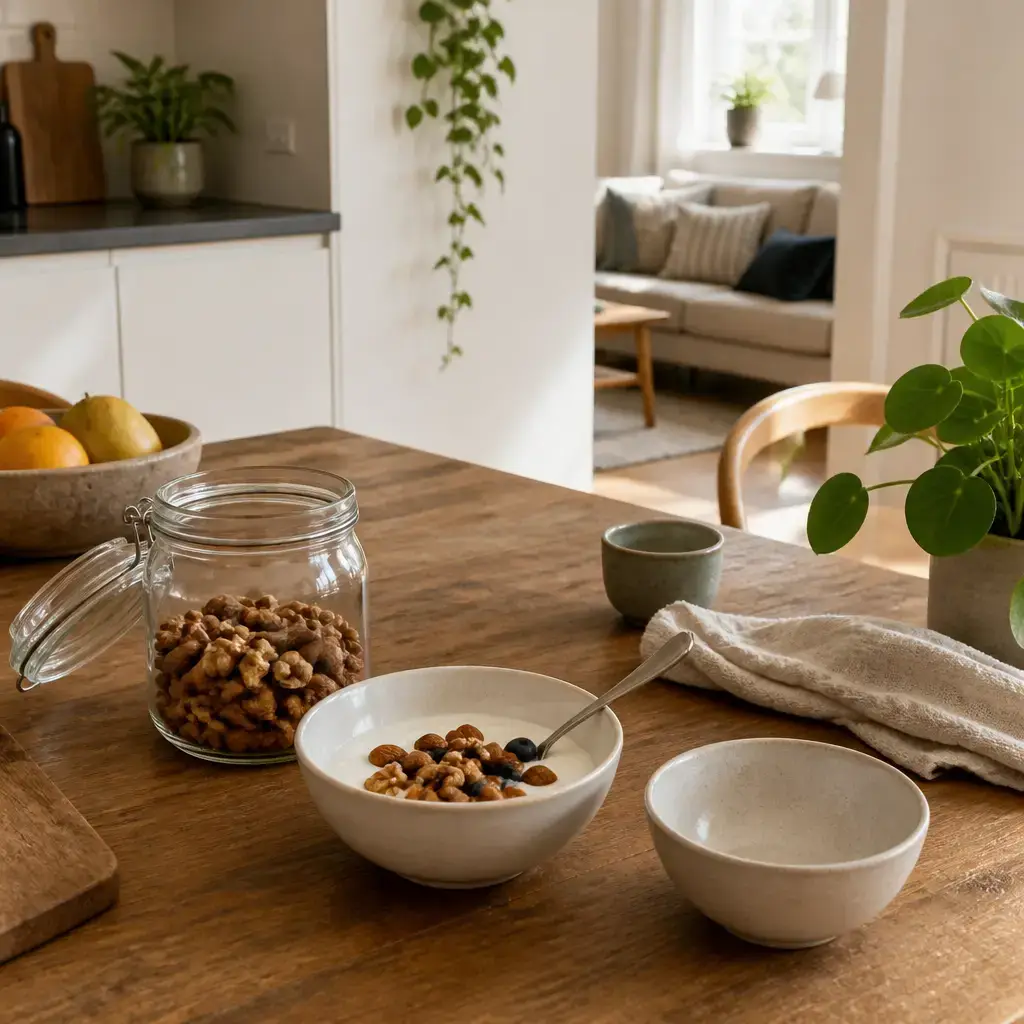
Joghurt in 'zum Beispiel Joghurt' means “yogurt.” It is first given as a light snack and then appears in 'Joghurt mit Nüssen' as the base of the combination.
Haben
Haben at the beginning of 'Haben wir auch Nüsse?' asks whether the household has nuts. The verb comes first here because the sentence is a yes-or-no question.
wir
wir in 'Haben wir auch Nüsse?' means “we” and refers to the speaker and listener together. It is the group being asked about having the nuts.
auch
auch in 'Haben wir auch Nüsse?' adds nuts to the things being considered and means “also” or “too.” It appears directly before 'Nüsse' in this question.
Nüsse
Nüsse in 'Haben wir auch Nüsse?' means “nuts,” the food being asked about. The same word appears in 'ein paar Nüsse' when some nuts are reserved for the other person.
Im
Im in 'Im Schrank sind welche.' means “in the” and introduces the location of the nuts. It is used directly before 'Schrank' in this location phrase.
Schrank
Schrank in 'Im Schrank sind welche.' means “cupboard.” The phrase identifies the cupboard as the place where some nuts are located.
sind
sind in 'Im Schrank sind welche.' means “are” and states that some nuts are present in the cupboard. It links the location 'Im Schrank' with 'welche'.
welche
welche in 'Im Schrank sind welche.' means “some” or “some of them” and refers back to the nuts. It avoids repeating 'Nüsse' after the location has been given.
mit
mit in 'Joghurt mit Nüssen' means “with” and connects the yogurt with the nuts added to it. The pattern names a food together with an accompanying ingredient.
Nüssen
Nüssen in 'Joghurt mit Nüssen' means “nuts” as the ingredient added to the yogurt. The related form 'Nüsse' appears when the dialogue asks about having nuts.
klingt
klingt in 'Joghurt mit Nüssen klingt gut.' means “sounds” and describes the speaker’s impression of the suggested combination. It is paired with 'gut' in the expression 'klingt gut'.
gut
gut in 'klingt gut' means “good” and shows approval of the yogurt-and-nuts combination. It follows 'klingt' in this way of saying that an idea sounds appealing.
eine
eine in 'eine kleine Schüssel' means “a” or “one” and introduces an unspecified bowl. It appears before the description 'kleine Schüssel' in the instruction.
kleine
kleine in 'eine kleine Schüssel' means “small” and describes the size of the bowl. It comes directly before 'Schüssel'.
Schüssel
Schüssel in 'Nimm eine kleine Schüssel.' means “bowl.” It names the container the listener is asked to take for the snack.
Das
Das in 'Das ist nicht zu viel.' means “that” or “it” and points to the amount being considered. Use 'Das ist' to comment on something just mentioned or shown.
ist
ist in 'Das ist nicht zu viel.' means “is” and connects 'Das' with the description 'nicht zu viel.' It states how the amount is judged.
zu
zu in 'nicht zu viel' means “too” and marks an amount as excessive. In the dialogue, 'nicht zu viel' says that the amount is not excessive.
mache
mache in 'Ich mache jetzt einen Snack.' means “make” or “prepare.” It describes the speaker preparing the snack at the present moment.
jetzt
jetzt in 'Ich mache jetzt einen Snack.' means “now” and marks the time of preparation. It tells the listener that the action is happening immediately.
Lass
Lass in 'Lass bitte ein paar Nüsse für mich übrig.' begins a polite request to leave something remaining. Together with 'übrig', it asks the other person not to use all of the nuts.
bitte
bitte in 'Lass bitte ein paar Nüsse für mich übrig.' means “please” and makes the request more polite. It is placed after 'Lass' in this request.
ein
ein in 'ein paar Nüsse' is part of the quantity expression meaning “a few” or “some.” Here it does not identify one individual nut; it combines with 'paar' to describe a small amount.
paar
paar in 'ein paar Nüsse' indicates a small number of nuts. The complete expression is used when asking to keep some nuts for the other person.
für
für in 'für mich' means “for” and marks the intended recipient of the nuts. It comes before 'mich' to show who should have them.
mich
mich in 'für mich' means “me” and refers to the person who wants some nuts kept aside. It follows 'für' in this recipient phrase.
übrig
übrig in 'Lass bitte ein paar Nüsse für mich übrig.' means “left over” or “remaining.” With 'Lass', it expresses the request that some nuts remain for the other person.