Der
Der means “the” in the exact phrases “Der Türgriff” and “Der kleine”. It introduces the item being discussed, and the same form can introduce a known person or object in a practical conversation.
Türgriff
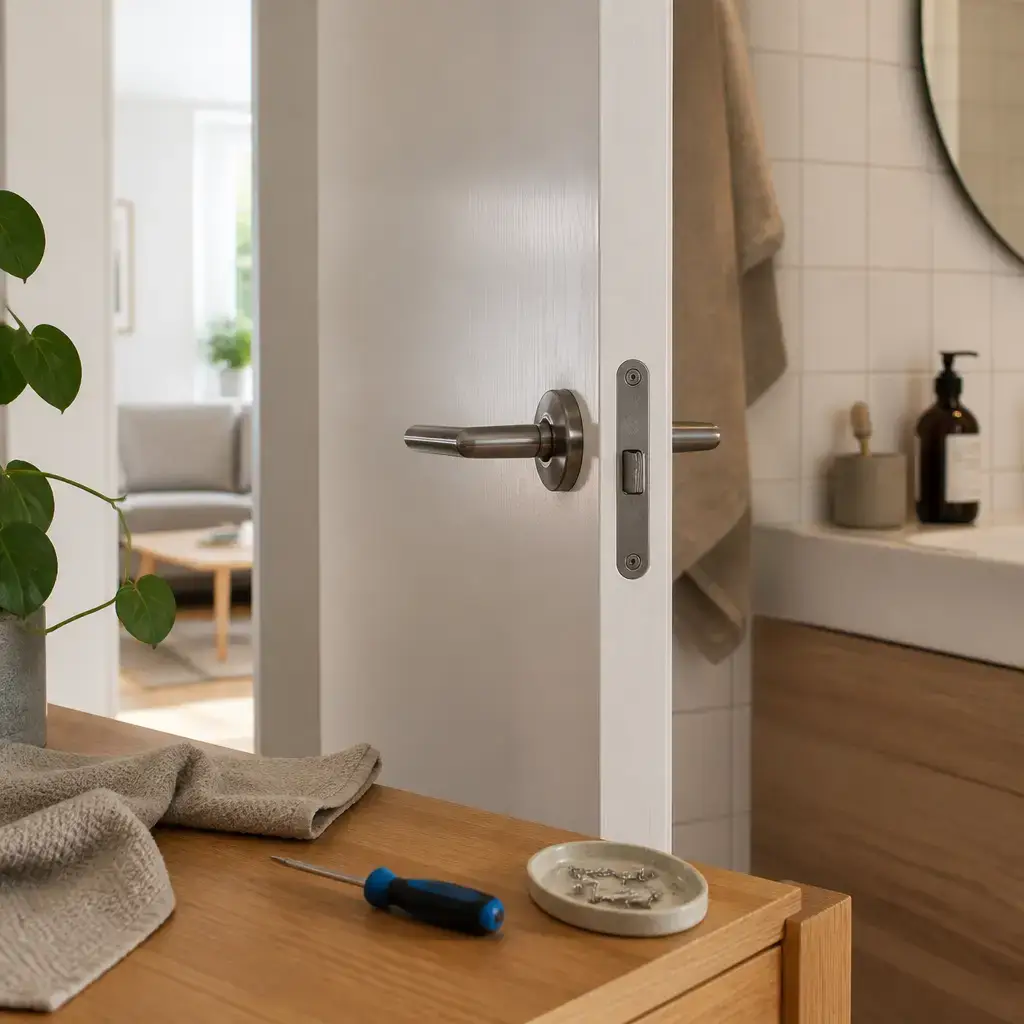
Türgriff means “door handle” here. It names the handle that feels loose and is tightened in the dialogue. Use it when describing a door or discussing a repair involving its handle.
im
im means “in the” in “im Badezimmer”. It is the common contracted form of in dem for a location. Use it before a place when saying that something is located there.
Badezimmer
Badezimmer means “bathroom” in this dialogue. It identifies the room where the door handle is located. Use it when giving a location in the home.
fühlt
fühlt contributes “feels” in “fühlt sich wieder locker an”. Together with sich and an, the construction describes how something seems by touch. Use this pattern when reporting the condition of an object.
sich
sich is the reflexive part of “fühlt sich wieder locker an”, which means that the handle feels loose. It connects the feeling back to the handle being described. Use it with this feeling construction rather than treating it as a separate English “itself”.
wieder
wieder means “again” in “fühlt sich wieder locker an”. It shows that the handle has become loose again after having been tighter before. Use it when a condition or event returns.
locker
locker means “loose” here and describes the condition of the door handle. It appears after the reflexive feeling construction. Use it for an object that is not firmly fixed.
an
an completes the separable construction in “fühlt sich wieder locker an”. With fühlt and sich, it helps express how the handle feels. In a main clause, this particle appears at the end of the sentence.
Ich
Ich means “I” and identifies the speaker who noticed the problem and will tighten the handle. It is the subject of the sentence. Use it to state your own observation or action.
habe
habe is used with the past participles in “habe es gestern bemerkt” and “vergessen” to describe what the speaker noticed and forgot. It is the first-person form of the auxiliary used here. Use it with a past participle when reporting a completed personal action.
es
es means “it” in “habe es gestern bemerkt”. It refers to the loose handle or the problem already mentioned. Use es when referring back to a neuter object or a previously stated situation.
gestern
gestern means “yesterday”. It places the noticing of the loose handle on the previous day. Use it with a past event whose time was the day before today.
bemerkt
bemerkt means “noticed” in “habe es gestern bemerkt”. It expresses becoming aware of the problem. The related verb is bemerken, and this form is used with habe in the dialogue.
aber
aber means “but” and contrasts noticing the problem with forgetting to tighten it. It links the two parts of the sentence. Use it to introduce an action or fact that contrasts with what was just said.
vergessen
vergessen means “forgot” in “aber vergessen, ihn festzuziehen”. It introduces the action that the speaker failed to remember doing. Use it before an infinitive phrase when explaining what someone forgot to do.
ihn
ihn means “him” or “it” here and refers to the masculine noun Türgriff. In “ihn festzuziehen”, it is the object that should be tightened. Use ihn when referring back to a masculine object.
festzuziehen
festzuziehen means “to tighten” in “ihn festzuziehen”. It is the action the speaker forgot to perform on the handle. The related verb is festziehen, and the zu-infinitive appears after vergessen.
Haben
Haben means “have” in the question “Haben wir einen Schraubenzieher in der Schublade?”. It asks whether the household has or contains a screwdriver. At the beginning of this question, the verb comes before the subject.
wir
wir means “we” in “Haben wir”. It includes the speaker and the person being addressed. Use it when asking about something shared or available to both people.
einen
einen means “a” in “einen Schraubenzieher”. It introduces one unspecified screwdriver as the object being looked for. Use it before a masculine object in this kind of question.
Schraubenzieher
Schraubenzieher means “screwdriver”. It names the tool needed for the screws. Use it when asking for or identifying this tool during a repair.
in
in means “in” in “in der Schublade”. It introduces the place where the screwdriver may be located. Use it before a location when describing something as being inside that place.
Schublade
Schublade means “drawer” in “in der Schublade”. It identifies the storage place being checked for the screwdriver. Use it when referring to a drawer in the home.
kleine
kleine means “small” in “Der kleine”. The noun is omitted because the conversation already makes clear that the speaker means the small screwdriver. Use this form with the article when selecting a small known object.
sollte
sollte means “should” in “sollte für diese Schrauben funktionieren”. It expresses an expectation that the small screwdriver will be suitable. Use sollte to describe something that is expected to work or be appropriate.
für
für means “for” in “für diese Schrauben”. It connects the screwdriver with the screws it is intended to work on. Use it to identify the object or purpose something is suitable for.
diese
diese means “these” in “diese Schrauben”. It points to the specific screws that are present in the repair. Use it when referring to nearby or already identified plural objects.
Schrauben
Schrauben means “screws” in “für diese Schrauben”. It names the small parts that the screwdriver must work with. Use it when discussing screws in a repair or assembly task.
funktionieren
funktionieren means “work” or “function” in “sollte für diese Schrauben funktionieren”. It says that the small screwdriver should be suitable for the screws. Use it after a modal form such as sollte to describe whether a tool or object will work.
Könntest
Könntest means “could” in the polite request “Könntest du den Griff halten?”. It asks the other person to hold the handle. Use this form at the beginning of a courteous request to another person.
du
du means “you” in “Könntest du”. It identifies the person being asked to hold the handle. Use it when addressing one familiar person directly.
den
den means “the” in “den Griff halten”. It introduces the specific handle that both speakers know. Here it marks the handle as the object of halten.
Griff
Griff means “handle” in “den Griff halten”. It refers to the handle being held during the repair. Use it for a handle or grip that someone can hold.
halten
halten means “hold” in “den Griff halten”. It describes keeping the handle in place while the other person tightens it. Use it with an object when asking someone to keep that object in their hands or position.
während
während means “while” in “während ich ihn festziehe”. It introduces an action happening at the same time as the handle is being held. It places the verb at the end of the clause that follows it.
festziehe
festziehe means “tighten” in “während ich ihn festziehe”. It describes the speaker’s action on the handle while the other person holds it. The related verb is festziehen, and this exact form follows ich in the subordinate clause.
halte
halte contributes “hold” or “keep” in “Ich halte ihn fest”. Together with fest, it means keeping the handle steady. Use this construction when saying that you are holding an object firmly in place.
fest
fest means “firmly” or “steady” in “halte ihn fest”. It adds the idea that the handle is being held securely, not merely touched. Use it with halten when someone should keep an object from moving.
drehst
drehst means “turn” in “während du ihn drehst”. It describes the other person turning the handle or related part during the repair. This exact form follows du and can be used when addressing one familiar person about a turning action.
Er
Er means “he” or “it” here and refers to the masculine noun Griff. In “Er fühlt sich jetzt viel fester an”, it makes the handle the subject of the sentence. Use Er when referring back to a known masculine object.
jetzt
jetzt means “now”. It shows that the handle feels firmer at the present moment after the repair. Use it to mark a current condition or action.
viel
viel means “much” in “viel fester”. It strengthens the comparison and shows a noticeable difference in firmness. Use viel before a comparative adjective when the difference is large or clear.
fester
fester means “firmer” in “viel fester”. It compares the handle’s current condition with its earlier loose condition. The related adjective is fest, and the comparative form is useful when describing a change in condition.
Lass
Lass means “let” in “Lass uns später sicherheitshalber noch einmal nachsehen”. Together with uns and the infinitive, it makes a suggestion meaning “let’s check”. Use it to propose a joint action.
uns
uns means “us” in “Lass uns ... nachsehen”. It includes both the speaker and the listener in the suggested action. Use it after Lass when proposing that the two of you do something together.
später
später means “later”. It postpones the suggested check until a time after the current repair. Use it when an action should happen at a later point.
sicherheitshalber
sicherheitshalber means “just in case” or “as a precaution”. It explains that the speakers want to check the handle again to make sure the repair holds. Use it when taking an extra precaution even though no new problem is currently known.
noch
noch contributes “again” or “once more” in “noch einmal”. Together, these words mean that the speakers will check one additional time. Use noch einmal when repeating an action.
einmal
einmal means “once” in “noch einmal”. With noch, it forms the reusable expression “noch einmal”, meaning “once more” or “again”. Use this expression when asking or suggesting that an action be repeated.
nachsehen
nachsehen means “check” or “look to verify” in “noch einmal nachsehen”. It describes inspecting the handle again later to make sure it remains firm. Use it after Lass uns when suggesting that you check something together.