Kann
“Kann” means “can” or “may” in the question “Kann ich dieses Gemeinschaftsbad benutzen?” It is the form of können used with ich and comes first because this is a yes-or-no question. Reuse it to ask whether you may or can do something, often with ich and an infinitive at the end.
ich
“ich” means “I” and identifies the person asking to use the bathroom. It is the subject of “Kann ich dieses Gemeinschaftsbad benutzen?” and “Ich brauche ein Papierhandtuch.” Reuse it as the subject when talking about your own actions or needs.
dieses
“dieses” means “this” and points to the particular shared bathroom being discussed in “dieses Gemeinschaftsbad.” It is the form used before this neuter noun in this sentence. Reuse it before a specific thing you are identifying as “this.”
Gemeinschaftsbad
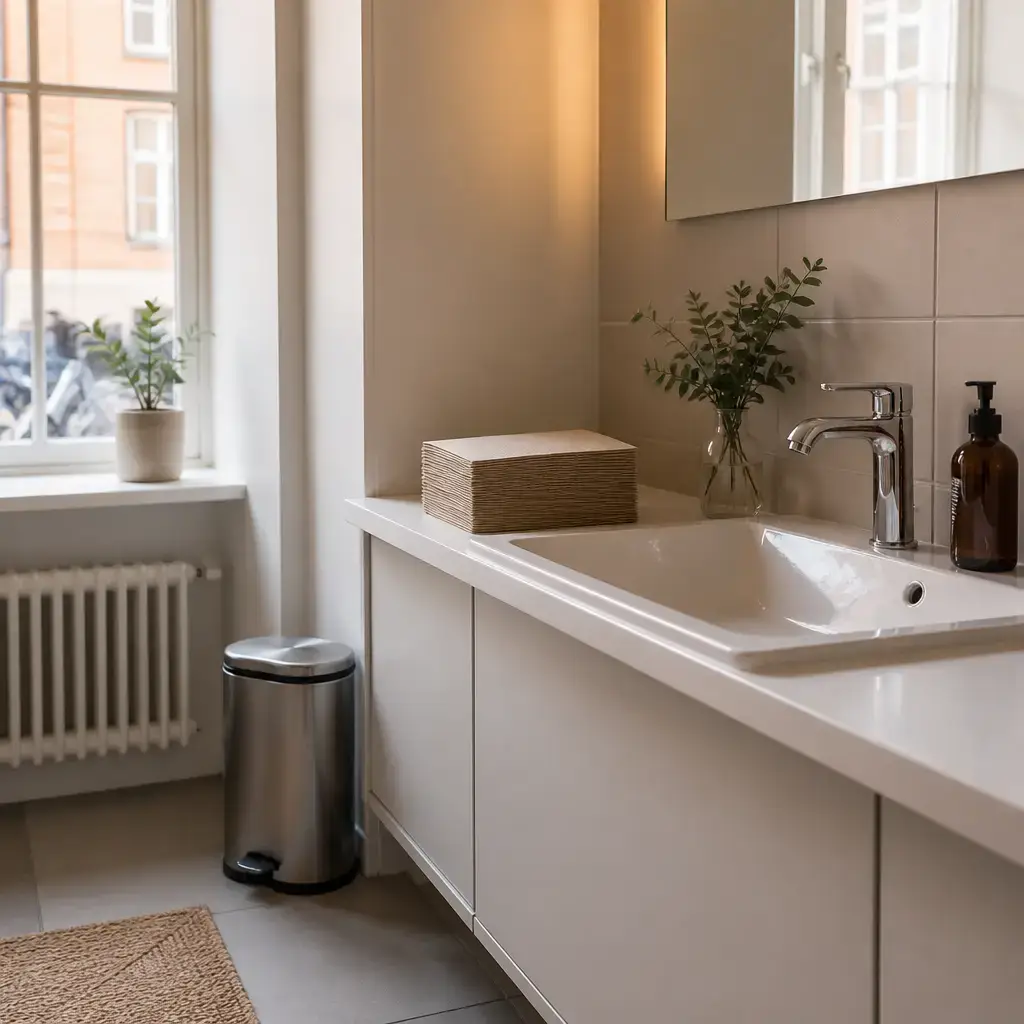
“Gemeinschaftsbad” means “shared bathroom,” the bathroom that is used by more than one person. It is a compound noun made from Gemeinschaft and Bad, and here it is the object of benutzen. Reuse it when referring to a bathroom shared by several people.
benutzen
“benutzen” means “to use” in “dieses Gemeinschaftsbad benutzen.” It is the infinitive placed at the end after Kann. Reuse it after a modal verb when saying that someone can, may, or needs to use something.
Du
“Du” means “you” when speaking informally to one person. In “Du kannst es benutzen,” it is the person being told that the bathroom may be used. Reuse it as the subject when addressing one familiar person directly.
kannst
“kannst” means “can” in “Du kannst es benutzen.” It is the form of können used with du, and it is followed by the infinitive benutzen at the end. Reuse it with du to say that one person can or may do something.
es
“es” means “it” and refers back to the shared bathroom in “Du kannst es benutzen.” It is the object of benutzen, standing in for the thing already mentioned. Reuse it to avoid repeating a previously mentioned neuter thing or situation.
Bitte
“Bitte” means “please” and makes “Bitte halte den Bereich am Waschbecken sauber” a polite request. It appears at the beginning of the request. Reuse it before a request or instruction when speaking politely.
halte
“halte” means “keep” in “Bitte halte den Bereich am Waschbecken sauber.” It is the informal singular imperative form of halten, telling one person what to do. Reuse it with an object and an adjective when asking someone to keep something in a particular condition.
den
“den” means “the” before Bereich in “den Bereich am Waschbecken.” Here it marks the specific area as the object of halte. Reuse it before a specific masculine noun when that noun is the object of an action.
Bereich
“Bereich” means “area,” here referring to the area around the sink. In “den Bereich am Waschbecken,” it is the area that should be kept clean. Reuse it for a specific part or zone of a room or place.
am
“am” means “at the” in “am Waschbecken,” identifying the location of the area. It is the contracted form of an dem. Reuse it before a place when describing something located at or by that place.
Waschbecken
“Waschbecken” means “sink” in “am Waschbecken” and “das Waschbecken.” It identifies the basin used for washing hands. Reuse it when referring to the sink area or to the sink as an object to clean.
sauber
“sauber” means “clean” in “halte den Bereich am Waschbecken sauber.” It describes the condition the area should remain in; the whole expression means “keep the area clean.” Reuse it after halten when asking someone to maintain something in a clean condition.
brauche
“brauche” means “need” in “Ich brauche ein Papierhandtuch.” It is the form of brauchen used with ich and introduces the thing that is needed. Reuse it with a noun or object when stating a personal need.
ein
“ein” means “a” or “one” in “ein Papierhandtuch,” referring to one paper towel without identifying a specific one. It comes directly before Papierhandtuch. Reuse it before a singular, non-specific item that you need or want.
Papierhandtuch
“Papierhandtuch” means “paper towel,” the item needed for wiping or drying. It is the object of brauche in “Ich brauche ein Papierhandtuch.” Reuse it when asking for or referring to a disposable towel made of paper.
Dort
“Dort” means “there” and points to the location near the sink in “Dort neben dem Waschbecken sind welche.” It appears at the beginning to identify where the paper towels are. Reuse it to point out a place that is visible or already understood.
neben
“neben” means “next to” or “near” in “neben dem Waschbecken.” It introduces the location of the paper towels in relation to the sink. Reuse it before a place or object when describing something beside it.
dem
“dem” means “the” in “dem Waschbecken.” Here it follows neben to identify the specific sink used as the location reference. Reuse it before a specific noun after neben when describing a fixed location beside that noun.
sind
“sind” means “are” in “Dort neben dem Waschbecken sind welche.” It is the form of sein used with the plural item represented by welche. Reuse it to say where plural things are, especially with a location placed at the beginning.
welche
“welche” means “some” or “some ones” in “sind welche,” referring back to the paper towels without repeating the noun. It stands for the plural items located near the sink. Reuse it when the objects are already clear from the conversation and do not need to be named again.
Kommt
“Kommt” means “comes” or “goes” in the question “Kommt das in den Müll?” The whole question asks whether the item belongs in the trash, while Kommt contributes the idea of going or ending up there. It is the form of kommen used with das in this question. Reuse this construction to ask where an item should go.
das
“das” means “this” or “it” in “Kommt das in den Müll?” and refers to the item being held or discussed. It is the subject of the question about where the item should go. Reuse it to point to a specific thing when its identity is clear from the situation.
in
“in” means “into” in “in den Müll” and “in den kleinen Mülleimer,” showing the destination of the item. Here it introduces a place that the item is being put into. Reuse it with a destination when describing movement into a container or area.
Müll
“Müll” means “trash” in “in den Müll,” referring to waste as a general destination. The phrase asks whether the item should be thrown away. Reuse it after a suitable destination expression when talking about disposing of something.
Tu
“Tu” means “put” in “Tu es in den kleinen Mülleimer.” It is the informal singular imperative form of tun and gives a direct instruction to one person. Reuse it with an object and a destination when telling someone to put something somewhere.
kleinen
“kleinen” means “small” in “den kleinen Mülleimer.” It describes the size of the bin and takes this form before the noun in this object phrase. Reuse it before a noun when describing a small item, place, or container.
Mülleimer
“Mülleimer” means “trash bin,” the specific container where the paper towel should be placed. It is the destination in “in den kleinen Mülleimer.” Reuse it when referring to a household bin for waste.
wische
“wische” means “wipe” in “Ich wische das Waschbecken auch schnell ab.” It is the form of wischen used with ich, and it combines with the separable element ab to express wiping a surface. Reuse it with a surface as the object when describing cleaning by wiping.
auch
“auch” means “also” or “too” in “Ich wische das Waschbecken auch schnell ab.” It adds this cleaning action to the other actions already discussed. Reuse it near the action or item that is being added to the conversation.
schnell
“schnell” means “quickly” in “Ich wische das Waschbecken auch schnell ab.” It describes how the wiping is done. Reuse it with an action when emphasizing that something happens in a short time or at a fast pace.
ab
“ab” contributes the idea of wiping something off or away in the separable verb expression “wische ... ab.” The object appears before ab, while ab comes at the end of this main clause. Reuse this word order with the same separable expression when describing wiping a surface.
hilft
“hilft” means “helps” in “Das hilft der nächsten Person.” It is the form of helfen used with Das, referring to the act of wiping the sink. Reuse it with a person or purpose when saying that an action is useful to someone.
der
“der” means “the” in “der nächsten Person.” It belongs to the phrase naming the person who benefits from the help. Here it is used in the phrase after hilft. Reuse it before a specific feminine noun in a phrase that identifies the recipient of help.
nächsten
“nächsten” means “next” in “der nächsten Person,” referring to the person who will use the shared bathroom afterward. It modifies Person and has this ending in the phrase after hilft. Reuse it before a person or event when referring to the one that follows in sequence.
Person
“Person” means “person” in “der nächsten Person,” the person who will use the clean sink after the speaker. It is the noun receiving the benefit expressed by hilft. Reuse it when referring neutrally to an individual rather than naming them.