Können
Können asks whether something is possible in the question Können wir den gemeinsamen Besprechungsraum benutzen? It is placed first because this is a question, and it is followed by the person and the action.
wir
Wir means the speakers together as “we” in Können wir den gemeinsamen Besprechungsraum benutzen? It identifies who wants to use the room and commonly appears after a question verb such as Können.
den
Den marks the specific room as the object of benutzen in den gemeinsamen Besprechungsraum. Here it is the masculine accusative article used before the noun Besprechungsraum.
gemeinsamen
Gemeinsamen describes the meeting room as shared or used by more than one group. It is placed before Besprechungsraum to specify which room is meant.
Besprechungsraum
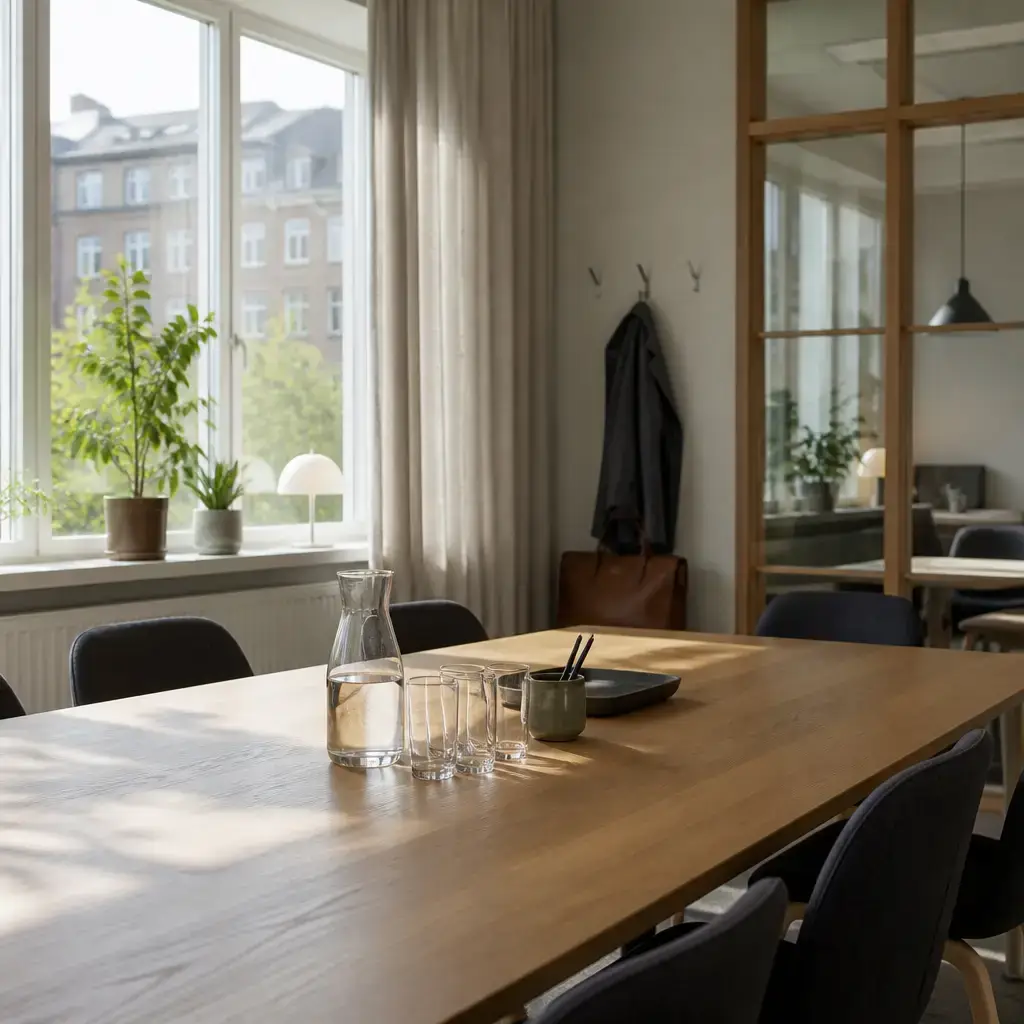
Besprechungsraum means meeting room, the shared room the speakers want to use. It is a compound referring to a room for meetings.
benutzen
Benutzen means to use the meeting room. In Können wir den gemeinsamen Besprechungsraum benutzen?, it stays in the infinitive after Können and comes at the end of the question.
Du
Du addresses one person informally in Du kannst ihn benutzen. It identifies the person receiving permission and is used for a single familiar or informal addressee.
kannst
Kannst means “can” when addressing one person with du. It is the form of können used in Du kannst ihn benutzen and is followed here by an infinitive.
ihn
Ihn means “it” here and refers back to the meeting room. It replaces the room noun as the object of benutzen.
aber
Aber means “but” and introduces a condition or restriction after giving permission. In Du kannst ihn benutzen, aber halte ihn für andere Leute ordentlich, it connects permission with the request to keep the room tidy.
halte
Halte asks one person to keep something in a particular condition in halte ihn für andere Leute ordentlich. It is a direct request to keep the room tidy, with ihn as the object and ordentlich describing the desired state.
für
Für means “for” in für andere Leute and shows who the tidy room is intended to benefit. It introduces the people considered when the room is kept orderly.
andere
Andere means “other” and distinguishes the people mentioned from the current speakers in für andere Leute. It is placed before Leute to describe which people are meant.
Leute
Leute means “people” in für andere Leute. Together with für, it identifies the people for whom the room should be kept tidy.
ordentlich
Ordentlich means tidy or orderly in halte ihn für andere Leute ordentlich. It describes the condition in which ihn, the room, should be kept.
Ist
Ist asks whether something has a particular state in Ist dieser Tisch frei? It is the form of sein used with the singular subject dieser Tisch and comes first in this yes-or-no question.
dieser
Dieser points to the particular table being considered in dieser Tisch. It comes before Tisch and identifies which table the speaker is asking about.
Tisch
Tisch means “table” in dieser Tisch. It is the thing whose availability is being checked and is referred to later by Er.
frei
Frei means available or unoccupied when the speaker asks whether the table is free. In Bitte halte den Tisch frei, the same form means that the table should remain clear.
Er
Er means “it” here and refers to the masculine noun Tisch. It is the subject of Er ist jetzt frei and stands for the table instead of repeating the noun.
jetzt
Jetzt means “now” and specifies that the table is available at the present moment in Er ist jetzt frei. It can be placed with a statement about a current situation.
Ich
Ich means “I” and identifies the speaker who will place the bag in Ich werde meine Tasche an die Wand stellen. It is the subject of the future statement.
werde
Werde expresses that the speaker will carry out an action in the future in Ich werde meine Tasche an die Wand stellen. It is the form of werden used with Ich and is followed by the infinitive stellen at the end.
meine
Meine means “my” and shows that the bag belongs to the speaker in meine Tasche. It comes before Tasche to identify whose bag is being placed.
Tasche
Tasche means “bag” and is the item the speaker will place by the wall. In Ich werde meine Tasche an die Wand stellen, it is the object of stellen.
an
An indicates the bag’s destination at or against the wall in an die Wand stellen. Here it introduces the phrase describing where the bag will be placed.
die
Die is the article used with Wand in an die Wand. Together with an, it introduces the wall as the destination of the placement.
Wand
Wand means “wall” in an die Wand. It identifies the surface beside or against which the speaker will place the bag.
stellen
Stellen means to put or place something upright, here the bag by the wall. In Ich werde meine Tasche an die Wand stellen, it is the infinitive following werde.
Bitte
Bitte means “please” and makes Bitte halte den Tisch frei a polite request. It is placed at the beginning of this request.
Wenn
Wenn introduces the time condition in Wenn wir fertig sind, lassen wir den Raum sauber. It can introduce a clause meaning “when” or “if,” with the related action following it.
fertig
Fertig means finished or done in Wenn wir fertig sind. With sind, it describes the point at which the speakers have completed their activity.
sind
Sind means “are” with the subject wir in Wenn wir fertig sind. It appears at the end of this wenn-clause and completes the meaning “when we are finished.”
lassen
Lassen means to leave something in a particular condition in lassen wir den Raum sauber. With den Raum and sauber, it expresses leaving the room clean after finishing.
Raum
Raum means “room” and is the place the speakers promise to leave clean. In lassen wir den Raum sauber, it is the object of lassen.
sauber
Sauber means clean and describes the condition of the room after the speakers finish. In lassen wir den Raum sauber, it completes the idea of leaving the room in that condition.
Das
Das means “that” and refers back to the preceding action of leaving the room clean in Das hilft der nächsten Gruppe. It is the subject of the statement about helping the next group.
hilft
Hilft means “helps” in Das hilft der nächsten Gruppe and describes a benefit for the next group. It is the form of helfen used with the subject Das, and the beneficiary follows in der nächsten Gruppe.
der
Der is the article used in der nächsten Gruppe for the group that benefits from the action. Here it marks the feminine dative phrase after hilft.
nächsten
Nächsten means “next” and identifies the group that will use the room after the current speakers. It is placed before Gruppe in der nächsten Gruppe.
Gruppe
Gruppe means “group” in der nächsten Gruppe. It identifies the people who benefit from finding the shared room clean.