Machst
In “Machst du Fotos?” means “take” as in taking photos. It is used with “du” to form a yes-or-no question. A reusable pattern is “Machst du ...?” followed by an activity or object.
du
“du” means “you” when addressing one person informally. In “Machst du Fotos?” it identifies the person being asked. Use “du” for a familiar individual in direct conversation.
Fotos
“Fotos” means photos, the things being taken in “Machst du Fotos?” It is the object of the activity. The phrase “Fotos machen” is a common way to talk about taking photos.
Ich
“Ich” means “I” and identifies the speaker in “Ich benutze an den meisten Tagen meine kleine Kamera.” It also begins “Ich habe...” and “Ich übe...”. A reusable pattern is “Ich” followed by the speaker’s action.
benutze
“benutze” means use in “Ich benutze an den meisten Tagen meine kleine Kamera.” It describes what the speaker does with the camera. Use “Ich benutze” before the thing being used.
an
In “an den meisten Tagen”, “an” gives the time relation meaning “on” or “during”. The whole phrase says that the action happens on most days. Use “an” with a day expression when talking about when something happens.
den
“den” is the article in the phrase “an den meisten Tagen”. It identifies the plural days being discussed. The reusable expression here is “an den meisten Tagen”.
meisten
“meisten” means most in “an den meisten Tagen”, referring to the majority of the days. It comes before “Tagen” in this time expression. Use “den meisten” before a plural noun when referring to most of a group.
Tagen
“Tagen” means days in “an den meisten Tagen”. Together, the phrase means “on most days”. It follows “an den meisten” in this time expression.
meine
“meine” means my in “meine kleine Kamera” and shows that the camera belongs to or is associated with the speaker. It comes before the noun it describes. A reusable pattern is “meine” followed by a thing connected with the speaker.
kleine
“kleine” means small and describes the camera in “meine kleine Kamera”. It comes directly before “Kamera” in the noun phrase. Use an adjective before a noun to describe its size or another quality.
Kamera
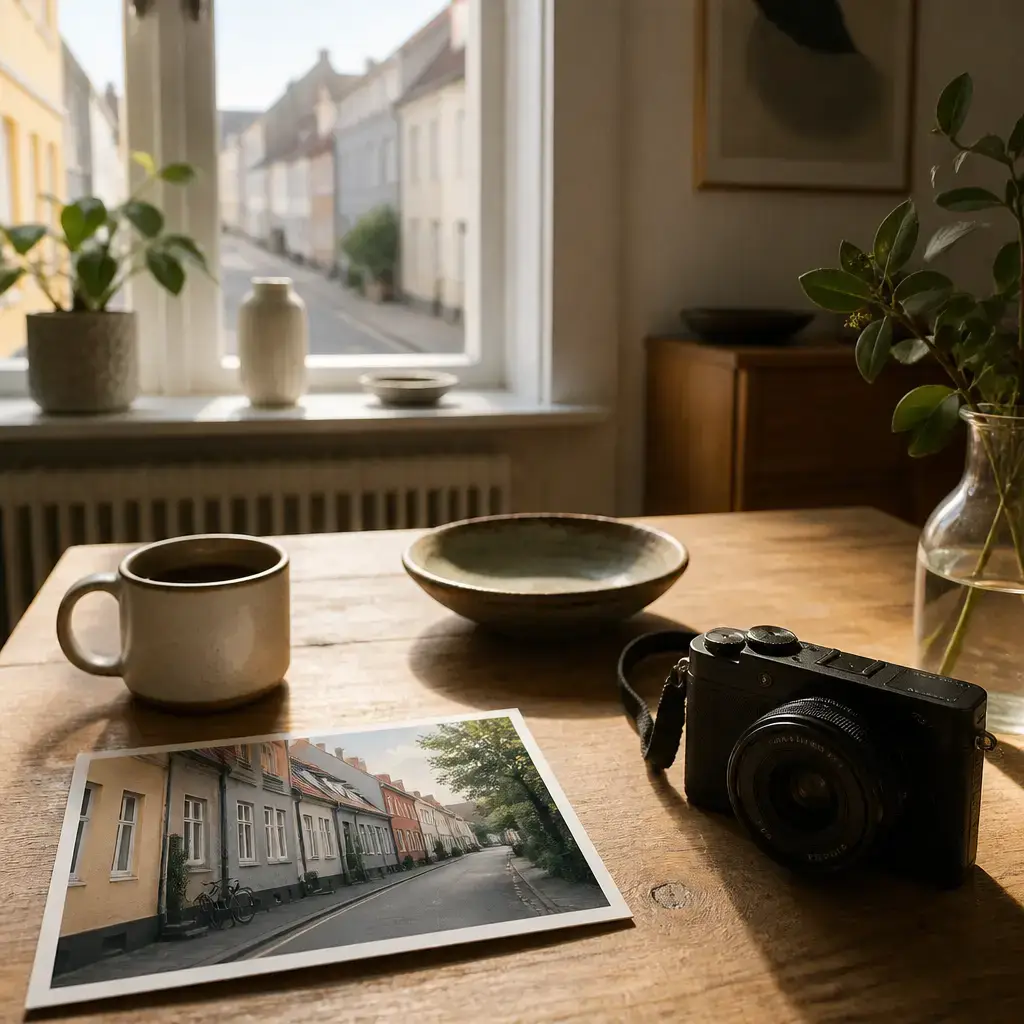
“Kamera” means camera, the object the speaker uses in “Ich benutze an den meisten Tagen meine kleine Kamera.” It is the thing used for taking photos. The phrase “meine kleine Kamera” identifies one specific camera.
Was
“Was” means what in “Was fotografierst du gern?” It asks which thing the other person likes to photograph. It appears at the beginning of this question before the verb.
fotografierst
“fotografierst” means photograph in “Was fotografierst du gern?” and refers to the action of taking pictures. It is used with “du” in a question about the other person’s preference. The pattern “Was fotografierst du gern?” asks about preferred subjects.
gern
“gern” shows that the action is enjoyed or preferred in “Was fotografierst du gern?” It changes the question from simply asking what someone photographs to asking what they like to photograph. Use a verb followed by “gern” to express that someone likes doing the action.
Ruhige
“Ruhige” means quiet and describes the streets in “Ruhige Straßen”. It comes before “Straßen” as part of the noun phrase. Use an adjective before a noun when describing the thing being discussed.
Straßen
“Straßen” means streets in “Ruhige Straßen mag ich am liebsten.” These are the subjects the speaker likes photographing most. It follows “Ruhige” in the description “Ruhige Straßen”.
mag
“mag” expresses liking in “Ruhige Straßen mag ich am liebsten.” The sentence puts “Ruhige Straßen” first and then states the speaker’s preference with “mag ich”. A reusable pattern is a liked thing followed by “mag ich”.
am
In “am liebsten”, “am” is part of the expression that shows the strongest preference. The whole phrase “mag ich am liebsten” means “I like ... best”. Keep “am” together with “liebsten” in this expression.
liebsten
“liebsten” completes “am liebsten” in “Ruhige Straßen mag ich am liebsten.” Together, these words show that quiet streets are the speaker’s top preference. The reusable pattern is “mag ich am liebsten” after the thing someone prefers most.
Kann
“Kann” means can in “Kann ich eins sehen?” and begins a request to see one photo. Together with “ich” and “sehen”, it asks whether the speaker may see it. A reusable request pattern is “Kann ich ...?” followed by an action.
eins
“eins” means one and refers to one photo in “Kann ich eins sehen?” It is also used in “Hier ist eins.” to present one photo. Use it when the item is understood from the context and does not need to be named again.
sehen
“sehen” means see in “Kann ich eins sehen?” and names the action being requested. It comes at the end of the question after “Kann ich eins”. The pattern “Kann ich ... sehen?” asks for permission to look at something.
Hier
“Hier” means here in “Hier ist eins.” It points to the photo being presented or shown. Use “Hier ist ...” when introducing or handing over something that is present.
ist
“ist” means is in “Hier ist eins.” and states that the photo is here or present. It connects “Hier” with “eins”. The pattern “Hier ist ...” is used to present something.
habe
“habe” means have and works with “aufgenommen” in “Ich habe es in der Nähe meines Zuhauses aufgenommen.” Together they say that the speaker took the photo. A reusable pattern is “Ich habe es ... aufgenommen”, with the object between “habe” and “aufgenommen”.
es
“es” means it and refers to the photo in “Ich habe es in der Nähe meines Zuhauses aufgenommen.” It is the thing the speaker took. It appears after “habe” and before the location phrase in this sentence.
in
In “in der Nähe meines Zuhauses”, “in” introduces the location where the photo was taken. The whole phrase means “near my home”. Use “in der Nähe” before the place that something is near.
der
“der” is the article in “in der Nähe meines Zuhauses”. It belongs to the location phrase and comes before “Nähe”. The reusable expression is “in der Nähe”.
Nähe
“Nähe” means vicinity or nearby area in “in der Nähe meines Zuhauses”. This phrase gives the location near which the photo was taken. Use “in der Nähe” when describing something as nearby.
meines
“meines” means my in “meines Zuhauses” and shows the relationship to the speaker’s home. It comes before “Zuhauses” in the location phrase. The reusable expression here is “in der Nähe meines Zuhauses”.
Zuhauses
“Zuhauses” means home in “meines Zuhauses”. With “meines”, the phrase means “of my home” and identifies the reference point for the location. It appears in “in der Nähe meines Zuhauses”.
aufgenommen
“aufgenommen” means taken here, referring to taking a photo in “Ich habe es in der Nähe meines Zuhauses aufgenommen.” Together with “habe”, it says that the speaker took it. Use it after an object in the pattern “Ich habe es ... aufgenommen” when describing a photo that was taken.
sieht
“sieht” means looks in “Es sieht einfach und klar aus.” It describes how the photo appears. It is used with “aus” in the pattern “Es sieht ... aus” followed by a description.
einfach
“einfach” means simple in “Es sieht einfach und klar aus.” It is one of the descriptions of how the photo appears. Use it with “sieht ... aus” to describe something’s appearance as simple.
und
“und” means and and links the two descriptions “einfach” and “klar” in “Es sieht einfach und klar aus.” It combines both qualities in one statement. The exact pattern is “einfach und klar”.
klar
“klar” means clear in “Es sieht einfach und klar aus.” It gives the second description of the photo’s appearance. It is linked to “einfach” by “und”.
aus
“aus” completes the expression “sieht ... aus” in “Es sieht einfach und klar aus.” Together, “sieht ... aus” means “looks” or “appears”. Use “sieht ... aus” with a description of how something appears.
übe
“übe” means practice in “Ich übe immer, wenn ich Zeit habe.” It describes the speaker’s repeated effort to improve at photography. Use “Ich übe” before the activity or skill being practiced.
immer
In “immer, wenn ich Zeit habe”, “immer” contributes the idea of each time or whenever. Together with “wenn”, the phrase means “whenever I have time”. A reusable pattern is “immer, wenn ...” followed by a situation that repeats.
wenn
“wenn” means when or whenever in “wenn ich Zeit habe”. It introduces the situation in which the speaker practices. Use “wenn” before a clause describing the time or condition for an action.
Zeit
“Zeit” means time in “wenn ich Zeit habe”. Together with “habe”, it expresses having time available. This phrase is useful when explaining that an activity happens only when there is enough time.