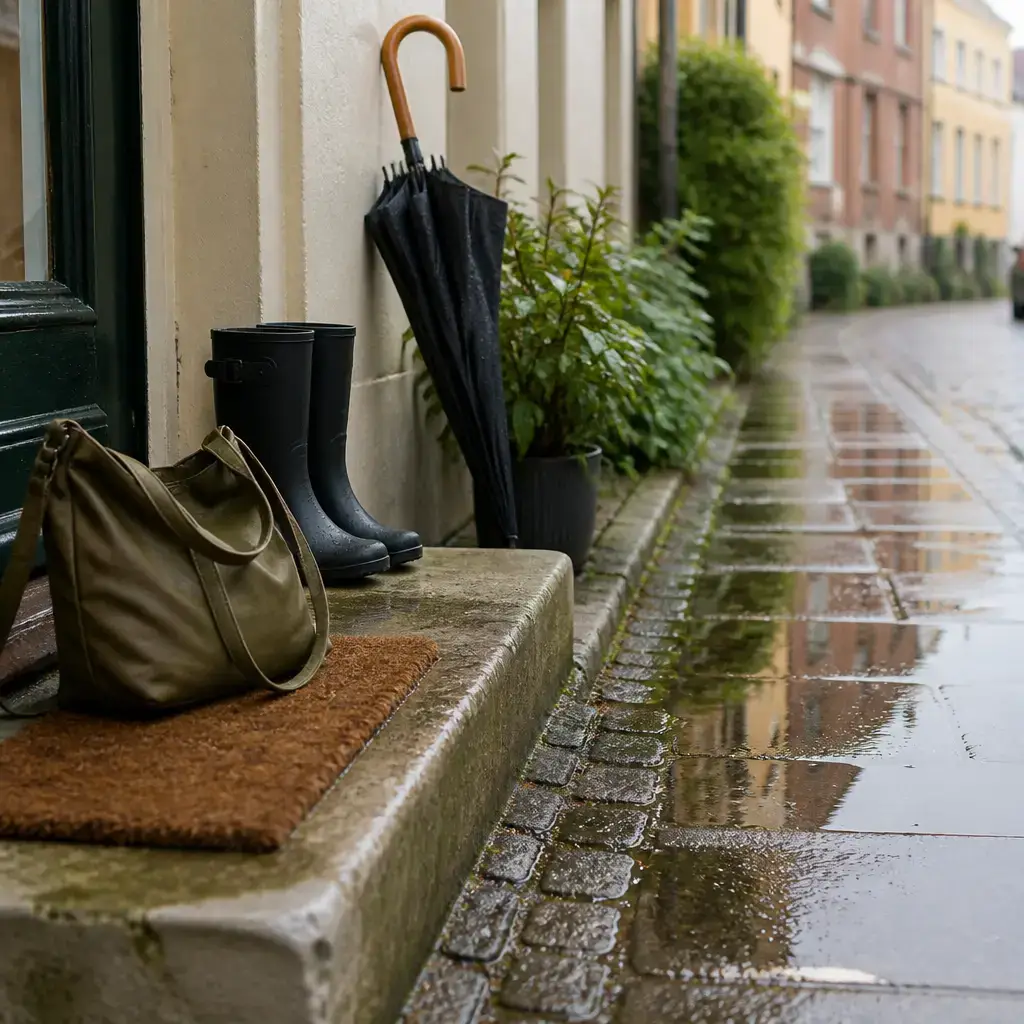
Draußen
“Draußen” means outside in this weather statement. It commonly appears at the beginning to specify where something is happening, as in “Draußen regnet es”.
regnet
“regnet” means is raining here and comes from regnen. In the weather pattern “regnet es”, es is the impersonal subject; use this pattern to talk about rain.
es
In “Draußen regnet es”, “es” is the impersonal subject used for the weather statement; it does not refer to a particular thing. The pattern “regnet es” is useful when talking about rain.
Zieh
“Zieh” tells one person to put on something and is the du imperative of anziehen. In “Zieh deine Stiefel an”, the verb and particle are separated around the object; use this pattern for telling someone to put on an item.
deine
“deine” means your and identifies the boots as belonging to the person addressed. It appears before the noun in “deine Stiefel”; reuse deine + noun for a familiar person’s item.
Stiefel
Stiefel means boots in “deine Stiefel”. Use it after a clothing expression such as “Zieh deine Stiefel an” when referring to boots.
an
In “Zieh deine Stiefel an”, “an” is the separable particle that completes the meaning put on. Use the separated pattern Zieh + object + an for a command to put on something.
bevor
bevor means before and introduces the event “du gehst”. In “bevor du gehst”, it connects the earlier action of putting on boots with leaving; use bevor + clause to order two events.
du
du means you for the person addressed in “bevor du gehst”. It is used for a familiar singular addressee and is the subject of this clause.
gehst
gehst means go or leave here and comes from gehen. In “bevor du gehst”, it appears at the end of the clause after bevor; reuse bevor + subject + verb for a before-clause.
Auf
In “Auf dem Weg”, “Auf” means on and locates the puddles on the path. Use auf + place when describing where something is located.
dem
“dem” is the article used before Weg in the location phrase “Auf dem Weg”. Learn it as part of this phrase when saying on the path; the article form depends on the surrounding grammar.
Weg
Weg means path in “Auf dem Weg”. Use it for a route or path, especially in the pattern Auf dem Weg.
sind
“sind” means are here and comes from sein. In “Auf dem Weg sind Pfützen”, it follows the location phrase and states that the puddles are there.
Pfützen
Pfützen means puddles in “Auf dem Weg sind Pfützen”. Use it for small pools of water that may be on a path after rain.
Geh
Geh means go or walk and is a direct command to one person; it is the du imperative of gehen. In “Geh langsam um sie herum”, it starts an instruction about how to move around the puddles.
langsam
langsam means slowly here and tells the person to move carefully. It modifies the action in “Geh langsam um sie herum”; use it after a movement command to specify pace.
um
In “um sie herum”, um contributes the meaning around and works with herum to describe movement around the puddles. Use um + object + herum when directing someone around something.
sie
“sie” means them here and refers back to Pfützen. In “um sie herum”, it is the thing being moved around; reuse it when the thing referred to is already known.
herum
“herum” completes the expression “um sie herum”, which means around them. It helps show that the movement goes around the puddles.
Meine
“Meine” means my and identifies the bag as belonging to the speaker. It comes before Tasche in “Meine Tasche”; use meine + noun to name something belonging to the speaker.
Tasche
Tasche means bag in “Meine Tasche könnte nass werden”. Use it for a bag that someone carries, especially when discussing keeping it dry.
könnte
“könnte” means might or could here and expresses a possibility; it comes from können. In “Meine Tasche könnte nass werden”, it makes getting wet a possible result rather than a certainty; reuse könnte + infinitive to state a possibility.
nass
nass means wet in “nass werden”. It describes the possible state the bag may reach; use it with werden to say that something gets wet.
werden
In “nass werden”, werden means get or become and describes a change into a state. Use werden + adjective for a change such as becoming wet.
Halte
“Halte” means keep or hold here and gives a command to one person; it is the du imperative of halten. In “Halte sie unter deinem Mantel”, the command tells the listener where to keep the bag.
unter
In “unter deinem Mantel”, unter means under and gives the bag’s location. Use unter + noun when something is beneath another thing, as with keeping an item under a coat.
deinem
“deinem” means your in “unter deinem Mantel” and identifies the coat as belonging to the person addressed. It appears directly before Mantel in this location phrase.
Mantel
Mantel means coat in “unter deinem Mantel”. Use it when referring to the outer garment that can cover or protect something from rain.
Ich
Ich means I and marks the speaker in “Ich sollte auch einen Regenschirm mitnehmen”. It is used when the speaker states their own intention or recommendation.
sollte
“sollte” means should here and expresses what the speaker thinks is advisable; it is a form of sollen. In “Ich sollte auch einen Regenschirm mitnehmen”, it is followed by the action the speaker considers sensible.
auch
auch means also or too and adds the umbrella to the things the speaker should take. In “sollte auch einen Regenschirm mitnehmen”, it comes before the object and the infinitive phrase.
einen
“einen” is the indefinite article before Regenschirm, meaning an in “einen Regenschirm”. It identifies the umbrella as the object being taken along.
Regenschirm
Regenschirm means umbrella in “einen Regenschirm mitnehmen”. Use it as the object of mitnehmen when someone decides to take an umbrella along.
mitnehmen
mitnehmen means take along and includes the idea of bringing an item with you. In “einen Regenschirm mitnehmen”, it follows the object; after sollte, the infinitive stays at the end of the sentence.
Das
“Das” means that and refers to the umbrella-taking action just mentioned, not to a single noun. In “Das hilft dir, trocken zu bleiben”, it serves as the subject of the helpful result.
hilft
“hilft” means helps here and is a form of helfen. In “Das hilft dir”, the thing that helps comes first and the person helped follows as dir; use helfen + person to describe a helpful measure.
dir
“dir” means to you and identifies the person who benefits from the help in “Das hilft dir”. It is used after hilft to say whom something helps.
trocken
trocken means dry in “trocken zu bleiben”. It describes the state the listener can maintain with the umbrella; use it with bleiben when someone remains dry.
zu
In “trocken zu bleiben”, zu marks the infinitive phrase that explains what the help makes possible. It appears directly before bleiben in this construction.
bleiben
bleiben means stay or remain in “trocken zu bleiben”. Together with trocken, it means remain dry; use zu + bleiben after an expression such as hilft when describing the result.