Kann
The capitalized form "Kann" asks for permission in "Kann ich die Schere benutzen?"; the lowercase form "kann" in "finden kann" expresses ability. It is a form of können, and it commonly appears before the subject in a yes-or-no question or after another clause in a statement. Use it when asking whether someone may do something or can do something.
ich
"ich" means I and is the subject referring to the speaker in the dialogue. It is used before a verb such as "Kann ich" and "Ich brauche". Use it when talking about your own actions, needs, or plans.
die
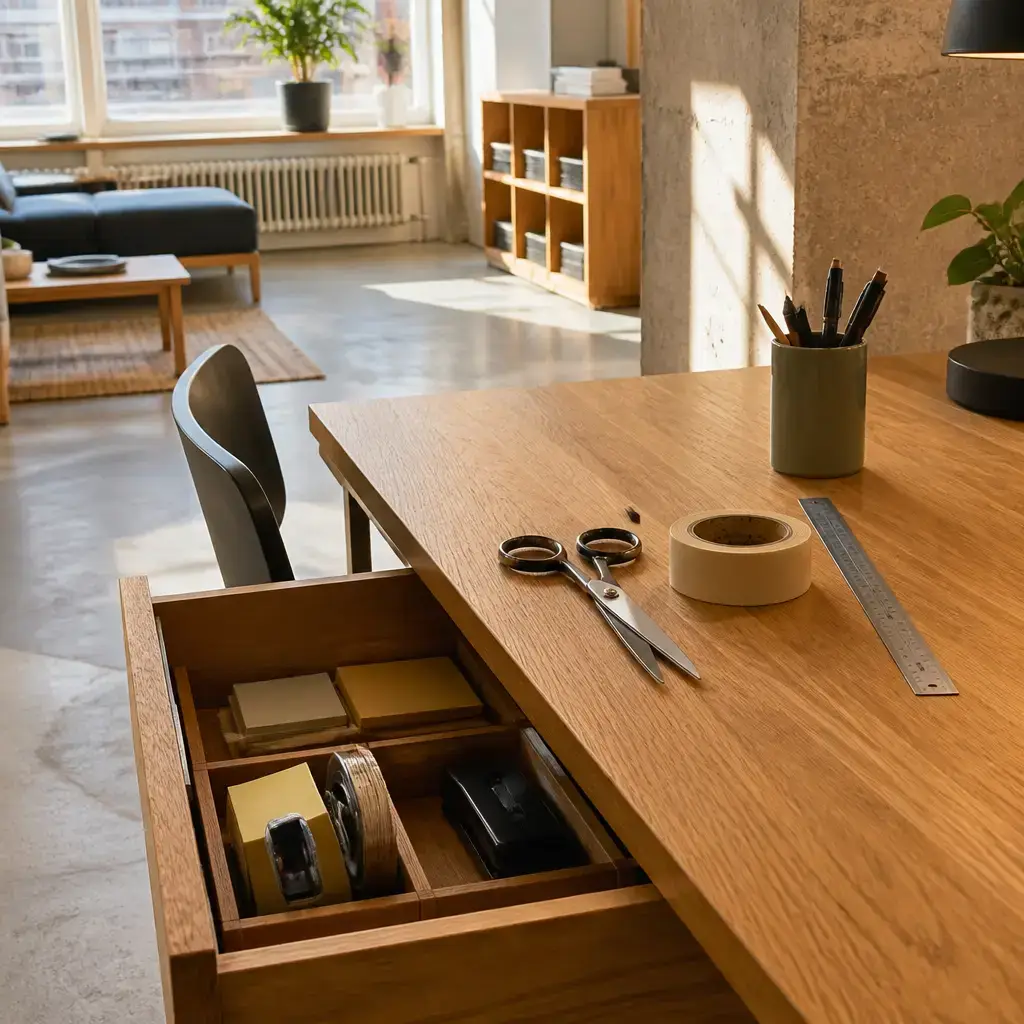
In "die Schere", "die" identifies the specific scissors being discussed. It is the definite article used with the feminine noun Schere in this object phrase. Use it before a known or clearly identified item.
Schere
"Schere" means scissors in "die Schere". The word names the tool that the speaker wants to use, and the article shows that this is a specific tool. Use it when asking for or referring to scissors.
benutzen
"benutzen" means to use in "Kann ich die Schere benutzen?" It stays in this infinitive form after the modal verb Kann. A useful pattern is "Kann ich ... benutzen?" when asking permission to use an item.
Nimm
"Nimm" means take in the direct instruction "Nimm sie". It is the informal singular command form of nehmen and is used because one person is being addressed. Use it when telling one person to take something.
sie
In "Nimm sie", "sie" means them and refers to the scissors. It is the object of the instruction, so the speaker does not repeat the name of the item. Use this pronoun when the plural items are already clear from the conversation.
und
"und" means and and links the two instructions in "Nimm sie und halte die Klingen nach unten." It shows that the second action should follow together with the first. Use it to connect related actions or pieces of information.
halte
"halte" means hold or keep in "halte die Klingen nach unten." It is the informal singular command form of halten and tells one person how to position the blades. Use it in an instruction when someone should keep an object in a particular position.
Klingen
"Klingen" means blades and refers to the sharp parts of the scissors in "die Klingen". The plural form is used because the instruction concerns the blades as parts of the scissors. Use it when describing or giving safety instructions about blades.
nach
In "nach unten", "nach" indicates direction toward a place or direction. Together with unten, it tells the listener that the blades should point downward. Use "nach" with a direction such as "nach unten" when describing where something should point or move.
unten
"unten" means down or below in "nach unten." It completes the direction expression and specifies the lower direction for the blades. Use it when describing a position or movement toward a lower place.
brauche
"brauche" means need in "Ich brauche auch etwas Klebeband." It is the first-person form of brauchen because the speaker is saying what they need. Use it before the thing you need, as in "Ich brauche ...".
auch
"auch" means also or too and adds another requested item in "Ich brauche auch etwas Klebeband" and another item in "Hast du auch ein Lineal?" It commonly appears near the item or action being added. Use it when adding something to what has already been mentioned.
etwas
"etwas" means some or an unspecified amount in "etwas Klebeband." It makes the amount of tape indefinite rather than naming a particular quantity. Use it before a substance or uncounted material when you need an unspecified amount.
Klebeband
"Klebeband" means tape in "etwas Klebeband." It names the material the speaker needs, and etwas shows that no exact amount is specified. Use it when asking for or locating tape.
Das
The capitalized form "Das" means the in "Das Klebeband ist in der Schublade." It identifies the tape that was just mentioned, and the capitalization comes from its position at the beginning of the sentence. Use it to introduce a known neuter-noun item at the start of a sentence.
ist
"ist" means is and states where the tape is located in "Das Klebeband ist in der Schublade." It is the third-person singular form of sein used with Klebeband. Use it to describe a current location or state.
in
"in" means in and places the tape inside the drawer in "in der Schublade." Here it introduces the container where the item can be found. Use it before a place when something is located inside it.
der
In "der Schublade", "der" means the and identifies a specific drawer. It is the article used here with the feminine noun Schublade after in for a fixed location. Use it before a known drawer when saying where something is located.
Schublade
"Schublade" means drawer in "in der Schublade." It names the place where the tape is stored. Use it when telling someone where an item is kept in a drawer.
Hast
"Hast" means have in the question "Hast du auch ein Lineal?" It is the form of haben used with du and appears before the subject because this is a yes-or-no question. Use it to ask whether someone has a particular item.
du
"du" means you and refers to the person being addressed in "Hast du" and "Du kannst." It is used for one person in the informal form of address. Use it when speaking directly to one familiar person.
ein
"ein" means a or an in "ein Lineal." It introduces one ruler without identifying a particular ruler in advance. Use it before a singular item when the listener does not yet know exactly which one it is.
Lineal
"Lineal" means ruler in "ein Lineal." It names the tool the speaker asks about and later needs to leave in a visible place. Use it when asking for or referring to a ruler.
Ja
"Ja" means yes and confirms the answer to "Hast du auch ein Lineal?" It is a complete short response before the speaker explains where the ruler is. Use it to give an affirmative answer.
es
In "es liegt auf meinem Schreibtisch" and "es von dort nehmen", "es" means it and refers to the ruler. The pronoun avoids repeating Lineal in the following sentences. Use it when a singular item is already clear from the conversation.
liegt
"liegt" means lies or is located in "es liegt auf meinem Schreibtisch." It is the form of liegen used to describe the ruler's stationary position on the desk. Use it when an object is resting or located in a place.
auf
"auf" means on in "auf meinem Schreibtisch." It describes the ruler's position on the surface of the desk. Use it with a surface when saying where an object is located.
meinem
"meinem" means my in "meinem Schreibtisch" and shows that the desk belongs to the speaker. Its form fits the fixed-location phrase after auf with the masculine noun Schreibtisch. Use it before a noun when identifying something as belonging to you in a phrase like "auf meinem ...".
Schreibtisch
"Schreibtisch" means desk in "auf meinem Schreibtisch." It names the surface where the ruler is located. Use it when telling someone where an item is on a desk.
kannst
"kannst" means can or are able to in "Du kannst es von dort nehmen." It is the form of können used with du and is followed by the infinitive nehmen. Use the pattern "Du kannst es ... nehmen" to tell someone that they are able to take an item.
von
"von" means from in "von dort" and marks the starting place for taking the ruler. It commonly appears before a person, place, or point of origin. Use it when saying where something comes from or where someone should take it from.
dort
"dort" means there in "von dort." It points to the place already identified as the speaker's desk. Use it to refer to a place that is clear from the situation without naming it again.
nehmen
"nehmen" means take in "es von dort nehmen." It is the infinitive used after kannst, so the modal verb carries the personal form. Use a modal verb followed by "nehmen" when telling someone they can take something.
bringe
"bringe" means bring, and with zurück it means return in "Ich bringe alles zurück." It is the first-person form of bringen and describes the speaker's planned action after finishing. Use it with zurück when saying that you will return an item.
alles
"alles" means everything in "Ich bringe alles zurück." It refers collectively to the scissors, tape, ruler, and other borrowed items rather than naming each one. Use it when referring to all relevant things together.
zurück
"zurück" means back and adds the idea of returning something to bringe in "Ich bringe alles zurück." It is used with the verb to show movement back to the original place or owner. Use it when saying that an item will be returned.
wenn
"wenn" means when in "wenn ich fertig bin" and introduces the time condition for returning the items. It begins a subordinate clause, with the verb at the end in this dialogue. Use it to connect an action with the time when another action is completed.
fertig
"fertig" means finished or done in "ich fertig bin." With bin, it describes the speaker as having completed the work. Use "fertig sein" when saying that a task or activity is finished.
bin
"bin" means am in "ich fertig bin." It is the first-person form of sein and appears at the end of the subordinate clause after wenn. Use it with an adjective such as fertig to describe your current state.
Leg
"Leg" means put or lay in the instruction "Leg das Lineal oben hin." It is the informal singular command form of legen and tells one person where to place the ruler. Use it when instructing one person to place an object somewhere.
oben
"oben" means on top or above in "oben hin." It specifies the upper position where the ruler should be placed. Use it when describing an upper surface or position.
hin
In "Leg das Lineal oben hin", "hin" indicates movement to the specified place and completes the placement instruction. Together with Leg, it shows that the ruler should be put there rather than merely being located there. Use it in a placement expression when an object is moved to a position.
damit
"damit" means so that and introduces the purpose in "damit ich es später finden kann." The following clause explains why the ruler should be left on top. Use it to connect an action with its intended result or purpose.
später
"später" means later in "später finden kann." It places the finding action at a later time, after the ruler has been left there. Use it when referring to a future time after the current action.
finden
"finden" means find in "ich es später finden kann." It is the infinitive after kann and describes locating the ruler later. Use it in a pattern such as "etwas finden" when saying that you can locate an item.