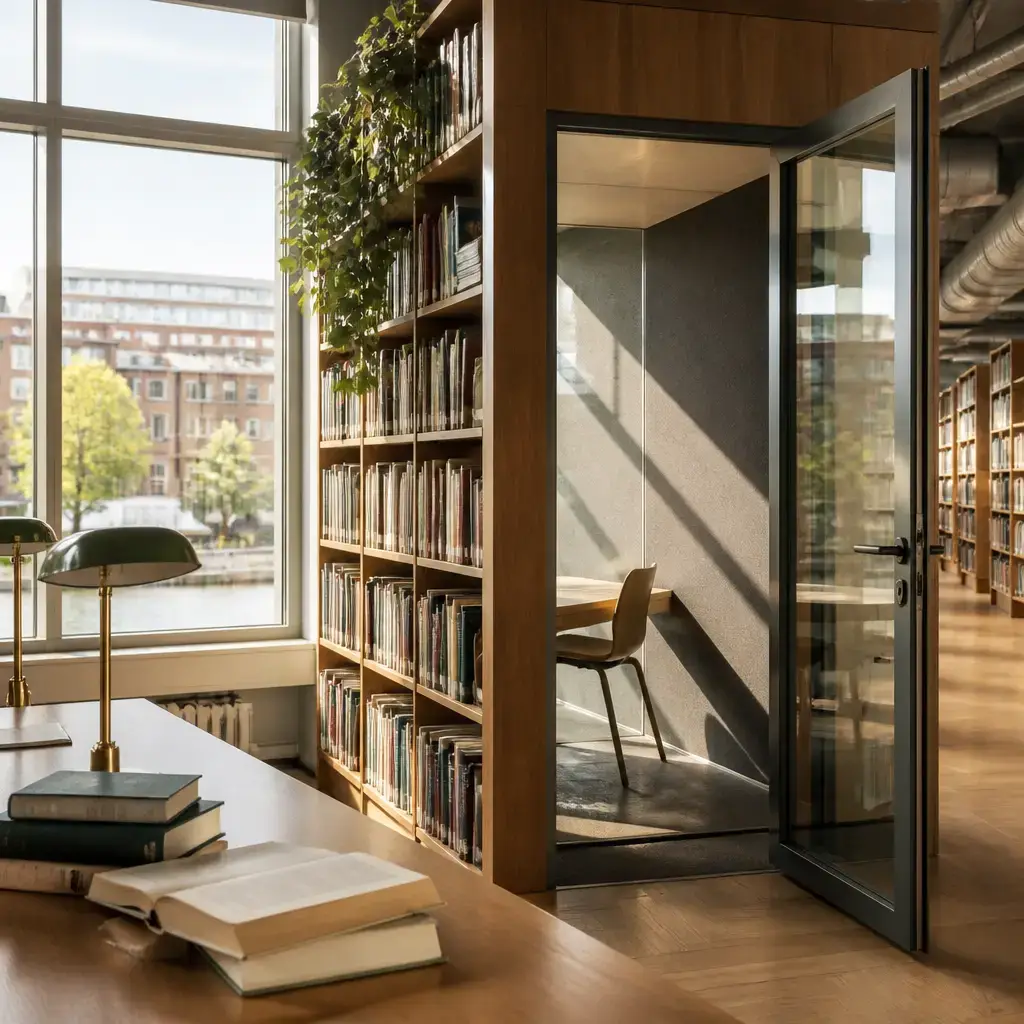
Ist
“Ist” asks whether something is available in “Ist ein Studierraum frei?”. The same form appears as “ist” in “Jetzt ist einer frei.” to state that one is available.
ein
“ein” introduces one unspecified study room in “Ist ein Studierraum frei?”. It comes directly before the noun “Studierraum” in this question.
Studierraum
“Studierraum” means study room in “Ist ein Studierraum frei?”. It names the room the speaker wants to use for reading.
frei
“frei” means available in “Ist ein Studierraum frei?” and “Jetzt ist einer frei.”. With a room, it indicates that the room can be used.
Jetzt
“Jetzt” means now and emphasizes the room’s current availability in “Jetzt ist einer frei.”. It is placed at the beginning to set the time for the statement.
einer
“einer” means one of them and refers back to a study room in “Jetzt ist einer frei.”. It lets the speaker avoid repeating “Studierraum”.
Kann
“Kann” asks whether the speaker is allowed or able to read in “Kann ich dort lesen?”. The pattern “Kann ich ...?” is useful for asking whether you may do something.
ich
“ich” means I and identifies the speaker in “Kann ich dort lesen?”. It is the person asking about reading in the room.
dort
“dort” means there and points to the study room in “Kann ich dort lesen?”. It identifies the place where the reading would happen.
lesen
“lesen” means to read in “Kann ich dort lesen?”. In “zum Lesen”, the capitalized form “Lesen” names the activity of reading.
Du
“Du” means you when addressing one person informally in “Du kannst ihn zum Lesen benutzen und die Tür schließen.”. It addresses the person receiving the instruction.
kannst
“kannst” means can or are able to when used with “Du” in “Du kannst ihn zum Lesen benutzen und die Tür schließen.”. It is followed by actions the listener may perform.
ihn
“ihn” means it and refers to the study room in “Du kannst ihn zum Lesen benutzen ...”. It is the thing that the listener can use.
zum
“zum” means for the in “zum Lesen” and introduces the purpose of using the room. This form is used directly before the activity “Lesen”.
benutzen
“benutzen” means to use in “Du kannst ihn zum Lesen benutzen ...”. The pattern “etwas benutzen” describes using a particular thing for a purpose.
und
“und” means and and connects the actions of using the room and closing the door in “... benutzen und die Tür schließen.”. It joins the two actions in one instruction.
die
“die” means the in “die Tür”, while “Die” at the start of “Die Wände ...” also means the. In this dialogue, it introduces the door and the walls being discussed.
Tür
“Tür” means door in “die Tür schließen.”. The expression describes closing the door of the study room.
schließen
“schließen” means to close in “die Tür schließen.”. The reusable pattern “die Tür schließen” describes closing a door.
Bleibt
“Bleibt” asks whether something remains in “Bleibt es dort ruhig?”. Here it asks whether the quiet condition will continue in that place.
es
“es” means it in “Bleibt es dort ruhig?”. It refers to the place or situation whose quietness is being discussed.
ruhig
“ruhig” means quiet in “Bleibt es dort ruhig?”. It describes the condition the speaker wants to know will continue there.
Wände
“Wände” means walls in “Die Wände halten den meisten Lärm ab.”. The walls are described as keeping noise out of the room.
halten
“halten” contributes the meaning of holding or keeping in “Die Wände halten den meisten Lärm ab.”. Together with “ab”, it expresses keeping noise out.
den
“den” means the in “den meisten Lärm”. It is part of the phrase identifying the noise that the walls keep out.
meisten
“meisten” means most in “den meisten Lärm”. The phrase says that the walls block most of the noise, not necessarily all of it.
Lärm
“Lärm” means noise in “den meisten Lärm”. It is the noise that the walls keep out.
ab
“ab” completes the meaning of “halten” in “Die Wände halten den meisten Lärm ab.”. Together, these words express blocking or keeping something out.
Dieser
“Dieser” means this in “Dieser Raum passt für mich.”. It points specifically to the room being considered.
Raum
“Raum” means room in “Dieser Raum passt für mich.”. It identifies the study room that suits the speaker.
passt
“passt” means works or suits in “Dieser Raum passt für mich.”. The pattern “X passt für mich” says that X is suitable for the speaker.
für
“für” means for in “passt für mich”. It introduces the person for whom the room is suitable.
mich
“mich” means me in “passt für mich”. It identifies the speaker as the person for whom the room works.
Bitte
“Bitte” means please in “Bitte hinterlasse den Raum für andere sauber.”. It makes the request to leave the room clean more polite.
hinterlasse
“hinterlasse” asks the listener to leave the room in a particular condition in “Bitte hinterlasse den Raum für andere sauber.”. Here, the requested result is that the room remains clean for others.
andere
“andere” means other people in “für andere”. It refers to people who will use the room after the current user.
sauber
“sauber” means clean in “Bitte hinterlasse den Raum für andere sauber.”. It describes the condition in which the room should be left.