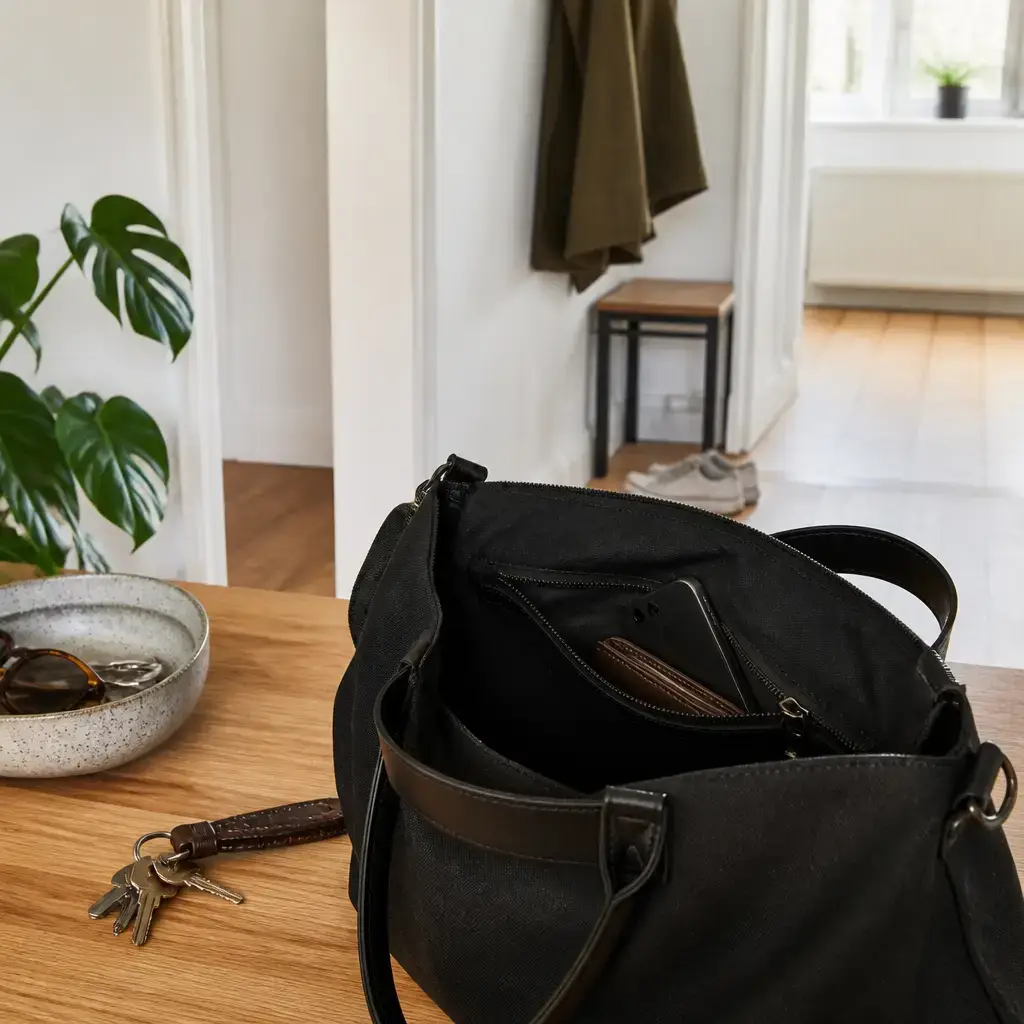
Wo
Wo asks for a location: here it means where the wallet should be put. It commonly starts a location question, for example the new example Wo ist die Tasche? Use it when asking another person where something is or where it belongs.
soll
soll expresses what the speaker should do in the question Wo soll ich mein Portemonnaie hinlegen? It is used with ich and the infinitive hinlegen, which comes at the end of this question. Use soll ich + infinitive when asking what action is appropriate.
ich
ich means I and is the person who would put away the wallet. It appears before soll in the question Wo soll ich mein Portemonnaie hinlegen? Use it when talking about your own action, ability, or situation.
mein
mein means my and identifies the wallet as belonging to the speaker. Here it comes directly before Portemonnaie in mein Portemonnaie. Use mein + noun when referring to something that belongs to you.
Portemonnaie
Portemonnaie means wallet, the item whose safe place is being discussed. In the dialogue it is the object of hinlegen. Use it when talking about carrying or storing a wallet.
hinlegen
hinlegen means put down or put somewhere, as in Wo soll ich mein Portemonnaie hinlegen? It is the infinitive used at the end after soll. Use it with the thing being placed, such as etwas hinlegen, when asking or saying where to put something.
Steck
Steck is a direct instruction to put or keep something in a place, as in Steck es in die Innentasche. It is used here to tell someone where to put the wallet. Use Steck ... in ... when telling someone to place an item inside something.
es
es means it and refers here to the wallet. It comes after Steck and before the destination in Steck es in die Innentasche. Use es when the item being discussed is already clear.
in
in marks the destination of the wallet in Steck es in die Innentasche. The full phrase shows movement into the inside pocket. Use in + place when saying where something is put or directed.
die
die is the form of the definite article meaning the before Innentasche in die Innentasche. It identifies a specific inside pocket. Use die directly before a noun when referring to a particular item with this article form.
Innentasche
Innentasche means inside pocket, the safer place recommended for the wallet. In die Innentasche names the destination where the wallet should be put. Use it when distinguishing an inner pocket from another pocket in a bag.
Ist
Ist means is and begins the question Ist die Vordertasche sicher? It asks whether the front pocket has the quality of being safe. Use Ist ...? at the start of a question about a thing or place.
Vordertasche
Vordertasche means front pocket, the pocket whose safety is being questioned. It is the subject of Ist die Vordertasche sicher? Use it when identifying a pocket at the front of a bag.
sicher
sicher means safe or secure here and describes whether the front pocket protects the wallet. It appears after ist in Ist die Vordertasche sicher? Use etwas ist sicher when describing something as safe.
sicherer
sicherer means safer and compares the inside pocket with the front pocket mentioned just before it. In Die Innentasche ist sicherer, it says that the inside pocket offers more safety. Use X ist sicherer when comparing two options.
kann
kann means can and expresses the speaker's ability to close the zipper in Ich kann den Reißverschluss schließen. It is followed by the infinitive schließen at the end. Use kann + infinitive when saying that someone can do something.
den
den means the before Reißverschluss in den Reißverschluss schließen, identifying the zipper as the thing being closed. It belongs to this specific object phrase. Use den before a specific noun when this article form is required in the sentence.
Reißverschluss
Reißverschluss means zipper, the part of the bag that the speaker can close. It appears in the object phrase den Reißverschluss schließen. Use it when talking about opening or closing a zipper.
schließen
schließen means close in Ich kann den Reißverschluss schließen. It is the infinitive after kann and describes the action applied to the zipper. Use etwas schließen when saying that you close an object such as a zipper.
Damit
Damit means with that or by doing that and refers to closing the zipper in Damit sollte es sicher sein. It connects the previous action with the expected result. Use Damit ... when pointing to an action or method just mentioned and describing its result.
sollte
sollte expresses an expectation in Damit sollte es sicher sein: closing the zipper is expected to make it secure, but this is not presented as an absolute guarantee. It is used here before sein in the phrase sollte es sicher sein. Use sollte ... sein when giving a cautious expectation about a result.
sein
sein means be and completes sollte es sicher sein, meaning that it should be secure. It appears at the end after sollte. Use sollte ... sein to describe an expected state or quality.
Handy
Handy means phone and is the second valuable item mentioned in Mein Handy ist auch darin. It is the subject of the sentence about what is inside. Use Handy when talking about a mobile phone.
auch
auch means also or too and adds the phone to the wallet as another item that is inside. In Mein Handy ist auch darin, it appears before darin. Use auch when adding another person, thing, or fact to information already given.
darin
darin means in there and refers to the inside of the pocket or bag. In Mein Handy ist auch darin, it states where the phone is without repeating the place. Use etwas ist darin when confirming that something is inside a previously understood container.
Schau
Schau is a direct instruction to look or check, as in Schau in die Tasche, bevor du gehst. It tells the other person to inspect the pocket before leaving. Use Schau in ... when directing someone to look inside a place.
Tasche
Tasche refers here to the pocket or compartment being checked inside the bag. In Schau in die Tasche, it is the destination of the look. Use Tasche when talking about a bag or a pocket, with the exact meaning determined by context.
bevor
bevor means before and introduces the event that should happen later in the sentence: before you go. It begins the clause bevor du gehst. Use bevor + clause to say that one action happens earlier than another.
du
du means you and refers to the person being told to check the pocket. It is the subject of bevor du gehst. Use du when addressing one person directly in an informal context.
gehst
gehst means go or leave here and refers to the addressee's departure in bevor du gehst. It is the dialogue form of gehen used with du and comes at the end of the bevor clause. Use bevor du gehst when telling someone to do something before they leave.