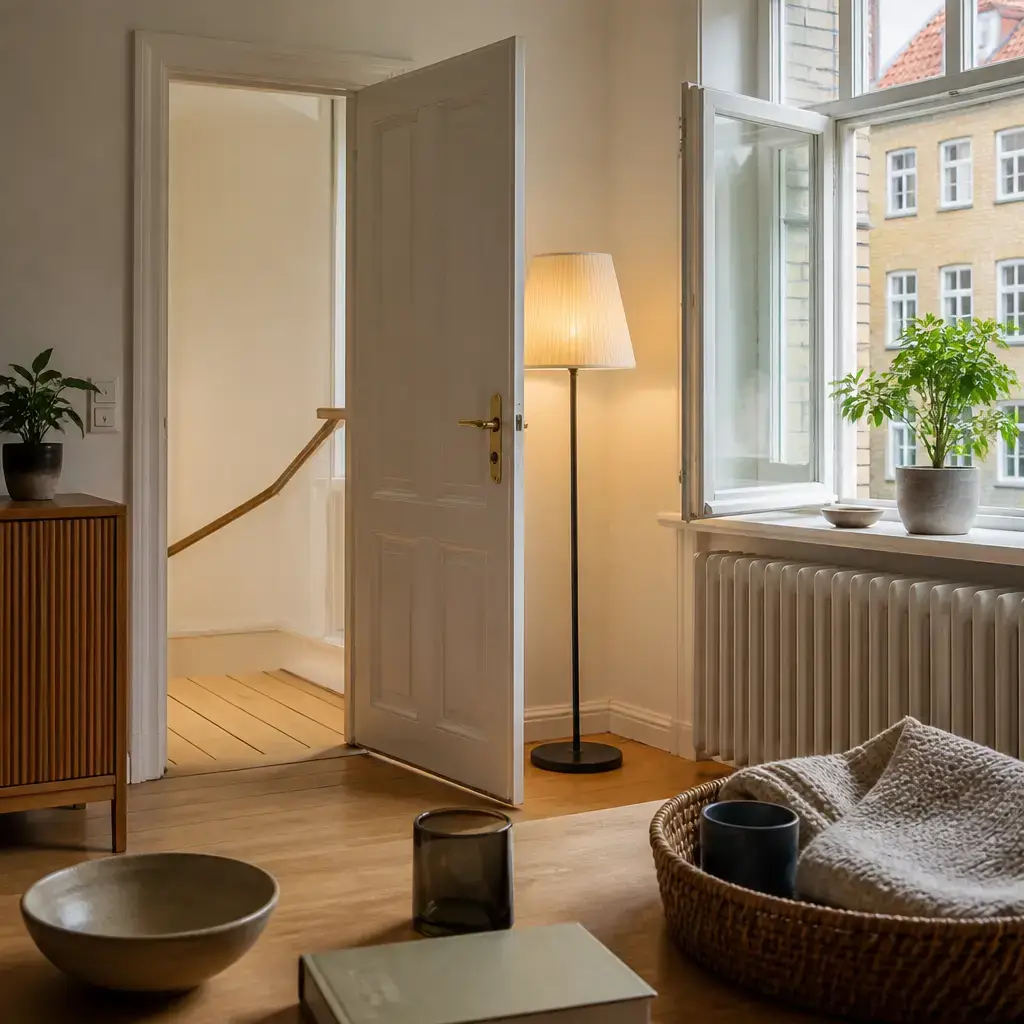
About This Lesson
Use Basic Home Actions to practice German conversation, pronunciation, vocabulary, grammar, and quizzes.
Dialogue
A
Bitte mach die Tür auf.
BIT-tuh mahkh dee TEWR owf. Please open the door.
B
Bitte mach das Fenster zu.
BIT-tuh mahkh dahss FEN-stuh tsoo. Please close the window.
A
Bitte mach es an.
BIT-tuh mahkh ess AHN. Please turn it on.
B
Bitte mach es aus.
BIT-tuh mahkh ess OWSS. Please turn it off.
A
Bitte gib mir das.
BIT-tuh gip meer dahss. Please give me this.
B
Ich nehme das.
ikh NAY-muh dahss. I will take this.Word by Word
Bitte
“Bitte” means “please” in these polite requests, such as “Bitte mach die Tür auf.” It commonly comes before a request: “Bitte” + request. You use it when asking someone politely to do something.
mach
“Mach” is the informal request form of machen in the expressions “mach die Tür auf,” “mach das Fenster zu,” “mach es an,” and “mach es aus.” Together with the following particle, it asks someone to open, close, turn on, or turn off something. You use “Mach …” when giving a simple request to one person you address informally.
die
In “die Tür,” “die” is the definite article meaning “the” and belongs with Tür. The exact phrase “die Tür” means “the door.” You reuse it before this noun when referring to a specific door.
Tür
“Tür” means “door” in “Bitte mach die Tür auf.” The phrase “die Tür” refers to the specific door being opened. You use “Tür” when talking about a door in a home or another building.
auf
In “mach die Tür auf,” “auf” is the separable part that makes the request mean “open the door.” It appears after the object in this dialogue: “mach die Tür auf.” You use this pattern when asking someone to open a door or another suitable object.
das
In “das Fenster,” “das” means “the” and belongs with Fenster; later, in “Ich nehme das,” “das” means “this” or “that” as the thing being taken. The exact phrases are “das Fenster” and “Ich nehme das.” You use the article before the noun, but the pronoun can stand alone when the thing is already clear.
Fenster
“Fenster” means “window” in “Bitte mach das Fenster zu.” The phrase “das Fenster” refers to the specific window being closed. You use “Fenster” when talking about a window in a home or another building.
zu
In “mach das Fenster zu,” “zu” is the separable part that makes the request mean “close the window.” It appears after the object in this dialogue: “mach das Fenster zu.” You use this pattern when asking someone to close a window or another suitable object.
es
“Es” means “it” in “Bitte mach es an” and “Bitte mach es aus.” It refers to an object or device that is already understood from the situation. You use “mach es an” or “mach es aus” when asking someone to turn that thing on or off.
an
In “mach es an,” “an” is the separable part that makes the request mean “turn it on.” It comes after “es” in the exact phrase “mach es an.” You use this pattern for a device or other thing that can be turned on.
aus
In “mach es aus,” “aus” is the separable part that makes the request mean “turn it off.” It comes after “es” in the exact phrase “mach es aus.” You use this pattern for a device or other thing that can be turned off.
gib
“Gib” means “give” in the request “Bitte gib mir das.” It is used with the recipient “mir” and the thing being given “das.” You use the pattern “gib mir …” when asking one person informally to give you something.
mir
“Mir” means “to me” or “me” as the recipient in “Bitte gib mir das.” It appears between “gib” and “das” in the pattern “gib mir das.” You use “mir” when saying that something is given or shown to you.
Ich
“Ich” means “I” in “Ich nehme das.” It identifies the speaker as the person taking the item. You use “Ich” at the beginning of a sentence when describing your own action or choice.
nehme
“Nehme” means “take” in “Ich nehme das,” where the speaker says they will take or choose the item. It follows “Ich” and comes before the object “das.” You can reuse the pattern “Ich nehme …” when accepting or choosing something.
Grammar Points
mach ... auf / zu / an / aus
Mach die Tür auf.
MAHkh dee TEWR owf.Open the door.
With separable verbs, the prefix moves to the end in a simple command: mach ... auf.
gib + mir + das
Gib mir das.
GIP meer dahss.Give me this.
The person receiving something comes directly after the verb: gib mir das.
German Vocabulary
anmachen
verb
AHN-mah-khen
to turn on
mach ... an
Bitte mach es an.
aufmachen
verb
OWF-mah-khen
to open
mach ... auf
Bitte mach die Tür auf.
ausmachen
verb
OWSS-mah-khen
to turn off
mach ... aus
Bitte mach es aus.
das
pron
dahss
this; that
das Fenster
noun
dahss FEN-stuh
the window
die Tür
noun
dee TEWR
the door
es
pron
ess
it
gib
verb
gip
give
ich
pron
ikh
I
mir
pron
meer
me
nehmen
verb
NAY-mun
to take
nehme
zumachen
verb
TSOO-mah-khen
to close
mach ... zu
Bitte mach das Fenster zu.
Quiz
Word Order
Arrange the words in the correct order.
Please open the door.
Show Answer
Bitte mach die Tür auf.Please close the window.
Show Answer
Bitte mach das Fenster zu.Please turn it on.
Show Answer
Bitte mach es an.Spelling
Tap the letters to spell the word.
to take
Show Answer
nehmeI
Show Answer
ichthis; that
Show Answer
dasit