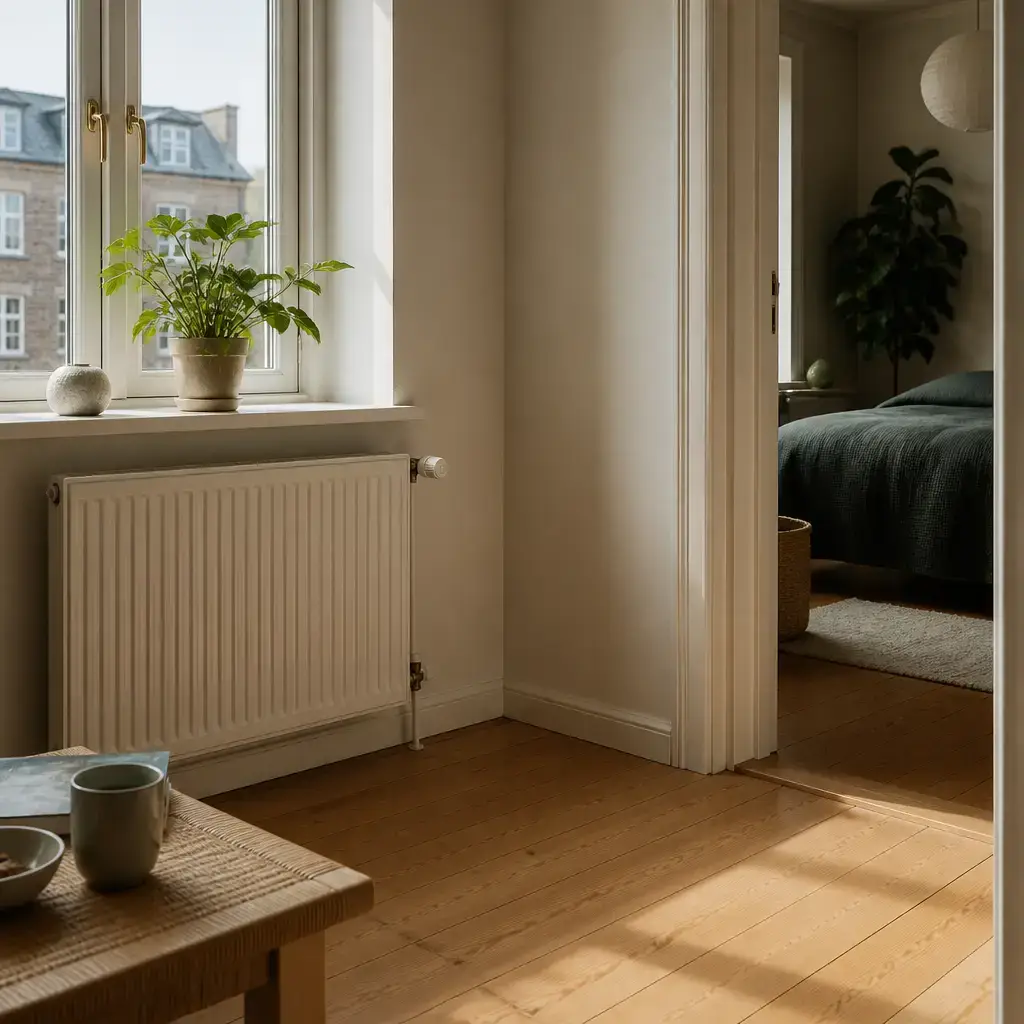
Varmen
“Varmen” means the heating in this dialogue. It refers to the heating system being discussed; a useful pattern is “Varmen fungerer” for “The heating works.” You could use it when reporting a problem with heating at home.
slår til
“slår til” means switches on here, describing the heating starting to operate. The construction combines “slår” with “til” to express switching on as a whole. A new example is “Lyset slår til,” meaning “The light switches on.”
men
“men” introduces the contrast between the heating switching on and the room not becoming comfortable. It connects two contrasting clauses, as in “Varmen slår til, men rummet bliver aldrig behageligt.” Use it when adding an opposing point.
rummet
“rummet” means the room affected by the heating problem. It identifies the particular room in “rummet bliver aldrig behageligt.” You can use it when describing conditions inside a room.
bliver
“bliver” means becomes in “rummet bliver aldrig behageligt.” It links the room to the resulting condition “behageligt.” A new example is “Vandet bliver varmt,” meaning “The water becomes warm.”
aldrig
“aldrig” means never and shows that the room does not become comfortable at any time in the situation described. It appears before “behageligt” in “bliver aldrig behageligt.” Use it to state that something does not happen at any time.
behageligt
“behageligt” describes the room as comfortable in “rummet bliver aldrig behageligt.” It is the condition the room fails to reach. A new example is “Det er behageligt her,” meaning “It is comfortable here.”
Termostaten
“Termostaten” means the thermostat being checked as a possible cause of the heating problem. It is the subject of “Termostaten fungerer måske.” Use it when discussing temperature control in a room or building.
fungerer
“fungerer” means works or functions in “Termostaten fungerer måske.” It says that the thermostat may be operating properly. A new example is “Systemet fungerer,” meaning “The system works.”
måske
“måske” expresses uncertainty: the thermostat may be working, but this is not confirmed. In “Termostaten fungerer måske,” it is placed after the verb. Use it when presenting a possible explanation rather than a certainty.
mens
“mens” means while and introduces the simultaneous or contrasting situation involving the radiator valve. It connects “Termostaten fungerer måske” with “radiatorventilen stadig sidder fast.” Use it to compare two situations happening at the same time.
radiatorventilen
“radiatorventilen” means the radiator valve that may be causing the problem. It is the subject of “radiatorventilen stadig sidder fast.” Use it when discussing the part that controls a radiator.
stadig
“stadig” means still and shows that the valve remains in the stuck condition. In “stadig sidder fast,” it emphasizes that the condition continues. Use it when an unwanted or expected situation has not changed.
sidder fast
“sidder fast” means remains stuck in this dialogue. The construction combines “sidder” and “fast” to describe something staying unable to move. A new example is “Døren sidder fast,” meaning “The door is stuck.”
Det
“Det” means that in “Det tænkte jeg også på,” referring back to the possibility just mentioned. It points to the previous idea rather than naming it again. Use it to refer back to a situation or statement already under discussion.
tænkte
“tænkte” means thought or wondered in “Det tænkte jeg også på.” Together with “på,” it shows that the speaker had considered the same possibility. A new example is “Jeg tænkte på problemet,” meaning “I thought about the problem.”
jeg
“jeg” means I and identifies the speaker in “Det tænkte jeg også på.” It is the person who had considered the possibility. Use it when stating your own thought, action, or opinion.
også
“også” means also or too in “Det tænkte jeg også på.” It shows that the speaker had the same thought as the other person. Use it to agree that another person has done or thought the same thing.
på
“på” contributes the idea of about in the expression “Det tænkte jeg også på.” It completes the pattern for thinking about a topic or possibility. A new example is “Jeg tænkte på det,” meaning “I thought about it.”
fordi
“fordi” means because and introduces the reason the speaker considered the possibility. It connects “Det tænkte jeg også på” with the observation about the pipe. Use it to give a reason for a statement.
røret
“røret” means the pipe observed near the wall. It is the thing that feels warm in “røret føles varmt.” Use it when describing a pipe in a heating or plumbing system.
føles
“føles” means feels in “røret føles varmt.” It describes the sensation the pipe gives when touched. A new example is “Overfladen føles glat,” meaning “The surface feels smooth.”
varmt
“varmt” means warm in “føles varmt,” describing the temperature of the pipe. It gives the quality perceived by touch. A new example is “Vandet føles varmt,” meaning “The water feels warm.”
tæt
“tæt” contributes the meaning of close or near in “tæt på væggen.” Together with “på,” it locates the pipe near the wall. Use the pattern “tæt på [sted eller ting]” when describing a nearby location.
væggen
“væggen” means the wall in “tæt på væggen.” It is the reference point for the pipe’s location. Use it when describing where an object or fixture is positioned indoors.
Så
“Så” means then or so in “Så er problemet sandsynligvis...” It draws a conclusion from the preceding observation about the warm pipe. Use it to introduce a result or conclusion based on what was just said.
er
“er” means is in “Så er problemet sandsynligvis...” It links the problem with the diagnosis that follows. A new example is “Problemet er lille,” meaning “The problem is small.”
problemet
“problemet” means the problem being diagnosed. In “problemet sandsynligvis...” it is the subject of the conclusion about circulation and power. Use it when identifying or discussing a difficulty.
sandsynligvis
“sandsynligvis” means probably and marks the explanation as likely rather than certain. It appears before “cirkulationen” in the conclusion. Use it when giving a reasoned but unconfirmed assessment.
cirkulationen
“cirkulationen” means the circulation referred to as the likely source of the heating problem. It is contrasted with “strømmen” in “cirkulationen snarere end strømmen.” Use it when discussing movement of heating fluid or air in a system.
snarere
“snarere” contributes the meaning rather in the contrast “snarere end.” It directs the conclusion toward circulation instead of power. Use it with “end” when choosing one explanation over another.
end
“end” means than in “snarere end strømmen.” It completes the comparison between circulation and power. Use the pattern “snarere end [alternativ]” when saying that one possibility is more likely than another.
strømmen
“strømmen” means the power or electricity being considered as an alternative cause. In “snarere end strømmen,” it is the explanation that is considered less likely. Use it when discussing electricity as a possible source of a technical problem.
Kan
“Kan” asks whether a technician is able or permitted to examine the problem in “Kan en tekniker undersøge det...?” At the beginning of the question, it introduces a polite request about possibility. Use it to ask whether someone can do something.
en
“en” means a in “en tekniker.” It introduces one technician without identifying a particular person. Use it before a singular noun such as “en tekniker” when referring to an unspecified person.
tekniker
“tekniker” means technician, the person who might examine the heating system. It appears after “en” in “en tekniker.” Use it when referring to someone who diagnoses or repairs technical equipment.
undersøge
“undersøge” means check or examine in “undersøge det.” It describes the technician’s proposed inspection of the heating problem. A new example is “undersøge systemet,” meaning “examine the system.”
uden
“uden” means without in “uden at gå ind i alle rum.” It introduces an action that is not done: entering every room. Use the pattern “uden at [verb]” when describing something done without another action.
at
“at” is the infinitive marker in “at gå ind.” It introduces the base verb after “uden.” Use it before an infinitive in constructions such as “uden at vente,” a new example meaning “without waiting.”
gå
“gå” means go in “gå ind i alle rum.” Together with “ind,” it describes entering the rooms. A new example is “gå hjem,” meaning “go home.”
ind
“ind” means in or into in “gå ind i alle rum.” It adds the direction of movement to “gå,” giving the meaning enter. Use it with a movement verb when someone moves inside.
i
“i” means in and introduces the rooms in “i alle rum.” Here it marks the places the technician would enter. Use it before a place when describing being or moving inside it.
alle
“alle” means all or every in “alle rum.” It shows that the question concerns the rooms as a complete set. Use it before a plural noun when referring to the whole group.
rum
“rum” means rooms in “alle rum.” It names the spaces the technician might need to enter. Use it after a quantity or determiner when referring to rooms generally.
Teknikeren
“Teknikeren” means the technician in “Teknikeren får måske brug for adgang.” It refers to the specific technician already introduced as “en tekniker.” Use it when the person is now identifiable from the conversation.
får
“får” means gets or comes to have in “får måske brug for adgang.” In the construction “får brug for,” it expresses that someone will need something. A new example is “Hun får brug for hjælp,” meaning “She will need help.”
brug for
“brug for” means need in “får måske brug for adgang.” The construction as a whole expresses that access is required, with “brug” referring to need or use and “for” linking it to what is needed. A new example is “Jeg har brug for tid,” meaning “I need time.”
adgang
“adgang” means access in “brug for adgang.” It refers to permission or the possibility of entering the apartment or its rooms. Use it when discussing access to a building, room, or system.
sammenligne
“sammenligne” means compare in “til at sammenligne temperaturerne.” It describes checking the temperatures against one another. A new example is “sammenligne priser,” meaning “compare prices.”
temperaturerne
“temperaturerne” means the temperatures the technician wants to compare. It is the object of “sammenligne” in “sammenligne temperaturerne.” Use it when discussing measured temperatures in different places.
hele
“hele” means whole or entire in “hele lejligheden.” It emphasizes that the comparison covers the apartment as a complete unit. Use it before a noun when referring to something in its entirety.
lejligheden
“lejligheden” means the apartment in “hele lejligheden.” It identifies the complete living space across which temperatures may be compared. Use it when discussing the specific apartment already understood in the situation.
arrangere
“arrangere” means arrange in “Jeg kan arrangere det.” It describes organizing the technician’s access. A new example is “arrangere et møde,” meaning “arrange a meeting.”
hvis
“hvis” means if and introduces the condition for arranging access. It connects “Jeg kan arrangere det” with the technician giving reasonable notice. Use it to state a condition that must be met.
giver
“giver” means gives in “giver et rimeligt varsel.” Here it describes the technician providing notice before the visit. A new example is “Hun giver besked,” meaning “She gives notice or lets someone know.”
et
“et” means a in “et rimeligt varsel.” It introduces one unspecified notice period. Use it before a singular noun such as “et varsel” when referring to one non-specific item.
rimeligt
“rimeligt” means reasonable in “et rimeligt varsel.” It describes notice that is considered sufficient for the tenant to prepare. Use it when evaluating whether a request, amount, or period is fair.
varsel
“varsel” means notice in “et rimeligt varsel.” It refers to advance information about the technician’s visit. Use it when discussing how much advance warning someone should give.
Vi
“Vi” means we and identifies the speakers as a group making a joint decision. It is the subject of “Vi bør bede om...” Use it when referring to yourself together with another person or group.
bør
“bør” means should in “Vi bør bede om...” It gives advice or a recommendation about the next step. Use it when suggesting what someone ought to do.
bede
“bede” means ask for or request in “bede om et klart tidsrum.” The construction “bede om” expresses requesting a particular thing, with “om” linking the request to its object. A new example is “bede om hjælp,” meaning “ask for help.”
om
“om” contributes the meaning for in the request construction “bede om et klart tidsrum.” It connects “bede” to the thing being requested. Use the pattern “bede om [noget]” when asking for something.
klart
“klart” means clear in “et klart tidsrum.” It describes a time window that is specified and easy to understand. Use it when requesting precise information or an unambiguous arrangement.
tidsrum
“tidsrum” means time window or period in “et klart tidsrum.” It refers to the period during which the technician could visit. Use it when arranging an appointment or defining a period of time.
før
“før” means before and introduces the action that must happen first in “før vi bekræfter det.” It places requesting a clear time window before confirming the appointment. Use it to order two actions in time.
bekræfter
“bekræfter” means confirm in “vi bekræfter det.” It describes formally agreeing to the arrangement after receiving a clear time window. A new example is “Vi bekræfter aftalen,” meaning “We confirm the agreement.”