Jeg
“Jeg” means “I” and is the speaker referring to themself in “Jeg har lagt min oplader et andet sted.” It is used as the subject before the verb when talking about your own action or situation.
har
In “Jeg har lagt min oplader et andet sted,” “har” helps express that the speaker has placed or left something. A useful pattern is “har” followed by an action form, as in “har lagt,” when describing a completed action that matters now.
lagt
“Lagt” means placed or left in “har lagt min oplader et andet sted.” It is used with “har” in this dialogue, and “har lagt” is useful when saying that you put something somewhere.
min
In “min oplader,” “min” means “my,” while the capitalized “Min” in “Min burde passe” means “mine” and refers to the other person’s charger. Use “min” before something you possess, or use “Min” on its own when the possessed item is already clear.
oplader
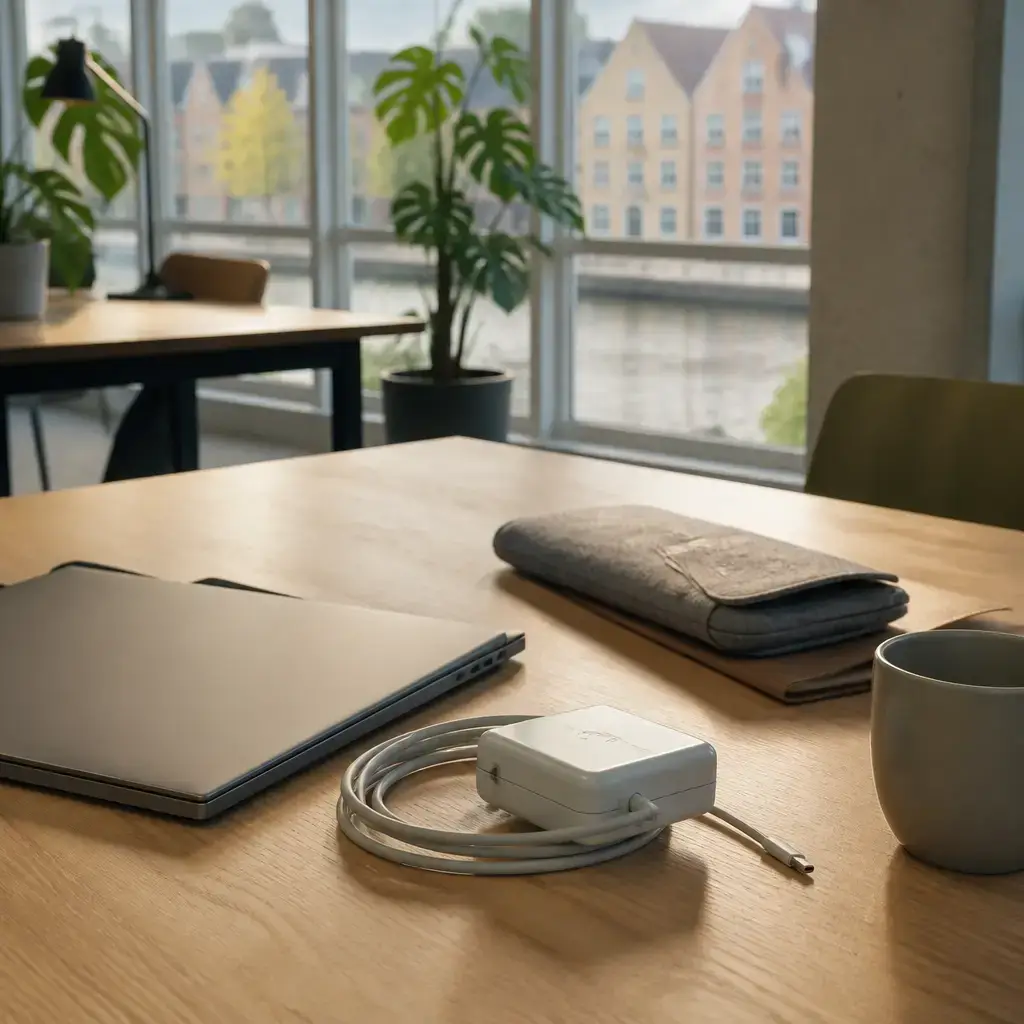
“Oplader” means charger in “min oplader.” The word identifies the item being discussed and can be reused in a possession phrase such as “min oplader” when asking for or describing a charger.
et
In “et andet sted,” “et” introduces the place as one unspecified place. A useful pattern is “et” followed by a noun phrase when referring to an unspecified item or location.
andet
“Andet” means other or another in “et andet sted.” The phrase is useful when explaining that something is located somewhere different from the current place.
sted
“Sted” means place or location in “et andet sted.” It is useful after a description such as “et andet” when saying where something is.
og
“Og” means “and” and links “Jeg har lagt min oplader et andet sted” with “batteriet på min bærbare er næsten tomt.” Use it to connect two related facts or actions in one statement.
batteriet
“Batteriet” means “the battery” in “batteriet på min bærbare.” The form identifies the particular battery being discussed, and the phrase “batteriet på” can connect a battery with the device it belongs to.
på
In “batteriet på min bærbare,” “på” links the battery with the laptop it belongs to. A useful pattern is “X på Y” when identifying something associated with or located on another thing.
bærbare
In “min bærbare,” “bærbare” refers to the speaker’s laptop. The possessive phrase is useful when distinguishing this device from another computer or laptop in the same workspace.
er
In “batteriet på min bærbare er næsten tomt,” “er” means “is” and links the battery with its condition. Use “er” before a description when stating what something is like.
næsten
“Næsten” means “almost” in “næsten tomt,” showing that the battery is very close to being empty but not necessarily completely empty. It commonly comes before the description it limits.
tomt
“Tomt” means empty in “er næsten tomt,” describing the battery’s nearly empty state. The pattern “er næsten” followed by a description is useful for reporting a condition that is close to a limit.
burde
“Burde” means “should” in “Min burde passe,” expressing an expectation rather than an absolute guarantee. A useful pattern is “burde” followed by an action form when making a cautious prediction.
passe
“Passe” means fit in “burde passe,” referring to whether the charger is compatible with the laptop port. The pattern “burde passe” is useful when predicting that an object will fit.
hvis
“Hvis” means “if” or “provided that” and introduces the condition “din port bruger det nyere stik.” Use “hvis” before a condition that must be true for the main statement to apply.
din
“Din” means “your” in “din port.” It identifies something belonging to or associated with the person being addressed, and it is placed before the relevant noun.
port
“Port” means port or connection port in “din port bruger det nyere stik.” It is useful when discussing the connection point on a computer or another device.
bruger
In “din port bruger det nyere stik,” “bruger” means “uses,” describing which connector the port accepts or operates with. A useful pattern is a subject followed by “bruger” and the thing it uses.
det
The forms “det” and “Det” refer either to a thing or to a situation: “det nyere stik,” “det gør den,” and “Det går an.” Use the form before a neuter noun phrase, as a pronoun for an already mentioned matter, or at the start of a sentence referring to the situation.
nyere
“Nyere” means newer in “det nyere stik,” distinguishing this connector from an older one. It is useful before a noun when comparing the item with another version or type.
stik
“Stik” means connector or plug in “det nyere stik.” The phrase identifies the specific connection type required by the port.
Ja
“Ja” means “yes” and confirms that the port does use the newer connector. It is useful at the beginning of a reply when directly confirming the preceding question or condition.
gør
In “det gør den,” “gør” carries the repeated action and means “does,” avoiding repetition of the idea that the port fits. This pattern is useful when confirming an action already mentioned.
den
“Den” refers to a previously mentioned common-gender item in “det gør den” and “få den tilbage,” while “Den” in “Den aftale” introduces the specific agreement. Use it either to refer back to an understood item or directly before a noun.
selv om
“Selv om” means “although” or “even though” in “selv om jeg kun har brug for opladeren.” The component “selv” strengthens the concession, while “om” introduces the subordinate clause; use the whole expression before a fact that does not prevent the main statement.
kun
“Kun” means “only” in “jeg kun har brug for opladeren under denne upload,” limiting the need to this particular period. It usually comes before the part of the sentence that is being restricted.
brug for
The construction “har brug for opladeren” means “needs the charger.” Within the construction, “brug” contributes the idea of use or need and “for” connects that need to the required item; reuse it as “have brug for” followed by the thing needed.
opladeren
“Opladeren” means “the charger” in “har brug for opladeren,” referring to the specific charger being borrowed. The form is useful when the particular charger is already known from the conversation.
under
“Under” means “during” in “under denne upload,” placing the need within the time of the upload. Use “under” before an activity or period when describing what happens during it.
denne
“Denne” means “this” in “denne upload,” identifying the current upload rather than a different one. It is placed before the noun that is being singled out.
upload
“Upload” means upload in “denne upload,” referring to the current transfer of files. The phrase is useful when specifying the digital task during which the charger is needed.
går an
The construction “Det går an” means that something is manageable or acceptable. “Går” supplies the idea of something working or going, while “an” completes the expression; use the whole phrase when accepting a proposed arrangement.
eftersom
“Eftersom” means “since” or “because” and introduces the reason “min computer allerede er fuldt opladet.” Use it before a clause that explains why the preceding situation is acceptable.
computer
“Computer” means computer in “min computer.” It is useful for identifying the device whose battery state affects whether the charger is available.
allerede
“Allerede” means “already” in “allerede er fuldt opladet,” showing that the computer reached that state before the current moment. It commonly appears with a statement about an existing condition.
fuldt
“Fuldt” means fully in “fuldt opladet,” indicating the complete degree of charging. It is useful directly before a description when emphasizing that something has reached its full state.
opladet
“Opladet” means charged in “er fuldt opladet,” describing the computer’s battery state. The pattern “er fuldt opladet” is useful when confirming that a device does not currently need charging.
kan
“Kan” means “can” or “be able to” in “Jeg kan give den tilbage” and “du nemt kan få den tilbage.” It is followed by an action form and is useful for expressing ability or a possible arrangement.
give
“Give” means give in “Jeg kan give den tilbage,” referring to returning the charger. A useful pattern is “give” followed by the item and “tilbage” when promising to return something.
tilbage
“Tilbage” means back or returned in “give den tilbage” and “få den tilbage.” It marks that the item is being returned to the person who had it before.
så snart
“Så snart” means “as soon as” in “så snart filerne er færdige med at synkronisere.” In the construction, “så” sets up the time relation and “snart” adds the meaning of immediate timing; use it before the event that triggers the next action.
filerne
“Filerne” means “the files” in “filerne er færdige med at synkronisere,” referring to the specific files involved in the upload. It is useful when talking about known files that are being processed.
færdige
“Færdige” means finished or done in “filerne er færdige med at synkronisere.” The pattern “er færdige med at” describes that a task involving the subject has been completed.
med
In “færdige med at synkronisere,” “med” is part of the expression describing completion of an activity. A useful pattern is “færdig med at” followed by an action form when saying that someone or something has finished doing something.
at
In “at synkronisere,” “at” marks the action form that follows. The pattern “at” plus an action form is useful after expressions such as “færdige med” when naming the activity.
synkronisere
“Synkronisere” means synchronize in “at synkronisere,” referring to the files completing their synchronization. It is useful after “at” when naming the action that the files are completing.
Lad
“Lad” asks the other person to let something remain in “Lad den blive i nærheden.” It is useful at the start of a direct request followed by the item concerned and an action such as “blive.”
blive
“Blive” means stay or remain in “Lad den blive i nærheden.” The pattern “blive” followed by a place is useful when asking someone or something not to move away.
i
In “i nærheden,” “i” helps express location. This fixed phrase is useful when saying that a person or object should remain nearby.
nærheden
“Nærheden” means the vicinity or nearby in “i nærheden.” The phrase is useful for describing a location close enough for someone to reach or retrieve something easily.
for
In “for jeg får måske brug for den senere,” “for” means “because” and introduces the reason for keeping the charger nearby. The same word also appears inside “brug for,” where it links the need to the item needed; use “for” before a reason clause in the first pattern.
får
In “jeg får måske brug for den senere,” “får” contributes the meaning “come to need” as part of the construction “får brug for.” A useful pattern is “får brug for” followed by the item that may be needed.
måske
“Måske” means “maybe” in “jeg får måske brug for den senere,” marking the future need as uncertain. It is useful when you want to mention a possibility without presenting it as certain.
senere
“Senere” means “later” in “jeg får måske brug for den senere,” referring to a time after the current moment. It is useful when postponing a possible need or action.
du
“Du” means “you” in “så du nemt kan få den tilbage,” referring to the person addressed. It is used as the subject before the verb when describing that person’s action or ability.
få
“Få” means get in “kan få den tilbage,” referring to recovering or receiving the charger again. The pattern “få” followed by an item and “tilbage” is useful when describing the return of something.
nemt
“Nemt” means easily in “du nemt kan få den tilbage,” describing how the person can retrieve the charger. It is useful near the action it describes when emphasizing that something will not be difficult.
aftale
“Aftale” means arrangement or agreement in “Den aftale fungerer.” It refers to the plan the two people have just made, and it is useful when discussing whether an agreed plan is practical.
fungerer
“Fungerer” means works or functions in “Den aftale fungerer,” saying that the arrangement is practical. A useful pattern is an arrangement or solution followed by “fungerer” when confirming that it works.
uden
“Uden” means “without” in “uden at afbryde nogen af os,” introducing something that does not happen. The reusable pattern “uden at” followed by an action form describes doing one thing without doing another.
afbryde
“Afbryde” means interrupt in “uden at afbryde nogen af os.” It is useful after “uden at” when explaining that an action will happen without disturbing or stopping someone.
nogen
In “nogen af os,” “nogen” refers to any one person in the group of “us.” The pattern “nogen af” is useful when referring to one possible person from a stated group.
af
In “nogen af os,” “af” means “of” and connects the selected person with the group “os.” A useful pattern is a pronoun or quantity word followed by “af” and the group being referred to.
os
“Os” means “us” in “nogen af os,” referring to the two people in the conversation. It is used after “af” here to identify the group from which one person might be affected.