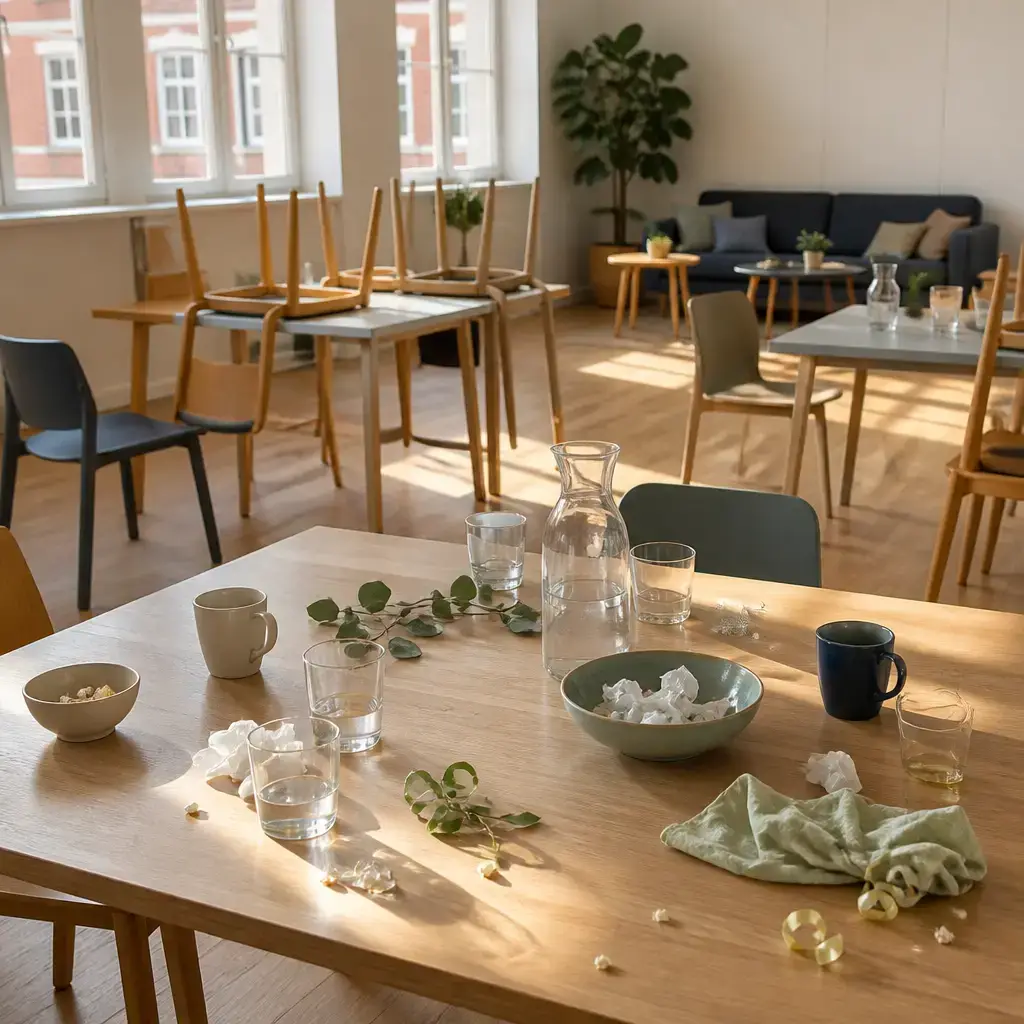
Fællesrummet
“Fællesrummet” means “the common room” here and refers to the specific room where the event took place. The form is used as the subject in “Fællesrummet ser rodet ud”; a definite room noun can be used this way when the room is already known.
ser
“ser” means “looks” here as part of “ser rodet ud”, an expression for how something appears. The reusable pattern is “ser + description + ud”, as in “ser klar ud” in this dialogue.
rodet
“rodet” describes the common room as messy in “Fællesrummet ser rodet ud”. It is used in the pattern “ser rodet ud” to give an appearance assessment.
ud
“ud” completes the appearance expression “ser rodet ud”, giving the meaning “looks messy” rather than simply “sees out”. Use “ser + adjective + ud” when describing how something looks.
efter
“efter” means “after” and places the event before the time being described in “efter arrangementet”. It is commonly placed before a noun or noun phrase to express a later time.
arrangementet
“arrangementet” means “the event” and refers to the specific event that has just ended. In “efter arrangementet”, it follows “efter” to identify what happened earlier.
Vi
“Vi” means “we” in “Vi skal gøre rent”. It is the subject of the sentence, and the same pronoun appears as lowercase “vi” later in “vi har reserveret det”; use it before an action shared by the speaker and others.
skal
“skal” means “need to” in “Vi skal gøre rent”, expressing an obligation connected with cleaning the reserved room. The reusable pattern is “skal + infinitive”, such as “skal gøre”.
gøre
“gøre” contributes the verb “do” in the fixed expression “gøre rent”, which means “clean” in this dialogue. It is the infinitive after “skal”; reuse “gøre rent” when talking about cleaning a place.
rent
“rent” means “clean” in the expression “gøre rent”. Together, “gøre rent” describes the activity of cleaning, and this phrase can be used for cleaning a room or another place.
fordi
“fordi” means “because” and introduces the reason in “fordi vi har reserveret det”. Use “fordi” before a clause that explains why an action is needed.
har
“har” means “have” and works with “reserveret” in “har reserveret” to refer to a reservation that has already been made. The reusable pattern is “har + completed action form + object”, as in “har reserveret det”.
reserveret
“reserveret” means “reserved” in “vi har reserveret det”, referring to the room being booked by the speakers. It follows “har” and can be reused with an object when describing something that has already been reserved.
det
“det” means “it” here and refers back to the common room in “vi har reserveret det”. It is used after the verb as the thing that was reserved; a known room can be referred to this way instead of repeating the noun.
Lad
“Lad” begins the suggestion “Lad os bruge en tjekliste”, meaning “let’s use a checklist”. The reusable pattern is “Lad os + infinitive” when proposing a joint action.
os
“os” means “us” in “Lad os bruge en tjekliste”. Together with “Lad” it forms the suggestion “Lad os ...”, used when inviting the listener to do something together.
bruge
“bruge” means “use” in “bruge en tjekliste”. It is the infinitive after “Lad os” and is followed here by the object “en tjekliste”.
en
“en” means “a” in “en tjekliste”, introducing one checklist that has not been specified more closely. It comes directly before the noun it introduces.
tjekliste
“tjekliste” means “checklist”, the list the speakers will use to guide the cleanup. In “bruge en tjekliste”, it is the object of “bruge”; the same pattern works with a checklist used for another task.
så
“så” means “so that” in “så vi ikke glemmer noget” and introduces the purpose of using the checklist. It is followed here by a clause describing the result the speakers want.
ikke
“ikke” means “not” and negates “glemmer” in “vi ikke glemmer noget”. In this clause it comes before the verb and shows that the speakers want to avoid forgetting anything.
glemmer
“glemmer” means “forget” in “vi ikke glemmer noget”. It is used with “ikke” and the object “noget”; the reusable pattern is “ikke glemmer + thing” when saying that something should not be forgotten.
noget
“noget” means “anything” in the negative clause “vi ikke glemmer noget”. It is the thing that might be forgotten, and “glemme noget” is a common pattern for forgetting something.
Jeg
“Jeg” means “I” in “Jeg kan samle skraldet sammen”. It is the subject of the speaker’s proposed task and is used before an action the speaker can carry out.
kan
“kan” means “can” in “Jeg kan samle skraldet sammen”, expressing ability or an offer to take responsibility for the task. The reusable pattern is “kan + infinitive”, such as “kan samle” or “kan sætte”.
samle
“samle” means “collect” in “samle skraldet sammen”. It is the infinitive after “kan”, and with “sammen” it describes gathering the trash into one collection.
skraldet
“skraldet” means “the trash” and refers to the specific trash left after the event. It is the object in “samle skraldet sammen”, the thing being collected.
sammen
“sammen” means “together” in “samle skraldet sammen”, showing that the trash is gathered into one collection. The reusable expression is “samle + object + sammen” for collecting separate things together.
og
“og” means “and” and links the speaker’s task with the listener’s task in “Jeg kan samle skraldet sammen, og du kan sætte stolene på plads igen”. Use it to connect two related actions or clauses.
du
“du” means “you” and addresses the other person in “du kan sætte stolene på plads igen”. It is the subject of the second task and is commonly followed by a verb describing what the listener can do.
sætte
“sætte” means “put” or “place” in “sætte stolene på plads igen”. It is the infinitive after “kan” and describes returning the chairs to their proper positions.
stolene
“stolene” means “the chairs” and refers to the specific chairs in the common room. It is the object of “sætte” in “sætte stolene på plads igen”.
på
“på” is part of the expression “på plads”, which means “in the proper place” in this dialogue. Together with “sætte”, the pattern “sætte + object + på plads” describes putting something where it belongs.
plads
“plads” means “place” in the expression “på plads”, referring to the proper position of the chairs. It is used with “på”, not as a shortened form of the whole expression.
igen
“igen” means “again” or “back” in “sætte stolene på plads igen”, showing that the chairs are being returned to their previous places. It commonly follows an action that restores an earlier arrangement.
bordene
“bordene” means “the tables” and refers to the specific tables in the room. It is the subject of “Skal bordene stå” and the object being returned to the usual arrangement.
stå
“stå” means “stand” or “be positioned” here, describing where the tables should be in “Skal bordene stå”. It is the infinitive after “Skal” and can describe the position of furniture.
som
“som” means “as” or “the way” in “som de stod før”, comparing the current table arrangement with an earlier one. It introduces the clause that describes how the tables were positioned before.
de
“de” means “they” and refers back to the tables in “som de stod før”. It is the subject of “stod”, used when talking about the position of those tables.
stod
“stod” means “stood” or “were positioned” in “som de stod før”, referring to the tables’ earlier position. It is used with “før” to describe how the arrangement was at an earlier time.
før
“før” means “before” in “som de stod før”, pointing to the earlier arrangement of the tables. It can be placed after a clause to refer to a previous time or state.
Den
“Den” means “the” in “Den næste gruppe”, identifying a particular group that will use the room next. It comes before the adjective and noun in this phrase.
næste
“næste” means “next” in “Den næste gruppe”, identifying the group that comes after the current event. It is placed between “Den” and “gruppe” to describe which group is meant.
gruppe
“gruppe” means “group” in “Den næste gruppe”. It identifies the people expected to use the room after the speakers finish resetting it.
forventer
“forventer” means “expects” in “Den næste gruppe forventer, at ...”. It is followed here by “at” and a clause describing what the group expects.
at
“at” means “that” in “forventer, at rummet er sat op som normalt”. It introduces the content of the group’s expectation, followed by a complete clause.
rummet
“rummet” means “the room” and refers to the specific common room being cleaned and reset. It is the subject of “rummet er sat op som normalt”.
er
“er” means “is” in “rummet er sat op som normalt”, describing the room’s current setup. It connects the room with the condition expressed by “sat op som normalt”.
sat
“sat” contributes the meaning “set” or “arranged” in “rummet er sat op som normalt”. Together with “op”, it describes the room as arranged in the usual way.
op
“op” completes “sat op”, meaning “set up” or “arranged” in “rummet er sat op som normalt”. The reusable expression is “sat op” when describing how a room or space has been arranged.
normalt
“normalt” means “normally” or “as usual” in “sat op som normalt”. It describes the usual arrangement expected by the next group and is also used in the pattern “som normalt”.
vil
“vil” expresses the speaker’s intention in “Jeg vil også tjekke”, meaning “I will also check”. The reusable pattern is “vil + infinitive” for saying what someone intends to do.
også
“også” means “also” in “Jeg vil også tjekke”, adding this check to the other cleanup tasks. It is placed before the infinitive here to add another intended action.
tjekke
“tjekke” means “check” in “Jeg vil også tjekke, om ...”. It is the infinitive after “vil” and is followed by “om” to specify what is being checked.
om
“om” means “whether” in “tjekke, om nogen har efterladt personlige ting”. It introduces an indirect question about whether something happened; the reusable pattern is “tjekke, om + clause”.
nogen
“nogen” means “anyone” in “om nogen har efterladt personlige ting”. It refers to an unspecified person who may have left something behind and is used here as the subject of the clause.
efterladt
“efterladt” means “left behind” in “har efterladt personlige ting”. It describes personal items that someone has left in the room, and the reusable pattern is “har efterladt + object”.
personlige
“personlige” means “personal” in “personlige ting”, describing items belonging to individual people rather than the room. It comes directly before the noun “ting”.
ting
“ting” means “items” or “things” in “personlige ting”. It is the object of “har efterladt”, referring to belongings that someone may have forgotten.
Opladere
“Opladere” means “chargers” and is one of the types of personal items that are easy to forget. It is a plural subject in “Opladere og notesbøger er nemme at glemme”.
notesbøger
“notesbøger” means “notebooks” and is paired with “Opladere” as another easily forgotten item. It is part of the plural subject before “er nemme at glemme”.
nemme
“nemme” means “easy” in “er nemme at glemme”, describing chargers and notebooks as easy to forget. The reusable pattern is “er nemme at + infinitive” for something that requires little effort or is easily done.
glemme
“glemme” means “forget” in “nemme at glemme”. It is the infinitive after “at” and completes the pattern describing items that are easy to forget.
klart
“klart” means “ready” in “Rummet ser klart ud nu”, describing the room as ready for use after cleaning and resetting. It is used with “ser ... ud” to give an appearance assessment.
nu
“nu” means “now” in “Rummet ser klart ud nu”, marking the time at which the room looks ready. It can be placed at the end of a sentence to emphasize the current state.
bør
“bør” means “should” or “ought to” in “Det bør være nemmere”, expressing an expected or desirable result. The reusable pattern is “bør + infinitive”, as in “bør være”.
være
“være” means “be” in “bør være nemmere”. It is the infinitive after “bør” and links the situation to the description “nemmere”.
nemmere
“nemmere” means “easier” in “være nemmere at reservere”, comparing the effort needed to book the room after it has been left clean. The reusable pattern is “være nemmere at + infinitive”.
reservere
“reservere” means “book” or “reserve” in “at reservere rummet igen”. It is the infinitive after “at” and takes “rummet” as its object when referring to booking the room.
når
“når” means “when” in “når vi efterlader det rent”, introducing the time or condition connected with leaving the room clean. It is followed here by a clause with its own subject and verb.
efterlader
“efterlader” means “leave” in “når vi efterlader det rent”, describing the state in which the speakers leave the room. The pattern “efterlader + object + description”, as in “efterlader det rent”, shows what condition the object is left in.