Alle
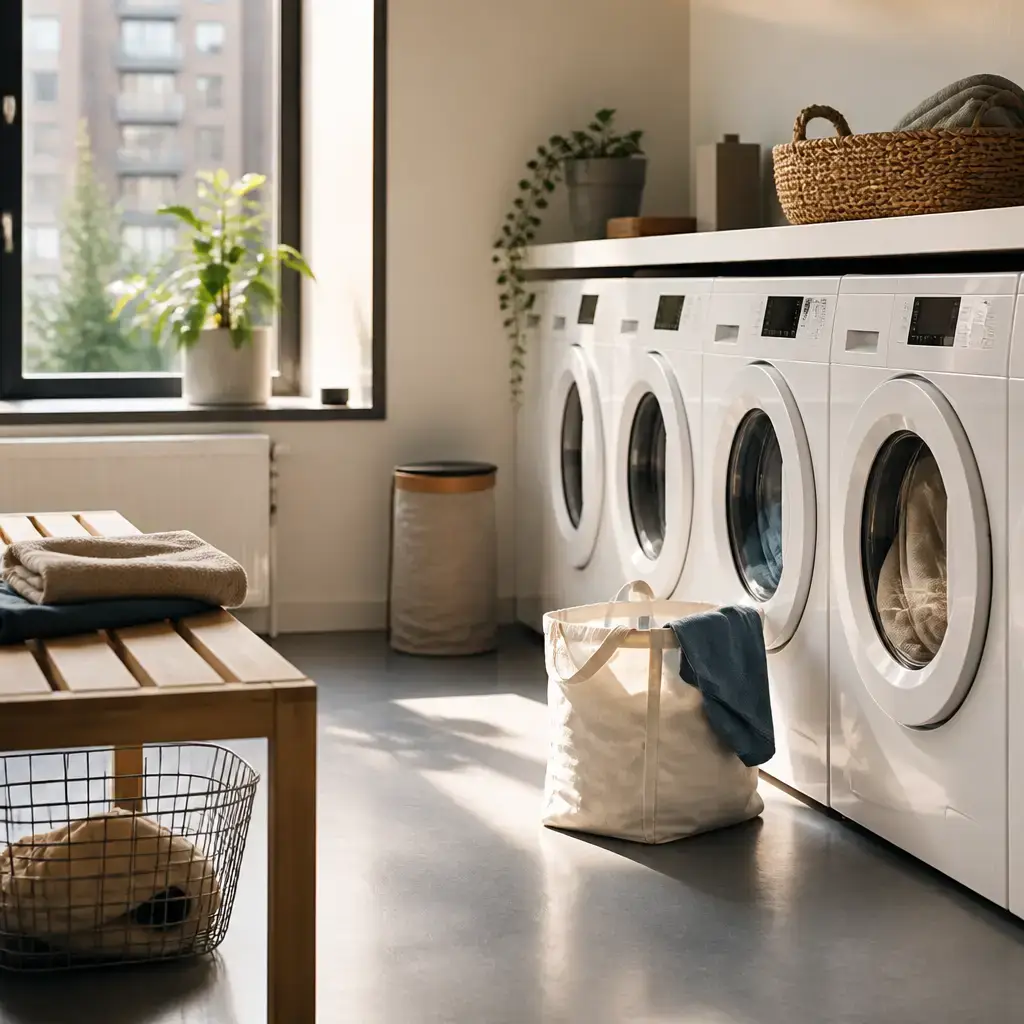
“Alle” means all in “Alle vaskemaskinerne er optaget igen.” It is used before the plural noun to include every washing machine. A reusable pattern is alle + a plural noun when referring to the whole group.
vaskemaskinerne
“Vaskemaskinerne” means the washing machines in this dialogue. Its citation form is vaskemaskine; this exact form refers to the machines as a definite plural group. It is useful when talking about the machines in a shared laundry room.
er
“Er” means are in “Alle vaskemaskinerne er optaget igen.” It is the present form of være and links the washing machines to their current state. A reusable pattern is er + a description of a current state.
optaget
“Optaget” means occupied or in use here, describing machines that cannot currently be used. It follows er in “er optaget.” A reusable pattern is to use this form after er when saying that something is occupied.
igen
“Igen” means again and shows that the machines are full once more. It adds repetition to the statement “Alle vaskemaskinerne er optaget igen.” Use it when a situation has happened another time.
Tjek
“Tjek” means check and is a direct instruction in “Tjek planen.” It asks someone to look at information carefully. A reusable pattern is Tjek + the thing that should be checked.
planen
“Planen” means the schedule or plan in “Tjek planen.” Its citation form is plan; this exact form refers to a specific plan. It is useful for directing someone to consult an agreed schedule.
og
“Og” means and and connects the two instructions “Tjek planen og se.” It joins actions that should be carried out together. Use it to connect two related actions or pieces of information.
se
“Se” means see or check in “se, hvornår den næste vask er færdig.” Here it introduces the information the person should find out. A reusable pattern is se + an indirect question or piece of information.
hvornår
“Hvornår” means when in the indirect question “hvornår den næste vask er færdig.” It asks about the time at which something happens. Use it before a clause when checking when an event will occur.
den
“Den” means the in “den næste vask” and points to a specific washing load. It helps identify which load is meant. A reusable pattern is den + a description of one specific common-gender noun.
næste
“Næste” means next in “den næste vask.” It identifies the load that comes after the current one. Use it before a noun when referring to the next item or event in an order.
vask
“Vask” means a wash or laundry load in “den næste vask” and “min vask.” In this setting it refers to one washing cycle and its laundry. A reusable pattern is a possessive or determiner before vask when identifying whose load it is.
færdig
“Færdig” means finished or done in “er færdig” and “være færdig.” It describes the washing load or machine as having completed its cycle. A reusable pattern is være færdig when saying that an activity or process is complete.
En
“En” means one in “En af maskinerne.” It identifies one machine from the larger group. A reusable pattern is en af + a plural noun when selecting one item from a group.
af
“Af” means of in “En af maskinerne,” showing that one machine belongs to the larger set. Together with en, it expresses one item from a group. Use it in the pattern en af + a plural noun.
maskinerne
“Maskinerne” means the machines in “En af maskinerne.” Its citation form is maskine; this exact form is a definite plural referring to the machines already relevant in the room. It is useful when distinguishing the machines as a group.
burde
“Burde” means should or ought to in “burde snart være færdig.” Here it expresses an expectation that the machine will be finished soon. A reusable pattern is burde + an infinitive when stating what is expected or advisable.
snart
“Snart” means soon in “burde snart være færdig.” It places the expected completion in the near future. Use it when an event is expected to happen in a short time.
være
“Være” means be in “burde snart være færdig.” It is the infinitive used after burde and connects the subject with the state of being finished. A reusable pattern is a modal verb followed by være + a description.
men
“Men” means but and introduces a contrast between the expected finished machine and the absent person. It connects the two parts of “burde snart være færdig, men den person...” Use it when the second statement differs from or limits the first.
person
“Person” means person in “den person, der satte den i gang.” It identifies the individual responsible for starting the machine. A reusable pattern is den person, der + a clause describing what that person did.
der
“Der” means who or that in the relative clause “der satte den i gang.” It links person with the information about which person is meant. Use it after a noun to introduce a clause describing that noun.
satte
“Satte” means started in “satte den i gang.” It is the past form related to sætte and describes the person starting the machine. The reusable construction is sætte something i gang, meaning to start it or put it into operation.
i
“I” means into or in as part of the expression “satte den i gang.” Its meaning here comes from the whole expression, which describes starting the machine. Keep it together with gang when reusing this construction.
gang
“Gang” contributes the idea of operation or running in “satte den i gang.” The full expression means that the person started the machine. A reusable pattern is sætte something i gang when putting a process into operation.
her
“Her” means here in “er her ikke.” It identifies the place where the person is absent. Use it to refer to the speaker’s or listener’s current location.
ikke
“Ikke” means not in “er her ikke.” It negates the statement that the person is here. A reusable pattern is placing ikke with the clause whose meaning should be denied.
Giv
“Giv” means give and is a direct instruction in “Giv personen et par minutter.” It asks someone to allow the person a short amount of time. A reusable pattern is Giv + a person + an amount of time or another thing.
personen
“Personen” means the person in “Giv personen et par minutter.” Its citation form is person; this exact form refers to a specific person already under discussion. It is useful when giving someone time or something.
et
“Et” means a or one in the fixed quantity expression “et par minutter.” It helps form the meaning a couple or a few with par. Use it as part of et par + a plural noun for a small quantity.
par
“Par” means a couple or few in “et par minutter.” Together, et par indicates a small number of minutes rather than an exact long period. A reusable pattern is et par + a plural countable noun.
minutter
“Minutter” means minutes in “et par minutter.” It names the time period that should be allowed before moving the laundry. Use it after a quantity expression when specifying a duration in minutes.
før
“Før” means before in “før du flytter deres vasketøj.” It places the moving action after the waiting or allowed time. A reusable pattern is før + a clause describing the later action.
du
“Du” means you and is the subject of “du flytter deres vasketøj.” It addresses the person who may move the laundry. Use it when speaking directly to one person.
flytter
“Flytter” means move in “før du flytter deres vasketøj.” Its citation form is flytte; this exact form describes moving the laundry from its current place. A reusable pattern is flytte + the object that is being moved.
deres
“Deres” means their in “deres vasketøj.” It shows that the laundry belongs to the person being discussed. Use it directly before the noun that identifies what belongs to them.
vasketøj
“Vasketøj” means laundry in “deres vasketøj.” It refers to the clothes being washed rather than to the machine itself. A reusable pattern is a possessive or other determiner before vasketøj when identifying whose laundry it is.
Hvor
“Hvor” contributes how in the question “Hvor længe er det rimeligt at vente?” Together with længe, it asks about duration. Use the construction Hvor længe when asking how long something should continue.
længe
“Længe” means long in the duration question “Hvor længe...” It describes the length of the waiting period rather than a physical length. Use it with Hvor to ask about the duration of an action or situation.
det
“Det” is the it in “det rimeligt at vente,” within the expression “det er rimeligt at vente.” It provides the subject for the evaluation that follows. A reusable pattern is det er + an adjective + at + an action.
rimeligt
“Rimeligt” means fair or reasonable in “det er rimeligt at vente.” It evaluates the suggested waiting period as acceptable. Use it to judge whether an action or amount is reasonable.
at
“At” marks the infinitive in “at vente.” It connects the evaluation rimeligt with the action of waiting. A reusable pattern is an adjective followed by at + an infinitive when evaluating an action.
vente
“Vente” means wait in “at vente.” It names the action whose reasonable duration is being discussed. Use it after at or another construction that introduces an infinitive.
jeg
“Jeg” means I and identifies the speaker in “før jeg flytter det” and “Jeg sætter en påmindelse.” It marks the speaker as the person taking or planning the action. Use it as the subject when talking about your own action.
kort
“Kort” means short in “En kort ekstra ventetid.” It describes the waiting period as brief. A reusable pattern is kort + a noun describing a limited duration or size.
ekstra
“Ekstra” means extra in “En kort ekstra ventetid.” It says that the waiting time is additional to the normal cycle time. Use it before a noun when referring to an added amount, period, or item.
ventetid
“Ventetid” means waiting time or grace period in “En kort ekstra ventetid.” It names the period people allow before taking the machine or moving the laundry. Use it when discussing how long someone must wait.
nok
“Nok” means enough in “er nok, hvis andre venter.” It says that the short extra waiting period is sufficient under that condition. A reusable pattern is er nok when stating that an amount or action is sufficient.
hvis
“Hvis” means if and introduces the condition “hvis andre venter.” It explains when the short grace period is considered enough. Use it before a clause that gives a condition for another statement.
andre
“Andre” means other people or others in “hvis andre venter.” It refers to people besides the person whose laundry is already in the machine. Use it when contrasting one group with other people or things.
venter
“Venter” means wait or are waiting in “hvis andre venter.” Its citation form is vente; this exact form describes other people waiting for a machine. Use it after the subject when describing an ongoing or relevant wait.
sætter
“Sætter” means set in “Jeg sætter en påmindelse.” Its citation form is sætte; here it describes setting a reminder. A reusable pattern is sætte + an object when arranging or placing something for later use.
påmindelse
“Påmindelse” means reminder in “Jeg sætter en påmindelse.” It is something that helps the speaker remember to return on time. Use it when discussing alerts or other aids for remembering an action.
så
“Så” has two related functions in this dialogue: “så jeg kommer tilbage” introduces the intended result, while “Så er det lettere” means then or in that way. It connects an action with its consequence or explains what follows. A reusable pattern is så + a clause describing the result or next step.
kommer
“Kommer” means come in “så jeg kommer tilbage.” Its citation form is komme; with tilbage, it describes returning to the laundry room. A reusable pattern is a subject + kommer tilbage when someone returns.
tilbage
“Tilbage” means back or returning in “kommer tilbage.” It adds the idea of movement to the previous place. Use it with a movement verb when describing a return.
min
“Min” means my in “min vask.” It identifies the washing load as belonging to the speaker. Use it directly before a noun when referring to something belonging to oneself.
lettere
“Lettere” means easier in “Så er det lettere at bede alle andre...” It compares the situation with one in which asking everyone else would be more difficult. It is the comparative form related to let. A reusable pattern is det er lettere at + an action.
bede
“Bede” means ask or request in “bede alle andre om at gøre det samme.” It is part of the construction for asking someone to do something. A reusable pattern is bede + a person + om at + an action, with the object and action kept in place.
om
“Om” is part of the request construction “bede alle andre om at gøre det samme.” It links the people being asked with the requested action. A reusable pattern is bede someone om at + an action.
gøre
“Gøre” means do in “om at gøre det samme.” It names the action that everyone else is being asked to carry out. A reusable pattern is gøre det samme when referring back to an action already mentioned.
samme
“Samme” means same in “gøre det samme.” It refers back to the same responsible behavior, namely returning for one’s laundry. Use it when an action or thing should match something already mentioned.
kan
“Kan” means can in “Jeg kan ikke klage.” It expresses ability or possibility and is followed by the infinitive klage. A reusable pattern is kan + an infinitive, with ikke added when the ability or possibility is denied.
klage
“Klage” means complain in “kan ikke klage over efterladt vasketøj.” It names the complaint the speaker says would be inconsistent. A reusable pattern is klage over + the thing being complained about.
over
“Over” means about in the construction “klage over efterladt vasketøj.” It introduces the subject of the complaint. Use it after klage when identifying what the complaint concerns.
efterladt
“Efterladt” means abandoned or left behind in “efterladt vasketøj.” It describes laundry that someone has left in the shared space. Use it before a noun when describing something that has been left behind.
også
“Også” means also or too in “jeg også lader mit blive liggende der.” It adds that the speaker would do the same thing as the people being criticized. It can be placed before the verb phrase to add another person or action to the statement.
lader
“Lader” means leave or let in “lader mit blive liggende der.” Its citation form is lade; here it introduces the speaker allowing the laundry to remain in place. A reusable pattern is lade + an object + blive + a description of its continuing state.
mit
“Mit” means my or mine in “lader mit blive liggende der.” It stands for the speaker’s own laundry, avoiding a repeated noun. Use it when referring back to something belonging to the speaker.
blive
“Blive” means remain or become in “blive liggende der.” After lader, it describes the laundry continuing in its position. A reusable pattern is lade something blive + a state or position.
liggende
“Liggende” means lying or left lying in “blive liggende der.” Together with blive, it describes the laundry remaining where it is. Use this construction when an object continues to be left in a lying position.
Fællesvaskeriet
“Fællesvaskeriet” means the shared laundry room or facility in “Fællesvaskeriet fungerer bedre.” Its citation form is fællesvaskeri; this exact form refers to the specific shared facility. It is useful as the subject when describing how the shared laundry system operates.
fungerer
“Fungerer” means works or functions in “Fællesvaskeriet fungerer bedre.” Its citation form is fungere; it describes how well the shared laundry facility operates. A reusable pattern is a place, system, or arrangement + fungerer + a description of how it works.
bedre
“Bedre” means better or more smoothly in “fungerer bedre.” It compares the operation of the shared laundry system with a less effective situation. It is the comparative form related to god. Use it after a verb such as fungerer when describing improved operation.
når
“Når” means when in “når folk holder øje med vasketiderne.” It introduces the situation in which the laundry facility works better. Use it before a clause describing a repeated or relevant time or condition.
folk
“Folk” means people in “når folk holder øje med vasketiderne.” It refers generally to the users of the shared laundry room. Use it as a subject when speaking about people as a group without naming them individually.
holder øje med
“Holder øje med” means keep an eye on or monitor in “holder øje med vasketiderne.” The whole expression means paying attention to something over time: holder contributes keeps, øje means eye, and med links the attention to what is monitored. A reusable pattern is holder øje med + the thing being monitored.
vasketiderne
“Vasketiderne” means the laundry cycle times in “holder øje med vasketiderne.” Its citation form is vasketid; this exact form is a definite plural referring to the relevant cycle times. It is useful when people need to monitor how long laundry cycles take.