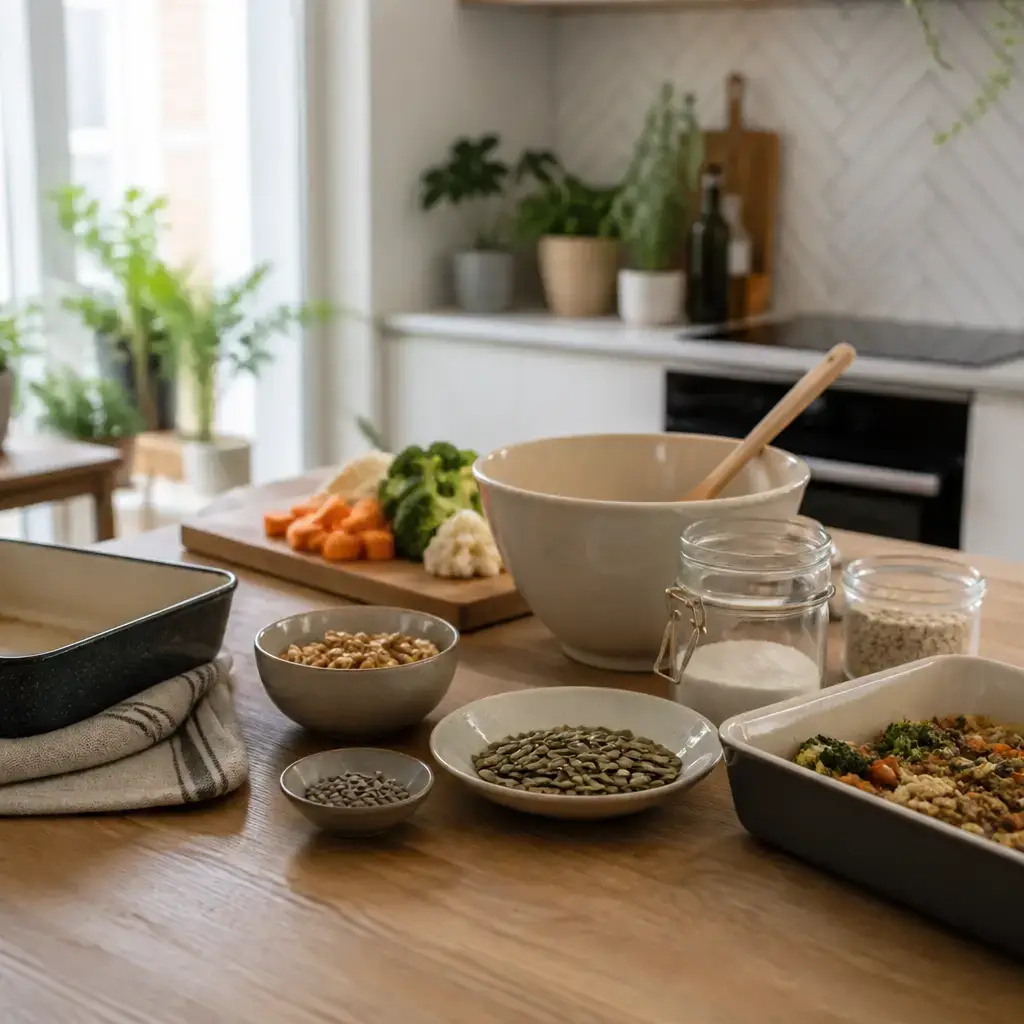
Før
“Før” means “before” here and introduces the time condition “Før vi begynder at lave mad”. It is reused before a clause to say that one action happens earlier than another. In a new example: Før du går, sluk lyset means “Before you leave, turn off the light.”
vi
“vi” means “we” and is the subject of “Før vi begynder”. It refers to the speaker and at least one other person. Use “vi” before the verb when talking about what we do together.
begynder
“begynder” means “begin” or “start” in “vi begynder at lave mad”. It is the present form used with “vi” here. A useful pattern is “begynder at” followed by an action, such as “begynder at arbejde” in a new example.
at
“at” marks the infinitive in “at lave mad”, so the phrase means “to cook”. It comes directly before the verb form that names the action. A common pattern is “at” plus an action verb, as in “at spise” in a new example.
lave
“lave” means “make” or, in “lave mad”, “cook”. It appears after the infinitive marker “at”. The reusable expression “lave mad” is used when talking about preparing food.
mad
“mad” means “food” in the expression “lave mad”, which means “cook”. The word is part of that common expression rather than naming a particular dish here. Use “mad” when referring generally to food.
lad
“lad” contributes the suggestion “let’s” in the expression “lad os tjekke”. Together with “os”, it invites the other person to do the action with the speaker. A useful pattern is “lad os” followed by an infinitive verb.
os
“os” means “us” in “lad os tjekke”, referring to the speaker and the other person together. It completes the suggestion expression “lad os”. Use “lad os” before an action you want to propose doing together.
tjekke
“tjekke” means “check” in “lad os tjekke ingredienserne”. It is the action proposed after “lad os”. A useful pattern is “tjekke” followed by the thing being checked, such as “tjekke datoen” in a new example.
ingredienserne
“ingredienserne” means “the ingredients” in “tjekke ingredienserne”. The ending “-ne” marks the specific ingredients being discussed. Use it when the ingredients are already identified in the situation.
og
“og” means “and” and links “ingredienserne” with “eventuelle erstatninger”. It joins items or actions that belong together. Use “og” to add another related item or idea.
eventuelle
“eventuelle” means “any” or “possible” in “eventuelle erstatninger”. It describes substitutions that may be needed, without saying that they are definitely needed. It is placed before the noun it describes.
erstatninger
“erstatninger” means “substitutions” in “eventuelle erstatninger”. It refers to alternative ingredients that can replace another ingredient. A useful pattern is “en erstatning for” something in a new example.
Opskriften
“Opskriften” means “the recipe” in “Opskriften kræver valnødder”. The ending “-en” marks this as the specific recipe being discussed. Use it when referring to a recipe already known in the conversation.
kræver
“kræver” means “requires” or “calls for” in “Opskriften kræver valnødder”. It says that the recipe lists walnuts as an ingredient. A useful pattern is “noget kræver” followed by what is needed.
valnødder
“valnødder” means “walnuts” in “kræver valnødder”. Here it names the ingredient required by the recipe. Use it when identifying walnuts as an ingredient or food.
en
“en” means “a” or “one” in “en gæst”. It introduces one unspecified guest. It is placed directly before the noun it determines.
gæst
“gæst” means “guest” in “en gæst har nøddeallergi”. It refers to a person attending the meal. Use “en gæst” when introducing a guest who has not been identified more specifically.
har
“har” means “has” in “en gæst har nøddeallergi”. It states that the guest has or experiences the allergy. A useful pattern is “har” followed by a condition or possession.
nøddeallergi
“nøddeallergi” means “nut allergy” in “har nøddeallergi”. It names the guest’s allergy and explains why walnuts must be avoided. Use it when informing someone about an allergy to nuts.
Så
“Så” means “then” in “Så bør vi helt udelade valnødderne”. It connects the allergy information with the resulting recommendation. Use “så” to introduce a conclusion or next step based on what was just said.
bør
“bør” means “should” in “bør vi helt udelade valnødderne”. It expresses a recommendation that follows from the allergy risk. It is followed by the action that is recommended.
helt
“helt” means “completely” in “helt udelade valnødderne”. It strengthens the instruction by saying that the walnuts should be omitted in full. It is placed before the action it modifies here.
udelade
“udelade” means “leave out” or “omit” in “udelade valnødderne”. It is the action recommended for avoiding the walnuts. A useful pattern is “udelade” followed by the ingredient or item being left out.
valnødderne
“valnødderne” means “the walnuts” in “udelade valnødderne”. The ending “-ne” refers to the specific walnuts required by the recipe. Use this form when the walnuts have already been identified.
Ristede
“Ristede” means “toasted” in “Ristede frø”. It describes the seeds as having been toasted before they are used. It appears directly before the food it describes.
frø
“frø” means “seeds” in “Ristede frø”. Here the seeds are proposed as an ingredient that can add crunch. A useful pattern is “bruge frø” when talking about using seeds in food.
vil
“vil” expresses the expected result in “vil stadig give retten lidt knas”, meaning that the seeds would still give the dish some crunch. It is followed by the action “give”. Use “vil” when describing an expected effect or result.
stadig
“stadig” means “still” in “vil stadig give”. It shows that the seeds will provide the benefit even after the walnuts are replaced. It is placed near the verb or verb phrase whose result continues.
give
“give” means “give” in “give retten lidt knas”. It describes the effect the toasted seeds have on the dish. A useful pattern is “give” followed by the recipient and the result, as in “give retten smag” in a new example.
retten
“retten” means “the dish” in “give retten lidt knas”. The ending “-en” refers to the specific dish being prepared. Use it when discussing that particular dish rather than food in general.
lidt
“lidt” means “some” or “a little” in “lidt knas”. It indicates a small amount of crunch. It is placed before the quality or substance being added here.
knas
“knas” means “crunch” in “give retten lidt knas”. It describes the crisp texture that the seeds add to the dish. Use it when talking about a crunchy texture in food.
bruge
“bruge” means “use” in “Lad os bruge frø i stedet”. It names the proposed action of using seeds as the replacement ingredient. A useful pattern is “bruge” followed by the ingredient or object being used.
i
“i” contributes to the expression “i stedet”, meaning “instead”. It is not expressing a physical location here. Use “i stedet” to say that one choice replaces another.
stedet
“stedet” completes “i stedet”, which means “instead” in “bruge frø i stedet”. The full expression shows that seeds replace walnuts. A useful pattern is “bruge X i stedet” when choosing one thing as a replacement.
holde
“holde” means “keep” in “holde notatet om allergien synligt”. It describes maintaining the note in a visible state while cooking. A useful pattern is “holde” followed by an object and a describing word.
notatet
“notatet” means “the note” in “notatet om allergien”. The ending “-et” marks the specific note being kept visible. Use it when referring to a note already identified in the situation.
om
“om” means “about” or “concerning” in “notatet om allergien”. It links the note to its subject, the allergy. A useful pattern is “et notat om” followed by the topic of the note.
allergien
“allergien” means “the allergy” in “notatet om allergien”. The ending “-en” refers to the particular allergy already discussed. Use it when the allergy is known from the context.
synligt
“synligt” means “visible” in “holde notatet om allergien synligt”. It describes the note as remaining easy to see. It follows the object in the pattern “holde noget synligt”.
mens
“mens” means “while” in “mens vi laver mad”. It introduces an action happening during the same period as cooking. Use “mens” before a clause describing what is happening at that time.
laver
“laver” means “make” or “cook” in “vi laver mad”. Together with “mad”, it means “we cook”. The expression “lave mad” is a common way to talk about preparing food.
Da
“Da” means “since” or “as” in “Da det er en ret, der skal bages”. It introduces the reason for following the measurements closely. Use “da” before a reason that explains the recommendation that follows.
det
“det” means “it” in “det er en ret”. It refers to the dish being discussed. Use “det er” to identify or describe something in this kind of statement.
er
“er” means “is” in “det er en ret”. It links the subject with its description or identity. A useful pattern is “det er” followed by a noun or description.
ret
“ret” means “dish” in “en ret, der skal bages”. It refers to the food being prepared. Use “en ret” when naming a dish in general.
der
“der” introduces the describing clause “der skal bages”, which specifies what happens to the dish. Here it links “en ret” with the information that it is to be baked. Use “der” to begin a relative clause describing a noun.
skal
“skal” expresses that the dish is to be baked in “der skal bages”. It presents baking as the required or planned treatment of the dish. It is followed here by the passive form “bages”.
bages
“bages” means “be baked” in “der skal bages”. It describes the dish as receiving the baking action rather than naming who performs it. Use this form when the focus is on what is baked.
følge
“følge” means “follow” in “følge målene nøje”. It describes following the measurements given for the recipe. A useful pattern is “følge” followed by instructions, measurements, or a plan.
målene
“målene” means “the measurements” in “følge målene nøje”. The ending “-ene” marks the specific measurements from the recipe. Use it when referring to measurements already established for the dish.
nøje
“nøje” means “closely” or “carefully” in “følge målene nøje”. It emphasizes that the measurements should be followed with precision. It is placed after the action phrase here.
nok
“nok” means “enough” in “Har vi nok mælk”. It asks whether the available amount of milk is sufficient. A useful pattern is “have nok” followed by the needed item.
mælk
“mælk” means “milk” in “nok mælk”. It names the ingredient whose quantity is being checked. Use it when talking about milk as an ingredient or drink.
eller
“eller” means “or” and links the two alternatives “Har vi nok mælk” and “skal jeg købe mere”. It introduces another possibility in the question. Use “eller” to connect alternatives.
jeg
“jeg” means “I” in “skal jeg købe mere”. It identifies the speaker as the person who may buy more milk. Place it before the verb when stating what the speaker will or should do.
købe
“købe” means “buy” in “skal jeg købe mere”. It names the possible action the speaker may take to get more milk. A useful pattern is “købe” followed by the item being purchased.
mere
“mere” means “more” in “købe mere”. It refers here to more milk without repeating “mælk”. Use “mere” after a verb when the quantity should be increased or replenished.
men
“men” means “but” in “Vi har nok, men tjek datoen”. It contrasts having enough milk with the additional need to check its date. Use “men” to connect two ideas that differ or add a limitation.
tjek
“tjek” means “check” in the instruction “tjek datoen”. It tells the listener to inspect the date. A useful pattern is “tjek” followed directly by the thing to inspect.
datoen
“datoen” means “the date” in “tjek datoen”. The ending “-en” refers to the specific date printed on the milk. Use it when asking someone to inspect an identified date.
du
“du” means “you” in “før du bruger den”. It identifies the person who will use the milk. It appears before the verb in this clause.
bruger
“bruger” means “use” in “før du bruger den”. It describes what the listener does with the milk. A useful pattern is “bruge” or its inflected form followed by the object being used.
den
“den” means “it” in “bruger den” and refers back to the milk. It avoids repeating the noun. Use it when referring to the specific item already mentioned.
ser
“ser” means “look” or “appear” in “Ingredienserne ser sikre ud”. Together with “ud”, it describes how the ingredients appear. A useful pattern is “se ... ud” followed by a description.
sikre
“sikre” means “safe” in “ser sikre ud”. It describes the ingredients as appearing safe. It is used with “ser ... ud” to express an appearance or assessment.
ud
“ud” completes “ser sikre ud”, meaning “look safe” or “appear safe”. It is part of the expression “se ... ud”, not a separate direction here. Use “se ... ud” before or around a description of appearance.
klare
“klare” means “ready” in “er klare til brug”. It describes the ingredients as ready to be used. A useful pattern is “klar til” or, here, “klare til” followed by the intended use.
til
“til” means “for” or “to” in “klare til brug”. It links the state of being ready with the intended use. A useful pattern is “klar til” followed by an activity or purpose.
brug
“brug” means “use” in “til brug”. The expression “til brug” means “for use” or “ready to be used”. Use it after “til” when referring to an intended use.
nu
“nu” means “now” in “klare til brug nu”. It says that the ingredients are ready at the present time. Place it at the end of a statement to specify when the situation applies.
Dette
“Dette” means “this” in “Dette tjek”. It points to the check that has just been carried out. Use it before a neuter noun when referring to a specific nearby thing or action.
hjælpe
“hjælpe” means “help” in “bør hjælpe os med”. It describes the expected benefit of the check. A useful pattern is “hjælpe nogen med at” followed by an action.
med
“med” is part of the construction “hjælpe os med at undgå”. It introduces the activity that the check helps the speakers perform. Use “hjælpe nogen med at” before an infinitive action.
undgå
“undgå” means “avoid” in “undgå allergirisici”. It names the action of staying away from allergy risks. A useful pattern is “undgå” followed by the danger, problem, or item to be avoided.
allergirisici
“allergirisici” means “allergy risks” in “undgå allergirisici”. It refers to risks connected with allergies during food preparation. Use it when discussing possible allergy-related dangers.
få
“få” means “make” in “få retten til at smage rigtigt”. It expresses causing the dish to have the desired taste. A useful pattern is “få noget til at” followed by an action or result.
smage
“smage” means “taste” in “få retten til at smage rigtigt”. It describes how the dish tastes. It appears after “til at” in the construction that says what the dish is made to do.
rigtigt
“rigtigt” means “right” or “correctly” in “smage rigtigt”. It says that the dish should have the proper or expected taste. It describes the result of the dish tasting in this expression.