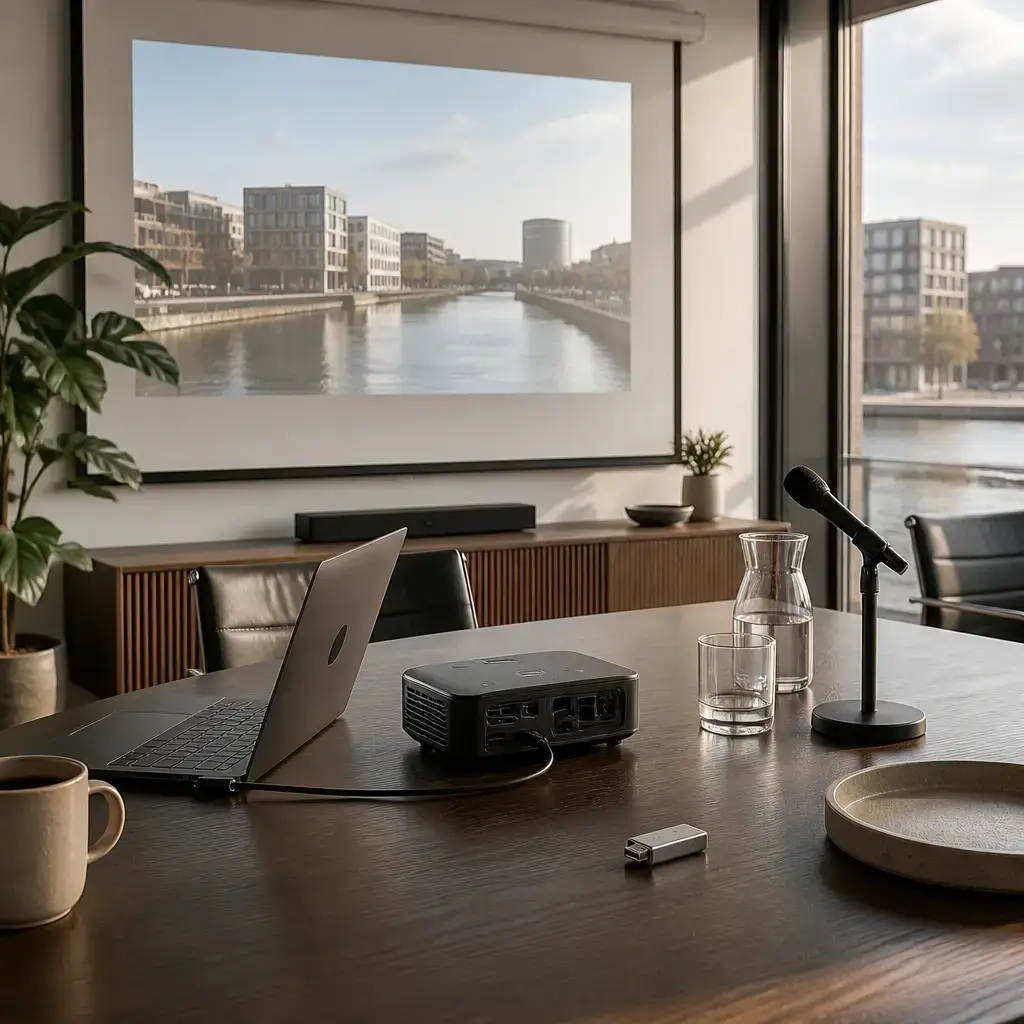
Vi
“Vi” means “we” in “Vi bør tjekke præsentationsudstyret”. It refers to the speaker and at least one other person. Use it as the subject when describing a shared action or plan.
bør
“bør” expresses that something is advisable or should be done, here in “Vi bør tjekke præsentationsudstyret”. It is followed by the action form “tjekke”. Use “bør” to recommend a responsible action.
tjekke
“tjekke” means to check or inspect in “bør tjekke præsentationsudstyret”. It names the action to be done after “bør”. A useful pattern is “tjekke” followed by the thing being inspected.
præsentationsudstyret
“præsentationsudstyret” means the presentation equipment in “tjekke præsentationsudstyret”. The form refers to the equipment needed for the presentation as a whole. Use it when discussing checking or preparing presentation equipment.
før
“før” means before and introduces the later event in “før kunderne kommer”. It connects the equipment check with the clients’ arrival. Use “før” before an event or clause that must happen later.
kunderne
“kunderne” means the clients in “før kunderne kommer”. The form refers to the specific clients expected at the meeting. Use it when talking about customers or clients already known in the situation.
kommer
“kommer” means come or arrive in “kunderne kommer”. Here it describes the clients arriving at the meeting. Use it after a subject to say that someone is coming to a place or event.
Jeg
“Jeg” means “I” in “Jeg kan tilslutte den bærbare computer”. It identifies the speaker as the person who can perform the action. Use it as the subject when describing your own action or ability.
kan
“kan” means can in “Jeg kan tilslutte den bærbare computer” and “Kan du også tjekke mikrofonens lydstyrke?”. It expresses ability in the first sentence and helps form a polite request in the question. Use “kan” before the action form of a verb.
tilslutte
“tilslutte” means connect in “tilslutte den bærbare computer til projektoren”. The pattern places the device being connected before “til” and the receiving device after it. Use this pattern when connecting one piece of equipment to another.
den
“den” means “the” in “den bærbare computer” and “Den første slide”. It points to a specific item already understood in the situation. Use it before a specific noun phrase such as a laptop or slide.
bærbare
“bærbare” identifies the computer as portable in “den bærbare computer”, which here means the laptop. It appears directly before “computer” to specify which computer is meant. Use this expression when distinguishing a laptop from another computer.
computer
“computer” means computer in “den bærbare computer”. Here it is the device connected to the projector. Use it with a describing word when you need to identify a particular computer.
til
In “tilslutte den bærbare computer til projektoren”, “til” marks the device to which the laptop is connected. In “ser ud til at være klar”, it is part of the expression meaning seems to. Use it according to the construction it belongs to.
projektoren
“projektoren” means the projector in “tilslutte den bærbare computer til projektoren”. It is the specific device receiving the laptop connection. Use it when discussing the projector used to display the presentation.
først
“først” means first in “til projektoren først”. It marks this connection as the first action in the sequence. Use it to indicate what should happen before other actions.
Billedet
“Billedet” means the image in “Billedet vises”. It refers to the image appearing from the projector. Use it when describing what is visible on a screen or projected surface.
vises
“vises” means is displayed or appears in “Billedet vises”. It describes the image being shown on the display. Use it when reporting whether something is appearing on a screen.
men
“men” means but and introduces the problem in “men det ser lidt strukket ud”. It contrasts the image being displayed with its imperfect appearance. Use it to connect two contrasting observations.
det
“det” means “it” in “det ser lidt strukket ud” and “Det lyder klart”. It refers to the image or sound being discussed. Use it as the subject when commenting on how something looks or sounds.
ser
“ser” means looks in “det ser lidt strukket ud” and helps form “ser ud til at være klar”. It describes appearance in the first expression and an impression or seeming in the second. Use “ser” with a description of how something appears.
lidt
“lidt” means a little in “ser lidt strukket ud”. It reduces the degree of the problem, so the image is only somewhat stretched. Use it before a description when you want to soften its degree.
strukket
“strukket” means stretched in “ser lidt strukket ud”. It describes the image’s distorted appearance. Use it when an image or display looks extended in the wrong proportions.
ud
In “ser lidt strukket ud” and “ser ud til at være klar”, “ud” is part of an expression rather than a separate direction word. Together with the surrounding words, it helps describe appearance or seeming. Learn it as part of the complete expression in each sentence.
justere
“justere” means adjust in “justere skærmindstillingerne”. It names the action of changing settings to improve the display. Use it before the setting or control that you want to change.
skærmindstillingerne
“skærmindstillingerne” means the display settings in “justere skærmindstillingerne”. It refers to the settings used to control how the screen or image appears. Use it when correcting a display problem.
og
“og” means and in “justere skærmindstillingerne og teste slidesene igen”. It joins two actions that the speaker can perform. Use it to connect related actions or items.
teste
“teste” means test in “teste slidesene igen”. It describes checking the slides after adjusting the settings. Use it before the thing being tested.
slidesene
“slidesene” means the slides in “teste slidesene igen”. It refers to the specific presentation slides being tested. Use it when discussing the visual pages of a presentation.
igen
“igen” means again in “teste slidesene igen”. It shows that the slides have already been tested and will be tested one more time. Use it after an action that is being repeated.
du
“du” means “you” in “Kan du også tjekke mikrofonens lydstyrke?”. It identifies the person being asked to perform the check. Use it when speaking directly to one person.
også
“også” means also in “Kan du også tjekke mikrofonens lydstyrke?”. It adds the microphone check to the tasks already being done. Use it to add another action or item to a request.
mikrofonens
“mikrofonens” means the microphone’s in “mikrofonens lydstyrke”. It shows that the volume belongs to or is associated with the microphone. Use this form before the thing connected to a specific microphone.
lydstyrke
“lydstyrke” means volume in “mikrofonens lydstyrke” and “mere lydstyrke”. It refers to how loud the microphone sound is. Use it when asking about or changing the volume of audio equipment.
lyder
“lyder” means sounds in “Det lyder klart”. It describes the quality of the sound coming from the microphone. Use the pattern “Det lyder” followed by a description of the sound.
klart
“klart” means clearly or clear in “Det lyder klart”. Here it says that the microphone sound is easy to hear and understand. Use it after “lyder” to describe clear sound.
bagerste
“bagerste” means backmost or at the back in “den bagerste række”. It identifies the row furthest back in the room. Use it before a noun when locating something at the rear.
række
“række” means row in “den bagerste række”. Here it refers to a row of seats in the meeting room. Use it when talking about people or seats arranged in a line.
har
“har” means has in “den bagerste række har måske brug for mere lydstyrke”. It introduces what the back row needs. Use it with “brug for” to say that someone or something needs something.
måske
“måske” means perhaps in “har måske brug for mere lydstyrke”. It shows that the need for more volume is possible but not certain. Use it to soften an uncertain suggestion or assessment.
brug for
“brug for” is the expression for need in “har måske brug for mere lydstyrke”. The words “brug” and “for” work together here to express what someone or something needs, rather than being translated separately. A useful pattern is “have brug for” followed by the needed thing.
mere
“mere” means more in “mere lydstyrke”. It asks for a greater amount of volume than there is now. Use it before an amount or quantity that should be increased.
tog
“tog” means brought or took along in “Jeg tog slidesene med”. Here it says that the speaker brought the slides with them. Use it with “med” when describing something carried or brought along.
med
In “tog slidesene med”, “med” contributes the meaning of bringing something along. It works with “tog” to show that the slides were carried to the meeting. Use it in a bring-along expression with the item being brought.
på
“på” means on in “på et backupdrev”. It indicates that the slides are stored on the backup drive. Use it with a storage medium when saying where digital material is kept.
et
“et” means “a” or “an” in “et backupdrev”. It introduces one unspecified backup drive. Use it before a singular noun when referring to one item that has not been specified more closely.
backupdrev
“backupdrev” means backup drive in “på et backupdrev”. It refers to the drive containing an extra copy of the slides. Use it when discussing a device kept as a backup for important files.
Lad
“Lad” begins the invitation “Lad os lave en hurtig prøve”. Together with “os”, it means let’s. Use this expression to suggest that the speaker and another person do an activity together.
os
“os” means us in “Lad os lave en hurtig prøve”. It includes the speaker and the person or people being addressed in the suggested action. Use it after “Lad” when making a shared suggestion.
lave
“lave” means do or make in “lave en hurtig prøve”. Here it describes carrying out a rehearsal. Use it before an activity or task that someone is going to perform.
en
“en” means “a” or “an” in “en hurtig prøve”. It introduces one unspecified rehearsal. Use it before a singular noun when referring to one item or activity.
hurtig
“hurtig” means quick in “en hurtig prøve”. It describes the rehearsal as short or efficient. Use it before a noun to describe an activity that does not take much time.
prøve
“prøve” means rehearsal in “en hurtig prøve”. Here it refers to practicing the presentation before the clients arrive, not to an attempt to obtain something. Use it for a practice run of an activity or performance.
første
“første” means first in “den første slide”. Here it identifies the opening slide of the presentation. Use it before a noun to mark the item that comes at the beginning.
slide
“slide” means slide in “den første slide”. It refers to one page or screen of the presentation. Use it when identifying a particular presentation slide.
virkede
“virkede” means worked or functioned in “Den første slide virkede”. It says that the opening slide operated successfully during the rehearsal. Use it when reporting that equipment, software, or a presentation element functioned properly.
så
“så” means so in “så alt ser ud til at være klar nu”. It introduces the result or conclusion drawn from the successful slide test. Use it to connect a reason or observation with its consequence.
alt
“alt” means everything in “alt ser ud til at være klar nu”. It refers collectively to the presentation equipment and preparations. Use it when making a general statement about all relevant things in a situation.
ser ud til
“ser ud til” means seems to in “alt ser ud til at være klar”. The complete expression presents something as an impression rather than an absolute certainty; “ser”, “ud”, and “til” work together in this construction. Use it before “at” and an action or state that appears to be true.
at
“at” introduces the following verb phrase in “at være klar”. It links “ser ud til” with the state being judged. Use it before a verb when completing the pattern “ser ud til at ...”.
være
“være” means be in “at være klar”. It links the subject “alt” with the state of being ready. Use it after “at” when describing a state in this expression.
klar
“klar” means ready in “at være klar nu”. It says that the equipment and preparation appear ready for the meeting. Use it after “være” to describe readiness for an upcoming activity.
nu
“nu” means now in “være klar nu”. It places the conclusion at the present moment, after the checks have been completed. Use it to emphasize the current time or situation.
Dette
“Dette” means this in “Dette teknikcheck”. It points to the tech check that has just been completed. Use it to refer directly to a nearby or current event or thing.
teknikcheck
“teknikcheck” means tech check in “Dette teknikcheck”. It refers to the check of the projector, microphone, slides, and backup drive. Use it for a review of technical equipment before an event.
giver
“giver” means gives in “giver os én ting mindre at bekymre os om”. Here it describes the tech check as removing one concern from the situation. Use it with a person or group receiving an effect, result, or benefit.
ting
“ting” means thing in “én ting mindre at bekymre os om”. It refers to one concern or task that no longer needs attention. Use it when speaking generally about an item, matter, or concern.
mindre
“mindre” means less or fewer in “én ting mindre”. Here it says that the number of things to worry about has been reduced by one. Use it after a quantity when describing a reduced amount or number.
bekymre
“bekymre” means worry in “at bekymre os om”. The complete phrase describes having a concern about something, with “os” showing who worries and “om” introducing the concern. Use it in the pattern “bekymre os om” when talking about something that causes concern.