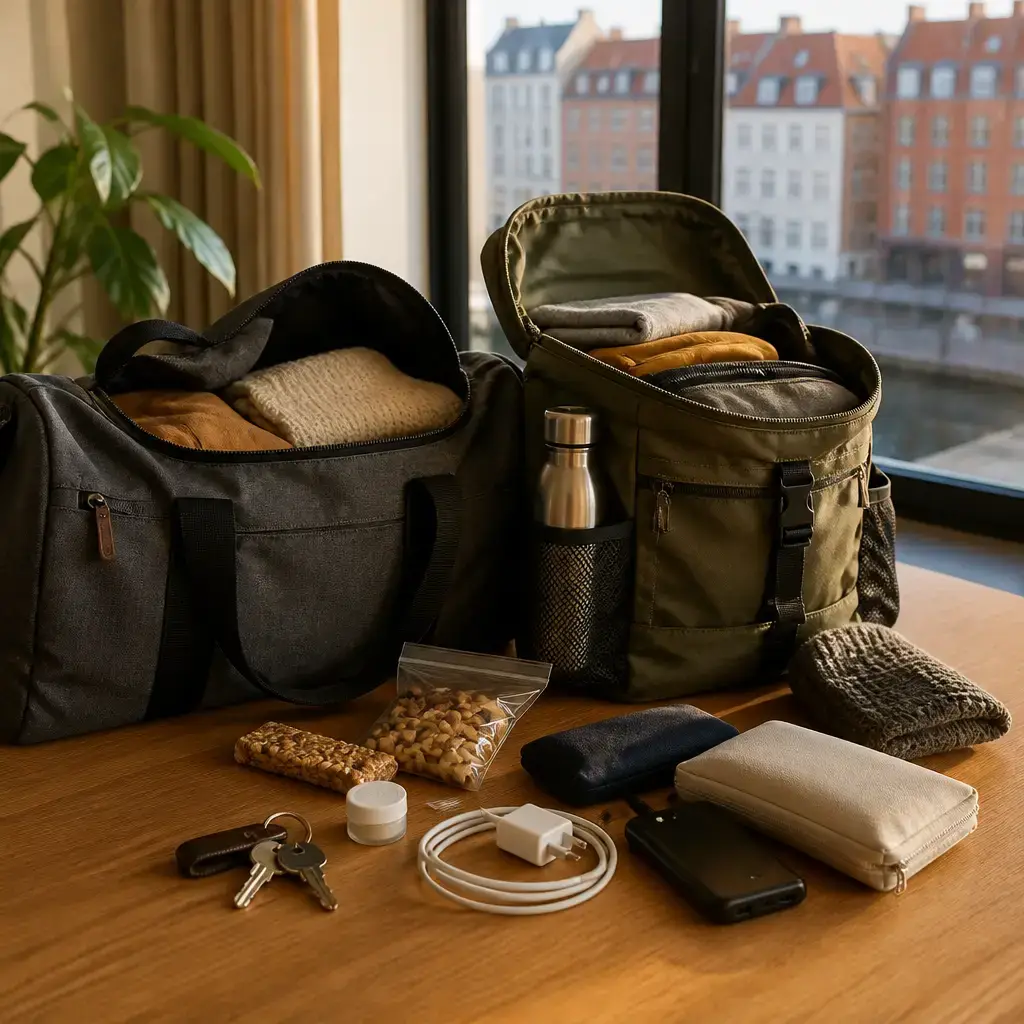
Vores
Vores means “our” in “Vores rejsetasker” and shows that the travel bags belong to the speakers. It is placed directly before the noun it describes. A new example is “Vores bil står udenfor” for “Our car is outside.”
rejsetasker
Rejsetasker means “travel bags” in “Vores rejsetasker”. It names the bags used for the journey. A useful pattern is “pakke rejsetasker” for “pack travel bags.”
skal
Skal expresses that something is required or needs to happen in “skal tjekkes”. Here it presents the check as necessary before leaving. A useful pattern is “skal + verb” for something that must happen.
tjekkes
Tjekkes means “be checked” in “skal tjekkes”. The form presents the bags as receiving the checking rather than naming who checks them. A useful pattern is “skal tjekkes før...” when something needs to be checked before an event.
en
En means “a” in “en sidste gang”, forming the expression “one final time” or “a final time”. It comes before the singular noun “gang”. A useful pattern is “en gang” when referring to one time or occasion.
sidste
Sidste means “final” or “last” in “en sidste gang”. It marks this as the final check before they leave. A useful pattern is “sidste + noun”, such as “sidste dag” for “last day.”
gang
Gang means “time” in “en sidste gang”, referring to one occasion or instance. Together with “en” and “sidste”, it means “one final time”. A useful pattern is “en gang” for “once” or “one time.”
før
Før means “before” in “før vi tager af sted”. It introduces the event that must happen later than the check. A useful pattern is “før + clause” when one action happens before another.
vi
Vi means “we” in “før vi tager af sted” and refers to the two speakers together. It is the subject of the clause after “før”. A useful pattern is “vi + verb” when describing what “we” do.
tager
Tager means “go” or “set off” in the expression “tager af sted”. Here it is part of the phrase for leaving. A useful pattern is “tage af sted” when saying that someone leaves or sets off.
af
Af contributes to the meaning “away” in “tager af sted”. It is part of the fixed expression “tage af sted”, so the whole expression means “leave” or “set off”. Use “tage af sted” as the reusable pattern.
sted
Sted means “place” in general, but in “tager af sted” it is part of the expression meaning “leave” or “set off”. Its meaning here comes from the full expression, not from “sted” alone. A useful pattern is “tage af sted fra...” when naming where someone sets off from.
Begynd
Begynd means “start” or “begin” in the instruction “Begynd med de ting”. It is used to tell the other person what to do first. A useful pattern is “Begynd med...” when starting with a particular task or group of things.
med
Med means “with” in “Begynd med de ting” and introduces what to start with. It follows “Begynd” in this instruction. A useful pattern is “begynd med + noun” for the first item in a task.
de
De has two dialogue uses: “de ting” means “the items”, while “De ligger” means “They are located”. In “de ting” it comes before a noun; in “De ligger” it refers back to the snacks and water. Use the surrounding words to identify which meaning applies.
ting
Ting means “things” or “items” in “de ting, du får brug for”. It refers broadly to the objects needed during the journey. A useful pattern is “ting, du får brug for” for “things you will need.”
du
Du means “you” in “du får brug for”. It identifies the person who needs the items. A useful pattern is “du + verb” when addressing one person directly.
får
Får means “get” in “du får brug for”, but together with “brug for” the expression means “need”. It introduces the person who will need the items. Use the pattern “få brug for + object” for “need something.”
brug
Brug contributes to the meaning “need” in “får brug for”. The complete expression “får brug for” is required for that meaning, so “brug” alone does not mean “need” here. A useful pattern is “få brug for [something]”.“
for
For is part of the expression “får brug for”, which means “need”. It links the expression to the thing that is needed. Preserve the pattern “få brug for + object” when reusing it.
under
Under means “during” in “under rejsen”. It places the need for the items within the time of the journey. A useful pattern is “under + event or period” for something happening during it.
rejsen
Rejsen means “the journey” or “the trip” in “under rejsen”. The form refers to the specific trip being prepared for. A useful pattern is “på rejsen” or “under rejsen” when discussing what happens during a trip.
Jeg
Jeg means “I” in “Jeg har mine nøgler”. It is the speaker referring to themself as the subject. A useful pattern is “Jeg har...” when listing possessions or available items.
har
Har means “have” in “Jeg har mine nøgler, medicin og et varmt lag tøj”. It introduces the items the speaker possesses or has packed. A useful pattern is “Jeg har + object” for saying what you have.
mine
Mine means “my” before the plural noun “nøgler” in “mine nøgler”. It shows that the keys belong to the speaker. A useful pattern is “mine + plural noun” when describing several things that belong to you.
nøgler
Nøgler means “keys” in “mine nøgler”. It names one of the items the speaker has for the trip. A useful pattern is “have sine nøgler” when talking about having one’s keys.
medicin
Medicin means “medicine” in the list “mine nøgler, medicin og et varmt lag tøj”. It names another item the speaker has. A useful pattern is “have medicin med” when saying that someone has medicine with them.
og
Og means “and” in “medicin og et varmt lag tøj”. It connects the listed items. A useful pattern is “A, B og C” when listing three or more things.
et
Et means “a” in “et varmt lag tøj”. It introduces the singular noun “lag”. A useful pattern is “et + singular noun” before a noun of this type.
varmt
Varmt means “warm” in “et varmt lag tøj”. It describes the layer of clothing as providing warmth. A useful pattern is “et varmt + noun” when describing one warm item.
lag
Lag means “layer” in “et varmt lag tøj”. It refers to one layer of clothing for the journey. A useful pattern is “et lag tøj” for “a layer of clothing.”
tøj
Tøj means “clothing” in “et varmt lag tøj”. It specifies what the layer consists of. A useful pattern is “lag tøj” when talking about clothing layers.
Er
Er means “are” at the beginning of the question “Er snacks og vand nemme at få fat i?”. It asks whether the snacks and water have the stated quality. A useful pattern is “Er ...?” for a yes-or-no question.
snacks
Snacks means “snacks” in “snacks og vand”. It names food items intended for the journey. A useful pattern is “have snacks med” when saying that someone has snacks with them.
vand
Vand means “water” in “snacks og vand”. It names the drink being checked before the journey. A useful pattern is “have vand med” when saying that someone brings water.
nemme
Nemme means “easy” in “nemme at få fat i”. It describes the snacks and water as easy to reach or obtain. A useful pattern is “nem at...” or “nemme at...” followed by an action, depending on what is being described.
at
At introduces the infinitive in “nemme at få fat i”. It connects the adjective “nemme” with the action being easy. A useful pattern is “nem at + verb” when saying that an action is easy to do.
fat
Fat contributes to the meaning “reach” or “get hold of” in “få fat i”. The complete expression “få fat i” describes obtaining or reaching something, so “fat” alone does not carry that meaning here. A useful pattern is “få fat i + object” for reaching or getting hold of something.
i
I is part of the expression “få fat i”, which means “reach” or “get hold of”. It comes after “fat” in this expression. Preserve the full pattern “få fat i + object” when reusing it.
ligger
Ligger means “are located” in “De ligger i sidelommen”. It describes where the snacks and water are placed. A useful pattern is “ligger i + place” when saying where an object is located.
sidelommen
Sidelommen means “the side pocket” in “i sidelommen”. It identifies the specific pocket where the items are located. A useful pattern is “i sidelommen” when describing something stored in the side pocket.
Hvad
Hvad means “what” in the question “Hvad med opladere og små ting til ekstra komfort?”. Together with “med”, it asks about additional items. A useful pattern is “Hvad med...?” when asking whether another thing should also be considered.
opladere
Opladere means “chargers” in “opladere og små ting til ekstra komfort”. It names the chargers being checked as part of the travel items. A useful pattern is “pakke opladere” when preparing chargers for a trip.
små
Små means “small” in “små ting til ekstra komfort”. It describes the comfort items as small objects. A useful pattern is “små + plural noun” when describing several small things.
til
Til means “for” in “ting til ekstra komfort”. It shows the purpose of the things: they are intended to provide extra comfort. A useful pattern is “ting til + purpose” when describing what items are for.
ekstra
Ekstra means “extra” in “ekstra komfort”. It adds the idea of comfort beyond the basic requirement. A useful pattern is “ekstra + noun” when describing an additional amount or benefit.
komfort
Komfort means “comfort” in “ting til ekstra komfort”. It names the benefit these small items are intended to provide during the journey. A useful pattern is “for ekstra komfort” when describing something intended to make a situation more comfortable.
pakket
Pakket means “packed” in “Jeg har pakket dem sammen”. With “har”, it describes completed packing. A useful pattern is “har pakket + object” when saying that something has been packed.
dem
Dem means “them” in “Jeg har pakket dem sammen” and refers to the chargers and small comfort items. It is used as the object of “pakket”. A useful pattern is “pakke dem...” when referring back to several objects.
sammen
Sammen means “together” in “pakket dem sammen”. It shows that the items were packed in one group or together. A useful pattern is “pakke noget sammen” when putting several things together.
så
Så has two dialogue uses: “så de er nemme at finde” means “so that they are easy to find”, while “Så burde vi kunne...” means “Then we should be able to...”. The surrounding clause shows whether it expresses a result or a consequence.
finde
Finde means “find” in “nemme at finde”. It is the action that the packed items are easy to carry out. A useful pattern is “nem at finde” or “nemme at finde” when something is easy to locate.
Det
Det means “that” or “it” in “Det burde gøre rejsen mere rolig”. It refers back to the way the items were organized. A useful pattern is “Det burde...” when responding to a situation and stating an expected result.
burde
Burde means “should” in “Det burde gøre...” and expresses an expected or likely result. Here the organized packing is expected to make the trip calmer. A useful pattern is “burde + verb” for an expected outcome.
gøre
Gøre means “make” in “burde gøre rejsen mere rolig”. It introduces the effect that the organization is expected to have. A useful pattern is “gøre + object + adjective” when saying that something makes another thing a certain way.
mere
Mere means “more” in “mere rolig”. It increases the degree of calmness expected for the trip. A useful pattern is “mere + adjective” when describing a greater degree of a quality.
rolig
Rolig means “calm” in “mere rolig”. It describes the trip as becoming calmer if the plans change. A useful pattern is “gøre noget mere rolig” in this type of result statement.
hvis
Hvis means “if” in “hvis planerne ændrer sig”. It introduces the condition under which the trip should become calmer. A useful pattern is “hvis + clause” when describing a condition.
planerne
Planerne means “the plans” in “hvis planerne ændrer sig”. It refers to the travel plans already understood in the conversation. A useful pattern is “hvis planerne...” when discussing possible changes to arrangements.
ændrer
Ændrer means “change” in “planerne ændrer sig”. It describes the plans becoming different from their current form. A useful pattern is “planerne ændrer sig” for saying that plans change.
sig
Sig is the reflexive part of “ændrer sig”, which means “change” when the plans themselves become different. It belongs with “ændrer” in this expression. Preserve the pattern “ændrer sig” when describing plans or circumstances changing.
også
Også means “also” in “Jeg har også ladet der være ekstra plads”. It adds another preparation to the previous list of packed items. A useful pattern is placing “også” before the main verb phrase when adding information.
ladet
Ladet contributes to the meaning “left” or “allowed to remain” in “ladet der være ekstra plads”. The full construction says that the speaker left extra space available. A useful pattern is “lade der være + noun” when leaving something available.
der
Der is a dummy subject in “ladet der være ekstra plads”. It helps form the construction meaning “leave there to be” or “leave available”; it does not refer to a specific place here. A useful pattern is “der er...” or “lade der være...” when stating that something exists or remains available.
være
Være means “be” in “ladet der være ekstra plads”. It forms the construction describing extra space as remaining available. A useful pattern is “der være + noun” after expressions such as “lade”.
plads
Plads means “space” in “ekstra plads”. It refers to room left in the bags for additional things. A useful pattern is “have plads til + object” when saying that there is room for something.
kunne
Kunne means “be able to” in “burde vi kunne tage af sted”. It expresses the expected possibility of leaving. A useful pattern is “kunne + verb” for saying that someone can do something.
uden
Uden means “without” in “uden at pakke om”. It introduces an action that will not be necessary. A useful pattern is “uden at + verb” for saying that something happens without another action.
pakke
Pakke means “pack” in “uden at pakke om”. It names the packing action that they hope to avoid repeating. A useful pattern is “pakke + object” when describing what someone packs.
om
Om contributes the meaning “again” in “pakke om”, which means “repack”. It changes the meaning from packing to packing again or differently. A useful pattern is “pakke om” when packing something again.
på
På means “at” in “på stationen”. It identifies the station as the place where they might otherwise have to repack. A useful pattern is “på + place” when describing being at a location such as a station.
stationen
Stationen means “the station” in “på stationen”. It names the place where the travelers expect to leave. A useful pattern is “på stationen” when referring to being at the station.