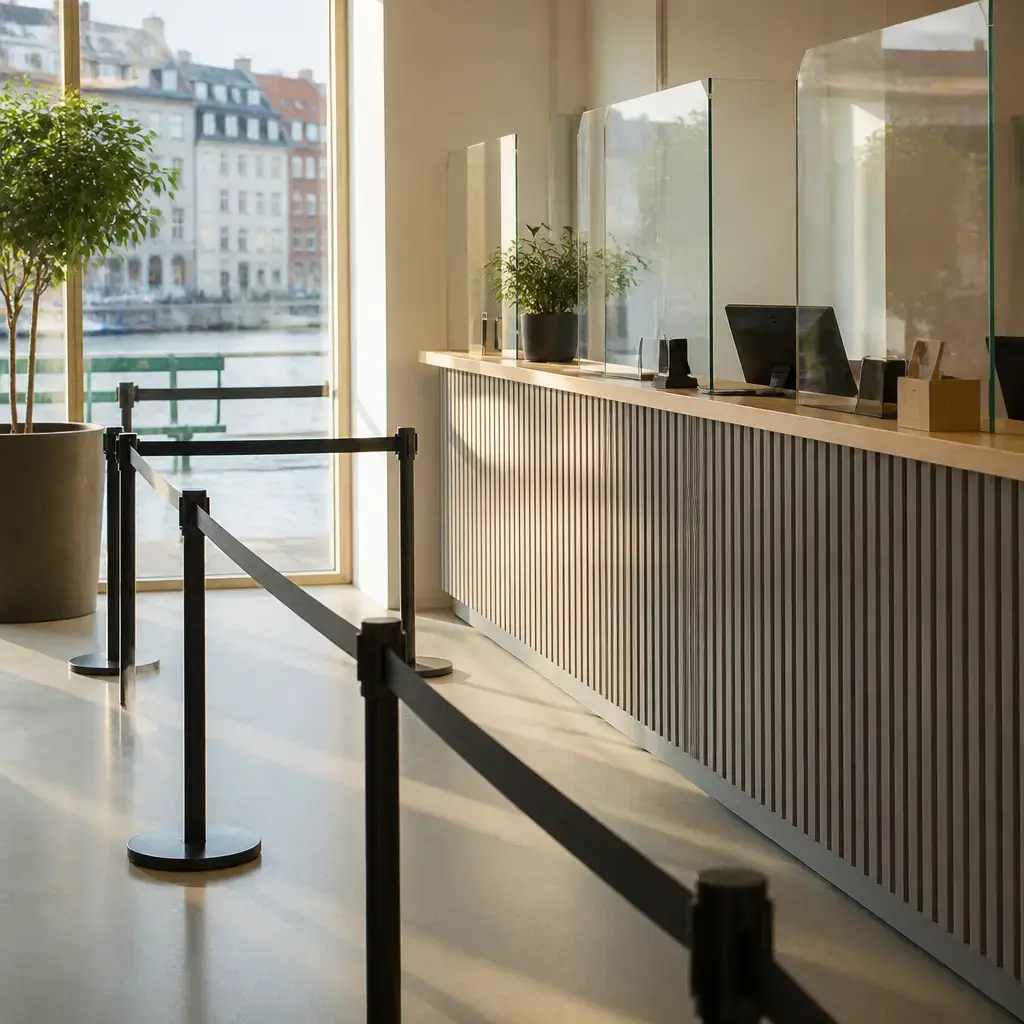
Undskyld
“Undskyld” means “excuse me” here and politely gets the other person’s attention. Use it when addressing someone you do not know, such as before asking a question at a service desk.
denne
“denne” means “this” and points to the particular queue being discussed. It appears directly before “kø” in “denne kø”, so it can be reused before a specific noun you are identifying.
kø
“kø” means “line” or “queue” in “denne kø”. Use it when talking about people waiting for service, for example with movement or waiting.
bevæger
“bevæger” means “moves” in “kø bevæger sig”. In this dialogue it describes the queue’s movement, and it is used together with “sig”.
sig
“sig” is the reflexive component in “bevæger sig”, showing that the queue is moving itself. Learn it as part of the reusable expression “bevæger sig” when describing movement.
langsomt
“langsomt” means “slowly” and describes how “denne kø bevæger sig”. It can be placed after a movement verb to describe the speed of the action.
Prøver
“Prøver” means “are trying” in the question “Prøver du at beslutte”. It asks whether the person is attempting to make a decision, and it is followed here by “du” and “at” plus another verb.
du
“du” means “you” when addressing one person directly. It is the subject in “Prøver du” and also appears as “Du” at the start of “Du kan blive ved med at vente”.
at
“at” marks the verb that follows in “at beslutte” and “at blive”. It is used before an infinitive after expressions such as “Prøver du” and “kan betale sig”.
beslutte
“beslutte” means “decide” in “at beslutte, om det kan betale sig”. It is used with “om” when the decision concerns whether something is worthwhile.
om
“om” introduces the question of whether something is the case in “om det kan betale sig”. Use it after a verb such as “beslutte” to introduce an indirect yes-or-no question.
det
“det” is the “it” in the expression “det kan betale sig”, referring to the situation of staying in the queue. Its meaning here is understood together with the complete expression “kan betale sig”.
kan
“kan” contributes the idea of possibility in “kan betale sig” and “kan blive”. In “kan blive”, it says that the person is able or permitted to stay, while in “kan betale sig” it belongs to the complete expression meaning “be worth it”.
kan betale sig
“kan betale sig” means “be worth it” in the question about staying. “kan” expresses the possibility, “betale” is the payment component, and “sig” is the reflexive component; together they form one expression rather than a literal instruction to pay oneself.
blive
“blive” means “stay” or “remain” in “at blive”. Here it describes remaining in the queue, and it is also part of the separate expression “blive ved med” later in the dialogue.
gør
“gør” means “do” in “Det gør jeg”, which confirms the previous question with the meaning “I do” or “I am”. This short response pattern can be used to confirm an action or situation already mentioned.
jeg
“jeg” means “I” and is the subject in “Det gør jeg”. It identifies the speaker as the person who confirms the previous statement.
Ved
“Ved” means “know” in “Ved du, om der er forsinkelse”. The same form appears as “ved” in “ved serviceskranken”, where it means “at” or “by”, so the context determines the meaning.
der
“der” introduces the existence of something in “der er forsinkelse”. It does not indicate the location “there” here; the phrase says that a delay exists.
er
“er” means “is” or “exists” in “der er forsinkelse”. Together with “der” it forms a useful pattern for stating that something is present or happening.
forsinkelse
“forsinkelse” means “delay” in “der er forsinkelse ved serviceskranken”. Use it when explaining that a service or process is later than expected.
serviceskranken
“serviceskranken” means “the service desk” in “ved serviceskranken”. It names the specific counter where service is provided, and the form is used after “ved” here.
Flere
“Flere” means “several” in “Flere henvendelser”. It indicates more than one request and comes directly before the plural noun it describes.
henvendelser
“henvendelser” means “requests” or “inquiries” in “Flere henvendelser”. Here it refers to matters brought to the service desk that need attention.
kræver
“kræver” means “require” or “need” in “henvendelser kræver ekstra opmærksomhed”. It connects the requests to what is needed to deal with them.
ekstra
“ekstra” means “extra” in “ekstra opmærksomhed”. It comes before the noun and indicates that more attention than usual is needed.
opmærksomhed
“opmærksomhed” means “attention” in “ekstra opmærksomhed”. The pattern “kræver ekstra opmærksomhed” is useful for saying that something needs particularly careful handling.
så
“så” means “so” or “therefore” in “så køen bevæger sig langsomt”. It links the reason that requests need extra attention to the result that the queue is moving slowly.
køen
“køen” means “the queue” in “køen bevæger sig langsomt”. It is the form of “kø” used for the specific queue already being discussed, and it is the subject of the movement.
ikke
“ikke” means “not” in “kan ikke blive”. It negates the possibility of staying, so the complete phrase means that the speaker cannot stay.
her
“her” means “here” in “blive her”. It identifies the place where the speaker is staying, namely the current location by the queue.
meget
“meget” means “much” in “meget længere”. It strengthens the comparison and shows that the speaker cannot remain for a substantially longer period.
længere
“længere” means “longer” in “meget længere”. It describes additional duration, especially with verbs such as “blive” when someone is deciding how long to remain.
blive ved med
“blive ved med” means “keep doing something” or “continue”. In “blive ved med at vente”, “blive” contributes staying, “ved med” contributes continuation, and the expression is followed by “at” plus the action that continues.
vente
“vente” means “wait” in “at vente”. It names the action the person can continue doing while remaining in the queue.
eller
“eller” means “or” and joins the two alternatives “blive ved med at vente” and “aflevere din henvendelse”. Use it when presenting a choice between options.
aflevere
“aflevere” means “hand in” or “leave with someone” in “aflevere din henvendelse ved skranken”. It describes giving a request to the service desk instead of continuing to wait.
din
“din” means “your” and identifies the request as belonging to the person being addressed. It appears before “henvendelse” in “din henvendelse”.
henvendelse
“henvendelse” means “request” or “inquiry” in “din henvendelse”. Here it is the document or matter that can be handed in at the desk.
skranken
“skranken” means “the desk” or “the counter” in “ved skranken”. It refers to the specific service counter where the request can be handed in.
ville
“ville” means “would” in “Det ville hjælpe”. It presents the possible benefit of handing in the request rather than stating it as a definite result.
hjælpe
“hjælpe” means “help” in “ville hjælpe”. It follows “ville” and describes the benefit that leaving the request could provide.
henvendelsen
“henvendelsen” means “the request” or “the inquiry” in “aflevere henvendelsen”. It is the specific request already mentioned, and this form identifies it as a particular item.
hvis
“hvis” means “if” and introduces the condition “nogen kan gennemgå den senere”. It is useful for explaining what must be true for a possible benefit to occur.
nogen
“nogen” means “someone” in “nogen kan gennemgå den”. It refers to an unspecified person who may review the request later.
gennemgå
“gennemgå” means “review” or “go through” in “gennemgå den”. It describes examining the request carefully, and it is followed here by the object pronoun “den”.
den
“den” means “it” in “gennemgå den” and refers back to “henvendelsen”. It is the object of the verb, so the pattern means “review it” rather than simply “review”.
senere
“senere” means “later” in “gennemgå den senere”. It places the review at a time after the request has been left at the desk.
Personalet
“Personalet” means “the staff” in “Personalet ved skranken”. It identifies the people working at the desk as the ones who can contact the visitor.
kontakte
“kontakte” means “contact” in “kontakte dig”. It describes reaching the person with an update, and it is followed by the person being contacted.
dig
“dig” means “you” as the object of “kontakte” in “kontakte dig”. It refers to the person who left the request and will receive the update.
når
“når” means “when” in “når de har nyt”. It introduces the time at which the staff will contact the person.
de
“de” means “they” in “de har nyt”. It refers back to “Personalet ved skranken”, the staff who may contact the visitor.
har
“har” means “have” in “har nyt”. Here it describes the staff having new information that can be communicated.
nyt
“nyt” means “something new” or “an update” in “har nyt”. The expression “har nyt” is a practical way to say that someone has new information to share.
giver
“giver” means “gives” in “giver mig et klart valg”. It describes the options providing the speaker with a clear choice.
mig
“mig” means “me” in “giver mig et klart valg”. It identifies the person who receives the choice, after the verb “giver”.
et
“et” means “a” or “an” before “valg” in “et klart valg”. It introduces one choice as a countable item in the expression.
klart
“klart” means “clear” in “et klart valg”. It describes the choice as easy to understand because the two alternatives have been explained.
valg
“valg” means “choice” in “et klart valg”. It refers to the decision between continuing to wait and leaving the request at the desk.
måske
“måske” means “maybe” in “måske bedre”. It softens the suggestion that leaving the request is the better option.
bedre
“bedre” means “better” in “bedre at aflevere den”. It compares leaving the request with continuing to wait and recommends the first option in the stated situation.
næste
“næste” means “next” in “din næste forpligtelse”. It identifies the upcoming commitment that may prevent the person from continuing to wait.
forpligtelse
“forpligtelse” means “commitment” or “obligation” in “din næste forpligtelse”. It refers to something the person has to attend to after leaving the service desk.