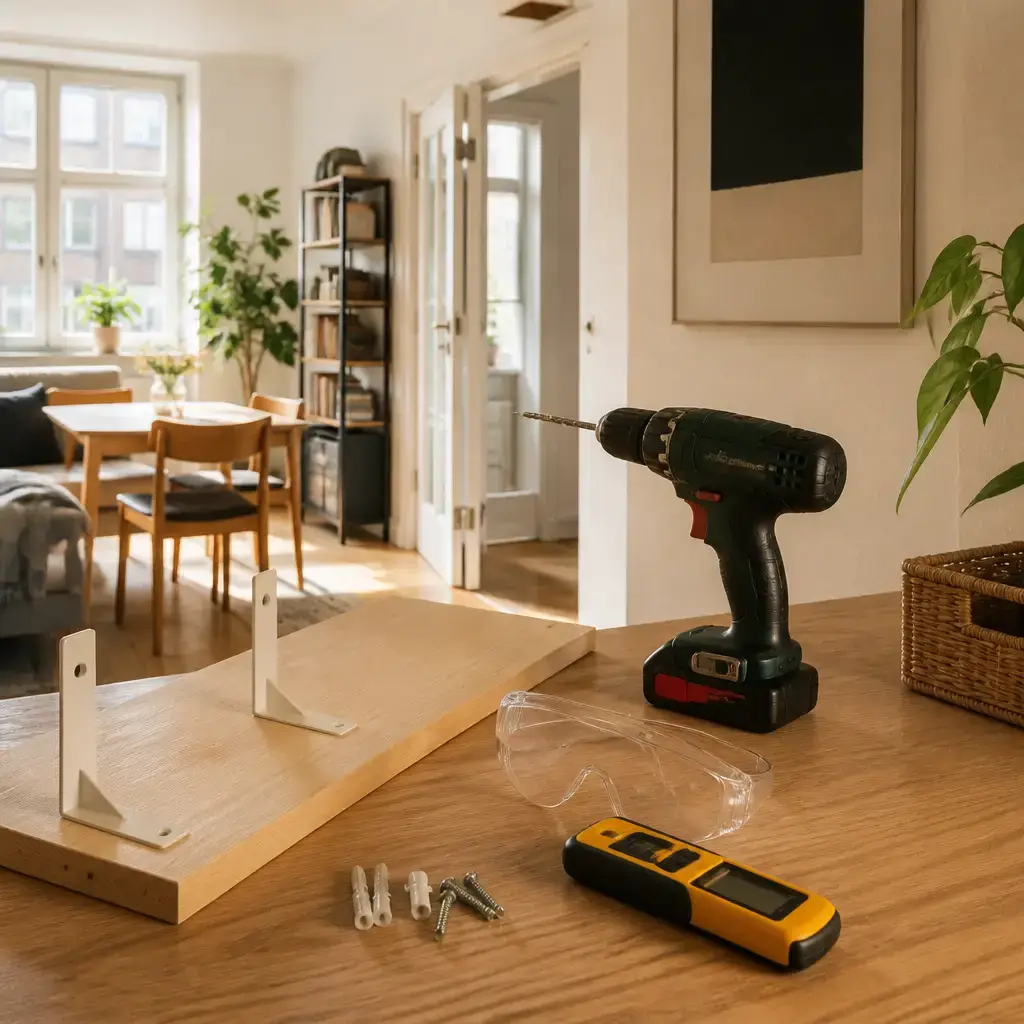
Må
Må means may or be allowed to in Må jeg låne din boremaskine, so it asks for permission to borrow the drill. It is used before the subject in this question, and låne states the permitted action.
jeg
Jeg means I and refers to the person asking to borrow the drill. In Må jeg låne din boremaskine, it comes after the modal verb Må because the question starts with the verb.
låne
Låne means borrow in Må jeg låne din boremaskine, referring to taking the drill temporarily with the expectation of returning it. After Må, it appears as the infinitive for the requested action.
din
Din means your and identifies the drill as belonging to or being provided by the person addressed. It comes directly before boremaskine in din boremaskine.
boremaskine
Boremaskine means drill, the tool being borrowed in this dialogue. It is used after din and is the object of låne; a reusable pattern is låne en boremaskine for borrowing a drill.
for
In for at sætte en lille hylde op, for introduces the purpose of borrowing the drill: in order to put up a shelf. The same form also appears in bekymret for at ramme, where it introduces what the person is worried about.
at
At introduces an infinitive: at sætte describes the purpose of borrowing the drill, and at ramme describes the feared action. It comes directly before the verb form in both constructions.
sætte
Sætte contributes the action of placing or setting something in sætter en lille hylde op. Together with op, sætte ... op means put up or install the shelf; it is followed here by the object en lille hylde.
en
En means a in en lille hylde, introducing one unspecified shelf. It comes before the singular noun hylde and its adjective lille.
lille
Lille means small and describes the shelf in en lille hylde. It is placed before the noun it describes and contributes the size information to the noun phrase.
hylde
Hylde means shelf, the object being put up in the dialogue. It follows the indefinite article en and is part of the placement expression sætte en lille hylde op.
op
Op contributes the upward or installation direction in sætte en lille hylde op. Together with sætte, it forms the expression for putting up the shelf rather than describing the drill itself.
Det
Det refers to the requested action in Det kan du, giving the reply You can. It is capitalized because it begins the sentence, while the same pronoun appears as det in other positions.
kan
Kan means can in Det kan du, expressing that the listener is able or permitted to do the requested action. In this reply it comes before du because the sentence begins with the verb.
du
Du means you and refers to the person who asked to borrow the drill. It is the subject in Har du brugt en boremaskine før? and follows kan in Det kan du.
Har
Har means have as the auxiliary in Har du brugt en boremaskine før? Together with brugt, it asks whether the person has used a drill before. It comes first because this is a question.
brugt
Brugt means used in Har du brugt en boremaskine før? It is the form of bruge used with har to describe a previous experience, and it follows the subject du.
før
Før means before and, at the end of Har du brugt en boremaskine før?, asks whether this has happened previously. It is also used before a clause in før jeg markerer hullerne and før jeg afleverer den tilbage.
Kun
Kun means only and limits the speaker's experience in Kun én gang to one occasion. It commonly comes before the quantity or time expression it limits.
gang
Gang means time or occasion in Kun én gang, describing one occurrence of using a drill. The expression én gang is used for something that happened once.
så
Så means so or therefore and links the limited experience to the request for instructions. In this sentence, the lack of experience is presented as the reason that instructions would help.
ville
Ville means would in det ville hjælpe med nogle grundlæggende instruktioner, presenting the help as a possible or expected benefit. It is followed by the infinitive hjælpe.
hjælpe
Hjælpe means help in det ville hjælpe med nogle grundlæggende instruktioner. After ville, it stays in the infinitive, and the construction hjælpe med is used with the thing that would be helpful.
med
Med means with in hjælpe med nogle grundlæggende instruktioner, identifying what the instructions would help with. The same form appears in med det, meaning with it, in the advice about taking one's time.
nogle
Nogle means some in nogle grundlæggende instruktioner, referring to an unspecified amount of instructions. It comes before the plural noun phrase it introduces.
grundlæggende
Grundlæggende means basic or fundamental and describes the instructions requested by the learner. It comes before instruktioner and specifies that the advice should cover the essentials.
instruktioner
Instruktioner means instructions, referring to practical guidance for using the drill safely. It follows nogle grundlæggende in the phrase used after hjælpe med.
Find ud af
Find ud af means find out or determine in Find ud af, hvilken slags væg det er. Find supplies the idea of finding, while ud af completes the expression and gives it the meaning of determining information; the expression is followed here by what kind of wall it is.
først
Først means first and tells the listener to determine the wall type before doing the other safety steps. It appears directly after the imperative expression Find ud af.
hvilken
Hvilken means which in hvilken slags væg det er, asking the listener to identify the relevant type. It comes before slags in the question about the wall.
slags
Slags means kind or type in hvilken slags væg det er. It is used in the pattern hvilken slags followed by the noun being classified.
væg
Væg means wall and is the thing whose type must be determined before drilling. It follows slags in hvilken slags væg det er.
er
Er means is in hvilken slags væg det er, linking the wall with the information about its type. It is the verb in the clause describing what kind of wall it is.
og
Og means and and connects the instruction to check the wall with the instruction to put on safety glasses. It joins the two actions in the same piece of advice.
tag
Tag means take or put on in tag sikkerhedsbriller på, where it is an instruction to put on the glasses. The same form begins Tag dig god tid med det, where it forms the expression for taking one's time.
sikkerhedsbriller
Sikkerhedsbriller means safety glasses, the protective equipment recommended before drilling. It is the object of tag and is completed by the particle på in tag sikkerhedsbriller på.
på
På means on in tag sikkerhedsbriller på, but together with tag it expresses putting the glasses on. Here it completes the instruction rather than describing the location of the glasses.
også
Også means also and adds the speaker's concern about electrical wires to the earlier information about drilling. It appears after er in Jeg er også bekymret.
bekymret
Bekymret means worried or concerned in Jeg er også bekymret for at ramme elektriske ledninger. It is used after er and is followed by for to introduce the action causing the concern.
ramme
Ramme means hit or strike in for at ramme elektriske ledninger, referring to accidentally hitting electrical wires with the drill. It appears as an infinitive after at.
elektriske
Elektriske means electrical and describes the wires in elektriske ledninger. It comes directly before ledninger and identifies the type of wires involved.
ledninger
Ledninger means wires, specifically the electrical wires that the speaker wants to avoid hitting. It is the object of ramme in ramme elektriske ledninger.
Brug
Brug means use in Brug denne detektor, giving a direct instruction to use the detector. It is an imperative placed at the beginning of the sentence.
denne
Denne means this and points to the detector being offered or indicated by the speaker. It comes before detektor in denne detektor.
detektor
Detektor means detector, the tool recommended for checking the drilling area. It follows denne and is the object of Brug.
borer
Borer means drill in før du borer nogen steder, describing the action the listener should take only after checking the area. It is the verb used with du in the clause after før.
nogen
Nogen means any in nogen steder, referring to any places where the person might drill. Together with steder, it gives the broad meaning anywhere in this sentence.
steder
Steder means places in nogen steder, referring to possible drilling locations. It is the plural form used after nogen in the expression meaning anywhere.
scanner
Scanner means scan in Jeg scanner stedet, describing the speaker's planned check of the drilling spot. It is the verb used after Jeg and takes stedet as its object.
stedet
Stedet means the spot or the place in Jeg scanner stedet. It is the definite form of sted and refers to the particular location where the holes will be marked.
markerer
Markerer means mark in før jeg markerer hullerne, describing the action of indicating the hole positions. It is used with jeg in the clause after før and takes hullerne as its object.
hullerne
Hullerne means the holes, referring to the specific holes that will be marked for the shelf. It is the object of markerer in markerer hullerne.
Husk
Husk means remember in Husk at tage boremaskinen tilbage, giving a reminder or instruction. It is followed by at and the action that should not be forgotten.
tage
Tage means take or bring in Husk at tage boremaskinen tilbage, referring to bringing the borrowed drill back. It follows at and is completed by tilbage, which gives the return direction.
boremaskinen
Boremaskinen means the drill, referring to the particular borrowed tool that must be returned. It is the definite form of boremaskine and is the object of tage.
tilbage
Tilbage means back in tage boremaskinen tilbage, indicating that the drill should return to the person or place it came from. It completes the return expression with tage.
sammen
Sammen means together in sammen med opladeren og borene, requiring the drill to be returned as part of the same set. The expression sammen med introduces the accompanying items.
opladeren
Opladeren means the charger, referring to the specific charger belonging with the drill. It is the definite form of oplader and appears after sammen med.
borene
Borene means the drill bits, referring to the specific bits that should be returned with the drill and charger. It is used as a definite plural item in sammen med opladeren og borene.
fjerner
Fjerner means removes or cleans off in Jeg fjerner støvet, describing the speaker's action of removing dust from the drill or its parts. It is the verb used with jeg and takes støvet as its object.
støvet
Støvet means the dust, referring to the dust produced while using the drill. It is the definite form of støv and is the object of fjerner.
afleverer
Afleverer means hands back or returns in før jeg afleverer den tilbage. It describes returning the drill to its owner and is used with den as the object.
den
Den means it in afleverer den tilbage and refers back to boremaskinen, the drill. It is the object pronoun used with afleverer, while tilbage specifies that it is being returned.
dig
Dig is the reflexive object pronoun you in Tag dig god tid med det. It refers back to the person addressed and is required in this expression for taking one's time.
god
God means good in god tid, but the complete expression Tag dig god tid means take your time or allow yourself enough time. It comes directly before tid in this fixed usage.
tid
Tid means time in Tag dig god tid med det, referring to allowing enough time for the task. Together with god and the reflexive expression, it gives the advice to work without rushing.
sikkerhed
Sikkerhed means safety in sikkerhed er vigtigere end fart. It is the subject being compared with speed and represents the priority in the advice.
vigtigere
Vigtigere means more important in sikkerhed er vigtigere end fart. It is the comparative form used to compare the importance of safety with the importance of speed.
end
End means than and introduces the second part of the comparison in vigtigere end fart. It connects what is more important with the thing used as the comparison.
fart
Fart means speed in sikkerhed er vigtigere end fart. It is the comparison point showing that working safely matters more than completing the task quickly.