Jeg
“Jeg” means “I” in this dialogue. It is the speaker referring to themself, as in “Jeg er nødt til ...”. The same form is used at the beginning of a sentence.
er
In “Jeg er nødt til ...”, “er” means “am” and forms the expression for needing or being obliged to do something. A reusable pattern is “Jeg er nødt til at ...” followed by an action.
nødt
In “Jeg er nødt til at fortælle dig ...”, “nødt” expresses necessity or obligation. The complete reusable construction is “være nødt til at ...”, meaning that someone needs to do something.
til
Here “til” is part of “nødt til at fortælle”, the construction meaning “need to tell”. Reuse it in “være nødt til at ...” before “at” and an action.
at
Here “at” introduces the action in “at fortælle” after “nødt til”. It is used before the verb in a reusable infinitive pattern such as “til at ...”.
fortælle
“Fortælle” means “to tell” in “at fortælle dig noget”. It is used before the person receiving the information and then the information itself, as in “fortælle dig noget”.
dig
“Dig” means “you” as the person being told something in “fortælle dig noget”. A reusable pattern is “fortælle dig ...” when addressing one person.
noget
“Noget” means “something” in “fortælle dig noget”. It refers to unspecified information, and it commonly follows verbs such as “fortælle” when the exact information is not yet named.
om
“Om” means “about” in “noget om den taske”. It introduces the topic of the information, so “noget om ...” is a useful reusable pattern.
den
In “den taske”, “den” means “the” and identifies the bag. In “med den”, the same form means “it” and refers back to the bag.
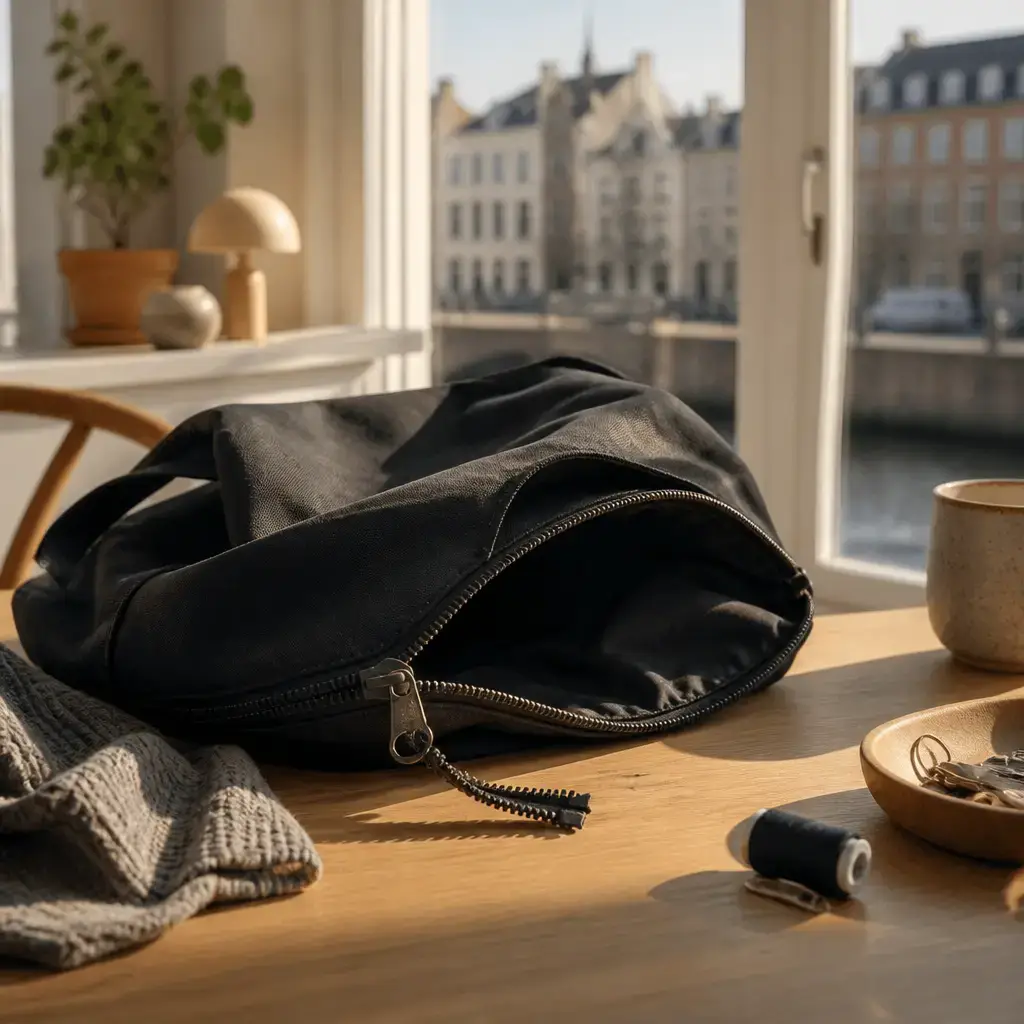
taske
“Taske” means “bag” in “den taske”. It is used after “den” here to identify the borrowed object.
lånte
“Lånte” means “borrowed” in “den taske, jeg lånte”. It describes the bag as the one the speaker borrowed, and it can be reused after an object to say what someone borrowed.
Skete
“Skete” means “happened” in the question “Skete der noget ...?”. It is the past form used to ask whether an event occurred, commonly followed by “der” and “noget” in this pattern.
der
In “Skete der noget ...?”, “der” is a grammatical subject placeholder used in the question about whether something happened. The reusable pattern is “Skete der noget med ...?”.
med
In “noget med den”, “med” connects the event to the bag and means “with” or “concerning” it. In “tage den med til ...”, it helps express taking the object along to a place.
under
“Under” means “during” in “under din rejse”. It introduces the period when something happened, and it can be reused before an event or period such as a trip.
din
“Din” means “your” in “din rejse”. It identifies the trip as belonging to or being associated with the person addressed, and it comes before the noun here.
rejse
“Rejse” means “trip” in “din rejse”. It names the journey during which the damage occurred and follows the possessive “din” in this phrase.
Lynlåsen
“Lynlåsen” means “the zipper” in “Lynlåsen satte sig fast”. The form identifies a specific zipper, and it is the subject of the statement about what happened.
satte
In “satte sig fast”, “satte” contributes to the meaning “got” in the expression “got stuck”. The full expression “sætte sig fast” is a reusable way to describe something becoming stuck.
sig
In “satte sig fast”, “sig” is the reflexive component referring back to the zipper. Together with “satte” and “fast”, it forms the expression meaning “got stuck”.
fast
In “satte sig fast”, “fast” means “stuck”. Its meaning comes from the full expression, which describes a zipper or another object becoming unable to move freely.
og
“Og” means “and” and links “Lynlåsen satte sig fast” with “en del af den gik løs”. It is used to join two related statements.
en
“En” means “a” in “en del”. It introduces one unspecified part, and it is placed directly before the noun “del” in this phrase.
del
“Del” means “part” in “en del af den”. The phrase identifies a portion of the zipper, and “del af ...” is a reusable pattern for referring to part of something.
af
“Af” means “of” in “en del af den”. It links the part to the thing it belongs to or comes from, as in the reusable pattern “en del af ...”.
gik
In “gik løs”, “gik” contributes to the meaning “came” in the expression “came loose”. The full phrase is used to describe a component separating or becoming detached.
løs
In “gik løs”, “løs” means “loose”. Together with “gik”, it describes part of the zipper becoming detached rather than remaining attached.
Var
“Var” means “was” in the question “Var lynlåsen allerede beskadiget?”. It asks about the zipper’s condition, and it appears at the beginning because this is a yes-or-no question.
allerede
“Allerede” means “already” in “allerede beskadiget”. It asks whether the damage existed before the event being discussed, and it is placed before the description of the condition.
beskadiget
“Beskadiget” means “damaged” in “Var lynlåsen allerede beskadiget?”. It describes the zipper’s condition and follows the form of “was” in this question.
Eller
“Eller” means “or” at the beginning of the alternative question “Eller gik den i stykker ...?”. It introduces another possible explanation for the damage.
i
In “i stykker”, “i” is part of the expression meaning “broken”. The complete phrase “gå i stykker” is a reusable way to say that something breaks.
stykker
In “gik i stykker”, “stykker” is part of the fixed expression meaning “broke” or “was broken”. The phrase should be learned as the complete pattern “gå i stykker”.
mens
“Mens” means “while” in “mens du brugte den”. It introduces an action happening during another action and is followed here by a clause with “du”.
du
“Du” means “you” in “mens du brugte den”. It identifies the person using the bag, and it is the subject of the clause after “mens”.
brugte
“Brugte” means “used” in “du brugte den”. It describes the past action of using the bag, and it follows the subject “du” in this clause.
virkede
In “Den virkede fin”, “virkede” means “seemed” or “appeared to be”. Together with “fin”, it says that the bag appeared to be in good condition.
fin
In “virkede fin”, “fin” means “fine” or “in good condition”. It describes how the bag appeared before the problem occurred.
før
“Før” means “before” in “virkede fin før”. It places the bag’s apparently good condition earlier in time, before the damage was noticed.
så
“Så” means “so” in “så jeg vil tage ansvar”. It connects the earlier observation that the bag seemed fine with the speaker’s decision to accept responsibility.
vil
“Vil” expresses the speaker’s intention or wish in “jeg vil tage ansvar”, meaning “I want to take responsibility”. A reusable pattern is “Jeg vil ...” followed by an action.
tage
In “tage ansvar”, “tage” means “take” as part of the expression “take responsibility”. The same pattern can be reused with “tage ansvar” when accepting responsibility for a situation.
ansvar
“Ansvar” means “responsibility” in “tage ansvar”. The meaning comes from the complete expression “tage ansvar”, used when someone accepts responsibility for what happened.
sætter
In “Jeg sætter pris på din ærlighed”, “sætter” is part of the expression meaning “appreciate”. The reusable construction is “sætte pris på ...” for expressing appreciation.
pris
In “sætter pris på”, “pris” is part of the fixed expression meaning “appreciate” or “value”. The complete pattern is “sætte pris på” followed by the person or quality being valued.
på
In “sætter pris på din ærlighed”, “på” completes the expression “sætte pris på”, meaning “appreciate”. It is followed here by the thing being appreciated.
ærlighed
“Ærlighed” means “honesty” in “din ærlighed”. It names the quality that the speaker appreciates, and it follows “din” in this phrase.
kan
“Kan” expresses possibility in “Den kan måske stadig repareres”, meaning that the bag may be repairable. It is followed by “repareres” to describe what can happen to the bag.
måske
“Måske” means “maybe” in “kan måske stadig repareres”. It makes the possibility less certain and is placed between “kan” and the rest of the statement.
stadig
“Stadig” means “still” in “kan måske stadig repareres”. It indicates that repair may remain possible at this point, despite the damage.
repareres
“Repareres” means “be repaired” in “kan måske stadig repareres”. It describes repair being done to the bag, and it follows “kan” in this possibility pattern.
få
In “få den repareret”, “få” means “arrange to have” something done. The reusable construction is “få [object] repareret”, where the object is repaired by someone else.
repareret
In “få den repareret”, “repareret” means “repaired” and describes the result arranged for the bag. It follows the object “den” in the construction “få den repareret”.
erstatte
“Erstatte” means “replace” in “erstatte tasken”. It is followed directly by the object being replaced, here “tasken”.
tasken
“Tasken” means “the bag” in “erstatte tasken”. The form refers to the specific bag already discussed, and it functions as the object of “erstatte”.
hvis
“Hvis” means “if” in “hvis det er nødvendigt”. It introduces a condition under which the speaker will arrange repair or replacement.
det
In “hvis det er nødvendigt”, “det” refers generally to the proposed repair or replacement situation. Together with “er nødvendigt”, the phrase means “if it is necessary”.
nødvendigt
“Nødvendigt” means “necessary” in “det er nødvendigt”. It describes whether the proposed action is needed and completes the conditional phrase “hvis det er nødvendigt”.
Lad
In “Lad os tage den med ...”, “Lad” helps form a suggestion meaning “let’s”. The reusable pattern is “Lad os ...” followed by the action being suggested.
os
In “Lad os tage den med”, “os” means “us” and refers to the speaker and listener together. It also appears in “beslutter os”, where it is part of the expression for deciding.
et
“Et” means “a” in “et reparationsværksted”. It introduces one unspecified repair shop and comes directly before the noun.
reparationsværksted
“Reparationsværksted” means “repair shop” in “et reparationsværksted”. It names the place where the bag can be examined or repaired.
vi
“Vi” means “we” in “før vi beslutter os”. It refers to the speaker and listener together and is the subject of the clause after “før”.
beslutter
In “før vi beslutter os”, “beslutter” means “decide”. The reusable expression is “beslutte sig”, used when a person or group makes a decision.
ked
In “Jeg er ked af ...”, “ked” expresses being sorry or regretful. The complete pattern “være ked af ...” is used to apologize or express regret about something.
ikke
“Ikke” means “not” in “jeg ikke fortalte dig det”. It negates the action “fortalte” and is placed before that verb in this clause.
fortalte
“Fortalte” means “told” in “jeg ikke fortalte dig det”. It describes the past act of giving the information to the listener, and it can be reused with a person and the information told.
snart
In “så snart det skete”, “snart” means “soon” and forms the time expression “as soon as”. The pattern introduces an event that should happen immediately after another event.
siger
In “Du siger det nu”, “siger” means “say” or “mention”. Here it refers to bringing the matter up by saying it, and it can be reused with “sige det” when referring to previously mentioned information.
nu
“Nu” means “now” in “Du siger det nu”. It places the act of mentioning the problem at the present time.
hjælper
“Hjælper” means “helps” in “det hjælper”. It says that the listener’s action has a helpful effect, and it can be reused with “det hjælper” to comment on a useful action.
får
In “Vi får se”, “får” is part of the expression meaning “we’ll see”. The complete phrase is used when the result will become clear later.
se
In “Vi får se, hvad de siger”, “se” means “see” as part of the expression “we’ll see”. It introduces waiting to find out what happens or what someone says.
hvad
“Hvad” means “what” in “hvad de siger”. It introduces the information that the speakers are waiting to learn, followed by the clause “de siger”.
de
“De” means “they” in “hvad de siger”. It refers to the people at the repair shop, who will give their opinion or answer.