Jeg
“Jeg” means “I” as the speaker in “Jeg tilmeldte mig online til dagens konference.” It identifies the person carrying out the action. Use it when describing your own action or situation in a conversation.
tilmeldte
“tilmeldte” means “registered” in “Jeg tilmeldte mig online til dagens konference.” It is the past form used with the reflexive object “mig” in the registration expression “tilmelde sig.” This is useful when telling conference staff that you registered.
mig
“mig” means “myself” or “me” in “tilmeldte mig.” It identifies the person who registered and completes the reflexive expression “tilmelde sig.” The dialogue uses it in “tilmeldte mig online til dagens konference” when the speaker reports their own registration.
online
“online” means “online” in “tilmeldte mig online.” It describes how the registration was made. It can be used with an action to show that it happened through the internet, especially when explaining a registration or booking.
til
“til” means “for” in “til dagens konference,” linking the registration to the conference it concerns. It is also used to connect an action or registration with its destination or purpose. Here it helps specify which event the speaker registered for.
dagens
“dagens” means “today’s” in “dagens konference.” It identifies the conference as the one associated with today. It is reused before an event or other noun when referring to something belonging to or connected with today.
konference
“konference” means “conference” in “dagens konference.” It names the event for which the speaker registered. The phrase “til dagens konference” is useful when identifying the event connected with a registration.
kan
“kan” means “can” or “is able to” in “Jeg kan hjælpe dig.” It expresses ability or an offer of assistance and is followed by the verb “hjælpe.” The pattern “kan” plus an action verb is useful when offering to do something for someone at a service desk.
hjælpe
“hjælpe” means “help” in “kan hjælpe dig med at tjekke ind.” It is the action offered by the staff member and follows “kan.” The reusable expression “hjælpe dig med at tjekke ind” describes assisting someone with a specific task.
dig
“dig” means “you” as the person receiving help in “hjælpe dig.” It is the person toward whom the action is directed. The dialogue uses it in “hjælpe dig med at tjekke ind” when staff address the attendee directly.
med
“med” means “with” in “hjælpe dig med at tjekke ind.” It introduces the task that the person is being helped with. The pattern “hjælpe nogen med at” is useful when describing assistance with an activity.
at
“at” marks the action “tjekke” after “med” in “med at tjekke ind.” It links the help being offered to the activity itself. The pattern “med at” can introduce the action involved in receiving help.
tjekke
“tjekke” is the verb part meaning “check” in the exact expression “tjekke ind,” which means check in. Its meaning here depends on the particle “ind,” which completes the check-in expression. The dialogue uses “at tjekke ind” for the task performed at the conference desk.
ind
“ind” is the particle completing “tjekke ind,” the expression for checking in. It contributes the sense of entering or completing the check-in process, but the full meaning comes from “tjekke ind” together. This expression is useful when describing arrival and registration at a venue.
Bekræft
“Bekræft” means “confirm” as a direct request in “Bekræft venligst din tilmelding.” It is the command form of “bekræfte” and asks the attendee to verify the registration. At a service desk, it is used to request confirmation of information.
venligst
“venligst” means “please” in “Bekræft venligst din tilmelding.” It makes the request more polite. It can be placed with a direct request when asking someone to complete a service or administrative action.
din
“din” means “your” in “din tilmelding.” It shows that the registration belongs to or is associated with the person being addressed. The phrase “din tilmelding” is useful when checking another person’s registration.
tilmelding
“tilmelding” means “registration” in “din tilmelding.” It refers to the attendee’s registration record for the conference. It can be used with a possessive such as “din” or with “bekræft” when discussing registration at a desk.
på
“på” means “on” in “på denne skærm.” It indicates where the attendee should confirm the registration. The pattern “på” plus a screen or interface is useful when directing someone to perform an action on a display.
denne
“denne” means “this” in “denne skærm.” It points to the specific screen being used at the desk. It is placed before a noun when identifying a particular nearby item.
skærm
“skærm” means “screen” in “på denne skærm.” It refers to the display on which the registration appears. The phrase is useful when directing someone to confirm or inspect information on a screen.
Den
The capitalized “Den” means “it” in “Den viser min tilmelding” and refers back to the screen. The lowercase form “den” in “den workshop” identifies a specific workshop. These uses help connect a noun already mentioned with information about it.
viser
“viser” means “shows” in “Den viser min tilmelding.” It describes what the screen displays. The form is useful when explaining that a screen, document, or system presents particular information.
min
“min” means “my” in “min tilmelding.” It shows that the registration belongs to the speaker. The phrase “min tilmelding” is useful when identifying one’s own registration to staff.
og
“og” means “and” and links items in “min tilmelding og den workshop.” It joins two pieces of information presented together. The dialogue also uses it in “materialer og dit navneskilt” to connect two items being handed over.
workshop
“workshop” means “workshop” in “den workshop om eftermiddagen.” It identifies the afternoon event chosen by the attendee. It can be used when discussing a selected session or activity at a conference.
om
In “workshop om eftermiddagen,” “om” means “in” or “during” and introduces the time of the workshop. In “oplysninger om, hvilke lokaler der er tildelt,” it introduces what the information concerns. These patterns are useful for describing a time or the subject of information.
eftermiddagen
“eftermiddagen” means “the afternoon” in “om eftermiddagen.” It identifies when the workshop takes place. The expression “om eftermiddagen” is useful when stating that an event happens during the afternoon.
som
“som” means “that” or “which” in “den workshop om eftermiddagen, som jeg valgte.” It introduces the clause that identifies which workshop is meant. The pattern noun + “som” + clause is useful for adding information about a particular person, thing, or event.
valgte
“valgte” means “chose” in “som jeg valgte.” It describes the attendee’s earlier selection of the workshop. The form is useful when explaining which option or session someone selected.
se
“se” means “see” in “kan se den workshop.” It follows “kan” and describes noticing or viewing information on the screen. The phrase “kan se” is useful when confirming that information is visible.
listen
“listen” means “the list” in “på listen.” It refers to the specific list on which the workshop appears. The phrase “på listen” is useful when saying that an item is included in a displayed or written list.
sammen
“sammen” means “together” in “sammen med oplysningerne.” With “med,” it indicates that the workshop is shown together with the badge details. The pattern “sammen med” is useful for describing accompanying people, items, or information.
oplysningerne
“oplysningerne” means “the information” or “the details” in “oplysningerne til dit navneskilt.” It refers to the specific details connected with the attendee’s badge. This form is useful when discussing known information associated with a document or identification item.
dit
“dit” means “your” in “dit navneskilt.” It shows that the name badge belongs to or is intended for the person being addressed. The phrase “dit navneskilt” is useful when handing someone their badge or discussing its details.
navneskilt
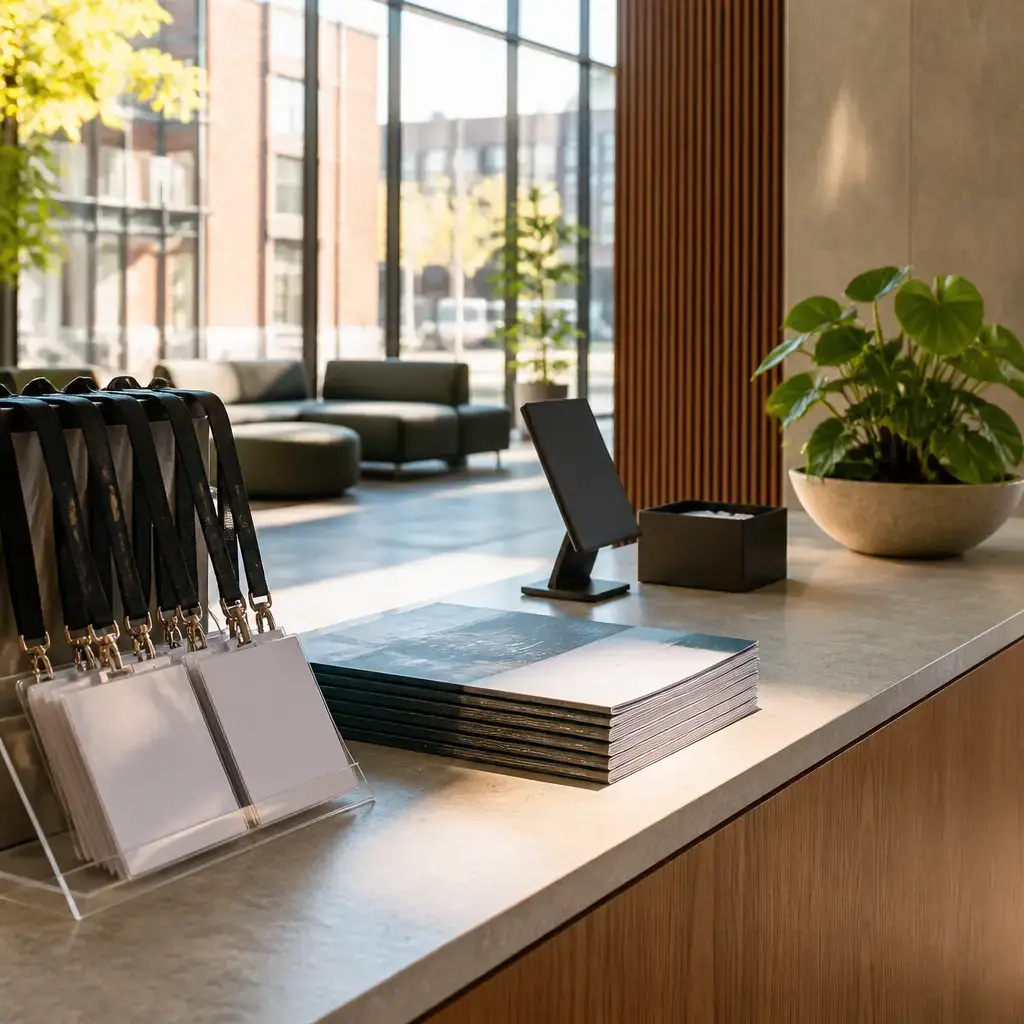
“navneskilt” means “name badge” in “dit navneskilt.” It is the identification badge given to the conference attendee. This word is useful when collecting, displaying, or checking identification at an event.
Er
“Er” means “is” in the question “Er der en trykt dagsorden?” and asks whether something is available. The lowercase form “er” in “dagsordener er her” means “are” and links the agendas with their location. The pattern “Er der ...?” is useful when asking whether something exists or is available.
der
“der” is part of the existence question “Er der en trykt dagsorden?” and helps ask whether an agenda is available. Here it does not name the location; the question is about whether something is present. The pattern “Er der ...?” is useful at a service desk when asking if an item is available.
en
“en” means “a” or “an” in “en trykt dagsorden.” It introduces one non-specific printed agenda. It is used before the noun when asking whether such an item is available.
trykt
“trykt” means “printed” in “en trykt dagsorden.” It describes the agenda as available on paper rather than only online. It can be placed before a noun to identify printed conference material.
dagsorden
“dagsorden” means “agenda” in “en trykt dagsorden.” It refers to the conference schedule or program. The dialogue also contrasts it with “den online dagsorden,” making it useful when discussing printed and digital schedules.
eller
“eller” means “or” in “eller skal jeg bruge den online?” It presents an alternative between using a printed agenda and using the online one. It is useful when asking someone to choose between two options.
skal
“skal” expresses “should” or asks what is expected in “skal jeg bruge den online?” It is followed by the infinitive “bruge” and frames the question as a choice or recommendation. The pattern “skal jeg” is useful when asking which action is appropriate.
bruge
“bruge” means “use” in “skal jeg bruge den online?” It is the action being considered and follows “skal.” The pattern “skal jeg bruge” is useful when asking whether to use a particular resource or tool.
De
“De” means “the” in “De trykte dagsordener er her.” It identifies the specific printed agendas available at the desk, and it is capitalized because it begins the sentence. Here it is a determiner before “trykte dagsordener,” not the pronoun “they.”
trykte
“trykte” means “printed” in “De trykte dagsordener.” It describes the agendas that are available at the desk. The phrase is useful when distinguishing printed materials from an online version.
dagsordener
“dagsordener” means “agendas” in “De trykte dagsordener.” It refers to multiple copies of the conference schedule. This plural form is useful when talking about several printed agendas available for attendees.
her
The lowercase “her” means “here” in “dagsordener er her,” identifying the location of the printed agendas. The capitalized form “Her” in “Her er dine materialer” introduces items being presented or handed over. It is useful when directing attention to something at the speaker’s current location.
men
“men” means “but” in “men den online version har de nyeste oplysninger.” It introduces a contrast between the printed agendas and the online version. It is useful when adding an important difference or qualification.
version
“version” means “version” in “den online version.” It identifies the online form of the agenda as distinct from the printed copies. The word is useful when comparing different forms of the same document or resource.
har
“har” means “has” in “version har de nyeste oplysninger.” It states that the online version contains or provides the latest information. It is useful when describing what a document or resource includes.
nyeste
“nyeste” means “latest” in “de nyeste oplysninger.” It identifies the information as the most current information available. It is useful when directing someone to the most up-to-date schedule or details.
oplysninger
“oplysninger” means “information” or “details” in “oplysninger om, hvilke lokaler der er tildelt.” It refers to room-assignment information in the online agenda. The pattern “oplysninger om” is useful when specifying the subject of information.
hvilke
“hvilke” means “which” in “hvilke lokaler der er tildelt.” It selects or identifies particular rooms from the available possibilities. The pattern “hvilke” plus a noun is useful when asking or explaining which items are involved.
lokaler
“lokaler” means “rooms” in “hvilke lokaler der er tildelt.” It refers to the rooms assigned to the conference sessions. This plural form is useful when discussing several rooms or room assignments.
tildelt
“tildelt” means “assigned” in “lokaler der er tildelt.” It describes the rooms as allocated to particular sessions or uses. The phrase is useful when discussing which rooms have been allocated in a schedule.
bruger
“bruger” means “use” in “Jeg bruger den online dagsorden.” It states the speaker’s intended choice of the online agenda. The pattern “Jeg bruger” plus an object is useful when saying which resource you will use.
så
“så” means “so” or “so that” in “så jeg ikke går glip af opdateringer.” It introduces the purpose of using the online agenda. The pattern “så” plus a clause is useful when explaining why an action is being taken.
ikke
“ikke” means “not” in “jeg ikke går glip af opdateringer.” It negates the expression “går glip af.” It is useful when stating that an unwanted result should be avoided.
går glip af
“går glip af” is the fixed expression meaning “miss” or “fail to catch” in “jeg ikke går glip af opdateringer.” “går” is the verb part, “glip” is the fixed element expressing missing out, and “af” introduces what is missed. The reusable pattern is “gå glip af” plus the thing someone does not want to miss.
opdateringer
“opdateringer” means “updates” in “går glip af opdateringer.” It refers to new or changed conference information. The phrase “gå glip af opdateringer” is useful when explaining why it is important to follow the latest information.
dine
“dine” means “your” in “dine materialer.” It shows that the materials belong to or are intended for the person being addressed. It is used before plural items when identifying what someone is receiving.
materialer
“materialer” means “materials” in “dine materialer.” It refers to the conference items given to the attendee at check-in. The phrase “dine materialer” is useful when handing over or identifying several event resources.
Hvilket
“Hvilket” means “which” in “Hvilket lokale skal jeg gå til først?” It asks the attendee to identify one room from the available options. The pattern “Hvilket” plus a noun is useful when asking which particular item or place is intended.
lokale
“lokale” means “room” in “Hvilket lokale.” It identifies the destination the attendee wants to find. The phrase “gå til lokale” is part of asking where to go for a session or activity.
gå
“gå” means “go” in “skal jeg gå til først?” It describes moving to the room and follows “skal.” The pattern “gå til” is useful when asking about or giving a destination.
først
“først” means “first” in “gå til først.” It asks about the initial room or destination in the attendee’s sequence. It is useful when asking what to do or visit before the other activities.
Åbningssessionen
“Åbningssessionen” means “the opening session” in “Åbningssessionen er i hovedsalen.” It identifies the first scheduled session of the conference. It is useful when giving directions to the event that begins the program.
i
“i” means “in” in “i hovedsalen.” It introduces the place where the opening session takes place. The pattern “i” plus a place is useful when stating the location of an event or activity.
hovedsalen
“hovedsalen” means “the main hall” in “i hovedsalen.” It identifies the larger central room as the location of the opening session. The phrase is useful when directing an attendee to the first event at a conference.
lige
“lige” means “straight” in “lige ned ad denne gang.” It indicates that the attendee should continue directly along the corridor. The phrase is useful when giving simple directions without a turn.
ned
“ned” means “down” as part of “lige ned ad denne gang.” Together with “ad,” it describes movement along the corridor. This direction phrase is useful when telling someone how to reach a nearby room or hall.
ad
“ad” means “along” or “down” in “ned ad denne gang.” It links the direction of movement to the corridor being followed. The pattern “ned ad” plus a route is useful when giving corridor or street directions.
gang
“gang” means “corridor” in “denne gang.” It identifies the passage the attendee should follow. The phrase “ned ad denne gang” is useful when directing someone through a building.