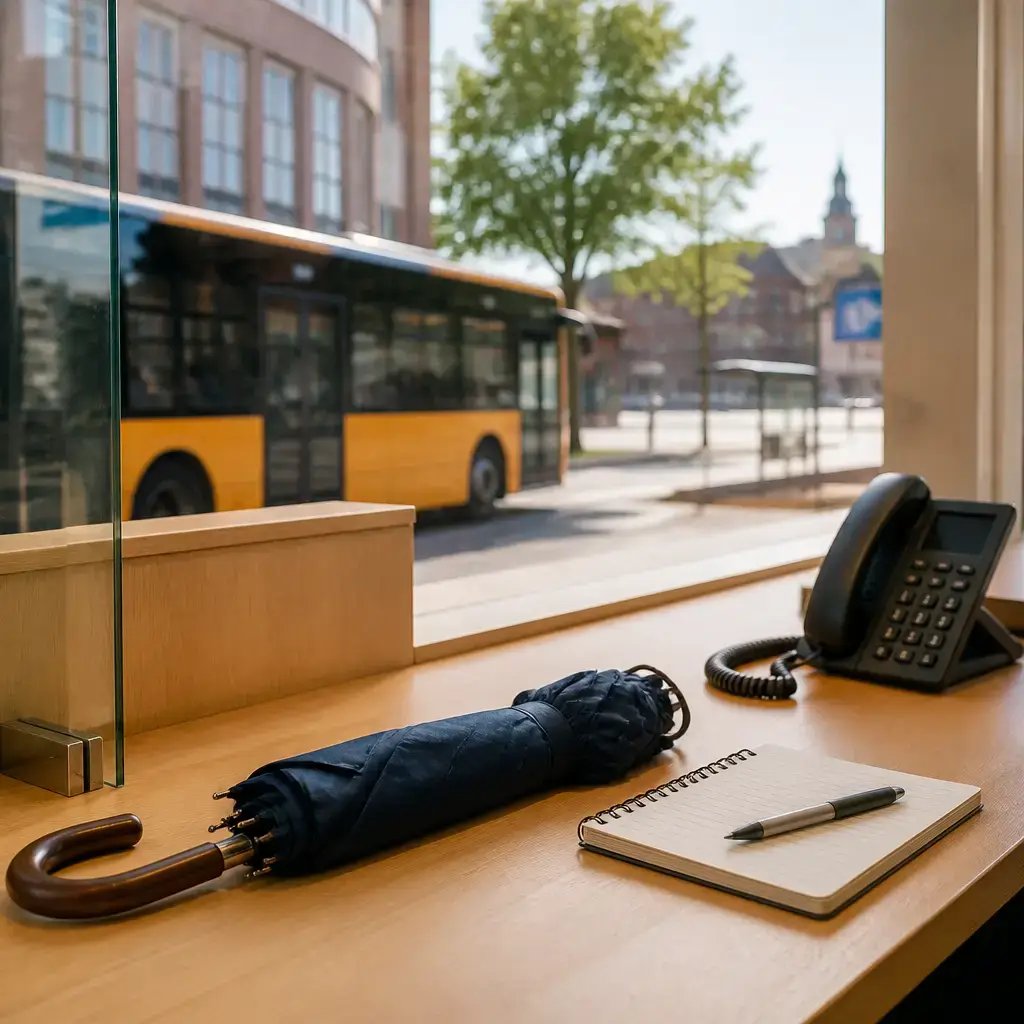
Jeg
“Jeg” means “I” and is the speaker referring to themself in “Jeg efterlod min paraply”. It is used as the subject before the action, for example when reporting something you did.
efterlod
“efterlod” means “left behind” in “Jeg efterlod min paraply i bussen”. It describes leaving the umbrella in a place, which is useful when reporting a lost item.
min
“min” means “my” and identifies the umbrella as belonging to the speaker in “min paraply”. It is placed directly before the thing being possessed.
paraply
“paraply” means “umbrella” in “min paraply”. Here it names the lost object, and it can be used after a possessive such as “min” when identifying something that belongs to you.
i
“i” means “in” or “on” in “i bussen”, describing the umbrella’s location inside the bus. This preposition is used here to give the place where something was left.
bussen
“bussen” means “the bus” in “i bussen”, referring to the specific bus involved in the report. The phrase “i bussen” gives the location of the lost item.
morges
“morges” means “this morning” in the time expression “i morges”. Use this expression when specifying that something happened earlier on the same day.
Du
“Du” means “you” when speaking directly to the passenger in “Du bør udfylde”. It is the person being advised and appears as the subject before “bør”.
bør
“bør” means “should” and gives advice in “Du bør udfylde en anmeldelse”. It is followed here by the action the person is advised to take, such as completing a report.
udfylde
“udfylde” means “fill out” in “udfylde en anmeldelse”. It describes completing the information in a report, and it follows “bør” in this advice.
en
“en” means “a” in “en anmeldelse”, introducing one unspecified report. It is placed directly before the noun when referring to a report that has not yet been identified as a specific one.
anmeldelse
“anmeldelse” means “report” in “en anmeldelse om en bortkommen genstand”. Here it is a formal report about a missing item, which is appropriate at a transport service point.
om
“om” means “about” in “en anmeldelse om en bortkommen genstand”. It introduces the subject of the report, namely the missing item.
bortkommen
“bortkommen” describes something that has gone missing in “en bortkommen genstand”. It is used before “genstand” to identify the item as lost.
genstand
“genstand” means “item” or “object” in “en bortkommen genstand”. It is a useful neutral word when describing a physical object in a report.
med
“med” means “with” in “med oplysninger om turen”. It introduces the information that should accompany the report.
oplysninger
“oplysninger” means “information” or “details” in “oplysninger om turen”. The word is used for the trip information needed to identify the bus journey.
turen
“turen” means “the trip” in “oplysninger om turen”. It refers to the particular journey connected with the lost umbrella, so the phrase asks for details about that journey.
Det
“Det” means “it” in “Det var i den bus”, referring to the location or situation being clarified. This form is used to introduce the explanation of where the umbrella was.
var
“var” means “was” in “Det var i den bus”. It describes the relevant past location when the passenger identifies which bus was involved.
den
“den” means “the” in “den bus”, identifying the particular bus that stopped there. In “Den er marineblå”, the same form refers back to the umbrella and means “it”.
bus
“bus” means “bus” in “den bus”. It identifies the vehicle, while “den bus, der stoppede her” specifies which bus the passenger means.
der
“der” means “that” or “which” in “den bus, der stoppede her”. It introduces the information describing the bus, namely that it stopped there.
stoppede
“stoppede” means “stopped” in “der stoppede her”. It describes the bus’s stop and helps distinguish it from other buses.
her
“her” means “here” in “stoppede her”, referring to the transport service point where the conversation is taking place. It is used to indicate the speaker’s current location.
morgenmyldretiden
“morgenmyldretiden” means “the morning rush hour” in “i morgenmyldretiden”. It identifies the busy morning period during which the bus stopped, making the trip easier to locate.
Kan
“Kan” means “can” in the question “Kan du beskrive paraplyen tydeligt?”. It asks whether the passenger is able to provide the requested description.
beskrive
“beskrive” means “describe” in “beskrive paraplyen tydeligt”. It is the action requested when someone needs clear identifying details about an object.
paraplyen
“paraplyen” means “the umbrella” in “beskrive paraplyen”. It refers to the specific umbrella already mentioned in the lost-item report.
tydeligt
“tydeligt” means “clearly” in “beskrive paraplyen tydeligt”. It tells the passenger that the description should make the object easy for staff to recognize.
er
“er” means “is” in “Den er marineblå”. It links the umbrella to its identifying characteristics, such as its color and condition.
marineblå
“marineblå” means “navy blue” in “Den er marineblå”. It gives a specific color that can help staff identify the umbrella.
og
“og” means “and” in “marineblå og sammenfoldet”. It joins two pieces of information about the umbrella: its color and its folded condition.
sammenfoldet
“sammenfoldet” means “folded” in “Den er ... sammenfoldet”. It describes the umbrella’s condition and provides another identifying detail.
et
“et” means “a” in “et træhåndtag”, introducing one handle as part of the umbrella’s description. It appears directly before the noun phrase describing the handle.
træhåndtag
“træhåndtag” means “wooden handle” in “med et træhåndtag”. It identifies the material and type of handle, giving staff a precise feature to look for.
Tilføj
“Tilføj” means “add” in “Tilføj et telefonnummer”. It is a direct instruction telling the passenger to include another piece of information in the report.
telefonnummer
“telefonnummer” means “phone number” in “Tilføj et telefonnummer”. It is the contact detail the passenger should provide so staff can reach them.
så
“så” means “so that” in “så personalet kan kontakte dig”. It introduces the purpose of adding the phone number: enabling staff to contact the passenger.
personalet
“personalet” means “the staff” in “så personalet kan kontakte dig”. It refers to the employees handling the lost-item report.
kontakte
“kontakte” means “contact” in “kan kontakte dig”. It describes reaching the passenger by using the phone number provided in the report.
dig
“dig” means “you” as the person staff may contact in “kontakte dig”. It identifies the receiver of the contact after “kontakte”.
hvis
“hvis” means “if” in “hvis den dukker op”. It introduces the condition under which staff would contact the passenger: if the umbrella turns up.
dukker op
“dukker op” means “turns up” or “appears” in “hvis den dukker op”. “dukker” contributes the idea of appearing, while “op” completes this expression; it is useful when an item or person is unexpectedly found.
Hvor
“Hvor” means “how” in “Hvor lang tid”, not “where”. Together with “lang tid”, it begins a question about the duration before the passenger receives a reply.
lang
“lang” means “long” in “Hvor lang tid”. It describes the length of the waiting period being asked about.
tid
“tid” means “time” in “Hvor lang tid plejer det at tage?”. The phrase asks how much time the process normally requires.
plejer
“plejer” expresses what usually happens in “Hvor lang tid plejer det at tage?”. It asks about the normal duration rather than one exceptional case.
at
“at” marks the infinitive in “at tage”. Here it connects the question about usual duration with the action of taking time.
tage
“tage” means “take” in the time expression “plejer det at tage”. It describes the amount of time required for the passenger to receive a reply.
før
“før” means “before” in “før jeg får svar”. It introduces the point in time that must be reached before the passenger receives a response.
får
“får” means “get” or “receive” in “jeg får svar”. It describes receiving the reply from the transport service.
svar
“svar” means “answer” or “reply” in “jeg får svar”. It refers to the response the passenger is waiting to receive.
kommer an på
“kommer an på” means “depends on” in “Det kommer an på”. “kommer” contributes “comes”, while “an” and “på” complete this fixed expression; it is used when the answer varies according to circumstances.
men
“men” means “but” in “Det kommer an på, men fundne genstande...”. It contrasts the uncertainty about timing with the following general information about found items.
fundne
“fundne” means “found” in “fundne genstande”. It describes items that have been located and are now available for collection.
genstande
“genstande” means “items” or “objects” in “fundne genstande”. It refers to physical belongings such as the umbrella being reported.
bliver
“bliver” means “are” or “become” here as part of “bliver ofte afhentet”. It helps describe what happens to the found items when they are collected.
ofte
“ofte” means “often” in “bliver ofte afhentet”. It shows that collection by evening is a common occurrence, not a guarantee.
afhentet
“afhentet” means “collected” or “picked up” in “bliver ofte afhentet”. It describes the action performed on found items by the people who come to collect them.
inden
“inden” means “by” or “before” in “inden aften”. It sets the latest time by which the collection commonly happens.
aften
“aften” means “evening” in “inden aften”. It identifies the time limit mentioned for collecting found items.
sender
“sender” means “send” or “submit” in “sender formularen ind”. Together with “ind”, it describes submitting the completed form to the service.
formularen
“formularen” means “the form” in “sender formularen ind”. It refers to the specific form the passenger has completed for the lost-item report.
ind
“ind” completes “sender formularen ind”, giving the idea of sending the form in or submitting it. This particle is used with the sending action in this context.
nu
“nu” means “now” in “sender formularen ind nu”. It shows that the passenger plans to submit the form immediately.
tjekker
“tjekker” means “check” in “tjekker igen i morgen”. It describes looking for an update or checking the situation again later.
igen
“igen” means “again” in “tjekker igen”. It shows that the passenger will repeat the checking action after doing it now.
morgen
“morgen” means “tomorrow” in “i morgen”. The phrase specifies that the next check will happen on the following day.
præcis
“præcis” means “specific” or “precise” in “En præcis beskrivelse”. It emphasizes that the description should contain exact identifying details.
beskrivelse
“beskrivelse” means “description” in “En præcis beskrivelse”. It refers to the information about the umbrella’s appearance and features.
vil
“vil” indicates an expected result in “vil gøre det lettere”. It connects the precise description with the improvement it is expected to create for the staff.
gøre
“gøre” means “make” in “vil gøre det lettere”. It describes causing the task of identifying the item to become easier.
lettere
“lettere” means “easier” in “gøre det lettere”. It describes the improved level of difficulty for the staff trying to identify the correct item.
for
“for” means “for” in “for personalet”. It identifies the staff as the people who benefit from the clearer description.
finde
“finde” means “find” in “for personalet at finde den rigtige genstand”. It names the task the staff can perform more easily when the description is precise.
rigtige
“rigtige” means “right” or “correct” in “den rigtige genstand”. It distinguishes the particular item that matches the passenger’s description.