Undskyld
In “Undskyld”, this politely means “excuse me” when getting the station staff member’s attention. It is useful at the beginning of a question to a stranger or employee.
er
In “er der en handicapvenlig vej”, er means “is” and helps ask whether a route exists. It is also used in “er lukket” and “er skiltene nemme at følge” to describe a state or condition.
der
In “er der en handicapvenlig vej”, der is part of the expression used to ask whether something exists. The pattern is useful when asking whether a route, service, or facility is available.
en
In “en handicapvenlig vej”, en introduces one non-specific route and corresponds to “a” or “an”. It comes directly before the noun phrase being introduced.
handicapvenlig
In “en handicapvenlig vej”, handicapvenlig describes a route as accessible for people with disabilities. It is placed before vej to specify what kind of route is meant.
vej
In “en handicapvenlig vej”, vej means a way or route to follow. Here it refers to a route through the station, and it is followed by “til den rigtige perron” to name the destination.
til
In “vej til den rigtige perron”, til links the route with its destination and means “to”. It is useful after a word for a route or direction when naming where it leads.
den
In “den rigtige perron” and “Den nærmeste elevator”, den marks a specific singular thing, meaning “the”. In “hvor den er”, den is a pronoun referring to the elevator and means “it”.
rigtige
In “den rigtige perron”, rigtige means “correct” or “right” and identifies the platform the traveler needs. It describes perron inside the definite phrase “den rigtige perron”.
perron
In “den rigtige perron”, perron means the train platform. It names the destination of the accessible route in the traveler’s question.
nærmeste
In “Den nærmeste elevator”, nærmeste means “the closest” or “the nearest”. It identifies the elevator by comparing its distance with other elevators, and it is useful before a place or facility being located.
elevator
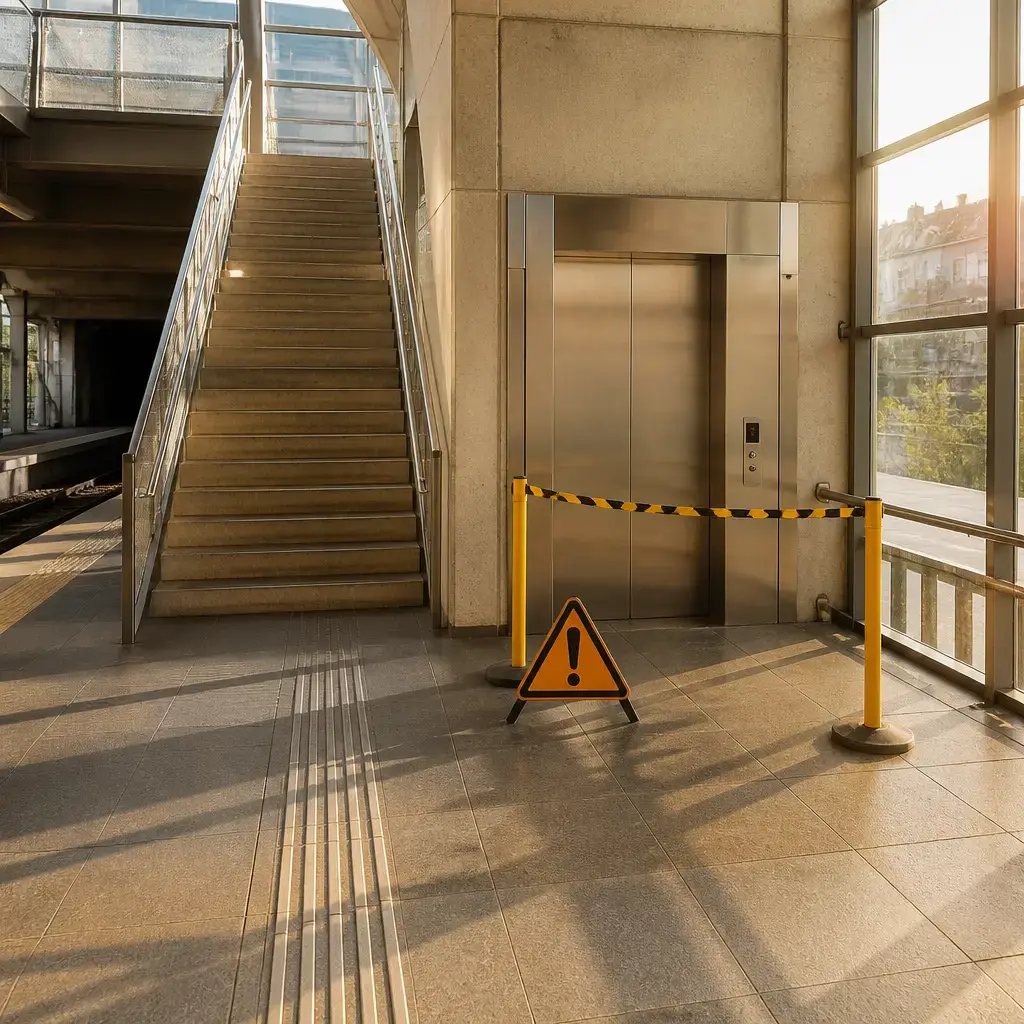
In “Den nærmeste elevator”, elevator means elevator or lift. It is the facility being discussed as closed and replaced by another elevator.
lukket
In “er lukket”, lukket describes the elevator’s current state as closed or unavailable. The phrase is useful for explaining why a facility cannot be used.
på grund af
In “på grund af vedligeholdelse”, the whole expression means “because of” and gives the reason for the elevator being closed. “På” contributes the linking expression, “grund” refers to a reason or basis, and “af” completes the relation to the cause that follows.
vedligeholdelse
In “på grund af vedligeholdelse”, vedligeholdelse means maintenance. It names the work being done as the reason the elevator is closed.
lige
In “lige nu”, lige emphasizes that something is happening at this exact moment. This expression is useful when stressing that a situation is current.
nu
In “lige nu”, nu means “now” and places the elevator’s closure in the present moment. It is also used in “Gå nu” and “Jeg går den vej nu” to refer to immediate action.
Det
In “Det kan være svært”, Det refers to the situation of using the alternate route with the heavy suitcase. In “Det kræver en kort gåtur”, it refers to that route and means “it” in the statement about what the route requires.
kan
In “Det kan være svært”, kan expresses possibility and means “might” in this context. In “Kan du vise mig”, it asks whether the other person is able to show the way.
være
In “kan være svært”, være is the form used after kan to express that something is or may be difficult. The pattern “kan være” is useful before a description of a possible situation.
svært
In “kan være svært”, svært describes the situation as difficult. Here the difficulty is connected with traveling with the heavy suitcase.
med
In “svært med min tunge kuffert”, med links the difficulty to the circumstance involving the suitcase and means “with”. It is useful for identifying the object or situation that makes something difficult.
min
In “min tunge kuffert”, min shows that the suitcase belongs to or is associated with the speaker. It comes before the noun phrase being identified as the speaker’s.
tunge
In “min tunge kuffert”, tunge means “heavy” and describes the suitcase. It helps explain why the longer route may be difficult for the traveler.
kuffert
In “min tunge kuffert”, kuffert means suitcase. It is the item the traveler is carrying and the circumstance connected with the difficulty.
Brug
In “Brug elevatoren”, Brug is a direct instruction meaning “use”. It is useful when telling someone which facility, tool, or route to choose.
elevatoren
In “Brug elevatoren”, elevatoren means “the elevator” and refers to a specific elevator already identified by the station staff. The ending marks the noun as definite.
ved
In “ved den nordlige indgang”, ved means “by” or “near” and locates the elevator in relation to the entrance. It is useful for identifying the position of a place or object near a landmark.
nordlige
In “den nordlige indgang”, nordlige means “northern” and identifies the entrance by its direction. It describes indgang within the location phrase.
indgang
In “den nordlige indgang”, indgang means entrance. It names the landmark used to locate the alternate elevator.
kræver
In “Det kræver en kort gåtur”, kræver means “requires”. The route is presented as needing a short walk, so the word introduces what is necessary.
kort
In “en kort gåtur”, kort means “short” and describes the distance or duration of the walk. It comes before gåtur to specify what kind of walk is required.
gåtur
In “en kort gåtur”, gåtur means a walk. It names the extra walking that the alternate elevator route requires.
du
In “Kan du vise mig” and “Hvis du går nu”, du means “you” and refers to the traveler being addressed. It identifies the person who may show the way or leave now.
vise
In “Kan du vise mig, hvor den er”, vise means “show” or “point out”. It introduces the action of indicating where the elevator is, with mig identifying the person receiving the information.
mig
In “vise mig”, mig means “me” and identifies the person to whom the way should be shown. It follows vise as the person receiving that action.
hvor
In “hvor den er”, hvor means “where” and introduces the clause that gives the elevator’s location. It is useful when asking someone to identify the position of a person or thing.
eller
In “eller er skiltene nemme at følge”, eller means “or” and connects two alternatives: asking for directions or relying on the signs. It is useful for presenting another possible way to solve a problem.
skiltene
In “er skiltene nemme at følge”, skiltene means “the signs” and refers to the specific station signs. The ending marks the plural noun as definite.
nemme
In “nemme at følge”, nemme means “easy” and describes the signs as easy to follow. The phrase evaluates how clearly the signs guide the traveler.
at
In “at følge”, at marks the following verb as an infinitive and corresponds to “to” in “to follow”. Here it connects følge with the description “nemme”.
følge
In “at følge”, følge means “follow” and refers to following the signs. It also appears as the instruction “følg”, so the word is useful for talking about following directions or instructions.
Gå
In “Gå forbi billetautomaterne”, Gå is a direct instruction meaning “go” or “walk”. It starts the directions the traveler should follow through the station.
forbi
In “Gå forbi billetautomaterne”, forbi means “past” and tells the traveler to pass the ticket machines. It is useful with a landmark that someone should move past.
billetautomaterne
In “forbi billetautomaterne”, billetautomaterne means “the ticket machines”. It identifies the station landmark that the traveler should pass.
og
In “og følg så de blå skilte”, og means “and” and joins the next direction to the instruction to go past the ticket machines. It connects related actions in a sequence.
følg
In “følg så de blå skilte”, følg is an instruction meaning “follow”. It tells the traveler to use the blue signs for the rest of the route.
så
In “følg så de blå skilte”, så means “then” and marks the next step after passing the ticket machines. It is useful for ordering directions or actions.
de
In “de blå skilte”, de marks the signs as specific and plural, meaning “the”. It appears before the adjective and noun in this phrase.
blå
In “de blå skilte”, blå means “blue” and identifies the signs by their color. The color helps the traveler recognize which signs to follow.
skilte
In “de blå skilte”, skilte means “signs” and is the plural noun in the phrase “the blue signs”. It identifies the written or visual directions the traveler should follow.
jeg
In “Jeg går den vej nu”, jeg means “I” and refers to the traveler speaking. It identifies the person who is going toward the alternate route.
stadig
In “stadig nå toget”, stadig means “still” and asks whether reaching the train remains possible despite the extra walk. It is useful when checking whether a plan is still on time.
nå
In “nå toget”, nå means to reach or manage to catch the train before it leaves. In “nå frem”, it means to get there or arrive, so the surrounding words determine the destination or outcome.
toget
In “nå toget”, toget means “the train” and refers to the specific train the traveler wants to catch. The ending marks the noun as definite.
før
In “før det kører”, før means “before” and introduces the event that must not happen first. Here it sets the train’s departure as the time limit for reaching it.
kører
In “før det kører”, kører describes the train leaving or going. In this station context, it refers to the train’s departure rather than to a person driving.
Hvis
In “Hvis du går nu” and “hvis du får brug for hjælp”, Hvis or hvis means “if” and introduces a condition. It is useful for explaining what will happen when a particular situation occurs.
går
In “Hvis du går nu”, går means “go” or “leave” and describes the traveler setting off now. Together with du and nu, it states the condition for arriving with time to spare.
burde
In “burde du nå frem”, burde means “should” and expresses an expectation that the traveler will arrive in time. It gives reassurance without presenting the result as completely certain.
frem
In “nå frem”, frem contributes the idea of reaching the destination or getting there. It is used together with nå here rather than as a standalone location word.
i
In “i god tid”, i is part of the expression meaning “with time to spare” or “in good time”. Here it does not describe a physical location; it helps express available time before the train leaves.
god
In “i god tid”, god contributes the idea that there is sufficient or favorable time available. The full expression is useful when reassuring someone that they are not late.
tid
In “i god tid”, tid means “time” and refers to the time available before the train departs. Together with i god, it expresses a comfortable time margin.
Spørg
In “Spørg personalet”, Spørg is an instruction meaning “ask”. It tells the traveler to request assistance from the staff if necessary.
personalet
In “Spørg personalet”, personalet means “the staff” and refers to the station employees who can provide help. The ending marks the group as specific.
gaten
In “ved gaten”, gaten means “the gate” and identifies the specific gate area where the staff can be found. The ending marks the noun as definite.
får brug for
In “får brug for hjælp”, the whole expression means “need help”. “Får” contributes the idea of getting or coming to, “brug” contributes “use”, and “for” completes the expression before the thing needed. A reusable pattern is the full expression followed by the need, as in “får brug for hjælp”.
hjælp
In “får brug for hjælp”, hjælp means “help” and is the assistance the traveler may need. It is the thing that follows the expression “får brug for”.
undervejs
In “hjælp undervejs”, undervejs means “on the way” or “while traveling”. It tells the traveler that assistance may be needed during the journey to the elevator, not only after arriving.