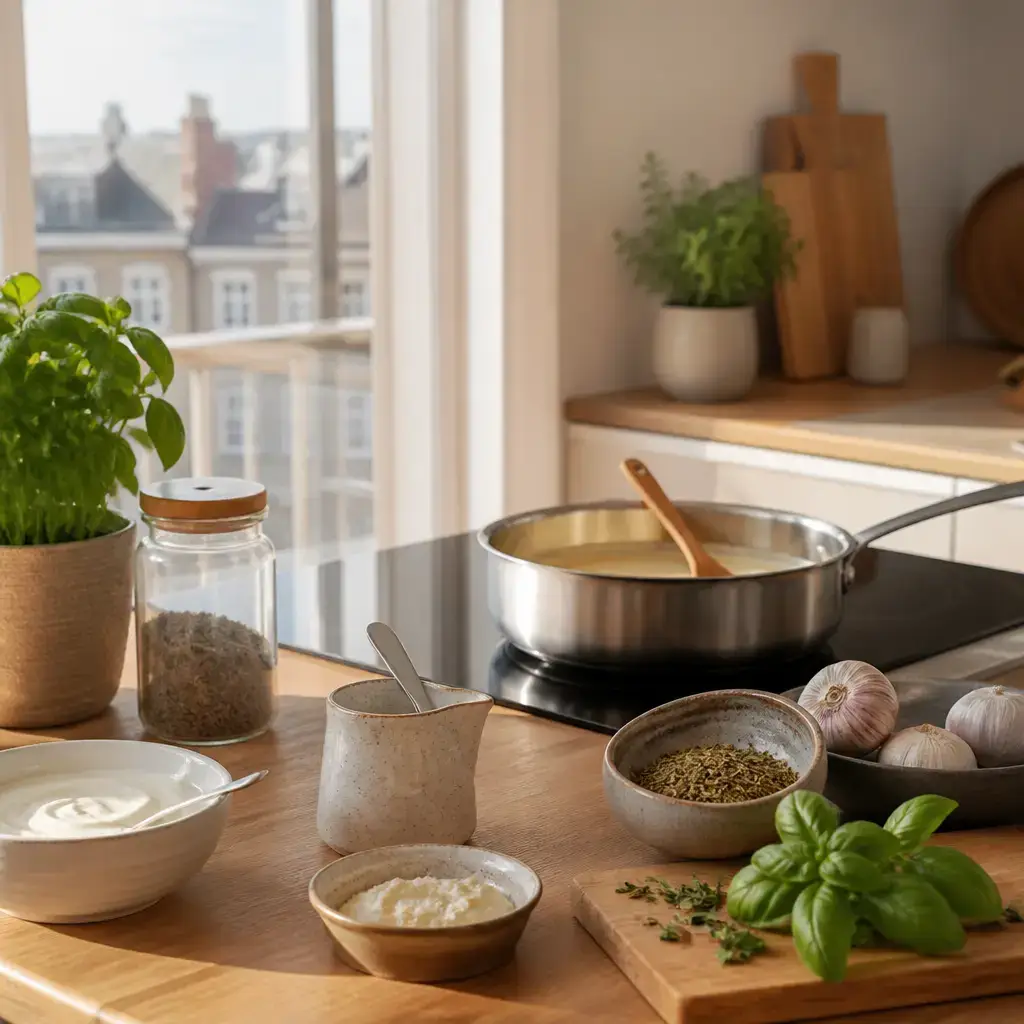
Opskriften
“Opskriften” means “the recipe” in “Opskriften kræver frisk basilikum” and refers to the recipe being followed. It is used as the subject when stating what a recipe requires, as in “Opskriften siger også”. Use it when discussing written cooking instructions at home.
kræver
“Kræver” means “requires” here: the recipe requires fresh basil. It states that something is necessary and takes the required item after it, as in “kræver frisk basilikum”. Use it when explaining what a recipe, task, or situation needs.
frisk
“Frisk” means “fresh” and describes the basil in “frisk basilikum”. It comes directly before the ingredient it describes. Use it when distinguishing a fresh ingredient from the dried alternative mentioned later.
basilikum
“Basilikum” means “basil”, the fresh herb required by the recipe. In “frisk basilikum”, it names the ingredient after its description. Use it when identifying basil as an ingredient in a recipe or dish.
men
“Men” means “but” and introduces the problem that only dried herbs are available after the recipe requires fresh basil. It connects two contrasting parts, as in “..., men vi har kun tørrede krydderurter”. Use it to contrast a requirement with the available alternative.
vi
“Vi” means “we” and refers to the two people preparing the food together. It is used as the subject in “vi har”, “Vi kan stadig lave den”, and “vi bruger”. Use it when describing an action shared by yourself and another person.
har
“Har” means “have” in “vi har kun tørrede krydderurter”, stating what the speakers have available. It is used with the available item after it. Use it when saying what ingredients or supplies are on hand.
kun
“Kun” means “only” and limits what the speakers have: they have dried herbs and no fresh basil mentioned here. It appears before the available item in “har kun tørrede krydderurter”. Use it to point out a limited choice or quantity.
tørrede
“Tørrede” means “dried” and describes the herbs available in “tørrede krydderurter”. It appears before the plural ingredient it describes. Use it when identifying dried herbs as a substitute for fresh basil.
krydderurter
“Krydderurter” means “herbs” and names the dried ingredients available in the kitchen. It appears in “tørrede krydderurter” and later as the object of “tilsætte”. Use it when talking about herbs used to season food.
kan
“Kan” means “can” in “Vi kan stadig lave den”, expressing that making the dish remains possible. In “kan smage kraftigere” and “kan saucen skille”, it introduces another possible result. Use it before an infinitive to discuss ability or possibility.
stadig
“Stadig” means “still” and shows that the dish can be made despite the missing fresh basil. It appears after “kan” in “kan stadig lave den”. Use it when something remains possible or true after a change or difficulty.
lave
“Lave” means “make” or “cook” in “Vi kan stadig lave den”. It follows “kan” and takes “den” as the thing being made. Use it when talking about preparing a dish or making something in a practical situation.
den
“Den” means “it” here and refers to the dish they are discussing and preparing. In “lave den”, it is the object of “lave”. Use it to refer back to a previously mentioned item when its identity is already clear.
smagen
“Smagen” means “the flavor” in “smagen bliver bare lidt anderledes”. It names the flavor as the thing that changes when dried herbs are used. Use it when describing how a dish tastes.
bliver
“Bliver” means “becomes” or, in this context, “will be” in “smagen bliver ... anderledes”. It describes a change in the flavor and also appears in “resultatet bliver godt”. Use it when saying what something turns into or how it ends up.
bare
“Bare” means “just” and softens the statement that the flavor will be different: “bare lidt anderledes”. It minimizes the difference rather than presenting it as a serious problem. Use it to describe a limited or relatively small change.
lidt
“Lidt” means “a little” and limits the degree of difference in “lidt anderledes”. It comes before the word describing the degree or quality. Use it when describing a small amount or a minor change.
anderledes
“Anderledes” means “different” and describes how the flavor will be after the substitution. In “smagen bliver ... anderledes”, it describes the resulting state. Use it when comparing a result with what was originally expected.
Skal
“Skal” means “should” in the question “Skal vi tilsætte de tørrede krydderurter tidligere?” It presents a suggestion for a shared action and comes before “vi”. Use it when asking whether a proposed action should be taken.
tilsætte
“Tilsætte” means “add” in “Skal vi tilsætte de tørrede krydderurter”. It names the action of putting an ingredient into the dish and takes the ingredient as its object. Use it when discussing adding an ingredient during cooking.
de
“De” is “the” before the plural ingredient phrase “de tørrede krydderurter”. It identifies the specific herbs already mentioned in the conversation. Use it before a known plural group of ingredients or objects.
tidligere
“Tidligere” means “earlier” in “tilsætte ... tidligere” and “Add them earlier” in the reply. It indicates a point before the originally planned time. Use it when changing the timing of a cooking step or another action.
så
In “så de bliver bløde”, “så” means “so that” and introduces the intended result of adding the herbs earlier. At the start of “Så behøver vi ikke gætte næste gang”, “Så” means “then” and introduces the consequence. Use it either to connect an action with its result or to move to a consequence.
bløde
“Bløde” means “soft” in “de bliver bløde i saucen”. It describes the condition the herbs are expected to reach while in the sauce. Use it when describing food becoming soft during cooking.
i
“I” means “in” in “i saucen” and places the herbs inside the sauce. It introduces the container or mixture where the change happens. Use it before a place, container, or mixture that something is in.
saucen
“Saucen” means “the sauce” and is the mixture in which the herbs soften. It appears after “i” in “i saucen” and later as the subject of “saucen skille”. Use it when referring to the specific sauce being prepared.
Tilsæt
“Tilsæt” means “add” as a direct instruction in “Tilsæt dem tidligere”. It tells the listener to add the herbs earlier in the process. Use it when giving a cooking instruction to another person.
dem
“Dem” means “them” and refers back to the dried herbs in “Tilsæt dem tidligere”. It is the object of the instruction “Tilsæt”. Use it to avoid repeating a known plural ingredient or group of objects.
og
“Og” means “and” and links two instructions: “Tilsæt dem tidligere, og brug mindre”. It joins related actions in the same advice. Use it to connect steps or recommendations that belong together.
brug
“Brug” means “use” as the instruction “brug mindre”, telling the listener to use a smaller amount. It takes the quantity word “mindre” after it. Use it when giving advice about how much of an ingredient or resource to use.
mindre
“Mindre” means “less” in “brug mindre”, referring to the amount of dried herbs. It follows “brug” to specify a reduced quantity. Use it when recommending a smaller amount of an ingredient or something uncounted.
fordi
“Fordi” means “because” and introduces the reason for using less: dried herbs can taste stronger. It connects advice with its explanation, as in “brug mindre, fordi ...”. Use it when giving a reason for a cooking decision.
smage
“Smage” means “taste” in “tørrede krydderurter kan smage kraftigere”. It describes the flavor effect the herbs can have. It follows “kan” and can be used when explaining how an ingredient or dish tastes.
kraftigere
“Kraftigere” means “stronger” and describes the stronger taste of dried herbs. It appears after “smage” in “smage kraftigere”. Use it when comparing the intensity of a taste or another sensory effect.
siger
“Siger” means “says” in “Opskriften siger også”. It introduces information given by the recipe, followed by “at” and the instruction about cream. Use it when reporting what a person, text, or instruction states.
også
“Også” means “also” and adds the cream instruction to the earlier recipe information. In “Opskriften siger også”, it shows that this is another thing the recipe says. Use it when adding a related point to information already given.
at
In “siger også, at vi skal bruge fløde”, “at” introduces the content of what the recipe says. In “for at få en jævn konsistens”, it helps introduce the purpose of using cream. Use it in these exact patterns when reporting information or expressing purpose.
bruge
“Bruge” means “use” in “vi skal bruge fløde” and names the action recommended by the recipe. It follows “skal” and takes “fløde” as its object. Use it when saying which ingredient or tool is needed for a preparation.
fløde
“Fløde” means “cream”, the ingredient the recipe recommends for a smooth texture. It appears as the object of “bruge” in “bruge fløde”. Use it when identifying cream as an ingredient in a sauce or other dish.
for
In “for at få en jævn konsistens”, “for” is part of the purpose expression meaning “in order to”. It connects using cream with the intended result, a smooth texture. Use the exact pattern “for at få” when explaining the purpose of an action.
få
“Få” means “get” in “for at få en jævn konsistens”, describing the desired result of using cream. It follows “at” in the purpose expression. Use it when describing obtaining or achieving a result.
en
“En” means “a” in “en jævn konsistens”. It introduces the singular texture being sought. Use it before a singular noun when referring to one unspecified result or quality.
jævn
“Jævn” means “smooth” in “en jævn konsistens”. It describes the desired even texture of the sauce. Use it when describing a sauce or mixture whose texture is smooth and even.
konsistens
“Konsistens” means “texture” or “consistency” in “en jævn konsistens”. It names the quality the cream is intended to produce. Use it when discussing how thick, smooth, or even a food mixture feels.
Hvis
“Hvis” means “if” and introduces a condition in “Hvis vi bruger yoghurt i stedet”. It also begins “Hvis resultatet bliver godt”. Use it to state a condition before describing its possible result or consequence.
bruger
“Bruger” means “use” in the condition “Hvis vi bruger yoghurt i stedet”. It describes the possible choice to use yogurt instead of cream. Use it in a conditional clause when discussing what ingredients the cooks choose.
yoghurt
“Yoghurt” means “yogurt”, the proposed substitute for cream in the sauce. It is the object of “bruger” in “bruger yoghurt i stedet”. Use it when identifying yogurt as an alternative ingredient.
stedet
“Stedet” contributes to the expression “i stedet”, which means “instead” here. The whole expression shows that yogurt replaces cream rather than being added alongside it. Use “i stedet” when describing a substitution.
bør
“Bør” means “should” or “ought to” in “bør vi skrue ned for varmen”. It gives advice about what to do if yogurt is used. Use it when recommending an action as sensible or advisable.
skrue
“Skrue” means “turn” or “adjust” in the cooking expression “skrue ned for varmen”. It names the action of reducing the heat setting. Use it with “ned” and “for varmen” when advising someone to lower the heat.
ned
“Ned” means “down” in “skrue ned for varmen”. Together with “skrue”, it indicates a reduction rather than a physical downward movement. Use it in this expression when lowering a heat setting or another adjustable level.
varmen
“Varmen” means “the heat” in “skrue ned for varmen”. It is the setting that should be reduced when using yogurt. Use it when talking about the heat level under a pan or during cooking.
Ellers
“Ellers” means “otherwise” and introduces the unwanted result of not lowering the heat: the sauce might separate and look strange. It connects an omitted action with its consequence. Use it to warn what may happen if advice is not followed.
skille
“Skille” means “separate” in “saucen skille”. Here it describes the sauce losing its smooth mixture. It follows “kan” and is useful when warning about a possible cooking problem.
se
“Se” contributes the meaning “look” or “appear” in “se mærkelig ud”. Together with “ud”, it describes how the sauce may appear rather than the act of seeing it. Use it when describing the visible appearance of a dish.
mærkelig
“Mærkelig” means “strange” in “se mærkelig ud”. It describes the unusual appearance the sauce might have if it separates. Use it when saying that food or another result looks unusual.
ud
“Ud” is part of the expression “se mærkelig ud”, which means “look strange”. It completes the appearance expression with “se” and does not mean “out” separately in this sentence. Use it with “se” when describing how something looks.
Det
“Det” means “it” or “that” in “Det burde hjælpe”. It refers to the proposed method of stirring the mixture in slowly near the end. Use it to point back to an action or situation just mentioned.
burde
“Burde” means “should” or “ought to” in “Det burde hjælpe”. It expresses an expected helpful effect rather than a firm guarantee. Use it when making a cautious recommendation or prediction.
hjælpe
“Hjælpe” means “help” in “Det burde hjælpe at røre det langsomt i”. It describes the expected benefit of the stirring method. It follows “burde” and can be used when an action is expected to improve a situation.
røre
“Røre” means “stir” in “at røre det langsomt i”. The phrase describes incorporating the mixture by stirring it in slowly. Use it when giving instructions for mixing an ingredient into a sauce.
langsomt
“Langsomt” means “slowly” and describes how the stirring should be done in “røre det langsomt i”. It gives the manner of the action. Use it when a cooking step should be carried out gently or at a slow pace.
til
“Til” is part of the expression “til sidst”, meaning “at the end” or “near the end”. In the dialogue it places the stirring step late in the cooking process. Use “til sidst” when specifying the final stage of a process.
sidst
“Sidst” means “last” or “at the end” in “til sidst”. Together with “til”, it identifies when the stirring should happen. Use it when placing an action at the end of a sequence.
resultatet
“Resultatet” means “the result” in “Hvis resultatet bliver godt”. It refers to how the adapted dish turns out. Use it when evaluating the outcome of a recipe or another process.
godt
“Godt” means “well” or “good” in “resultatet bliver godt”, describing a successful result. It follows “bliver” and evaluates how the result turns out. Use it when saying that a dish or process has produced a good outcome.
skriver
“Skriver” means “write” or “writes” in “skriver jeg ned”. In this conditional sentence, it describes the speaker’s planned action if the result is good. Use it with “ned” when recording information for later use.
jeg
“Jeg” means “I” and identifies the speaker who will record the substitution in “skriver jeg ned”. It appears after the conditional clause in the main clause. Use it when talking about your own action or decision.
hvad
“Hvad” means “what” and introduces the information being written down in “hvad vi brugte i stedet”. It asks indirectly which substitute was used. Use it to introduce an indirect question or information about an unknown thing.
brugte
“Brugte” means “used” in “hvad vi brugte i stedet”. It describes the ingredient choice that was made during the cooking. Use it when referring back to what was used in a completed preparation.
behøver
“Behøver” means “need” in “behøver vi ikke gætte”. With “ikke” and the following infinitive, it expresses that guessing will not be necessary. Use the pattern “behøver ... ikke” when saying that an action is unnecessary.
ikke
“Ikke” means “not” and negates the need to guess in “behøver vi ikke gætte”. It appears with “behøver” to form the meaning “do not need to”. Use it to deny or exclude an action or situation.
gætte
“Gætte” means “guess” in “behøver vi ikke gætte”. It is the action that will no longer be necessary because the substitution has been recorded. Use it when someone must decide without certain information.
næste
“Næste” means “next” in “næste gang”. It describes the following occasion when they cook the recipe. Use it before a time or occasion noun to refer to the one coming after the current one.
gang
“Gang” means “time” or “occasion” in “næste gang”. The phrase refers to the next time they prepare the dish. Use it with a time word such as “næste” when referring to a future occasion.