Min
‘Min’ means ‘my’ here and identifies the cousin as belonging to the speaker. It is placed before ‘kusine’ in the reusable pattern ‘Min kusine’ when talking about the speaker’s female cousin.
kusine
‘kusine’ means ‘female cousin’ in this dialogue. Use it after a possessive such as ‘Min’ when introducing a female cousin.
kommer
‘kommer’ means ‘is coming’ here, describing the cousin’s arrival. It can be used for someone coming to a place, as in ‘Hun kommer’ for ‘She is coming.’
og
‘og’ means ‘and’ and links ‘kommer’ with ‘skal bo’. It is useful for joining two connected actions or events.
skal
In ‘skal bo’, ‘skal’ indicates that the cousin is going to stay; in ‘Skal vi’, it introduces a suggestion or question about what to do. It is commonly followed by another verb in its basic form, such as ‘bo’ or ‘lægge’.
bo
‘bo’ means ‘live’ or ‘stay’ in ‘skal bo hos os’. With ‘skal’, it describes a planned stay with the speakers.
hos
‘hos’ means ‘at or with someone’ in ‘hos os’. Use it before a person or pronoun to identify whose home or company is involved.
os
‘os’ means ‘us’ after ‘hos’, so ‘hos os’ means ‘with us’ or ‘at our place’. The same form is used when the speakers are the people affected by an action.
på
In ‘på et kort besøg’, ‘på’ is part of the expression meaning ‘on a visit’ or ‘for a visit’. It is reused in the pattern ‘på et besøg’ when describing a visit.
et
‘et’ is the indefinite article before ‘kort besøg’, meaning ‘a’. It is used with this neuter noun in the phrase ‘et kort besøg’.
kort
‘kort’ means ‘short’ and describes the duration of ‘besøg’. It can be placed before a noun to describe a short event or period.
besøg
‘besøg’ means ‘visit’ in ‘et kort besøg’. Use it with a duration or purpose when talking about someone visiting.
Vi
‘Vi’ means ‘we’ and refers to the two people preparing the room. It commonly appears at the beginning of a sentence before the verb, as in ‘Vi bør gøre …’.
bør
‘bør’ means ‘should’ and expresses a recommendation about preparing the room. It is followed by a verb in its basic form, such as ‘gøre’.
gøre
In ‘gøre gæsteværelset mere behageligt’, ‘gøre’ means ‘make’, because the speakers want to change the room’s condition. The reusable pattern is ‘gøre noget mere …’ when making something more a certain way.
gæsteværelset
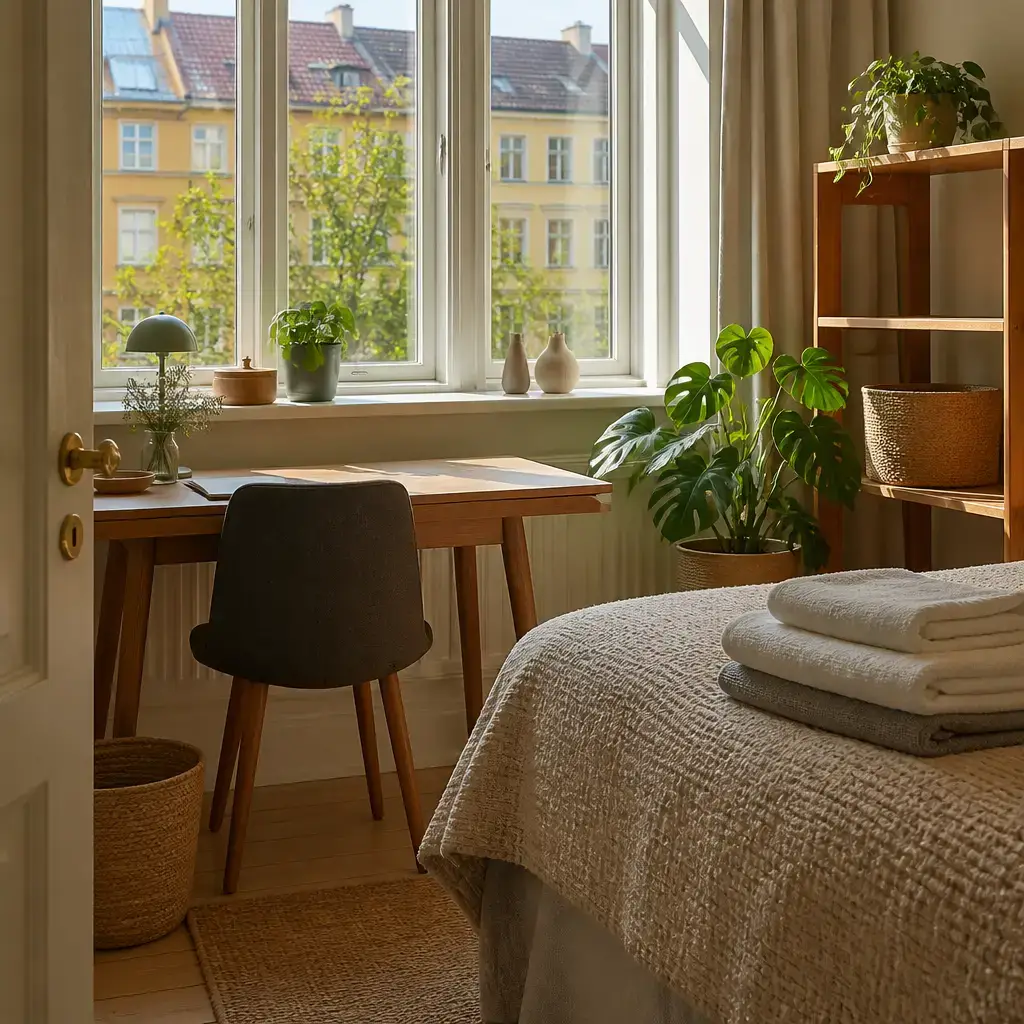
‘gæsteværelset’ means ‘the guest room’, referring to the specific room being prepared. The definite form is used because both speakers know which room they mean.
mere
‘mere’ means ‘more’ and shows that the guest room should become more comfortable than it is now. It can be placed before an adjective, as in ‘mere behageligt’.
behageligt
‘behageligt’ means ‘comfortable’ in the result ‘make the guest room more comfortable’. It describes the condition the room should have after the preparation.
før
‘før’ means ‘before’ and introduces the time when the room should be prepared. It can link an action to a later event, as in ‘før hun kommer’.
hun
‘hun’ means ‘she’ and refers to the cousin. Use it as the subject of a clause, for example before ‘kommer’.
Lad
‘Lad’ means ‘let’ in ‘Lad mig rydde’, introducing an offer to do something. The reusable pattern is ‘Lad mig’ followed by an action.
mig
‘mig’ means ‘me’ after ‘Lad’, so ‘Lad mig’ means ‘let me’. It identifies the person who will carry out the following action.
rydde
‘rydde’ means ‘clear’ or ‘tidy’ in ‘rydde skrivebordet’. Use it before the object that is being cleared or tidied.
skrivebordet
‘skrivebordet’ means ‘the desk’, specifically the desk that should be cleared for the laptop. The definite form refers to a particular desk in the room.
så
‘så’ means ‘so that’ here and introduces the purpose of clearing the desk. It links one action to the result or purpose that follows.
har
‘har’ means ‘has’ in ‘hun har plads’. It expresses that someone has or possesses something, such as space.
plads
‘plads’ means ‘space’ in ‘plads til sin bærbare computer’. The common pattern is ‘plads til’ followed by the person or thing that needs space.
til
‘til’ means ‘for’ in ‘plads til sin bærbare computer’. It marks what the available space is intended for.
sin
‘sin’ means ‘her own’ in this clause and refers back to the female subject ‘hun’. It is used before the noun that belongs to that subject, here ‘bærbare computer’.
bærbare
‘bærbare’ contributes the meaning ‘portable’ in ‘sin bærbare computer’, the Danish expression for a laptop. It describes the computer and appears directly before ‘computer’.
computer
‘computer’ means ‘computer’ in the phrase ‘bærbare computer’. Together with ‘bærbare’, it identifies the device for which the desk needs space.
instruktionerne
‘instruktionerne’ means ‘the instructions’ about using the internet. The definite plural form refers to the particular instructions the guest should find.
om
‘om’ means ‘about’ in ‘instruktionerne om internettet’. It introduces the subject that the instructions concern.
internettet
‘internettet’ means ‘the internet’. In ‘om internettet’, it specifies what the instructions are about.
ligge
‘ligge’ means ‘be left’ or ‘lie’ in ‘Lad instruktionerne … ligge’. The construction tells someone to leave the instructions in a place.
sted
‘sted’ means ‘place’ in ‘et sted, hvor …’. It identifies an unspecified location and is followed by information about where the guest can find the instructions.
hvor
‘hvor’ means ‘where’ and introduces the clause describing the place. The pattern ‘et sted, hvor …’ is used to say where something can happen or be found.
nemt
‘nemt’ means ‘easily’ here and describes how the guest can find the instructions. It is placed near the verb phrase ‘kan finde dem’ to describe the manner of finding them.
kan
‘kan’ means ‘can’ and expresses the guest’s ability to find the instructions. It is followed by the basic form ‘finde’.
finde
‘finde’ means ‘find’ in ‘kan finde dem’. After ‘kan’, it stays in this basic form and is followed by the object being found.
dem
‘dem’ means ‘them’ and refers to ‘instruktionerne’. It appears after ‘finde’ as the object of the finding.
lægge
‘lægge’ means ‘put’ or ‘place’ in the question about putting towels in the room. It is used for placing something somewhere and is followed by a location such as ‘på værelset’.
ekstra
‘ekstra’ means ‘extra’ and describes towels in addition to the usual ones. It is placed directly before the noun ‘håndklæder’.
håndklæder
‘håndklæder’ means ‘towels’ and refers to the extra towels for the guest. It is used as the object after ‘lægge’ in the question.
værelset
‘værelset’ means ‘the room’ and identifies where the towels should be placed. The definite form refers to the guest room already being discussed.
eller
‘eller’ means ‘or’ and presents the alternative of showing the cupboard. It joins two options in a question, such as ‘lægge … eller vise …’.
vise
‘vise’ means ‘show’ in ‘vise hende skabet’. It is followed by the person being shown something and then the thing being shown.
hende
‘hende’ means ‘her’ and identifies the female guest as the person who might be shown the cupboard. It follows ‘vise’ as the person receiving the information.
skabet
‘skabet’ means ‘the cupboard’. In ‘vise hende skabet’, it is the specific cupboard that could be shown to the guest.
Læg
‘Læg’ means ‘put’ or ‘place’ as a direct instruction to put the towels in the room. It is the command form used at the beginning of ‘Læg dem på værelset’.
Det
‘Det’ means ‘it’ and refers to putting the towels in the room. It is the subject of the following statement about the benefit for guests.
giver
‘giver’ means ‘gives’ in ‘giver gæster mere privatliv’. It is used with the receiver and the benefit that the action provides.
gæster
‘gæster’ means ‘guests’ and identifies the people who receive more privacy. It follows ‘giver’ as the receiver of the benefit.
privatliv
‘privatliv’ means ‘privacy’ in the phrase ‘mere privatliv’. It is the benefit guests get when towels are already available in the room.
Jeg
‘Jeg’ means ‘I’ and introduces the speaker’s personal preference about being a host. It commonly appears before the verb, as in ‘Jeg vil gerne være …’.
vil
‘vil’ means ‘want’ in ‘vil gerne være’. Together with ‘gerne’, it expresses a wish or preference to be something or do something.
gerne
‘gerne’ helps express ‘would like to’ in ‘vil gerne være’. The reusable pattern is ‘vil gerne’ followed by a verb in its basic form.
være
‘være’ means ‘be’ in ‘vil gerne være en afslappet vært’. After ‘vil gerne’, it describes the role or quality the speaker wants to have.
en
‘en’ means ‘a’ before ‘afslappet vært’. It introduces one host as a general description of the speaker’s desired role.
afslappet
‘afslappet’ means ‘relaxed’ and describes the kind of host the speaker wants to be. It appears before the noun ‘vært’ in this description.
vært
‘vært’ means ‘host’, the person receiving or accommodating a guest. The phrase ‘en afslappet vært’ describes a host who does not make the visit overly formal.
ikke
‘ikke’ means ‘not’ and negates the description that follows. In ‘ikke en, der forklarer …’, it contrasts the desired host with someone who explains every detail.
der
‘der’ means ‘who’ or ‘that’ in the relative clause ‘der forklarer …’. It links the description of the person to the action they perform.
forklarer
‘forklarer’ means ‘explains’ in the relative clause. It describes what the unwanted type of host does and is followed by the thing being explained.
hver
‘hver’ means ‘every’ in ‘hver eneste detalje’. It points to all individual details, not just details in general.
eneste
‘eneste’ adds the sense of ‘single’ or ‘every single’ in ‘hver eneste detalje’. Together with ‘hver’, it emphasizes that no detail is omitted.
detalje
‘detalje’ means ‘detail’ in ‘hver eneste detalje’. It is the object of ‘forklarer’, identifying what the overly explanatory host would explain.
besked
‘besked’ means ‘note’ in this context, referring to a short written message for the guest. It can also refer to a message more generally, but here it is information left for someone.
er
‘er’ means ‘is’ in ‘En kort besked er nok’. It connects the note with the judgment that it is sufficient.
nok
‘nok’ means ‘enough’ and says that a short note is sufficient. The pattern ‘X er nok’ is useful when saying that something meets the need.
især
‘især’ means ‘especially’ and highlights the most useful subjects for the note. It is followed here by ‘om’ and the topics being highlighted.
nøgler
‘nøgler’ means ‘keys’ and is one of the topics the note should cover. It appears in a list after ‘især om’.
lys
‘lys’ means ‘lights’ in the list of practical information for the guest. It is another topic introduced by ‘om’.
morgenmad
‘morgenmad’ means ‘breakfast’. In the dialogue, it is one of the subjects worth mentioning in the short note.
Hvis
‘Hvis’ means ‘if’ and introduces a condition about preparing the room in advance. It begins the conditional clause ‘Hvis vi gør det klar på forhånd’.
gør
In ‘gør det klar’, ‘gør’ means ‘make’ and describes preparing something so it is ready. The reusable pattern is ‘gøre noget klar’ for preparing something.
klar
‘klar’ means ‘ready’ in ‘gør det klar’. It describes the result that the object should have after the preparation.
på forhånd
The whole expression ‘på forhånd’ means ‘in advance’, before the relevant time. In this expression, ‘på’ and ‘forhånd’ work together to show that something is done early; it can be reused after an action such as ‘gør det klar på forhånd’.
behøver
‘behøver’ means ‘need to’ in ‘behøver vi ikke skynde os’, which says that the speakers do not need to hurry. The pattern ‘behøver ikke’ is used to say that an action is unnecessary.
skynde
‘skynde’ means ‘hurry’ in ‘skynde os’. With ‘os’, it describes the speakers moving or acting quickly because of time pressure.
senere
‘senere’ means ‘later’ and refers to a later time when the visit is closer or underway. It can be placed at the end of a sentence about doing something later.
får
‘får’ means ‘makes’ in ‘får hende til at føle sig velkommen’. It introduces the result that the preparation causes for the guest.
at
‘at’ is the infinitive marker before ‘føle’ and forms ‘til at føle’. It links the result introduced by ‘får’ to the action the guest experiences.
føle
‘føle’ means ‘feel’ in ‘føle sig velkommen’. It describes the guest’s emotional experience after the room has been prepared.
sig
‘sig’ means ‘herself’ in ‘føle sig velkommen’ and refers back to ‘hende’. It is used with ‘føle’ when the person experiences a feeling about herself.
velkommen
‘velkommen’ means ‘welcome’ in ‘føle sig velkommen’. The phrase describes the guest’s feeling that she is received warmly.
uden
‘uden’ means ‘without’ and introduces something that does not happen: making the visit too formal. It is followed here by an action expressed with ‘at’.
besøget
‘besøget’ means ‘the visit’, referring to the cousin’s stay. The definite form identifies the particular visit already discussed.
for
‘for’ means ‘too’ in ‘for formelt’, indicating an excessive degree of formality. It is placed directly before the adjective it intensifies.
formelt
‘formelt’ means ‘formal’ in the phrase ‘for formelt’. Together, ‘for formelt’ means ‘too formal’ and describes a visit that would feel excessively formal.