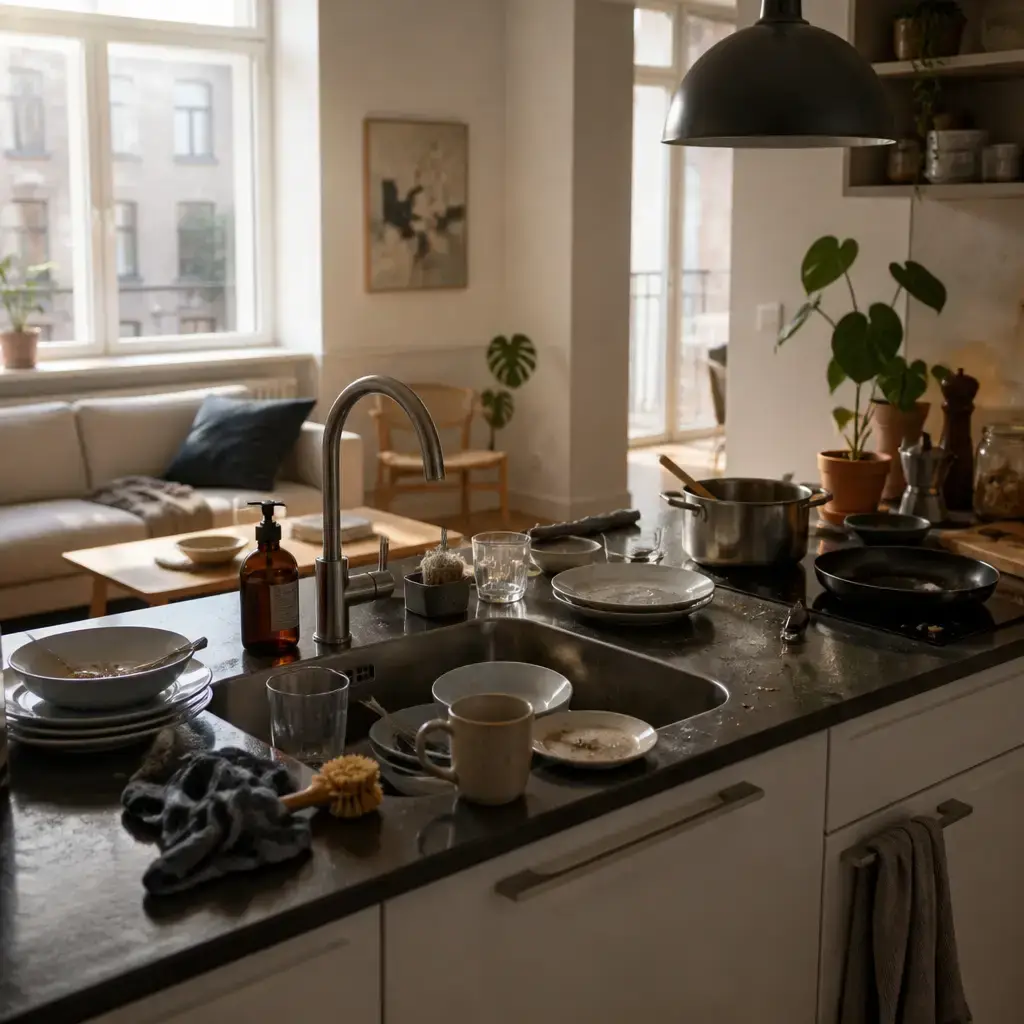
Vores
‘Vores’ means ‘our’ here and shows that the cleaning routine belongs to the speakers together. It comes before ‘rengøringsrutine’ in the phrase ‘Vores rengøringsrutine’. Use it when referring to something shared by the speaker and other people.
rengøringsrutine
‘Rengøringsrutine’ means ‘cleaning routine’, the regular way the housemates organize cleaning. It is the subject of ‘Vores rengøringsrutine fungerer ikke’. Use it for an agreed or repeated plan for cleaning.
fungerer
‘Fungerer’ means ‘works’ or ‘functions’; here it says that the cleaning routine is not successful. In ‘Vores rengøringsrutine fungerer ikke’, it describes whether the routine produces the desired result. ‘Fungerer ikke’ is a useful pattern for saying that a plan or arrangement does not work.
ikke
‘Ikke’ means ‘not’ and makes ‘fungerer’ negative in ‘fungerer ikke’. It is placed after the verb in this sentence. Use ‘ikke’ to reject or negate the action or situation described by the verb.
og
‘Og’ means ‘and’ and links the statement about the routine with the statement about the kitchen. In ‘fungerer ikke, og køkkenet’, it joins two related parts of the sentence. Use it to add another connected point.
køkkenet
‘Køkkenet’ means ‘the kitchen’, the shared area that becomes messy. The ending in this exact form is part of the definite noun form used after the sentence begins. Use it when referring to the particular kitchen already relevant to the speakers.
bliver
‘Bliver’ means ‘becomes’ here and introduces a change in the kitchen’s condition. In ‘bliver ved med at blive rodet’, it is part of the expression saying that something keeps happening. Use it with a description when talking about a change of condition.
ved
In ‘bliver ved med at blive rodet’, ‘ved’ is part of the whole expression meaning that the situation continues. By itself, it does not carry the full meaning ‘keeps’ in this sentence. Learn it together with ‘bliver ved med at’ for an ongoing action or repeated change.
med
In ‘bliver ved med at blive rodet’, ‘med’ belongs to the expression for continuing to do or experience something. It connects the continuation expression to ‘at blive rodet’. Use the complete pattern ‘bliver ved med at’ when saying that something keeps happening.
at
In ‘bliver ved med at blive rodet’, ‘at’ marks the following verb form as part of the ongoing-action expression. It does not mean direction here. Use it after ‘bliver ved med’ before the action or change that continues.
rodet
‘Rodet’ means ‘messy’ or ‘untidy’ here, describing the condition the kitchen repeatedly reaches. It occurs in ‘bliver ved med at blive rodet’, where the kitchen becomes messy again and again. Use it to describe a place whose things are not in order.
Jeg
‘Jeg’ means ‘I’ and identifies the speaker in ‘Jeg tror ikke’. It is the person giving the opinion about the housemates’ intentions. Use it at the beginning of a statement about your own thoughts or views.
tror
‘Tror’ means ‘think’ or ‘believe’ here and introduces the speaker’s opinion. In ‘Jeg tror ikke, at nogen af os gør det med vilje’, it is followed by a statement about what the speaker does not believe. Use ‘Jeg tror’ when expressing a personal view rather than a definite fact.
nogen
‘Nogen’ means ‘anyone’ or ‘either one’ in ‘nogen af os’. The phrase refers to either member of the two-person group, and the negative context makes the meaning ‘neither of us’. Use it with ‘af’ and a group when referring to one or more possible people from that group.
af
In ‘nogen af os’, ‘af’ means ‘of’ and identifies the group from which a possible person is considered. It links ‘nogen’ to ‘os’. Use ‘af’ in this pattern when talking about one member or some members of a group.
os
‘Os’ means ‘us’ in ‘nogen af os’, referring to the two housemates. It names the group after ‘af’. Use it when the speaker refers to themselves together with another person or other people.
gør
‘Gør’ means ‘does’ or ‘does it’ here in ‘gør det med vilje’. It describes the action that neither housemate is carrying out intentionally. Use it with ‘det’ when referring back to an action already understood from the context.
det
‘Det’ means ‘it’ in ‘gør det med vilje’, referring back to the cleaning behavior being discussed. It is the thing being done intentionally or unintentionally. Use it to refer to an action or situation already clear from the conversation.
vilje
In ‘med vilje’, ‘vilje’ refers to intention, so the whole phrase means ‘on purpose’. The word contributes the idea of deliberate choice inside this fixed expression. Use ‘med vilje’ when explaining that an action was intentional.
Måske
‘Måske’ means ‘maybe’ and introduces a possible solution in ‘Måske har vi brug for en tydeligere standard’. It makes the suggestion less definite and more tentative. Use it when proposing an idea without presenting it as certain.
har
‘Har’ means ‘have’ in ‘har vi brug for’, which is the expression used to say that the speakers need something. The object of the need is ‘en tydeligere standard’. Use ‘har brug for’ when stating that someone needs a person, thing, or arrangement.
vi
‘Vi’ means ‘we’ and refers to both housemates in ‘har vi brug for’. It is also used at the start of ‘Vi kunne skiftes til opgaverne’. Use it when the speaker includes themselves and at least one other person.
brug
In ‘har brug for’, ‘brug’ is part of the expression meaning ‘need’. The needed item here is ‘en tydeligere standard’. Use the complete expression ‘har brug for’ before the thing or arrangement that is needed.
for
‘For’ has two functions in this dialogue. In ‘har brug for’, it completes the expression meaning ‘need’, while in ‘frem for’ it contributes the meaning ‘rather than’. Learn its meaning from the complete expression around it.
en
‘En’ means ‘a’ or ‘an’ before ‘tydeligere standard’. It introduces one non-specific standard. Use it before a singular noun in a phrase such as ‘en tydeligere standard’.
tydeligere
‘Tydeligere’ means ‘clearer’, comparing the proposed standard with the current one. It describes ‘standard’ in ‘en tydeligere standard’. Use it when suggesting that an explanation, rule, or arrangement should be easier to understand than before.
standard
‘Standard’ means ‘standard’ here: the level or rule the housemates will use to judge whether cleaning is sufficient. It is the object of ‘har brug for’. Use it when discussing an agreed level of quality or an expected rule.
især
‘Især’ means ‘especially’ and highlights the dishes and stove as the most important parts of the clearer standard. It narrows attention within the broader cleaning issue. Use it before the specific item or area that deserves particular attention.
opvasken
‘Opvasken’ means ‘the dishes’ or ‘the washing-up’ in this context. It is one of the areas covered by the cleaning standard in ‘opvasken og komfuret’. Use it when referring to the dishes as a cleaning task or group of items.
komfuret
‘Komfuret’ means ‘the stove’, the other specific kitchen area mentioned in the proposed standard. It is linked to ‘opvasken’ by ‘og’. Use it when referring to the particular stove that needs to be cleaned.
kunne
‘Kunne’ means ‘could’ in ‘Vi kunne skiftes til opgaverne’. It presents taking turns as a possible suggestion rather than a firm instruction. Use it to propose a possible action or arrangement politely.
skiftes
‘Skiftes’ means ‘take turns’ in ‘skiftes til opgaverne’. The housemates would alternate responsibility for the tasks instead of assigning them permanently to one person. Use it with ‘til’ when people take turns doing tasks.
til
In ‘skiftes til opgaverne’, ‘til’ links taking turns with the tasks being rotated. It is part of the construction ‘skiftes til’. Use this construction when responsibility alternates between people or groups.
opgaverne
‘Opgaverne’ means ‘the tasks’, referring to the cleaning duties that the housemates will rotate. It is the specific set of tasks already relevant to their routine. Use it when discussing a known group of duties.
hver
‘Hver’ means ‘each’ or ‘every’ in ‘hver uge’. It shows that the rotation happens in every week. Use it before a singular time expression to describe a regular interval.
uge
‘Uge’ means ‘week’ in ‘hver uge’, which means ‘every week’. It gives the time interval for changing the task assignments. Use it with a time word such as ‘hver’ when describing a weekly routine.
så
‘Så’ means ‘so’ here and introduces the intended result of rotating the tasks. The result is that ‘den samme person ikke altid vasker gulv’. Use it to connect a proposed action with its purpose or consequence.
den
‘Den’ means ‘the’ in ‘den samme person’. Together with ‘samme’, it identifies the particular person who might otherwise always do the task. Use it before a singular noun in a definite phrase.
samme
‘Samme’ means ‘same’ in ‘den samme person’. It emphasizes that the responsibility should not repeatedly fall to one particular person. Use it when identifying something as identical to something already mentioned or understood.
person
‘Person’ means ‘person’ in ‘den samme person’. It refers to one housemate who might otherwise always mop. Use it for an individual when the person’s identity is not specified by name.
altid
‘Altid’ means ‘always’ and describes a repeated pattern in ‘ikke altid vasker gulv’. The sentence says that one person should not have this task every time. Use it to describe something that happens on every occasion or as a constant habit.
vasker
‘Vasker’ means ‘washes’ here, specifically mops the floor in ‘vasker gulv’. It describes one of the cleaning tasks that should rotate between the housemates. Use it with the cleaning object or area being washed.
gulv
‘Gulv’ means ‘floor’ in ‘vasker gulv’, referring to the floor as the object of the mopping task. The phrase describes a regular household chore. Use it when talking about cleaning or washing a floor.
lyder
‘Lyder’ means ‘sounds’ in ‘Det lyder fair’. It introduces the speaker’s impression that the suggested arrangement seems fair. Use it with an adjective when giving an opinion about how an idea or proposal appears.
fair
‘Fair’ means ‘fair’ or reasonable in ‘Det lyder fair’. It evaluates the proposal to rotate cleaning tasks positively. Use it when saying that an arrangement treats people reasonably.
selv
In ‘selv om’, ‘selv’ is part of the conjunction meaning ‘although’ or ‘even though’. It introduces a qualification to the positive reaction ‘Det lyder fair’. Use the complete expression ‘selv om’ before a contrasting statement.
om
In ‘selv om’, ‘om’ completes the conjunction meaning ‘although’. It introduces the fact that the speaker prefers one task to another. Use it together with ‘selv’, not alone, for this concessive meaning.
foretrækker
‘Foretrækker’ means ‘prefer’ in ‘jeg foretrækker at gå ud med skraldet frem for at gøre badeværelset rent’. It states which cleaning task the speaker likes better. Use it before an activity or option followed by the alternative being compared.
gå
‘Gå’ means ‘go’ in the activity ‘gå ud med skraldet’. Here it is part of the expression for taking the trash out. Use it with ‘ud med’ when describing going outside with something.
ud
In ‘gå ud med skraldet’, ‘ud’ means ‘out’ and shows movement outside. Together with ‘gå’ and ‘med skraldet’, it forms the activity of taking out the trash. Use it after a movement verb when the movement is outward.
skraldet
‘Skraldet’ means ‘the trash’ in ‘gå ud med skraldet’. It is the thing being taken outside. Use it when referring to the particular household waste that needs to be removed.
frem
In ‘frem for’, ‘frem’ is part of the comparison meaning ‘rather than’. It introduces the alternative the speaker prefers less: ‘at gøre badeværelset rent’. Use the complete expression ‘frem for’ to compare a preferred activity with another option.
gøre
‘Gøre’ means ‘do’ or ‘make’ in ‘gøre badeværelset rent’, where it means clean the bathroom. It is the activity contrasted with taking out the trash. Use it with an object and a result description when describing making something clean or ready.
badeværelset
‘Badeværelset’ means ‘the bathroom’ in ‘gøre badeværelset rent’. It is the room that would be cleaned in the less preferred task. Use it when referring to the particular bathroom in the shared home.
rent
‘Rent’ means ‘clean’ in ‘gøre badeværelset rent’. It describes the result intended for the bathroom, rather than naming the cleaning action itself. Use it after an object in a phrase that means making that object clean.
er
‘Er’ means ‘is’ in ‘Det er fint at have præferencer’. It links the situation ‘Det’ with the evaluation ‘fint’. Use it to describe what something is like or how a situation is evaluated.
fint
‘Fint’ means ‘fine’ or ‘acceptable’ in ‘Det er fint at have præferencer’. It says that having preferences is acceptable, while the next clause adds a limitation. Use it to approve of an action or situation in a calm, informal way.
have
‘Have’ means ‘have’ in ‘at have præferencer’, referring to possessing or holding preferences. The phrase is the activity that is judged acceptable in ‘Det er fint at have præferencer’. Use it before a noun when describing having something.
præferencer
‘Præferencer’ means ‘preferences’, here referring to preferred cleaning tasks. The word is the object of ‘have’ in ‘at have præferencer’. Use it when discussing choices or options that someone likes better than others.
men
‘Men’ means ‘but’ and introduces a limitation to the statement that preferences are acceptable. It connects ‘Det er fint at have præferencer’ with the requirement that unpleasant tasks must still be shared. Use it to contrast two related points.
de
‘De’ means ‘the’ in ‘de ubehagelige opgaver’, introducing a definite plural group of tasks. It points to the unpleasant duties under discussion. Use it before a plural adjective-and-noun phrase when referring to known items.
ubehagelige
‘Ubehagelige’ means ‘unpleasant’ and describes the cleaning tasks that people may not want to do. In ‘de ubehagelige opgaver’, it identifies the difficult or disliked duties. Use it before a noun when describing something uncomfortable or disagreeable.
skal
‘Skal’ means ‘must’ or ‘need to’ in ‘skal stadig deles’. It expresses that sharing the unpleasant tasks remains necessary. Use it before an action when stating an obligation or requirement.
stadig
‘Stadig’ means ‘still’ and shows that the requirement remains true despite the housemates having different preferences. In ‘skal stadig deles’, the unpleasant tasks continue to need shared responsibility. Use it when a situation remains unchanged or continues to apply.
deles
‘Deles’ means ‘be shared’ in ‘de ubehagelige opgaver skal stadig deles’. It describes distributing the unpleasant tasks between the housemates. Use it when responsibility, work, or another resource is divided among people.
Hvis
‘Hvis’ means ‘if’ and introduces a condition in ‘Hvis vi skriver det ned’. The result of that condition is that the housemates can avoid resentment building up. Use it at the start of a conditional statement.
skriver
‘Skriver’ means ‘write’ in ‘skriver det ned’. Together with ‘ned’, it means putting the agreement into written form. Use it with an object when recording a plan, rule, or piece of information.
ned
In ‘skriver det ned’, ‘ned’ contributes the meaning ‘down’ and completes the expression ‘write down’. It shows that the information is recorded rather than only spoken. Use it with ‘skriver’ when putting information into written form.
kan
‘Kan’ means ‘can’ in ‘kan vi undgå’. It expresses the possibility or ability to prevent resentment from building up. Use it before an action when saying that someone is able or in a position to do something.
undgå
‘Undgå’ means ‘avoid’ in ‘kan vi undgå, at bitterheden bygger sig op senere’. It describes preventing an unwanted result. Use it when saying that a person or group keeps away from a problem or stops it from happening.
bitterheden
‘Bitterheden’ means ‘the resentment’ in this conversation. It refers to the negative feeling that could grow if the cleaning responsibilities seem unfair. Use it when discussing a specific resentment that has already been identified in the situation.
bygger
‘Bygger’ means ‘builds’ in ‘bitterheden bygger sig op’. Here it describes resentment gradually increasing, not constructing a physical object. Use it in this expression when a feeling, pressure, or problem becomes stronger over time.
sig
In ‘bygger sig op’, ‘sig’ refers back to ‘bitterheden’ and is part of the expression for something building up on its own. It helps show that the resentment increases rather than being physically built by someone. Learn it together with ‘bygger ... op’ in this meaning.
op
In ‘bygger sig op’, ‘op’ completes the expression meaning ‘build up’ or gradually increase. It shows accumulation over time. Use it with ‘bygger sig’ when describing a feeling or problem that becomes stronger.
senere
‘Senere’ means ‘later’ and places the possible buildup of resentment at a future time. It appears at the end of ‘bygger sig op senere’. Use it when referring to a time after the current conversation or event.
Lad
‘Lad’ begins the suggestion ‘Lad os lave et enkelt skema’, meaning ‘let us make a simple chart’. It invites the other person to act together with the speaker. Use ‘Lad os’ to propose a joint action.
lave
‘Lave’ means ‘make’ in ‘Lad os lave et enkelt skema’. It describes creating the cleaning chart. Use it after ‘Lad os’ when suggesting that both speakers create or do something together.
et
‘Et’ means ‘a’ or ‘an’ before ‘enkelt skema’. It introduces one non-specific chart. Use it before a singular noun in a phrase such as ‘et enkelt skema’.
enkelt
‘Enkelt’ means ‘simple’ in ‘et enkelt skema’. It describes a chart that is easy to use and not complicated. Use it before a noun when emphasizing simplicity.
skema
‘Skema’ means ‘chart’ or ‘schedule’ here, referring to the written plan for assigning cleaning tasks. It is the object of ‘lave’. Use it for an organized table or plan that shows tasks or times.
gennemgå
‘Gennemgå’ means ‘review’ in ‘gennemgå det’. It describes looking at the chart again to evaluate how it works. Use it with an object when checking or discussing something systematically.
når
‘Når’ means ‘when’ and introduces the time condition in ‘når vi har prøvet det i et stykke tid’. The review will happen after the chart has been tried for some time. Use it to connect an action with the time when another event occurs.
prøvet
‘Prøvet’ means ‘tried’ in ‘har prøvet det’. It describes testing the cleaning chart in real use. Use it with ‘har’ when referring to an attempt or trial that has already taken place.
i
In ‘i et stykke tid’, ‘i’ means ‘for’ and introduces a duration. It shows how long the housemates will try the chart. Use it before a period of time when describing the length of an activity.
stykke
In ‘et stykke tid’, ‘stykke’ contributes to the expression meaning ‘a period of time’. It does not refer to a physical piece here. Use the complete expression when describing an unspecified amount of time.
tid
‘Tid’ means ‘time’ in ‘et stykke tid’, referring to the period during which the chart is tested. Together with ‘et stykke’, it gives an unspecified duration. Use it when talking about how long an activity continues.
føles
‘Føles’ means ‘feels’ in ‘Hvis det føles for strengt’. It describes how the cleaning arrangement seems emotionally or subjectively to the housemates. Use it when evaluating how a situation seems to someone.
strengt
‘Strengt’ means ‘strict’ in ‘føles for strengt’, describing a system with rules that seem too demanding. It evaluates the cleaning chart from the housemates’ perspective. Use it to describe rules or arrangements that allow little flexibility.
justere
‘Justere’ means ‘adjust’ in ‘kan vi justere det’. It describes changing the chart so it works better without abandoning the whole idea. Use it with an object when making a small change to a plan or system.
stedet
In ‘i stedet for at skændes’, ‘stedet’ is part of the expression meaning ‘instead of’. It sets changing the chart as the alternative to arguing. Use the complete expression ‘i stedet for’ before the alternative action or option.
skændes
‘Skændes’ means ‘argue’ or ‘quarrel’ in ‘i stedet for at skændes’. It refers to an angry disagreement between the housemates. Use it after ‘at’ when naming arguing as an action to avoid or replace.
Målet
‘Målet’ means ‘the goal’ in ‘Målet er et renere hjem’. It identifies the intended result of the cleaning arrangement. Use it when stating the main result that a plan is meant to achieve.
renere
‘Renere’ means ‘cleaner’, comparing the desired home with its current condition. In ‘et renere hjem’, it describes the practical improvement the housemates want, without requiring perfection. Use it when comparing a new condition with an earlier one.
hjem
‘Hjem’ means ‘home’ in ‘et renere hjem’. It refers to the shared living space that the cleaning routine is meant to improve. Use it when talking about the place where someone lives as a home.
perfekt
‘Perfekt’ means ‘perfect’ in ‘ikke et perfekt system’. It describes an ideal system that is completely flawless, which is explicitly not the goal. Use it when discussing an unrealistic or unnecessary standard of complete perfection.
system
‘System’ means ‘system’ here, referring to the cleaning chart and routine as an organized arrangement. It is contrasted with the more practical goal of a cleaner home. Use it for a structured method or arrangement for managing activities.