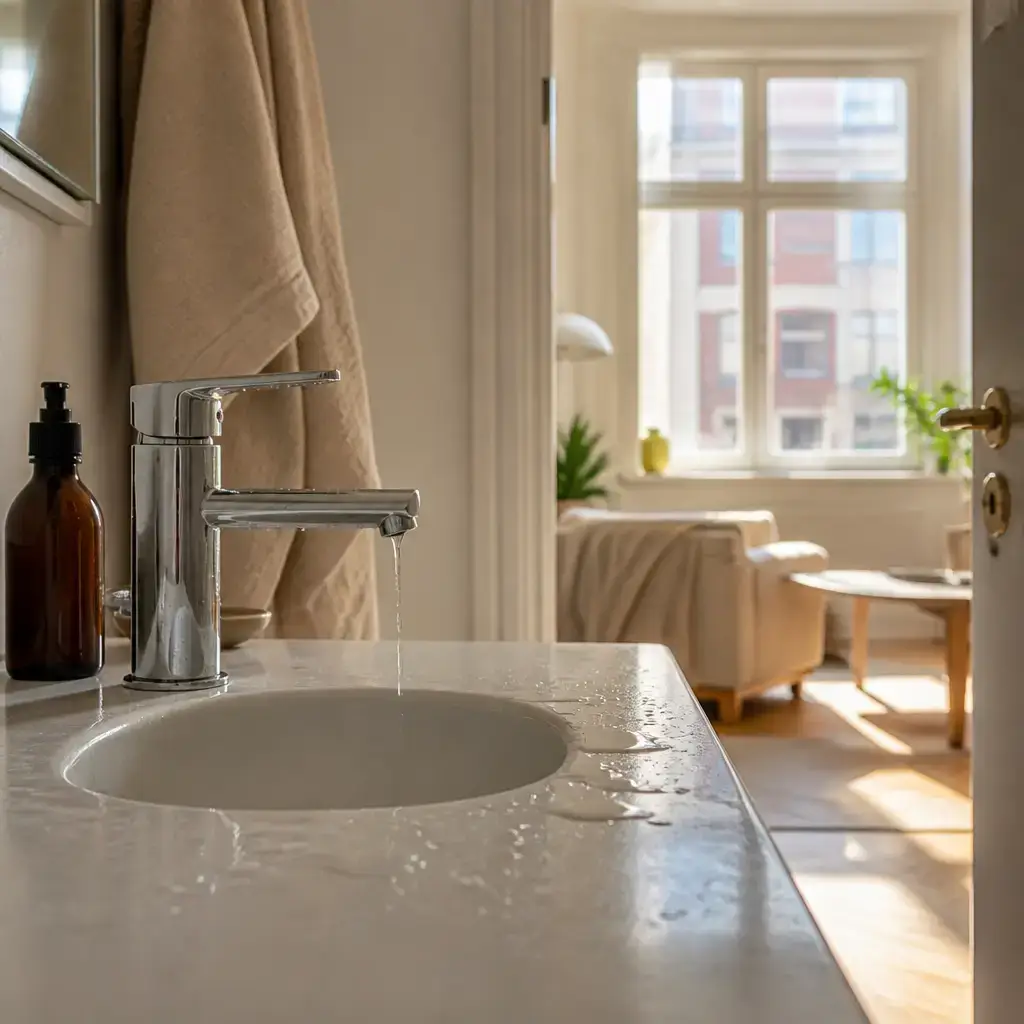
Vandhanen
Vandhanen means the tap, specifically the bathroom tap being discussed. In Vandhanen på badeværelset lækker igen, it is the subject that is leaking. This form is useful when identifying a particular tap in a repair conversation.
på
På shows the location of the tap in på badeværelset, meaning in or at the bathroom. It connects the object with its location here. Use it with a place when describing where something is located.
badeværelset
Badeværelset means the bathroom in på badeværelset. Together, the phrase identifies where the tap is. This is useful when reporting a problem in a specific room.
lækker
Lækker means leaks here, describing water escaping from the tap. In lækker igen, the form describes the current problem and its repetition. Use it when reporting that a tap or another container is leaking.
igen
Igen means again and shows that the leaking has happened before. The exact phrase lækker igen says that the tap has started leaking once more. Use it when an event or problem repeats.
selv
Selv means even here and emphasizes that the problem continues despite the earlier action. In selv efter at jeg spændte den i går, it highlights the unexpected persistence. This pattern is useful for saying that something happened despite a previous measure.
efter
Efter means after and places one event later than another. In efter at jeg spændte den i går, it introduces the earlier tightening as the reference event. Use it before a time expression or a clause describing what happened earlier.
at
At introduces the clause after efter in efter at jeg spændte den i går, explaining what happened before. It also introduces reported content in forklare, at en midlertidig reparation ikke virkede. Use it to connect a verb with a following statement.
jeg
Jeg means I and is the person who performed the tightening in jeg spændte den i går. It functions as the subject of that action. Use it before an action when speaking about yourself.
spændte
Spændte means tightened and describes the completed action performed on the tap. In jeg spændte den i går, it reports what the speaker did yesterday. Use this form when describing that earlier tightening action.
den
Den means it here and refers back to the tap in spændte den. It is the object receiving the tightening action. Use it when referring back to the specific tap without repeating the noun.
i
I means in as part of the time expression i går. Together, the phrase places the action on the previous day. Use it in this kind of fixed time expression.
går
Går means yesterday in i går. The phrase tells when the tightening happened. Use i går when referring to the previous day.
Da
Da means since here and introduces the reason for contacting the landlord. In Da det bliver ved med at ske, it links the repeated problem to the recommendation that follows. Use it to give a reason based on an ongoing situation.
det
Det means it here and refers to the problem or situation that keeps happening. In det bliver ved med at ske, it is the thing whose recurrence is being discussed. Use it to refer back to an already mentioned situation.
bliver
Bliver contributes to the continuation meaning in bliver ved med at ske. The whole expression says that the problem keeps happening, rather than describing a single event. This construction is useful for reporting a repeated or continuing situation.
ved
Ved is part of the continuation expression bliver ved med at ske. In this construction, it helps express that the event continues. Keep it together with bliver and med when describing something that keeps happening.
med
Med completes the continuation expression bliver ved med at ske. The full expression means keeps happening here, not simply with. Use it as part of this construction when an event continues.
ske
Ske means happen in bliver ved med at ske. It names the event that continues. Use it after this continuation expression when describing something that keeps happening.
bør
Bør means should or ought to and gives a recommendation in bør vi nok kontakte udlejeren. It presents contacting the landlord as the sensible next action. Use it when advising what someone ought to do.
vi
Vi means we and refers to the two adults deciding what to do together. In bør vi nok kontakte udlejeren, it is the subject of the recommended action. Use it when including yourself and at least one other person.
nok
Nok means probably here and softens the recommendation in bør vi nok kontakte udlejeren. It shows a reasonable expectation rather than absolute certainty. Use it when making a cautious suggestion.
kontakte
Kontakte means contact and names the action recommended in bør vi nok kontakte udlejeren. It follows the modal form and takes the landlord as its target. Use it when getting in touch with a person or organization about an issue.
udlejeren
Udlejeren means the landlord, the person the speakers plan to contact about the repair. In kontakte udlejeren, it is the person receiving the contact. Use it when referring to the landlord responsible for the rented home.
kan
Kan means can and expresses ability or possibility in kan sende et billede. It also appears in kan komme, where it concerns a possible visit. Use it before an action to say that it is possible or that someone is able to do it.
sende
Sende means send in kan sende et billede. The object being sent is et billede, which will document the leaking tap. Use it when sending a message, image, or other item to someone.
et
Et is the article used before billede in et billede. It introduces one unspecified item in the phrase. Use it before this noun when referring to a picture or photo for the first time.
billede
Billede means picture or photo in et billede. Here it is something the speaker can send to show the landlord the problem. Use it when referring to a visual image.
og
Og means and and links the two actions in sende et billede og forklare. It shows that the speaker plans to send a photo as well as explain the situation. Use it to join related actions or statements.
forklare
Forklare means explain in kan sende et billede og forklare, at en midlertidig reparation ikke virkede. It introduces the information that will be explained. Use it when giving someone the reason or details about a problem.
en
En is the article before reparation in en midlertidig reparation. It introduces one temporary repair that has already been attempted. Use it before this noun when referring to an unspecified repair.
midlertidig
Midlertidig means temporary and describes the repair in en midlertidig reparation. It shows that the repair was intended as a short-term measure. Use it when distinguishing a short-term measure from a lasting solution.
reparation
Reparation means repair in en midlertidig reparation. Here it refers to the earlier measure that did not solve the leaking problem. Use it when discussing work done to fix damage or a fault.
ikke
Ikke means not and negates the statement that the repair worked. In en midlertidig reparation ikke virkede, it changes the meaning to say that the repair failed. Use it directly with the statement or action being denied.
virkede
Virkede means worked here, referring to whether the temporary repair was successful. With ikke in ikke virkede, the sentence says that it did not work. Use it when evaluating whether a measure or solution was effective.
Nævn
Nævn means mention and is a direct instruction in Nævn, at der bliver spildt vand. It tells the listener to include this fact in the message. Use it when asking someone to mention a particular detail.
der
Der introduces the passive situation in der bliver spildt vand, where the focus is on water being wasted rather than on who wastes it. It does not refer to a physical place in this sentence. This pattern is useful when reporting an event without naming an agent.
spildt
Spildt contributes the meaning wasted or spilled in der bliver spildt vand. The full construction says that water is being wasted. Use it in this kind of report when water is lost unnecessarily.
vand
Vand means water in der bliver spildt vand. It identifies what is being wasted by the leaking tap. Use it when describing the substance involved in the repair problem.
bordpladen
Bordpladen means the counter or worktop, which is getting wet in bordpladen bliver våd. It identifies the particular surface affected by the water. Use it when reporting damage or wetness on a kitchen or bathroom counter.
våd
Våd means wet in bliver våd, describing the resulting condition of the counter. The phrase bordpladen bliver våd says that the counter is getting wet. Use it when describing a surface that has water on it.
Skal
Skal means should or shall in the question Skal vi sige, at vi ikke selv har forårsaget problemet? It asks whether the speakers ought to include a particular statement. Use Skal vi followed by an action when suggesting or checking a joint decision.
sige
Sige means say in Skal vi sige, at vi ikke selv har forårsaget problemet? It names the act of stating something in the message. Use it when discussing what someone should say.
har
Har means have in har forårsaget problemet. Together with the following form, it presents the causing as a completed action relevant to the current issue. Use it in this construction when connecting a past action with the present situation.
forårsaget
Forårsaget means caused in har forårsaget problemet. It identifies the speakers as the possible cause of the problem, which they want to deny. Use it when explaining what produced a problem or result.
problemet
Problemet means the problem in har forårsaget problemet. It refers to the leaking-tap issue already under discussion. Use it when referring to a specific problem known to both speakers.
Sørg
Sørg means make sure in Sørg for at få det tydeligt med. The whole expression instructs the listener to ensure that the point is clearly included. Use it when giving a practical instruction about checking that something is done.
for
For is part of the instruction Sørg for at få det tydeligt med. In this construction, it helps introduce what the listener must make sure to do. Keep it with Sørg when using this instruction.
få
Få contributes the meaning get or have included in få det tydeligt med. The full phrase Sørg for at få det tydeligt med means make sure to include that clearly. Use this construction when instructing someone to ensure that information is included.
tydeligt
Tydeligt means clearly in få det tydeligt med. It describes how the point should be included in the message. Use it when asking for information to be presented in an unmistakable way.
men
Men means but and contrasts two instructions in tydeligt med, men hold en rolig tone. The message should be clear while its tone remains calm. Use it to connect instructions or statements with an important contrast.
hold
Hold means keep or maintain in hold en rolig tone. It is an instruction to maintain a particular tone while writing. Use it when telling someone to preserve a manner, condition, or quality.
rolig
Rolig means calm and describes the tone in en rolig tone. It asks for a composed and non-confrontational style. Use it when describing a calm manner of speaking or writing.
tone
Tone means tone in en rolig tone. Here it refers to the manner and attitude of the written message. Use it when discussing how a message sounds to its reader.
Beskeden
Beskeden means the message, referring to the message being prepared for the landlord. In Beskeden skal være høflig, men specifik, it is the subject whose qualities are being specified. Use it for a particular message already understood in the conversation.
være
Være means be in Beskeden skal være høflig, men specifik. It connects the message with the qualities that it needs to have. Use it after skal when describing what something should be like.
høflig
Høflig means polite and describes the required manner of the message. In Beskeden skal være høflig, men specifik, it is balanced with being specific. Use it when describing respectful communication.
specifik
Specifik means specific and says that the message should give clear details. In høflig, men specifik, it is one of the message's required qualities. Use it when information needs to identify the issue or request precisely.
så
Så means so that in så der ikke opstår forvirring. It introduces the intended result of making the message clear and specific. Use it to connect an action with the result it is meant to produce.
opstår
Opstår means arises or occurs in der ikke opstår forvirring. With ikke, the phrase says that confusion should not arise. Use it when describing a problem or situation coming into existence.
forvirring
Forvirring means confusion in der ikke opstår forvirring. It names the misunderstanding the speakers want to prevent. Use it when unclear information could cause people to misunderstand.
Spørg
Spørg means ask and is an instruction in Spørg, hvornår en blikkenslager kan komme. It tells the listener to request information about the possible visit. Use it when directing someone to ask a question.
hvornår
Hvornår means when and introduces the question about the plumber's possible visit. In hvornår en blikkenslager kan komme, it asks for the time of an event. Use it in an embedded question about when something happens.
blikkenslager
Blikkenslager means plumber in en blikkenslager kan komme. It identifies the professional who may visit to repair the tap. Use it when discussing a plumber's visit or repair work.
komme
Komme means come in en blikkenslager kan komme, referring to the plumber coming to the home. It follows the expression of possibility in that clause. Use it when describing someone's arrival or visit.
fordi
Fordi means because and introduces the reason for the difficult scheduling in fordi morgener på hverdage er vanskelige for os. It connects the request for a visit time with the speakers' availability. Use it to explain why something is the case.
morgener
Morgener means mornings and identifies the times that are difficult for the speakers. In morgener på hverdage, it refers specifically to weekday mornings. Use it when discussing availability during several mornings.
hverdage
Hverdage means weekdays in morgener på hverdage. It limits the mornings being discussed to ordinary working days. Use it when distinguishing weekdays from other days.
er
Er means are in morgener på hverdage er vanskelige for os. It links the weekday mornings with their description. Use it to state what a plural subject is like or where it is.
vanskelige
Vanskelige means difficult and describes the weekday mornings in er vanskelige for os. It explains why arranging a morning visit is not convenient. Use it when a time, task, or situation presents a difficulty.
os
Os means us in vanskelige for os. It identifies the speakers as the people who find weekday mornings difficult. Use it after a preposition when referring to yourself together with other people.
foreslå
Foreslå means suggest in Vi kan foreslå et fleksibelt tidsrum. It names the action of offering a possible time arrangement. Use it when proposing an option for another person to consider.
fleksibelt
Fleksibelt means flexible and describes the time window in et fleksibelt tidsrum. It indicates that the proposed period allows some choice about the exact time. Use it when an arrangement can adapt to different schedules.
tidsrum
Tidsrum means time window or period in et fleksibelt tidsrum. It refers to the span during which someone can be at home for the visit. Use it when offering a range of time rather than one exact moment.
hvor
Hvor means where here and introduces the clause where someone can be at home. In et fleksibelt tidsrum, hvor nogen kan være hjemme, it refers back to the time window. Use it to connect a place or setting with information about it.
nogen
Nogen means someone in hvor nogen kan være hjemme. It refers to an unspecified person who can stay at home for the plumber's visit. Use it when the person's identity is not important or not yet known.
hjemme
Hjemme means at home in nogen kan være hjemme. It describes the location where someone can be present during the visit. Use it when talking about being in one's home.
burde
Burde means should or ought to in Det burde gøre det lettere for udlejeren at arrangere reparationen. It expresses an expected result of offering a flexible time window. Use it when predicting or gently stating what an action is expected to achieve.
gøre
Gøre means make in gøre det lettere. The whole phrase Det burde gøre det lettere says that the arrangement should make the repair visit easier to organize. Use it when describing an action that causes a change in difficulty or condition.
lettere
Lettere means easier in gøre det lettere. It describes the expected improvement for the landlord's arrangement of the repair. Use it when comparing a situation with a more difficult one.
arrangere
Arrangere means arrange in udlejeren at arrangere reparationen. It refers to organizing the repair visit. Use it when coordinating a service, appointment, or practical plan.
reparationen
Reparationen means the repair, referring to the repair needed for the leaking tap. In arrangere reparationen, it is the specific work the landlord must organize. Use it when referring to a particular repair already known in the conversation.