Undskyld
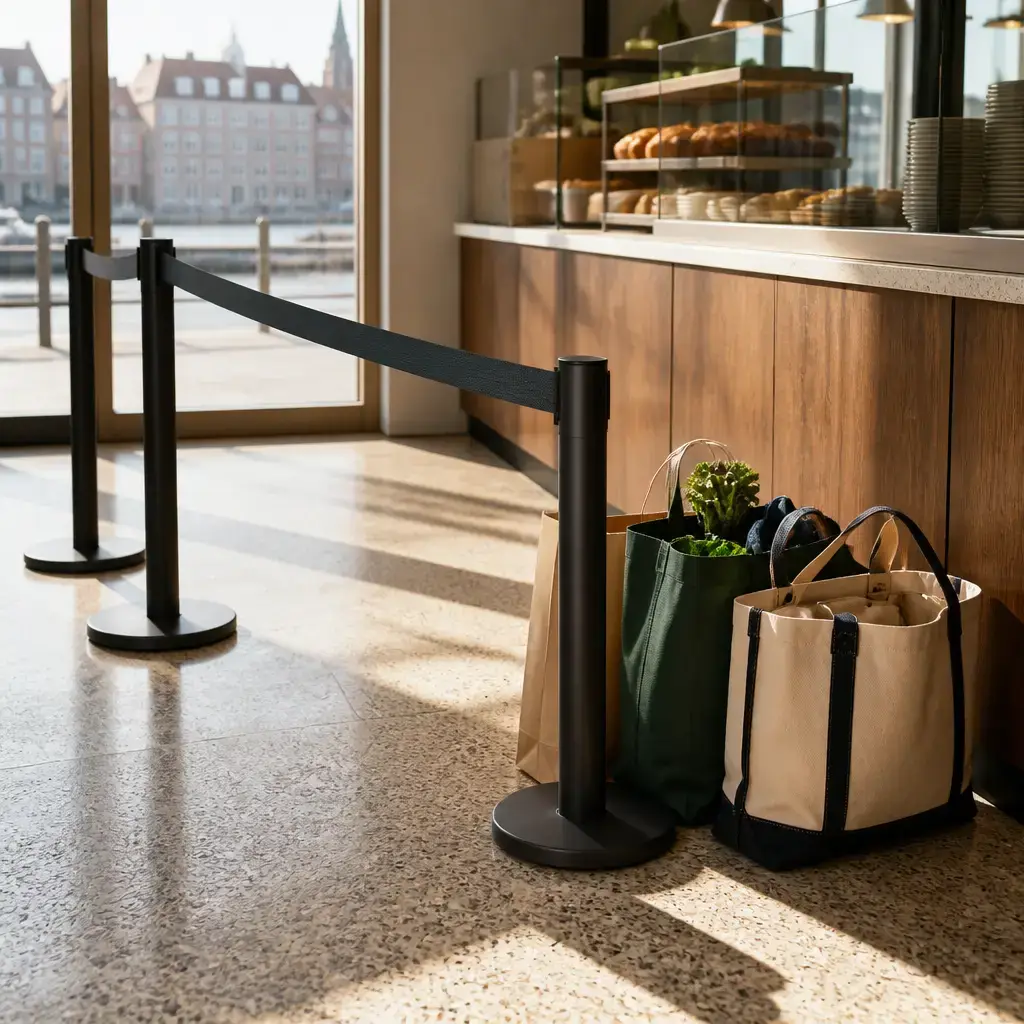
“Undskyld” means “excuse me” here and politely gets the other person’s attention before offering help. It can be used at the start of a polite request or interruption, such as a new example: “Undskyld, må jeg spørge dig om noget?”
du
“du” refers to the person being addressed: “you.” In “du må gerne komme foran mig,” it is the person who is being invited to move ahead. Use “du” as the subject before an action or permission expression when speaking directly to someone.
må
“må” gives permission in “du må gerne komme foran mig,” meaning that the person is allowed to go ahead. It is followed by “gerne” and the action “komme”; a reusable pattern is “Du må gerne + action.”
gerne
“gerne” makes “du må gerne komme foran mig” a friendly permission or invitation rather than a bare statement of possibility. Together, “må gerne” is useful when telling someone they are welcome to do something: a new example is “Du må gerne sætte dig.”
komme
“komme” means “come” or, in “komme foran mig,” “go ahead of me.” It is the action that follows “må gerne,” so “må gerne komme” is a reusable permission pattern before an infinitive.
foran
“foran” means “ahead of” or “in front of” in “komme foran mig.” With “komme,” it describes moving to a position ahead of someone; a reusable pattern is “komme foran + person.”
mig
“mig” means “me” in “foran mig,” identifying the person whose position is being moved ahead of. It follows “foran” in this expression, so “komme foran mig” is useful when letting someone go ahead in a line.
Er
“Er” means “are” at the beginning of the question “Er du sikker?” It asks whether the other person is certain, and the same question pattern can be reused with an adjective, for example in a new example: “Er du klar?”
sikker
“sikker” means “sure” or “certain” in “Er du sikker?” The expression checks whether someone really means or confirms something; use “Er du sikker?” when politely asking for confirmation.
Jeg
“Jeg” means “I” and is capitalized because it begins “Jeg vil ikke tage din plads.” It marks the speaker as the person who does not want to take the other person’s place; use it before a statement about your own action or intention.
vil
“vil” means “want” in “Jeg vil ikke tage din plads.” It is followed by “ikke” and the action “tage,” giving the reusable pattern “Jeg vil ikke + action” for saying that you do not want to do something.
ikke
“ikke” makes “Jeg vil ikke tage din plads” negative: the speaker does not want to take the other person’s place. It is placed after “vil” and before “tage” in this pattern, “vil ikke + action.”
tage
“tage” means “take” in “tage din plads,” referring to taking the other person’s place in the line. It follows “vil ikke,” and the reusable pattern is “tage + possessive word + noun,” as in “tage din plads.”
din
“din” means “your” before “plads” in “din plads,” referring to the person being addressed. It links the place to that person; use “din” before a possession when addressing one person, as in the new example “din taske.”
plads
“plads” means “place” or “spot” in the line: “tage din plads.” It refers to someone’s position rather than a general location, so “tage din plads” is useful when talking about occupying or taking someone’s spot.
Det
“Det” means “it” in “Det er helt i orden,” the expression used to reassure the other person that the situation is all right. It stands at the beginning of this fixed response; use “Det er ...” to describe or assess a situation.
helt
“helt” strengthens “i orden” in “Det er helt i orden,” giving the reassurance “It is completely all right.” It can be used before an expression or description when you want to emphasize that something is fully so.
i
“i” means “in” and is part of the expression “helt i orden,” which means that everything is all right. Keep it in this complete expression; a new example is “Det er i orden.”
orden
“orden” contributes the word “order” to the expression “helt i orden,” which here means “completely all right.” The whole expression is a practical reassurance after someone apologizes or worries about causing a problem.
dine
“dine” means “your” before “tasker,” referring to bags belonging to the person being addressed. It is used here with the plural item “tasker”; a reusable pattern is “dine + plural noun.”
tasker
“tasker” means “bags” in “dine tasker ser tunge ud.” It is the thing being described as heavy, so you can reuse it after a possessive word when talking about someone’s bags.
ser
“ser” means “look” in “dine tasker ser tunge ud.” Together with “ud,” it describes how the bags appear, and the reusable pattern is “subject + ser + description + ud.”
tunge
“tunge” means “heavy” in “ser tunge ud,” describing the bags’ apparent weight. It is used inside the pattern “ser ... ud” to say that something looks a certain way; a new example is “Taskerne ser tunge ud.”
ud
“ud” is the particle that completes “ser tunge ud,” meaning “look heavy” rather than simply “see heavy.” Keep it at the end of the description in the reusable pattern “ser + adjective + ud.”
sætter
“sætter” is part of “Det sætter jeg pris på,” the complete expression meaning “I appreciate it.” Here it contributes the idea of placing or setting value, and the full expression can be used to thank someone for a helpful action.
pris
“pris” means “value” inside “sætter jeg pris på,” which as a whole means “I appreciate it.” Do not use “pris” alone for this meaning; learn the complete pattern “sætte pris på + something” when expressing appreciation.
på
“på” completes the expression “Det sætter jeg pris på,” meaning that the speaker appreciates the helpful action. It belongs at the end of this expression after what is appreciated; a new example is “Jeg sætter pris på din hjælp.”
skal
“skal” expresses a promised or intended action in “Jeg skal nok sørge for ikke at forsinke dig.” Together with “nok,” it reassures the other person that the speaker will make sure of something. Use “Jeg skal nok + action” when giving this kind of assurance.
kun
“kun” means “only” in “Jeg skal kun bruge et minut,” limiting the amount of time needed. It comes before “bruge” and the time expression, so “kun bruge + amount of time” is a useful pattern for saying that something will take little time.
bruge
“bruge” means “need” in “Jeg skal kun bruge et minut,” referring to the amount of time required at the counter. After “skal,” it names the needed action or amount; use “bruge + time or thing” when saying what you need.
et
“et” means “a” or “one” before “minut” in “et minut.” It introduces the single unit of time being needed, and the pattern “et + time unit” can be reused with another suitable time expression.
minut
“minut” means “minute” in “et minut.” It specifies how long the person expects to need at the counter; use “et minut” to give a short estimated time.
ved
“ved” means “at” or “by” in “ved disken,” locating the action at the counter. It is useful before a place when saying where someone will wait, work, or be served.
disken
“disken” means “the counter” in “ved disken.” It identifies the service point where the person will spend a minute, and “ved disken” is a reusable location expression for being at a counter.
kan
“kan” means “can” or “be able to” in “Jeg kan godt vente lidt længere.” It introduces the action “vente,” while “godt” makes the statement reassuring; use “Jeg kan + action” to state what you are able or willing to do.
godt
“godt” helps make “Jeg kan godt vente lidt længere” sound like reassurance that waiting is no problem. In this expression, it supports “kan” rather than adding a separate object; use “kan godt + action” when saying that you can readily do something.
vente
“vente” means “wait” in “Jeg kan godt vente lidt længere.” It follows “kan,” and the reusable pattern is “kan + vente” followed by an amount or duration, such as “vente lidt.”
lidt
“lidt” means “a little” in “vente lidt længere,” reducing the amount of extra waiting. It is useful before a quantity or degree word when describing a small amount, as in the new example “vente lidt.”
længere
“længere” means “longer” in “vente lidt længere,” referring to additional waiting time. Together with “lidt,” it gives the pattern “vente lidt længere” for agreeing to wait for a little more time.
nok
“nok” contributes reassurance to “Jeg skal nok sørge for ikke at forsinke dig,” meaning that the speaker will make sure of the promised action. The pattern “skal nok + action” is useful when assuring someone that you will handle something.
sørge
“sørge” means “make sure” in “sørge for ikke at forsinke dig.” It is followed by “for” and the action that will be ensured, giving the reusable pattern “sørge for + action.”
for
“for” is part of the construction “sørge for ikke at forsinke dig,” which means “make sure not to delay you.” It connects “sørge” with the action being ensured; use “sørge for + infinitive” when taking responsibility for an outcome.
at
“at” introduces the infinitive “forsinke” in “for ikke at forsinke dig.” It marks the action that the speaker promises not to do, and the reusable negative pattern is “ikke at + infinitive.”
forsinke
“forsinke” means “delay” or “hold up” in “ikke at forsinke dig.” It is the action being avoided, with “dig” as the person who might be delayed; use “forsinke + person” when describing causing someone to wait longer.
dig
“dig” means “you” as the person who might be delayed in “forsinke dig.” It follows the verb “forsinke” as the affected person, so “forsinke dig” is useful when apologizing for or preventing a delay to someone.