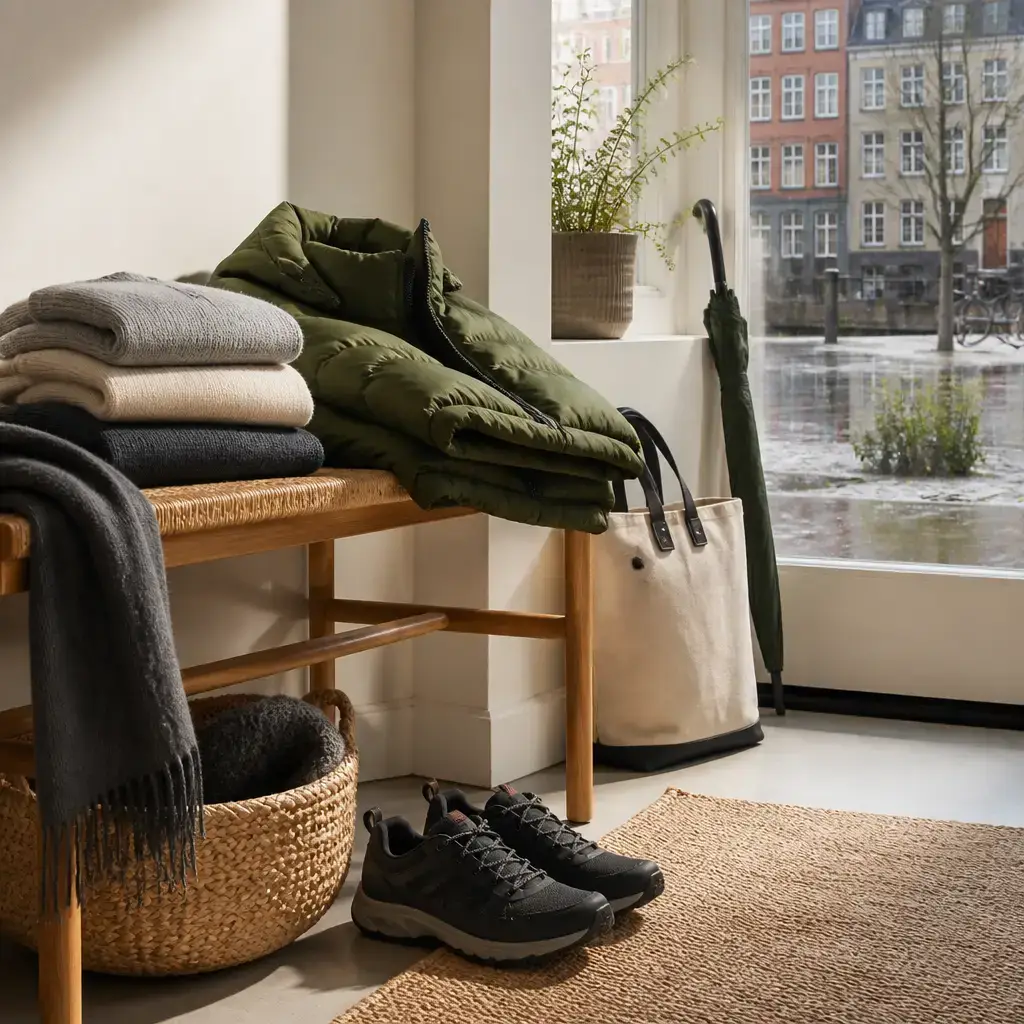
Vejret
In 'Vejret bliver ved med at skifte', 'Vejret' means the weather and is the subject being described. Use it when talking about the weather in a situation.
bliver ved med at
In 'bliver ved med at skifte', the whole expression means keeps on doing something. 'bliver' contributes the idea of continuing, 'ved med' forms the continuation expression, and 'at' introduces the action 'skifte'. Use 'bliver ved med at' before an action that continues.
skifte
In 'bliver ved med at skifte', 'skifte' means change, referring to the weather changing. It follows 'at' in this continuing-action construction. Use it for something that changes from one state or condition to another.
i
In 'i denne uge', 'i' means in and marks the time period when something happens. Use it before a time period to say when an event or situation takes place.
denne
In 'denne uge', 'denne' means this and points to the current week. Use it before a noun to identify something as the one currently being discussed.
uge
In 'denne uge', 'uge' means week and names the time period being discussed. It is used after 'denne' to refer to the current week.
Tag tøj på
In 'Tag tøj på i flere lag', the whole expression means put on clothes. 'Tag' gives the instruction to take or put, 'tøj' means clothes, and 'på' completes the expression with the idea of putting them on. Use it when telling someone to get dressed.
flere
In 'flere lag', 'flere' means several or more and indicates that there is more than one layer. Use it before a plural noun when referring to several items or an increased number of items.
lag
In 'flere lag', 'lag' means layers of clothing. It names the separate levels worn together. Use it when describing clothing arranged one layer over another.
så
In 'så du kan tilpasse det', 'så' means so and introduces the intended result or purpose. In 'Så kan du have den med', the same form means then and links to the next step. Use it to connect an action with its result or with what follows.
du
In 'så du kan tilpasse det', 'du' means you and is the person who can adjust the clothing. The same form is used for the person being addressed in 'du kan have den med' and 'du kan bære jakken'.
kan
In 'du kan tilpasse det', 'kan' means can and shows that the person has the ability or option to adjust it. The same form appears before 'have' and 'bære'. Use 'kan' before an action to express ability or possibility.
tilpasse
In 'tilpasse det', 'tilpasse' means adjust, referring to changing the clothing as the weather changes. It takes 'det' as the thing being adjusted here. Use it when adapting something to changed conditions.
det
In 'tilpasse det', 'det' means it and refers to the clothing or layers. In 'Det burde fungere', the same form refers to the proposed clothing and shoe choice as a whole. Use it for a thing or situation already understood from the context.
i løbet af
In 'i løbet af dagen', the whole expression means during the course of the day. 'i' and 'af' connect 'løbet' with the time period, while the complete expression functions as a time phrase. Use it before a time period to describe something happening during it.
dagen
In 'i løbet af dagen', 'dagen' means the day, referring to the day as the relevant time period. The exact form is used when the day is treated as a known period in the conversation.
Skal
In 'Skal jeg også tage en varm jakke med?', 'Skal' means should or shall and asks whether the speaker ought to bring the jacket. Use 'Skal jeg ...?' when asking whether an action is advisable or expected.
jeg
In 'Skal jeg også tage en varm jakke med?' and 'Jeg har også brug for sko', 'jeg' means I and identifies the speaker. Use it as the subject when talking about your own action, need, or opinion.
også
In 'Jeg har også brug for sko', 'også' means also or too and adds shoes to the things the speaker needs. In 'Skal jeg også tage...', it adds the jacket to the items being considered. Use it when adding another person, item, or action.
tage
In 'tage en varm jakke med', 'tage' means take or bring, with the jacket being brought along. The object comes before 'med' in this expression. Use it with an item and 'med' when telling someone to bring that item.
en
In 'en varm jakke', 'en' means a and introduces the jacket. In 'Tag en med', it means one and stands for the jacket already mentioned. Use it either before the noun being introduced or alone when the noun is understood.
varm
In 'en varm jakke', 'varm' means warm and describes the jacket. Use it before a clothing or weather-related noun when describing warmth.
jakke
In 'en varm jakke', 'jakke' means jacket and names the clothing item to bring. Use it when talking about a jacket as an item of clothing.
med
In 'tage en varm jakke med' and 'have den med', 'med' means along or with you. It shows that the jacket accompanies the person rather than being left behind. Use it after the item in expressions about bringing or carrying something along.
Tag
In 'Tag en med til morgenen', 'Tag' is an instruction to bring or take one. It appears at the beginning of a direct instruction and is followed by the item to bring. Use it when telling someone to take or bring something.
til
In 'til morgenen', 'til' means for and connects the jacket with the time when it is needed. Use it before a time period to show that something is intended for that time.
morgenen
In 'til morgenen', 'morgenen' means the morning and identifies the time when the jacket will be useful. The exact form refers to the morning as a known time period.
have
In 'have den med', 'have' contributes the idea of having or keeping something with you, so the whole expression means carry it along. It combines with 'den' for the item and 'med' for accompanying the person. Use 'have ... med' when you keep an item with you while going somewhere.
den
In 'have den med', 'den' means it or that one and refers back to the jacket. Use it for an item that has already been mentioned and is understood from the context.
senere
In 'have den med senere', 'senere' means later and places the carrying at a time after the morning. Use it to refer to a later point in time than the one just discussed.
hvis
In 'hvis det bliver varmere', 'hvis' means if and introduces the condition that it gets warmer. Use it before a condition that determines what happens next.
varmere
In 'bliver varmere', 'varmere' means warmer and describes a rise in temperature compared with before. It is the comparative form used when a condition becomes more warm.
har brug for
In 'Jeg har også brug for sko', the whole expression means need. 'har' contributes have, 'brug' contributes the idea of use or need, and 'for' completes the fixed expression. A reusable pattern is 'har brug for' followed by the thing needed.
sko
In 'brug for sko', 'sko' means shoes and names the footwear the speaker needs. In 'sko, som er nemme at gå i', the same word is the item being described. Use it when talking about footwear.
som
In 'sko, som er nemme at gå i', 'som' means that or which and links 'sko' to extra information about them. Use it after a noun to introduce a clause describing that noun.
er
In 'som er nemme at gå i', 'er' means are and links the shoes with the description 'nemme'. Use it to connect a subject with a description or state.
nemme
In 'nemme at gå i', 'nemme' means easy and describes the shoes as easy to walk in. The reusable pattern 'nemme at' is followed by an action that is easy to do.
at
In 'nemme at gå i', 'at' introduces the action 'gå', and in 'med at skifte' it introduces the action 'skifte'. In both places it marks the infinitive. Use it before an action after a construction such as 'nemme' or 'bliver ved med'.
gå
In 'at gå i', 'gå' means walk, specifically walking in the shoes. The following 'i' completes the idea of walking in something. Use it in the pattern 'gå i' when referring to walking in footwear.
Vælg
In 'Vælg et let par', 'Vælg' means choose and gives a direct instruction. Use it at the beginning of an instruction when telling someone which item to select.
et
In 'et let par', 'et' means a or one and introduces one pair. It comes directly before the noun being selected. Use it to introduce a single item in this kind of phrase.
let
In 'et let par', 'let' means light and describes the pair as not heavy. Use it before an item when describing its weight.
par
In 'et let par', 'par' means pair and refers to the pair of shoes. Use it for two matching items considered together, such as shoes.
godt
In 'godt greb', 'godt' means good or solid and describes the quality of the grip. It comes directly before 'greb' in this noun phrase. Use it before a noun when describing a positive or reliable quality.
greb
In 'med godt greb', 'greb' means grip, referring to how well the shoes hold on to the paths. Use it when discussing the traction or holding ability of footwear.
stierne
In 'hvis stierne er våde', 'stierne' means the paths and refers to the paths the person may walk on. The exact form identifies the paths being considered in the situation.
våde
In 'stierne er våde', 'våde' means wet and describes the paths. Use it when stating that a surface or other thing contains water or has become wet.
burde
In 'Det burde fungere', 'burde' means should or ought to and expresses an expectation rather than complete certainty. Use it before an action to say that something is expected to happen or work.
fungere
In 'Det burde fungere', 'fungere' means work or function, referring to the proposed clothing and shoe choice being effective. Use it after 'burde' when saying that a plan, item, or solution is expected to work.
om
In 'om eftermiddagen', 'om' means in or during and marks the time of day. Use it before a part of the day to say when something happens.
eftermiddagen
In 'om eftermiddagen', 'eftermiddagen' means the afternoon and identifies the relevant time of day. Use it with 'om' when referring to something happening during the afternoon.
bære
In 'bære jakken', 'bære' means carry and describes holding the jacket while moving around. It is used before the object being carried. Use it when someone physically carries an item.
jakken
In 'bære jakken', 'jakken' means the jacket and refers to the warm jacket already discussed. The exact form identifies it as a known item rather than introducing a new jacket.
uden
In 'uden at den føles tung', 'uden' means without and introduces an unwanted result that does not occur. The pattern 'uden at' is used before a clause describing what happens without taking place.
føles
In 'den føles tung', 'føles' means feels and describes the perceived weight of the jacket. Use it with an adjective to say how something feels to a person.
tung
In 'føles tung', 'tung' means heavy and describes how the jacket is perceived when it is carried. Use it after 'føles' to describe an item's perceived weight.