Undskyld
“Undskyld” means “excuse me” here and politely opens the customer’s complaint. It is used when getting someone’s attention at a service counter or before explaining a problem. A common reuse pattern is “Undskyld, …” followed by the reason for speaking.
jeg
“jeg” means “I” and identifies the customer as the person who thinks and received the order. It appears as the subject before “tror” in “jeg tror”. Reuse it as the subject when describing your own experience or action.
tror
“tror” means “think” in “jeg tror” and introduces the customer’s belief about the order. The phrase is cautious rather than a completely definite accusation. A common pattern is “jeg tror, …” followed by what you believe.
har
In “jeg har fået”, “har” helps express that the customer has received something. It works together with “fået”, so the meaning comes from the whole expression rather than “har” alone. Reuse the pattern “jeg har …” when stating what you have received or experienced.
fået
“fået” means “received” or “got” in “jeg har fået den forkerte bestilling”. It identifies the order that reached the customer. Reuse it with “har” when saying that you have received something.
den
“den” points to the specific order in “den forkerte bestilling”, meaning “the wrong order”. It combines with the following description and noun to identify one particular item. A reusable pattern is “den” followed by a describing word and a noun.
forkerte
“forkerte” means “wrong” in “den forkerte bestilling” and describes the order as not being the one expected. Its meaning is tied to the specific order the customer received. Reuse it before a noun when identifying an incorrect item or result.
bestilling
“bestilling” means “order” in “den forkerte bestilling”. It refers to the food order that the customer received. Reuse it when talking about placing, checking, or correcting an order.
Lad
“Lad” means “let” in “Lad mig lige tjekke det” and begins a polite offer to check the problem. It is used with “mig” and an action to say that the speaker will do something. A common pattern is “Lad mig …” followed by an action.
mig
“mig” means “me” in “Lad mig lige tjekke det” and identifies the person who will do the checking. It follows “Lad” in this expression. Reuse “Lad mig …” when offering to handle an action yourself.
lige
“lige” softens “Lad mig lige tjekke det” and gives the sense of checking briefly or just now. It makes the offer sound natural and reassuring in this service situation. Reuse it in a short request or offer when you want to make the action sound brief or immediate.
tjekke
“tjekke” means “check” in “Lad mig lige tjekke det”. It names the action the staff member offers to perform on the order problem. Reuse it with an object, such as the thing or information being checked.
det
“det” refers to the order problem just mentioned in “tjekke det”, meaning “check it” or “check that”. It avoids repeating the problem. Reuse “tjekke det” when the thing being checked is already clear from the conversation.
Hvad
“Hvad” means “what” in “Hvad bestilte du?” and asks which food or order the customer requested. It begins the question before the verb and subject. Reuse “Hvad …?” to ask for an unspecified thing.
bestilte
“bestilte” identifies the ordering action in “Hvad bestilte du?”, asking what the customer ordered. It refers to the order that was originally requested, not the food currently on the tray. Reuse it in the question pattern “Hvad bestilte du?” when clarifying an order.
du
“du” means “you” in “Hvad bestilte du?” and identifies the customer as the person who placed the order. It appears after “bestilte” in this question. Reuse it when addressing one person directly.
suppe
“suppe” means “soup” and names the food the customer originally ordered. In “Jeg bestilte suppe”, it is the requested item that should be replaced. Reuse it as the food item after a verb such as “bestilte” when describing an order.
men
“men” means “but” and contrasts the requested soup with the salad on the tray. It connects the two parts of the customer’s explanation. Reuse “men” to introduce information that differs from or corrects what came before.
der
In “der er en salat på denne bakke”, “der” helps introduce the fact that a salad is present on the tray. It is part of the whole “there is” construction rather than a separate physical location here. Reuse the pattern “der er …” when pointing out that something is present.
er
In “der er en salat på denne bakke”, “er” helps say that a salad is on the tray. The meaning “there is” comes from “der er” together. Reuse “der er” to state that something exists or is present in a place.
en
“en” means “a” in “en salat” and introduces one salad without identifying it as a particular salad. It comes directly before the noun “salat”. Reuse “en” before a singular noun when introducing an unspecified item.
salat
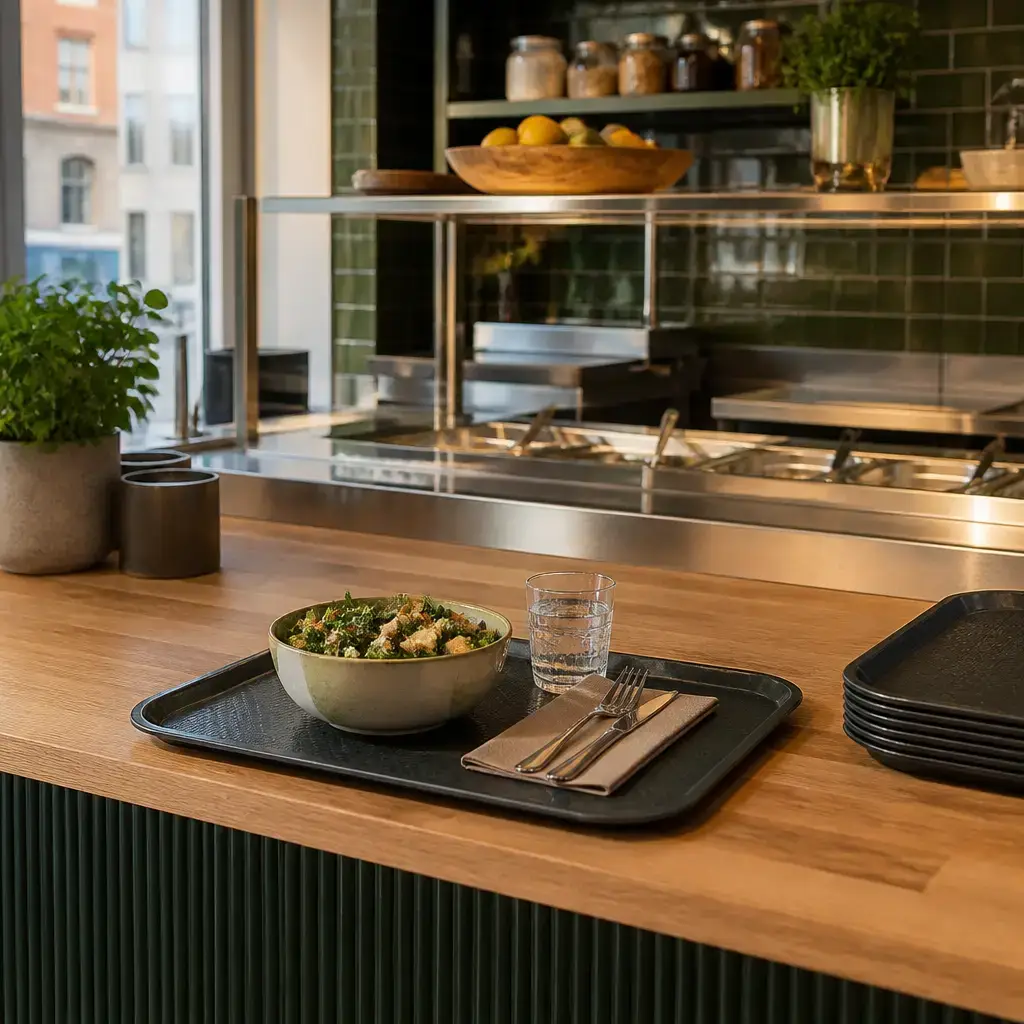
“salat” means “salad” and names the food that is actually on the tray. In “der er en salat”, it is the item that shows the order is wrong. Reuse it as a food noun when describing or ordering a salad.
på
“på” means “on” in “på denne bakke” and indicates the tray as the surface where the salad is located. It connects the food with the tray. Reuse “på” with a surface or place when describing where something is situated.
denne
“denne” means “this” in “denne bakke” and points to the particular tray near the speakers. It makes the reference specific and immediate. Reuse it before a noun when indicating one nearby or currently relevant item.
bakke
“bakke” means “tray” in “denne bakke”. It identifies the surface holding the salad and makes clear which food item the customer is pointing out. Reuse it when describing or locating food being carried on a tray.
kan
“kan” means “can” in “Jeg kan bytte den” and expresses the staff member’s ability or willingness to replace the item. It is followed by the action “bytte”. Reuse the pattern “Jeg kan …” when offering something you are able or prepared to do.
bytte
“bytte” means “replace” or “exchange” in “Jeg kan bytte den”. It names the staff member’s proposed solution to the wrong order. Reuse it with the item being exchanged or replaced.
med det samme
“med det samme” means “right away” in “Jeg kan bytte den med det samme”. The whole expression says that the replacement will happen immediately; “med”, “det”, and “samme” work together here. Reuse “med det samme” after an action when promising that it will happen without delay.
Skal
“Skal” means “should” in “Skal jeg vente her?” and asks whether waiting here is the appropriate next action. It forms a question with “jeg” and the action “vente”. Reuse “Skal jeg …?” when asking what you are expected or supposed to do.
vente
“vente” means “wait” in “Skal jeg vente her?”. It describes staying until the staff member brings the replacement. Reuse it with a place or with information about what you are waiting for.
her
“her” means “here” in “vente her” and refers to the customer’s current location at the counter. It specifies where the waiting should happen. Reuse it when directing someone to remain in the present place.
mens
“mens” means “while” in “mens du henter den” and connects the customer’s waiting with the staff member fetching the replacement. It introduces the action happening during the waiting. Reuse “mens” to link two actions that happen at the same time.
henter
“henter” means “get” or “fetch” in “mens du henter den”. It describes the staff member going to get the replacement item. Reuse it when someone collects or brings back something that has been requested.
Vent
“Vent” means “wait” in the polite instruction “Vent venligst ved disken”. It tells the customer to remain by the counter while the replacement is arranged. Reuse it at the beginning of a direct instruction about waiting.
venligst
“venligst” means “please” in “Vent venligst ved disken” and makes the instruction polite. It appears with the request to wait. Reuse it in formal or service-related requests when asking someone to do something courteously.
ved
“ved” means “by” in “ved disken” and indicates the location next to the counter. It tells the customer where to wait. Reuse “ved” with a place or object to specify that someone or something is beside or at it.
disken
“disken” means “the counter” in “ved disken”. It identifies the specific service counter where the customer should wait. Reuse it when referring to a known counter in a shop, café, or other service setting.
går
“går” means “go” or “move” in “Jeg går derover nu”. Here it says that the customer is moving over to the indicated place. Reuse it with a destination expression when describing movement from one place to another.
derover
“derover” means “over there” in “Jeg går derover nu” and points to the place indicated by the staff member. It supplies the destination for “går”. Reuse it after a movement verb when referring to a place away from the current position.
nu
“nu” means “now” in “Jeg går derover nu” and emphasizes that the customer will move immediately. It places the action at the present moment. Reuse it with an action when clarifying that something is happening or will happen at once.
Din
“Din” means “your” in “Din suppe” and identifies the soup as belonging to or being intended for the customer. It comes before the noun it describes. Reuse it before a noun when addressing one person and referring to something associated with that person.
bør
“bør” means “should” or “ought to” in “Din suppe bør være klar snart”. It expresses an expectation that the soup will be ready soon, not a direct instruction to the customer. Reuse the pattern “bør være” when stating what is expected to be the case.
være
“være” means “be” in “bør være klar”. It connects the expectation expressed by “bør” with the condition “klar”. Reuse “være” after a modal expression when describing a state or condition.
klar
“klar” means “ready” in “Din suppe bør være klar snart”. It describes the expected condition of the replacement soup. Reuse it after “være” when saying that food, an item, or a task is ready.
snart
“snart” means “soon” in “bør være klar snart” and indicates that the soup is expected to be ready after a short time. It reassures the customer about the waiting period. Reuse it with an expected future event that will happen in the near future.