Må
In “Må jeg låne din skruetrækker...?”, “Må” asks for permission: “may” or “could”. It is useful at the beginning of a polite request, followed by the person and an action.
jeg
“Jeg” means “I” in “Må jeg låne din skruetrækker...?”. Use it for the person who is asking or doing something; a common pattern is “Jeg skal...” followed by an action.
låne
In “Må jeg låne din skruetrækker...?”, “låne” means “borrow”, meaning to use something that belongs to someone else and return it later. It follows “Må jeg” in this permission request; a reusable pattern is “låne” plus the thing being borrowed.
din
“Din” means “your” in “din skruetrækker”, identifying the screwdriver as belonging to the person being addressed. It is placed directly before the noun it describes, as in “din” plus an item.
skruetrækker
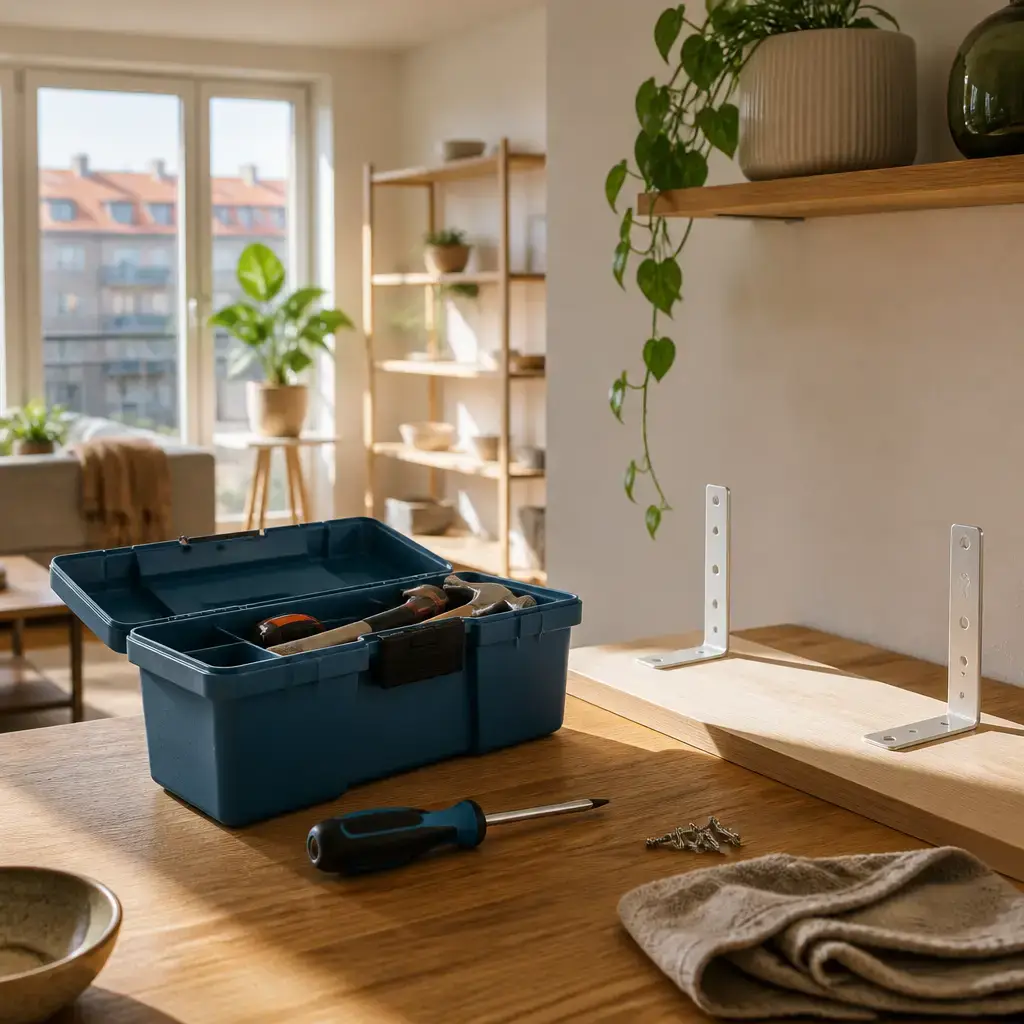
“Skruetrækker” means “screwdriver” in “din skruetrækker”. It is the tool being borrowed and used for the repair; you can place it after a possessive such as “din” or after an article.
til
In “til en lille reparation”, “til” introduces the purpose: the screwdriver is needed for a small repair. A useful pattern is “til” followed by the activity or purpose something is intended for.
en
In “en lille reparation”, “en” means “a”, introducing one non-specific repair. It comes before the adjective and noun in this phrase: “en” + “lille” + “reparation”.
lille
“Lille” means “small” in “en lille reparation”. It describes the size or limited extent of the repair and appears before the noun here; a reusable pattern is “en lille” plus a singular noun.
reparation
“Reparation” means “repair” in “en lille reparation”, the task for which the screwdriver is needed. It can follow an article and an adjective, as in “en lille reparation”.
Den
“Den” means “it” in “Den er i den blå værktøjskasse”, referring to the screwdriver mentioned just before. At the beginning of the sentence it identifies the item, followed by where it is; the same word appears as “den” later in the dialogue.
er
“Er” means “is” in “Den er i den blå værktøjskasse”, describing the screwdriver’s location. A common pattern is a subject followed by “er” and a place or description.
i
In “i den blå værktøjskasse”, “i” means “in” and shows that the screwdriver is inside the toolbox. Use “i” before a place or container, followed here by “den blå værktøjskasse”.
blå
“Blå” means “blue” in “den blå værktøjskasse”, identifying which toolbox is meant. It appears before the noun and after “den” in this phrase.
værktøjskasse
“Værktøjskasse” means “toolbox” in “den blå værktøjskasse”. It names the container where the screwdriver is located; it can follow an adjective in a phrase such as “den blå værktøjskasse”.
skal
In “Jeg skal stramme hyldebeslagene”, “skal” expresses that the speaker needs to or is supposed to tighten the brackets. It is followed by the infinitive “stramme”; “skal” plus an action is a useful way to describe a necessary task.
stramme
“Stramme” means “tighten” in “Jeg skal stramme hyldebeslagene”. It describes making the shelf brackets tighter and follows “skal” in this sentence; use it before the object of the action.
hyldebeslagene
“Hyldebeslagene” means “the shelf brackets” in “Jeg skal stramme hyldebeslagene”. It names the specific brackets that need tightening, not the shelf itself; it follows the action “stramme” as its object.
Brug
“Brug” means “use” in the instruction “Brug den mellemstore skruetrækker”. It gives a direct instruction and comes at the beginning of the sentence, followed by the tool to use.
mellemstore
“Mellemstore” means “medium-sized” in “den mellemstore skruetrækker”, identifying the screwdriver of medium size. It appears before the noun and after “den” in this definite description.
passer
In “Den passer bedre til de beslag”, “passer” means “fits” or “is suitable for”. It describes how well the screwdriver works with the brackets; a useful pattern is “passer ... til” followed by the thing it suits.
bedre
“Bedre” means “better” in “Den passer bedre til de beslag”, comparing this screwdriver’s suitability with another possibility. It comes after “passer” here and indicates a more suitable fit.
de
In “de beslag”, “de” points to the brackets being discussed: “those brackets”. It comes directly before the noun and helps identify the specific items the screwdriver fits.
beslag
“Beslag” means “brackets” in “de beslag”, referring to the shelf brackets mentioned earlier. It follows “de” and is the object of the phrase introduced by “til” in “passer bedre til de beslag”.
Hvornår
“Hvornår” means “when” in “Hvornår skal jeg aflevere den?”. It asks for the time of returning the screwdriver and begins this question; a common pattern is “Hvornår skal jeg...” followed by an action.
aflevere
In “skal jeg aflevere den?”, “aflevere” means “return” or “hand back” the screwdriver. It follows “skal jeg” and comes before the item being returned; use “aflevere” when giving an item back to someone or to a place.
Aflever
“Aflever” means “return” or “hand it back” in the instruction “Aflever den før aftensmaden, tak.” It is placed at the beginning as a direct request, followed by the item and the deadline.
før
In “før aftensmaden”, “før” means “before” and sets the deadline for returning the screwdriver. It comes before the event that marks the time limit, here “aftensmaden”.
aftensmaden
“Aftensmaden” means “dinner” in “før aftensmaden”. It names the time by which the screwdriver should be returned; it follows “før” when setting this kind of deadline.
tak
At the end of “Aflever den før aftensmaden, tak”, “tak” softens the instruction and means “please” here. It can be placed at the end of a request to make the request more polite.
Hvis
“Hvis” means “if” in “Hvis den bliver støvet...”, introducing a condition about the screwdriver becoming dusty. It begins the conditional part of the sentence and is followed by the situation that may occur.
bliver
In “bliver støvet”, “bliver” means “becomes” or “gets”, describing a change into a dusty condition. A useful pattern is “bliver” followed by an adjective, as in “bliver støvet”.
støvet
“Støvet” means “dusty” in “Hvis den bliver støvet”. It describes the condition the screwdriver may get into and follows “bliver” in this conditional expression.
tørrer
In “tørrer jeg den først af”, “tørrer” describes wiping or drying the screwdriver. Here its meaning is completed by “af” in “tørrer ... af”; the object “den” appears between the verb and “af”.
først
“Først” means “first” in “tørrer jeg den først af”, showing that wiping the screwdriver happens before it is returned. It can mark the first action in a sequence and appears before the separable part “af” here.
af
In “tørrer jeg den først af”, “af” is part of the expression meaning to wipe something off. It works together with “tørrer” and should not be treated as a separate complete action; the object “den” comes between them in this sentence.
Det
“Det” means “that” or “it” in “Det hjælper med at holde værktøjerne i god stand”, referring to the wiping action just described. It begins the sentence as the thing that provides the helpful result.
hjælper
In “Det hjælper med at holde værktøjerne i god stand”, “hjælper” means “helps”. It is followed by “med” and the activity that is helped; a reusable pattern is “hjælper med at” plus an action.
med
In “hjælper med at holde”, “med” forms the expression “helps with doing something”. It is followed by “at” and the action “holde”, so the whole pattern is “hjælper med at” plus an infinitive.
at
In “at holde værktøjerne i god stand”, “at” marks the action that follows “med”: keeping the tools in good condition. It comes directly before the infinitive “holde” in this construction.
holde
“Holde” means “keep” in “holde værktøjerne i god stand”, meaning to maintain the tools in good condition. It follows “at” and takes the tools as its object; a useful pattern is “holde” something “i god stand”.
værktøjerne
“Værktøjerne” means “the tools” in “holde værktøjerne i god stand”. It identifies the tools whose condition should be maintained and comes after “holde” as its object.
god
“God” means “good” in “i god stand”, describing the condition in which the tools should remain. It appears before “stand” in this fixed-looking phrase about maintaining something well.
stand
In “i god stand”, “stand” means “condition” or “state”. Together with “i god” it describes the tools as being kept in good condition; “holde ... i god stand” is a reusable pattern for maintaining something.