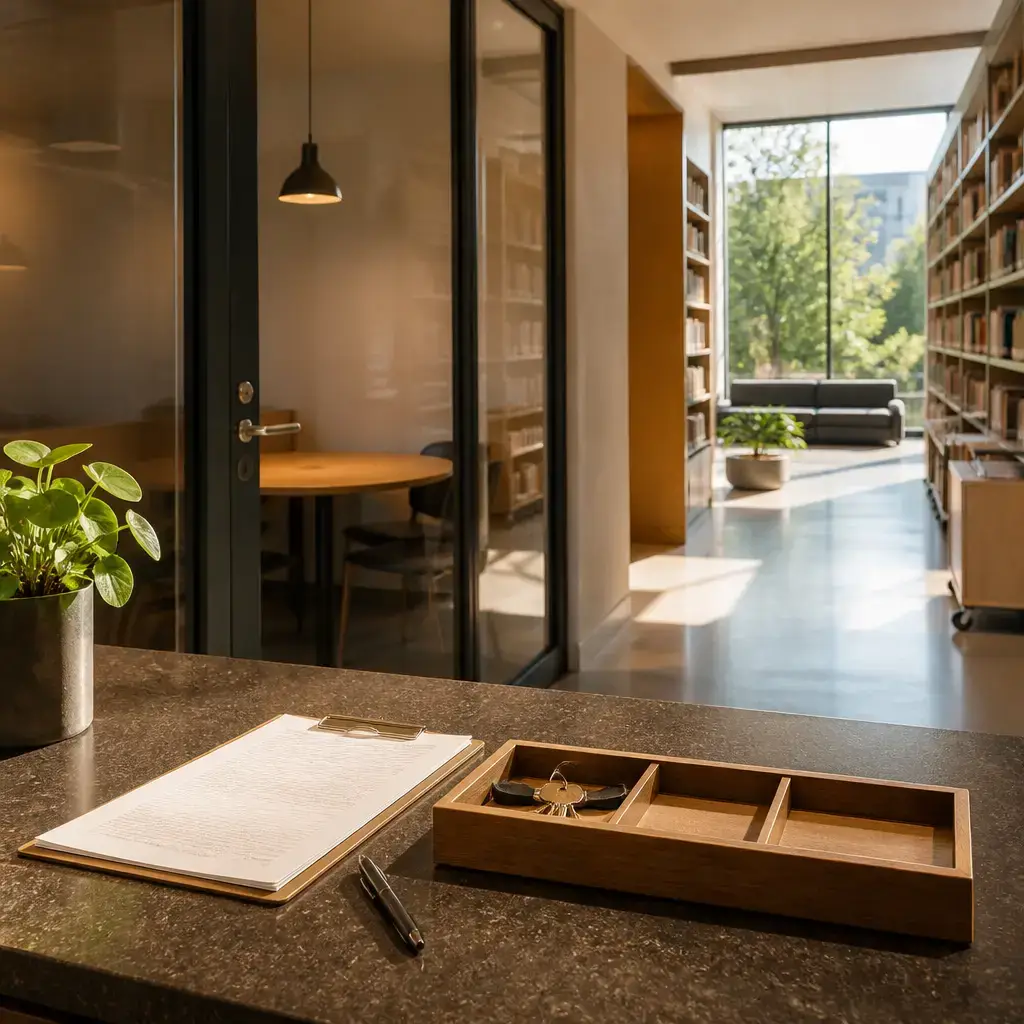
Jeg
In "Jeg vil gerne reservere", "Jeg" means “I” and identifies the person making the request. It is used as the subject before the verb, for example in a polite request at a library desk.
vil
In "Jeg vil gerne reservere", "vil" expresses the speaker’s wish or intention to reserve something. Together with "gerne" and an infinitive such as "reservere", it is a useful pattern for making a polite request.
gerne
In "Jeg vil gerne reservere", "gerne" helps express “would like to” in a polite, willing way. It commonly follows "vil" before the action word, as when asking staff for a service.
reservere
In "vil gerne reservere", "reservere" means “to reserve” or “to book” the study room. It follows the modal expression "vil gerne" and can be reused when booking a room or another service.
et
In "et studierum", "et" is the indefinite article “a” before this neuter noun. Use it before a single unspecified neuter thing when making a request such as asking for a study room.
studierum
In "et studierum", "studierum" means “study room”. The compound names the kind of room being reserved, so it is useful when asking a library employee about a place to study.
Lad
At the start of "Lad mig se", "Lad" introduces the request “let me”. This expression is useful when you want to check information before giving an answer.
mig
In "Lad mig se", "mig" means “me” and refers to the person who will do the checking. It follows "Lad" in this request pattern, which can be used when offering to look at information.
se
In "Lad mig se", "se" means “see” and, in this context, “check” the room information. It follows "Lad mig" and is useful when asking for a moment to inspect something.
hvilke
In "hvilke rum", "hvilke" means “which” and asks the listener to identify particular rooms. It comes before the noun in a question or embedded question about available options.
rum
In "hvilke rum", "rum" means “rooms”. Here it refers to the rooms the employee is checking, and it can be reused when asking about rooms in a building.
der
In "rum der er ledige", "der" introduces the clause describing which rooms are available. It links the noun "rum" to the information that follows and is useful in descriptions such as “rooms that are available.”
er
In "der er ledige", "er" means “are” and states the condition of the rooms. It is used with a description such as "ledige" when explaining availability.
ledige
In "rum der er ledige", "ledige" describes the rooms as available or vacant. Its form fits the plural rooms here, and the word is useful when asking which spaces can be used.
i
In "i dag", "i" forms the time expression meaning “today”. This expression is useful when asking about availability on the current day.
dag
In "i dag", "dag" means “day”, and the whole expression means “today”. It is used to specify that the room check concerns the current day.
har
In "har brug for", "har" means “have” as part of the expression for needing something. This pattern is useful for stating what place, object, or service you need.
brug
In "har brug for", "brug" contributes to the fixed expression meaning “need”; the meaning here comes from the whole expression, not from "brug" alone. Keep the object after "for", as in "har brug for et roligt sted".
for
In "har brug for", "for" completes the expression meaning “need”. The thing needed follows this expression, so it is useful for saying that you need a particular place or service.
roligt
In "et roligt sted", "roligt" describes the place as quiet or calm. Its form agrees with the neuter noun "sted", and the phrase is useful when explaining the kind of place you are looking for.
sted
In "et roligt sted", "sted" means “place”. It names the location the speaker needs and can be reused when asking for a suitable place to work or study.
hvor
In "et roligt sted, hvor jeg kan læse", "hvor" means “where” and introduces information about what happens in the place. It is useful for describing a location together with an activity.
kan
In "jeg kan læse", "kan" means “can” and expresses that the speaker is able or permitted to study there. It is followed by the infinitive "læse", making a useful pattern for stating what you can do in a place.
læse
In "kan læse", "læse" means “study” or “read”; here the context is studying with a classmate. It follows "kan" and can be reused when describing an activity that is possible in a room.
med
In "læse med en klassekammerat", "med" means “with” and shows who will study together with the speaker. It comes before the person or group accompanying the activity.
en
In "en klassekammerat", "en" is the indefinite article “a” before this common-gender noun. Use it when referring to one unspecified classmate, such as someone you will study with.
klassekammerat
In "en klassekammerat", "klassekammerat" means “classmate”. It identifies the person joining the study activity and is useful when explaining who you need the room for.
lille
In "Et lille rum", "lille" means “small” and describes the room’s size. Its form is used with the neuter noun "rum", making it useful when selecting a room by size.
ledigt
In "Et lille rum er ledigt", "ledigt" means “free” or “available” and describes the room. Its form agrees with the neuter noun "rum", and the sentence is useful for telling someone that a room can be booked.
eftermiddag
In "i eftermiddag", "eftermiddag" means “afternoon”. The whole time expression specifies when the room is free and can be reused when arranging an appointment or booking.
det
In "reservere det", "det" means “it” and refers back to the available room. It is the object of the booking action, so this pronoun helps avoid repeating the noun.
ved
In "ved skranken", "ved" means “at” or “by” and identifies the location of the booking. It is useful for asking where an action is handled, especially at a service point.
skranken
In "ved skranken", "skranken" means “the service desk” or “the counter”. The ending marks the specific desk being discussed, and the word is useful when directing someone to a library service point.
Udfyld
At the start of "Udfyld venligst formularen", "Udfyld" is a direct request to fill in or complete something. It is used here to instruct the visitor to complete the form at the desk.
venligst
In "Udfyld venligst formularen", "venligst" means “please” and makes the instruction more polite. It can be placed with a request when speaking courteously to a visitor or customer.
formularen
In "formularen", "formularen" means “the form” and refers to the specific request form being discussed. The ending marks it as a definite form, useful when both people know which document must be completed.
her
In "formularen her", "her" means “here” and points to the place where the form should be filled in. It is useful when directing someone to a particular location or document nearby.
Skal
At the start of "Skal jeg aflevere nøglen", "Skal" asks whether the speaker is expected or required to do something. This is a useful way to check an instruction, such as where a key must be returned.
aflevere
In "Skal jeg aflevere nøglen", "aflevere" means “return” or “hand in” the key. It follows "Skal jeg" and can be reused when asking about returning an item to a desk or person.
nøglen
In "aflevere nøglen", "nøglen" means “the key” and refers to the specific key for the study room. The ending marks the definite form, useful when the listener knows which key is meant.
denne
In "denne skranke", "denne" means “this” and points to the particular service desk nearby. It is useful when distinguishing one location from other desks or counters.
Aflever
At the start of "Aflever den før lukketid", "Aflever" is a direct instruction to return or hand something back. It tells the room user what to do with the key before leaving.
den
In "Aflever den", "den" means “it” and refers back to the key. It is the object of the instruction and allows the speaker to avoid repeating "nøglen".
før
In "før lukketid", "før" means “before” and sets the deadline for returning the key. It is useful for giving a time limit before an event or closing point.
lukketid
In "før lukketid", "lukketid" means “closing time”. The phrase tells the visitor when the key must be returned and is useful for stating a deadline connected with a facility’s hours.