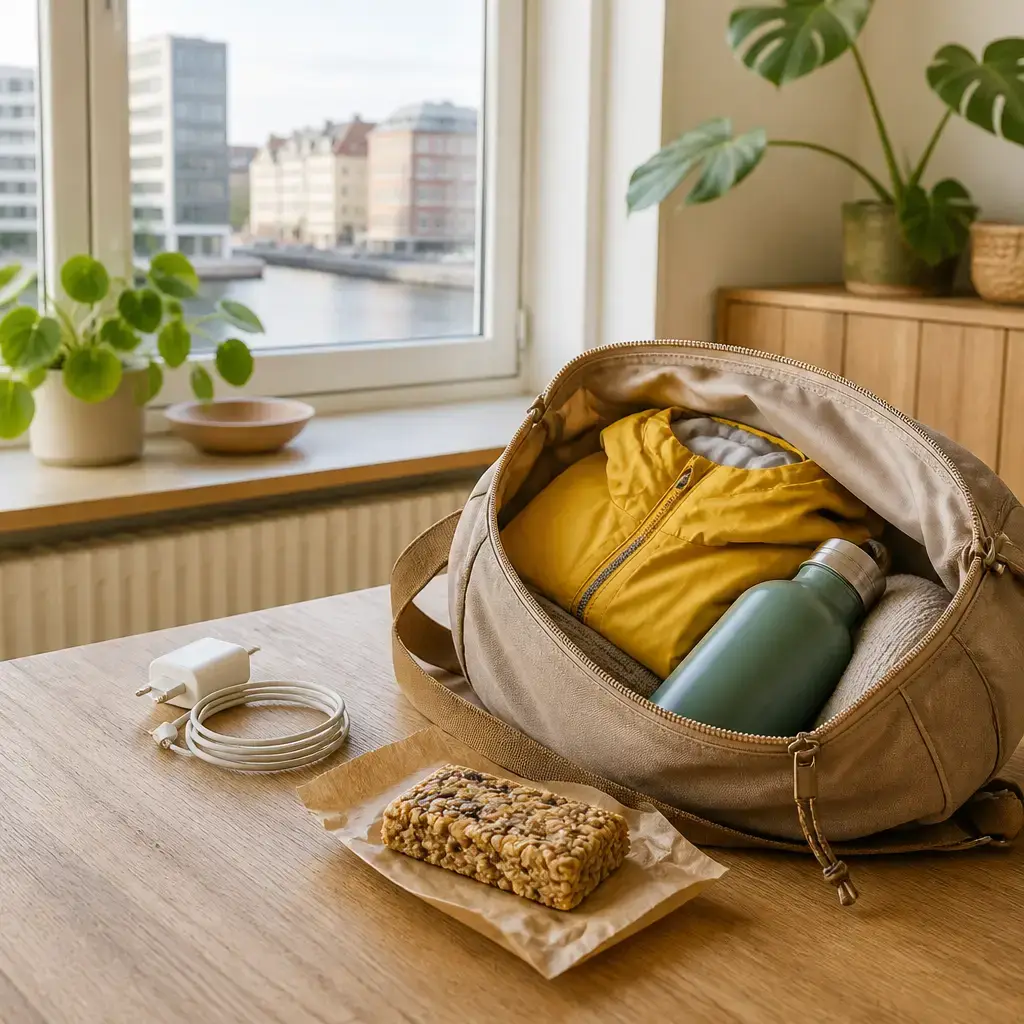
Jeg
Jeg means “I” here and identifies the speaker as the person packing or having something. Use it when talking about your own actions or possessions.
pakker
Pakker means “pack” in Jeg pakker min taske til udflugten. It describes putting things into a bag for a specific purpose; use it with the thing being packed, such as a bag or suitcase.
min
Min means “my” and shows that the bag belongs to the speaker in min taske. Use it before a singular common-gender noun when referring to something you own.
taske
Taske means “bag” in min taske. Use it for a bag that carries personal items, especially when packing or carrying things.
til
Til means “for” in til udflugten, showing the purpose of the bag and its contents. Use it before an activity or event that something is intended for.
udflugten
Udflugten means “the outing” in til udflugten. It is the definite form related to udflugt, and it refers to the particular outing already understood in the conversation. Use it when referring to a specific excursion.
Hvad
Hvad means “what” at the beginning of Hvad mangler du stadig at tage med? It asks which thing or things are involved. Use it to ask about an unknown item or information.
mangler
Mangler means “is missing” or, in Hvad mangler du stadig at tage med?, “still need.” It identifies what has not yet been included for the outing. Use it with a person and an item or action that is still needed.
du
Du means “you” and refers to the person packing the bag in Hvad mangler du stadig at tage med? Use it when addressing one person directly.
stadig
Stadig means “still” and shows that the need continues at this point in Hvad mangler du stadig at tage med? Use it when something remains true or unfinished.
at
At introduces the infinitive phrase at tage med in Hvad mangler du stadig at tage med? Here it links mangler to the action that is still needed. Use at before an infinitive after expressions such as mangler.
tage
Tage means “take” or “bring” in at tage med, referring to carrying something along to the outing. Use it with an object and med when the object should be brought along.
med
Med means “along” in tage med, adding the idea that something is brought with the person. Use it after a verb of taking or bringing when the item accompanies someone.
har
Har means “have” in Jeg har en oplader, en snack og en regnjakke. It states that the speaker possesses or has available these items. Use it before things someone owns or has with them.
en
En is the indefinite article “a” in en oplader, en snack, en ekstra flaske vand, and Tag en med. It introduces one non-specific item, while in Tag en med it also refers back to one bottle. Use it before a singular common-gender noun.
oplader
Oplader means “charger” in en oplader. It names the device included in the packed bag. Use it for a device used to charge another device.
snack
Snack means “snack” in en snack. It names a small amount of food being taken along. Use it when mentioning a small food item for a trip or break.
og
Og means “and” and joins the items in en oplader, en snack og en regnjakke. Use it to connect words or phrases, especially items in a list.
regnjakke
Regnjakke means “raincoat” in en regnjakke. It names clothing packed for possible rain. Use it when talking about outerwear for wet weather.
Det
Det means “that” in Det burde være nok, hvis vejret skifter, referring to the items and preparation just mentioned. Use it to point back to a situation, fact, or group of things.
burde
Burde means “should” in Det burde være nok, expressing an expectation that the available items will be sufficient. Use it to give a cautious expectation or recommendation.
være
Være means “be” in Det burde være nok. It completes the expression after burde and connects the preparation with the assessment of being enough. Use it after a modal expression when describing a state or condition.
nok
Nok means “enough” in Det burde være nok, meaning that the charger, snack, and raincoat should provide what is needed. Use it after a verb such as være to say that something is sufficient.
hvis
Hvis means “if” and introduces the condition hvis vejret skifter. Use it to connect a possible condition with its result.
vejret
Vejret means “the weather” in hvis vejret skifter. It refers to the weather as the condition that may change during the outing. Use it when discussing outdoor conditions.
skifter
Skifter means “changes” in hvis vejret skifter, describing a change in the weather. Use it with something that moves from one state or condition to another.
Skal
Skal means “should” or “shall” in Skal jeg tage en ekstra flaske vand med? It asks whether the speaker ought to bring something. Use it at the beginning of a question when asking about a proposed action.
ekstra
Ekstra means “extra” in en ekstra flaske vand, showing that the bottle would be additional to what is already packed. Use it before a noun when something is added beyond the usual or existing amount.
flaske
Flaske means “bottle” in en ekstra flaske vand. It names the container for the water. Use it when specifying a drink or other liquid by its container.
vand
Vand means “water” in en ekstra flaske vand. It identifies what the bottle contains. Use it when talking about water to drink or carry.
Tag
Tag means “bring” or “take” in Tag en med, giving a direct instruction to bring one bottle along. Use it to tell someone to take an item with them.
gåturen
Gåturen means “the walk” in hvis gåturen tager længere tid end forventet. It refers to the particular walk planned for the outing. It is the definite form related to gåtur; use it for a specific walk.
tager
Tager means “takes” in gåturen tager længere tid, describing the amount of time the walk requires. Use it with an activity or event and a measure of time.
længere
Længere means “longer” in længere tid end forventet, indicating a greater duration than expected. Use it with tid when comparing how long something lasts.
tid
Tid means “time” in længere tid. It measures the duration required by the walk. Use it after expressions that describe how long an activity lasts.
end
End means “than” in længere tid end forventet and introduces the second part of the comparison. Use it after a comparative expression such as længere.
forventet
Forventet means “expected” in længere tid end forventet, referring to the duration that had been anticipated. Use it after a comparison when measuring an actual result against an expectation.
er
Er means “is” in Min taske er fuld and Den er ikke for tung. It links the subject with a description of its state or quality. Use it to describe what something is like or how it is.
fuld
Fuld means “full” in Min taske er fuld, describing the bag as containing all the packed items it can reasonably hold. Use it after er to describe a container with no useful space left.
Den
Den means “it” in Den er ikke for tung and refers back to the bag. Use it to refer to a previously mentioned singular common-gender noun instead of repeating it.
ikke
Ikke means “not” in Den er ikke for tung and makes the description negative. Use it before the part of the sentence that is being negated.
for
For means “too” in ikke for tung, showing that the bag does not exceed the acceptable weight. Use it before an adjective when describing an excessive degree.
Så
Så means “then” in Så er du klar til at tage af sted, marking the conclusion that follows from the bag being ready. Use it to connect a situation with its result or next step.
klar
Klar means “ready” in du klar til at tage af sted. It describes being prepared to leave. Use it after være with til and an activity or action that someone is prepared to do.
tage af sted
Tage af sted is the expression “head out” or “leave” in klar til at tage af sted. Within the expression, tage supplies the action of moving, af marks movement away, and sted refers to a place; together they express leaving. Use it after klar til when someone is ready to depart.