Må
In “Må jeg bruge det fælles vaskerum?” this means “may” or “can” and asks for permission. It is used before a verb in the pattern “Må jeg bruge ...?” when asking whether you may use something. You could use it when asking permission to use a shared facility.
jeg
In “Må jeg bruge det fælles vaskerum?” this means “I” and refers to the person asking the question. It is the subject placed after “Må” in this question. Use “jeg” when referring to yourself.
bruge
In “Må jeg bruge det fælles vaskerum?” this means “use” and names the activity the speaker is asking permission to do. It follows “Må jeg” in this question. A useful pattern is “Må jeg bruge ...?” when asking to use a room, machine, or other object.
det
In “det fælles vaskerum” this means “the,” while in “Det er åbent nu.” it means “it.” In the first phrase it comes before “fælles vaskerum”; at the start of the second sentence it refers to the laundry room. The exact meaning therefore depends on the phrase in which “det” appears.
fælles
In “det fælles vaskerum” this means “shared” or “common” and describes a facility used by more than one person. It comes before the noun “vaskerum.” Use the pattern “fælles + noun” for something shared in a building or group.
vaskerum
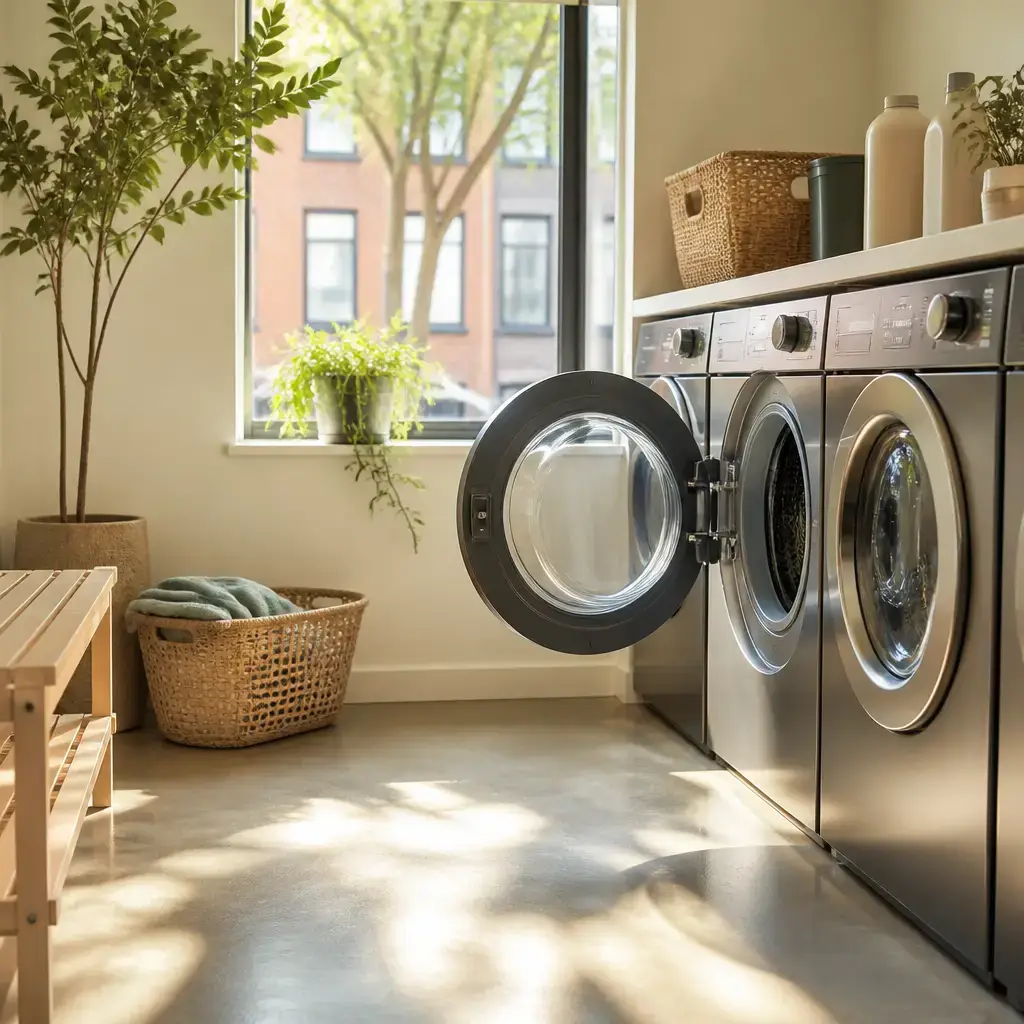
In “det fælles vaskerum” this means “laundry room,” the room where the washing machines are used. It is the place the speaker wants to use. A useful expression is “det fælles vaskerum” when referring to a shared laundry room.
er
In “Det er åbent nu.” this means “is,” describing the current state of the laundry room. In “Er denne maskine ledig?” the same form begins a question about the machine’s state. Use “er” with a description such as “er åbent” or “er ledig.”
åbent
In “Det er åbent nu.” this means “open” and says that the laundry room can currently be used. It follows “er” in the description “er åbent.” You can use “er åbent” to say that a room or facility is open.
nu
In “Det er åbent nu.” this means “now” and limits the statement to the present time. It appears at the end of the sentence. Use “nu” when giving information about what is true at this moment.
denne
In “denne maskine” and “Denne er ledig.” this means “this” and identifies the machine being discussed. It can come directly before “maskine,” or stand on its own when the noun is understood. Use “denne + noun” to point out a particular nearby item.
maskine
In “denne maskine” this means “machine,” specifically the washing machine being considered. It is the item whose availability is being checked. A useful expression is “Er denne maskine ledig?” when asking whether a particular machine is free.
ledig
In “Er denne maskine ledig?” and “Denne er ledig.” this means “free” or “available,” referring to a machine that is not currently occupied. The reusable expression “er ledig” states or asks about availability. You could use it when checking whether a shared machine or place can be used.
Hvor
At the beginning of “Hvor skal jeg stille min kurv?” this means “where” and asks about a location. It is followed by “skal jeg stille” to ask where the basket should be placed. Use “Hvor skal jeg ...?” when asking where to carry out an action.
skal
In “Hvor skal jeg stille min kurv?” this expresses “should” or “am supposed to” and asks for an instruction. It comes before “jeg” and is followed by “stille.” Use the pattern “skal jeg + verb” when asking what you should do.
stille
In “Hvor skal jeg stille min kurv?” this means “put” or “place” and describes positioning the basket somewhere. It follows “skal jeg.” A useful pattern is “stille + object + place,” as in placing a basket beside a wall.
min
In “min kurv” this means “my” and shows that the basket belongs to or is associated with the speaker. It comes directly before “kurv.” Use “min + noun” when referring to something that is yours.
kurv
In “min kurv” this means “basket,” the item the speaker wants to place in the laundry room. It is the object of “stille.” You can use “kurv” when talking about a basket for carrying clothes or other items.
Stil
In “Stil den ved siden af væggen.” this means “put” or “place” and gives an instruction. It is used at the beginning of the request, followed by the object “den.” Use “Stil + object + location” when telling someone where to place something.
den
In “Stil den ved siden af væggen.” this means “it” and refers back to “min kurv.” It appears after “Stil” as the object being placed. Use “den” to refer to the previously mentioned item in a pattern such as “Stil den ...”.
ved siden af
In “ved siden af væggen” this whole expression means “beside” or “next to.” The components “ved,” “siden,” and “af” work together: “ved” introduces the location, “siden” supplies the idea of a side, and “af” completes the relation. Use “ved siden af + noun” to specify where something is placed.
væggen
In “ved siden af væggen” this means “the wall,” the reference point beside which the basket should be placed. “Væggen” is the definite form related to “væg.” Use it after a location expression when referring to the specific wall being discussed.
tager
In “Jeg tager mit tøj ud” this means “take” as part of the expression for taking the clothes out. The complete action is expressed by “tager ... ud,” so “tager” alone does not carry the whole meaning. A reusable pattern is “tager + object + ud” when removing something.
mit
In “mit tøj” this means “my” and shows that the clothes belong to or are associated with the speaker. It comes directly before “tøj.” Use “mit + noun” when referring to something that is yours.
tøj
In “mit tøj” this means “clothes,” the items being washed and later removed from the machine. It is the object of the action expressed by “tager ... ud.” A useful expression from this context is “mit tøj” when talking about your own clothes.
ud
In “Jeg tager mit tøj ud” this means “out” and adds the direction of removal to “tager.” The complete meaning comes from “tager ... ud,” not from “ud” alone. Use the pattern “tager + object + ud” when taking something out of a machine, room, or container.
når
In “når vasken er færdig” this means “when” and introduces the time at which the clothes will be taken out. It connects the action “Jeg tager mit tøj ud” with the completion of the wash. Use “når + clause” when one action depends on another event happening.
vasken
In “når vasken er færdig” this means “the wash,” referring to the washing cycle in progress. It is the thing described as “færdig.” The form “vasken” is related to “vask” and identifies the specific wash being discussed.
færdig
In “vasken er færdig” this means “finished” or “done,” stating that the wash has completed. It follows “er” in the expression “er færdig.” Use “er færdig” for a task, process, or wash that has reached its end.
Hent
In “Hent dem med det samme.” this means “collect” or “fetch” and gives a direct request to get the clothes. It comes before the object “dem.” Use “Hent + object” when asking someone to go and get something.
dem
In “Hent dem med det samme.” this means “them” and refers to the clothes mentioned earlier. It is the object of “Hent.” Use “dem” after the verb when referring back to several previously mentioned items.
med det samme
In “Hent dem med det samme.” this whole expression means “right away” or “immediately.” “Med” introduces the phrase, while “det” and “samme” form its fixed “the same” part; together the three components express immediate action. A new example is “Gør det med det samme,” meaning “Do it right away.”