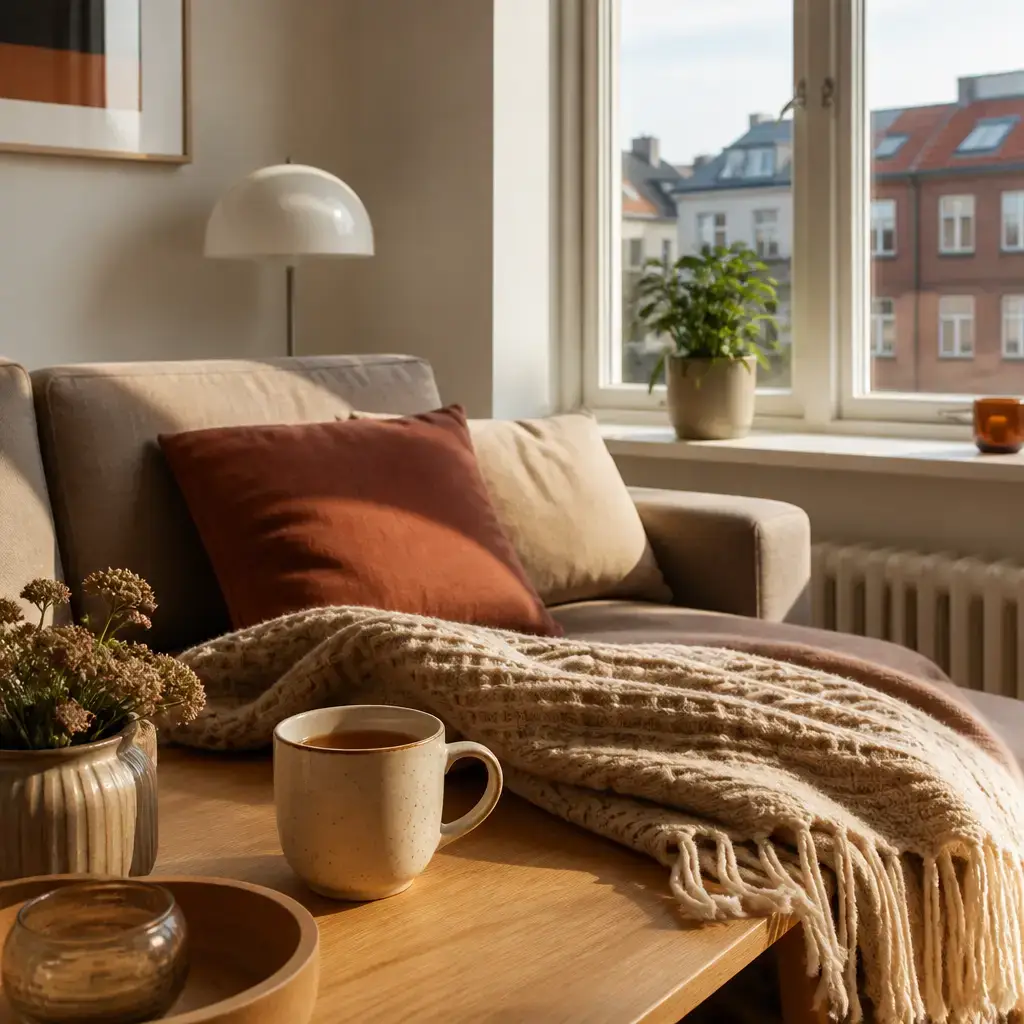
Jeg
“Jeg” means “I” here: it identifies the speaker as the person who feels cold. It commonly comes before the verb, as in “Jeg fryser nu.”
fryser
“Fryser” means “feel cold” in “Jeg fryser nu.” Danish uses this form to describe a person experiencing cold. You can reuse the pattern “Jeg fryser” when telling someone that you feel cold.
nu
“Nu” means “now” and places the feeling in the present moment in “Jeg fryser nu.” It commonly comes after the verb in a short statement like this.
Pak
“Pak” is the command to wrap or pack, and in “Pak dig ind i dette varme tæppe” it means “wrap.” The reusable pattern is “Pak dig ind i ...” when telling someone to wrap themselves in something.
dig
“Dig” refers to “yourself” in the command “Pak dig ind i dette varme tæppe.” It is the person receiving the action, and it also appears in “hvil dig” for “rest.”
ind
“Ind” is the inward particle in “Pak dig ind,” giving the command the meaning “wrap yourself in.” Together with “Pak dig” and “i dette varme tæppe,” it describes getting inside or under the blanket.
i
“I” means “in” in “Pak dig ind i dette varme tæppe.” It introduces what the person wraps themselves in, and commonly comes before a place or container.
dette
“Dette” means “this” in “dette varme tæppe.” It points to the specific blanket being offered and is placed before the noun phrase.
varme
“Varme” means “warm” in both “dette varme tæppe” and “denne varme kop.” It describes the blanket and the cup directly before the noun.
tæppe
“Tæppe” means “blanket” in “dette varme tæppe.” It is the object that the person is told to wrap themselves in.
Mine
“Mine” means “my” in “Mine hænder er også kolde.” It shows that the hands belong to the speaker and is used here with the plural noun “hænder.”
hænder
“Hænder” means “hands” in “Mine hænder er også kolde.” It is the body part being described as cold, and it follows the possessive “Mine.”
er
“Er” links “Mine hænder” with the description “kolde,” giving the meaning “are.” It is used here to state a condition or description.
også
“Også” means “also” or “too” in “Mine hænder er også kolde.” It adds the hands to the earlier statement about feeling cold and usually comes before the part being added.
kolde
“Kolde” means “cold” in “Mine hænder er også kolde.” It describes the speaker’s hands after the linking verb “er.”
Hold
“Hold” is the command “hold” in “Hold denne varme kop et stykke tid.” It tells someone to keep the cup in their hands, and the pattern “Hold denne varme kop ...” can be used for a direct instruction.
denne
“Denne” means “this” in “denne varme kop.” It points to the particular cup being offered and comes before the noun phrase.
kop
“Kop” means “cup” in “denne varme kop.” It is the object that the listener is told to hold.
et stykke tid
“Et stykke tid” means “for a while” as a whole in “Hold denne varme kop et stykke tid.” “Et” introduces one unit, “stykke” means a piece or period, and “tid” means time; together they express a limited period. It is a reusable time expression after an action, as in “Hold ... et stykke tid.”
Det
“Det” means “that” or “it” in “Det hjælper lidt.” It refers to the helpful warming measure just mentioned rather than naming it again. It commonly appears at the beginning when referring back to an action or thing.
hjælper
“Hjælper” means “helps” in “Det hjælper lidt.” It says that the warming measure has a positive effect, with “Det” as what provides the help.
lidt
“Lidt” means “a little” in “Det hjælper lidt.” It limits the amount of help being described and commonly follows the verb or adjective it modifies.
Sæt
“Sæt” is the command to sit down in “Sæt dig i sofaen.” It tells the listener to move into a seated position, and it is used here with “dig” and the place introduced by “i.”
sofaen
“Sofaen” means “the sofa” in “Sæt dig i sofaen.” The form refers to a specific sofa, the place where the listener is told to sit.
og
“Og” means “and” in “Sæt dig i sofaen og hvil dig.” It joins two instructions that should be followed together: sit on the sofa and rest.
hvil
“Hvil” is the command “rest” in “hvil dig.” It tells the listener to take a rest, and the reusable command pattern includes the object “dig.”
Rummet
“Rummet” means “the room” in “Rummet føles varmere nu.” It refers to the specific room being discussed and is the subject of the sentence.
føles
“Føles” means “feels” in “Rummet føles varmere nu.” It describes how the room is experienced, rather than simply stating a measured temperature. It can be used to describe how something seems to a person.
varmere
“Varmere” means “warmer” in “Rummet føles varmere nu.” It shows that the room feels warmer than before, following “føles” as the description of the room.
lukker
“Lukker” means “close” in “Jeg lukker vinduet.” In this dialogue, the speaker announces the action they will take with the window. The pattern “Jeg lukker ...” identifies the person carrying out the closing action.
vinduet
“Vinduet” means “the window” in “Jeg lukker vinduet.” It is the specific object that the speaker says they will close.
så
“Så” means “so that” in “så det bliver ved med at være sådan.” It introduces the intended result of closing the window: keeping the current warmer condition.
bliver
“Bliver” contributes the idea of remaining or continuing in “bliver ved med at være sådan.” The full expression says that the current condition continues, rather than changing.
ved
“Ved” is part of the continuation expression “bliver ved med at være sådan.” Together with “bliver” and “med,” it helps express that something keeps continuing.
med
“Med” completes the continuation expression “bliver ved med at være sådan.” In this sentence, the expression means that the room continues to be in the same condition.
at
“At” introduces the verb in “at være sådan.” Here it connects the continuation expression to the state that is being maintained.
være
“Være” means “be” in “at være sådan.” It names the state that is continuing, namely being “sådan,” or that way.
sådan
“Sådan” means “that way” in “bliver ved med at være sådan.” It refers back to the room’s warmer condition and avoids repeating the whole description.