Mit
In 'Mit ben', Mit means 'my' and comes before the noun it describes. Reuse it before a possessed noun in a similar phrase. You can use 'Mit ben gør lidt ondt.' when telling someone at home about your leg.
ben
In 'Mit ben', ben means 'leg'. It is the body part that is hurting in the dialogue. Reuse it when talking about a leg, especially in the expression 'Mit ben gør lidt ondt.'
gør
In 'gør lidt ondt', gør contributes the idea of causing or producing the pain; the whole expression says that something hurts. It comes before 'lidt ondt' in this pattern. Use it when reporting pain in a body part, as in 'Mit ben gør lidt ondt.'
lidt
In 'gør lidt ondt', lidt means 'a little' and shows that the pain is limited rather than severe. It comes before 'ondt' in this expression. Use it when describing mild pain, as in 'Mit ben gør lidt ondt.'
ondt
In 'gør lidt ondt', ondt expresses that something hurts or is painful. The complete expression is used for describing pain, rather than ondt alone. Use it when telling another person about a sore body part.
Sæt
In 'Sæt dig på denne stol', Sæt tells the listener to sit down; in other contexts, the same form can also mean put or place. It is the imperative form related to sætte. Use it when giving a direct instruction, such as asking someone to sit on a chair.
dig
In 'Sæt dig', dig refers back to the person who is being told to sit, so the phrase means 'sit down'. It follows Sæt in this instruction. Use it when directing someone to perform an action themselves.
på
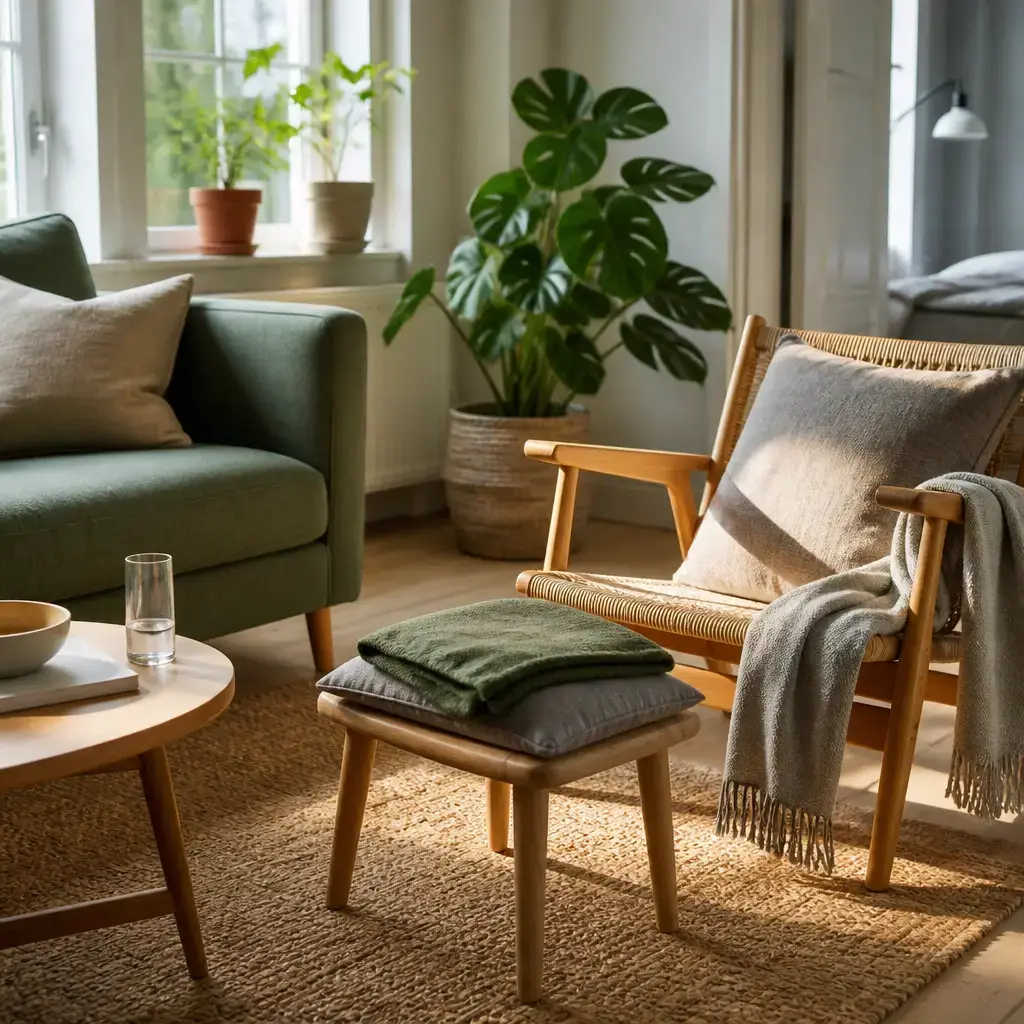
In 'på denne stol', på marks the chair as the place or surface where the person should sit. It comes before the location phrase 'denne stol'. Use it when describing sitting on a chair or another surface.
denne
In 'denne stol', denne means 'this' and points to a specific chair. It comes directly before the noun stol. Use it when directing someone toward a particular nearby object.
stol
In 'denne stol', stol means 'chair'. The phrase identifies the chair where the listener should sit. Use it when talking about a chair as a place to sit.
et
In 'et øjeblik', et means 'a' and introduces the noun øjeblik. Together, the phrase means 'for a moment'. Use this article with the exact expression 'et øjeblik' when asking someone to wait or pause briefly.
øjeblik
In 'et øjeblik', øjeblik means 'moment', referring to a short period of time. The article et comes before it in this expression. Use 'et øjeblik' when asking someone to sit or wait briefly.
Jeg
In 'Jeg gik for meget i dag', Jeg means 'I' and identifies the speaker as the person who walked. It appears at the beginning of the sentence before the verb gik. Use it as the subject when describing your own action or experience.
gik
In 'Jeg gik for meget i dag', gik says that the speaker walked earlier today. It is the past form related to gå. Use it with Jeg when describing walking that has already happened, as in 'Jeg gik for meget i dag.'
for
In 'for meget', for makes the amount excessive, giving the meaning 'too'. It comes directly before meget in this expression. Use it when saying that an amount or activity went beyond what was comfortable or suitable.
meget
In 'for meget', meget means 'much' or 'a lot', and with for the phrase means 'too much'. It follows for in the dialogue. Use this expression when explaining that you did an activity excessively.
i
In 'i dag', i forms part of the time expression meaning 'today'. It comes before dag. Use it with a time word when stating when something happens, as in 'Jeg gik for meget i dag.'
dag
In 'i dag', dag means 'day', and the complete expression means 'today'. It follows i in this time expression. Use 'i dag' when referring to the current day.
Læg
In 'Læg benet op her', Læg tells the listener to put or place the leg up. It is the imperative form related to lægge. Use it when giving an instruction to place something somewhere, as in 'Læg benet op her.'
benet
In 'Læg benet op her', benet means 'the leg' and refers to the specific leg already relevant in the conversation. It is the definite form related to ben. Use it when referring to that particular leg while giving the instruction.
op
In 'Læg benet op', op indicates upward placement, so the leg should be put up. It follows benet and completes the placement instruction. Use it with Læg when telling someone to raise or place something higher.
her
In 'Læg benet op her', her means 'here' and identifies the place where the leg should be put. It comes at the end of the placement instruction. Use it when directing someone to a location near the speaker.
og
In 'Læg benet op her, og hvil dig', og means 'and' and joins the instruction to put up the leg with the instruction to rest. It connects two actions in the same sentence. Use it when giving two related instructions together.
hvil
In 'hvil dig', hvil tells the listener to rest. It is the imperative form related to hvile, and dig shows that the listener is to rest themselves. Use it when advising someone who needs a break, as in 'Læg benet op her, og hvil dig.'
Må
In 'Må jeg gå lidt rundt senere?', Må asks whether the speaker is allowed or able to do something. It comes before Jeg in this question. Use it when asking permission to perform an action, as in 'Må jeg gå lidt rundt senere?'
gå
In 'Må jeg gå lidt rundt senere?', gå means 'walk' or 'go'. It follows the modal Må and describes the action the speaker wants permission to do. Use it for walking or going, including in the instruction 'Gå kun, hvis det føles okay.'
rundt
In 'gå lidt rundt', rundt means 'around' and shows that the walking is not toward one single stated destination. It follows gå and comes after lidt. Use it when describing moving around an area.
senere
In 'gå lidt rundt senere', senere means 'later', referring to a time after the current moment. It comes at the end of the question. Use it when asking about or referring to an action at a later time.
kun
In 'Gå kun, hvis det føles okay', kun means 'only' and limits the permission to walk to the stated condition. It comes directly after the command Gå. Use it when an action is allowed only under a particular circumstance.
hvis
In 'hvis det føles okay', hvis means 'if' and introduces the condition for walking. It comes before the condition 'det føles okay'. Use it when explaining that something should happen only when a condition is met.
det
In 'det føles okay', det functions as the subject of the statement about how the situation feels. Together with the rest of the phrase, it refers generally to whether things feel all right. Use it in this kind of impersonal statement about how something feels.
føles
In 'det føles okay', føles describes how the situation feels to the person. It is the form related to føle used with det in this sentence. Use it when judging whether a condition or experience feels comfortable or acceptable.
okay
In 'det føles okay', okay means 'okay' or 'all right'. It describes the condition that must be met before walking. Use it when saying that something feels acceptable or causes no problem.
bedre
In 'Det føles bedre på sofaen end på denne stol', bedre means 'better' and marks a more comfortable feeling in one place than another. It is the comparative form related to god and appears before the comparison with end. Use it when comparing how two places or options feel.
sofaen
In 'på sofaen', sofaen means 'the sofa' and refers to the specific sofa in the room. It is the definite form of sofa. Use it when describing sitting or feeling better on that particular sofa.
end
In 'bedre på sofaen end på denne stol', end means 'than' and introduces the second part of the comparison. It follows the first option and comes before the alternative. Use it when comparing two places, objects, or experiences.
Så
In 'Så sæt dig der', Så means 'then' and connects the comparison about the sofa to the resulting instruction. It appears at the beginning of the sentence. Use it when giving a consequence or next step based on what was just said.
der
In 'sæt dig der', der means 'there' and points to the place where the listener should sit. It follows the instruction and identifies the location. Use it when referring to a place that is visible or already understood.
hold
In 'hold benet i ro', hold tells the listener to keep the leg in a particular condition. It is the imperative form related to holde. Use it when instructing someone to keep something still or in place.
ro
In 'i ro', ro means 'stillness' or 'peace', and the whole phrase 'hold benet i ro' means to keep the leg still. It follows i in this fixed expression. Use it when telling someone to avoid moving a body part or object.