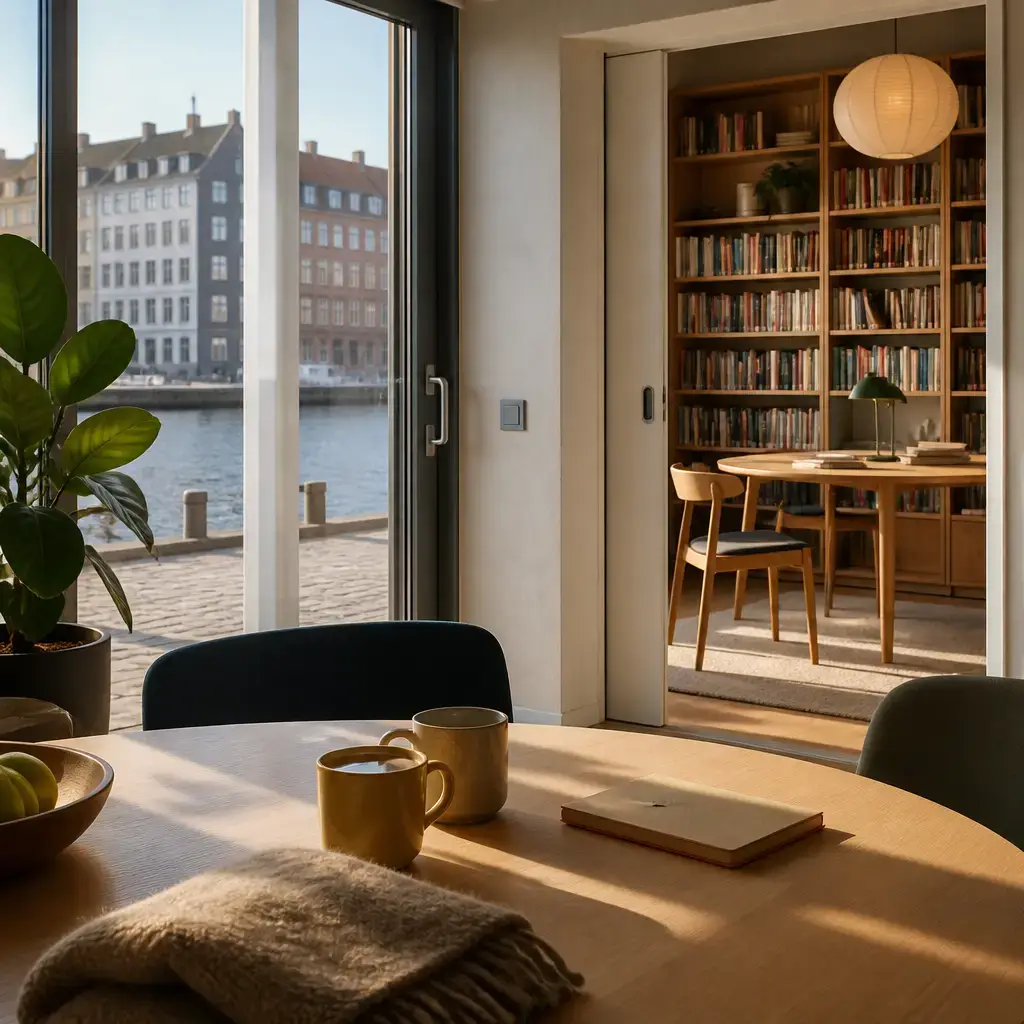
About This Lesson
Use Choosing a Simple Activity to practice Danish conversation, pronunciation, vocabulary, grammar, and quizzes.
Dialogue
A
Hvilken aktivitet skal vi lave?
VIL-gen ak-tee-vee-TEHT skahl vee LAY-vuh? What activity should we do?
B
Vi kunne gå udenfor.
Vee KOO-nuh goh OO-en-fohr. We could walk outside.
A
Det kan være koldt derude.
Deh kan VAIR-uh KAWL deh-OO-uh. It may be cold out there.
B
Så kan vi læse indenfor.
Soh kan vee LEH-suh IN-den-fohr. Then we can read inside.
A
Det lyder bedre at læse i dag.
Deh LEW-thuh BEH-druh ahd LEH-suh ee DAY. Reading sounds better today.
B
Lad os vælge et stille rum.
Lah ohs VEL-guh ed STEL-uh room. Let's choose a quiet room.
A
Jeg tager min bog med.
YAI TAY-uh min BOH mehd. I'll bring my book.
B
Jeg finder en plads til os.
YAI FEN-uh en PLASS tehl ohs. I'll find a spot for us.Word by Word
Hvilken
“Hvilken” means “which” in the question “Hvilken aktivitet skal vi lave?” It comes directly before the noun being selected, so “hvilken + noun” is a useful pattern for asking about one choice among options.
aktivitet
“Aktivitet” means “activity” here, the thing the speakers are deciding to do. It follows “Hvilken” in “Hvilken aktivitet”; a reusable pattern is “en aktivitet” for “an activity.”
skal
“Skal” expresses what the speakers should or shall do in “Hvilken aktivitet skal vi lave?” It is followed by the infinitive “lave,” giving the pattern “skal + infinitive” for asking about a planned or suggested action.
vi
“Vi” means “we” and refers to the two speakers together. It is the subject in “vi lave” and “Vi kunne gå”; use “vi” before an action when talking about yourself and other people.
lave
“Lave” means “do” here, as in doing an activity. It follows “skal” in “skal vi lave,” so “skal + lave” shows the action being considered.
kunne
“Kunne” presents walking as a possible suggestion in “Vi kunne gå udenfor.” It is followed by the infinitive “gå”; use “kunne + infinitive” to suggest something that is possible.
gå
“Gå” means “walk” or “go” in “gå udenfor.” It follows “kunne,” and “gå + place or direction” is a useful pattern for describing movement.
udenfor
“Udenfor” means “outside” and tells where the speakers could walk in “gå udenfor.” It is used as a location word after an action such as “gå”; a common pattern is “være udenfor” for “be outside.”
Det
“Det” means “it” and acts as the subject in “Det kan være koldt derude.” Here it introduces the situation being described, and a useful pattern is “Det er ...” or “Det kan være ...” when describing a condition.
kan
“Kan” expresses possibility in “Det kan være koldt derude,” so the weather may be cold. It is followed by “være”; “kan + infinitive” is a common pattern for saying that something can or may happen.
være
“Være” means “be” in “kan være koldt.” It follows the modal “kan” and links the situation to the description “koldt”; the pattern “kan være + description” expresses a possible condition.
koldt
“Koldt” means “cold” in the description “Det kan være koldt derude.” It describes the condition in this sentence and is used after “være,” as in “være koldt” when describing cold conditions.
derude
“Derude” means “out there,” referring to the outside area in “Det kan være koldt derude.” It combines a location with the sense of some distance from the speakers; use it to point to a place outside the immediate space.
Så
“Så” means “then” in “Så kan vi læse indenfor.” It connects the decision to read with the previous possibility that it may be cold outside; “så + clause” is useful for introducing a resulting action.
læse
“Læse” means “read” in “kan vi læse indenfor.” It follows “kan,” and “læse + location” can describe reading in a particular place.
indenfor
“Indenfor” means “inside” and gives the location for reading in “læse indenfor.” It is used as a location word after an action; a common pattern is “være indenfor” for “be inside.”
lyder
“Lyder” means “sounds” in “Det lyder bedre at læse i dag.” With “bedre,” the expression evaluates reading as a more appealing choice; a reusable pattern is “Det lyder + description” when giving an impression or reaction.
bedre
“Bedre” means “better” here, showing that reading seems preferable today. It follows “lyder” in “lyder bedre”; use “lyder bedre + action” to say that one option sounds more appealing.
at
“At” marks the infinitive in “at læse,” meaning “to read” in this clause. It comes directly before an infinitive; the pattern “at + infinitive” is used when an action is treated as an idea or activity.
i
“I” means “in” or “on” in general, but in “i dag” it forms the time expression “today.” Use “i + time expression” for certain time references, including “i dag.”
dag
“Dag” means “day” in the expression “i dag,” which means “today.” The word is used with “i” in this fixed time expression; “en dag” can be used for “a day” in a new example.
Lad
“Lad” begins the invitation “Lad os vælge et stille rum,” meaning “Let’s choose a quiet room.” Together with “os,” it forms a suggestion; use “Lad os + infinitive” to invite people to do something.
os
“Os” means “us” in “Lad os vælge,” where it refers to the people included in the suggestion. It follows “Lad” in the reusable pattern “Lad os + infinitive”; it also appears after “til” in “til os.”
vælge
“Vælge” means “choose” in “Lad os vælge et stille rum.” It follows “Lad os” in a suggestion, so “Lad os + vælge + object” is a useful pattern for proposing a choice.
et
“Et” means “a” or “an” before “rum” in “et stille rum.” It introduces one unspecified noun; use “et + noun” with this type of noun.
stille
“Stille” means “quiet” in “et stille rum.” It describes the room and comes before the noun; “stille + noun” is a reusable pattern for describing a quiet place or thing.
rum
“Rum” means “room” in “et stille rum,” the place the speakers want to choose for reading. It follows the article and adjective; a useful pattern is “et rum” for “a room.”
Jeg
“Jeg” means “I” and is the subject in “Jeg tager min bog med” and “Jeg finder en plads til os.” It comes before the action in these sentences; use “Jeg + verb” to state what you will do.
tager
“Tager” means “take” or “bring” in “Jeg tager min bog med,” where the book is brought along. The pattern “tager + object + med” is useful for saying that you take or bring something with you.
min
“Min” means “my” before “bog” in “min bog.” It shows that the book belongs to the speaker; use “min + noun” when referring to one of your own things.
bog
“Bog” means “book” in “Jeg tager min bog med.” It is the object of “tager” and is described by “min”; a useful pattern is “min bog” for “my book.”
med
“Med” means “along” or “with” in “tager min bog med.” After the object, it completes the expression for bringing something along; use “tage + object + med” for this purpose.
finder
“Finder” means “find” in “Jeg finder en plads til os.” It describes locating a suitable place for the group; use “finder + object” when saying what someone finds.
en
“En” means “a” or “an” before “plads” in “en plads til os.” It introduces one unspecified place; use “en + noun” with this type of noun.
plads
“Plads” means “spot” or “place” in “en plads til os.” It is the thing being found and is followed by “til os” to show who it is for; a useful pattern is “finde en plads” for “find a spot.”
til
“Til” means “for” in “en plads til os,” marking the people who will use the spot. The pattern “en plads til + person” is useful for describing a place intended for someone.
Grammar Points
Lad os + infinitiv
Lad os vælge.
Lah ohs VEL-guh.Let's choose.
“Lad os” is a fixed Danish expression used to suggest an action. It is followed by the infinitive form of the verb.
Danish Vocabulary
aktivitet
noun
ak-tee-vee-TEHT
activity
derude
adv
deh-OO-uh
out there
gå
verb
goh
to walk; to go
hvilken
det
VIL-gen
which
Hvilken
indenfor
adv
IN-den-fohr
inside
kold
adj
KAWL
cold
koldt
lave
verb
LAY-vuh
to do; to make
lyde
verb
LEW-thuh
to sound
lyder
læse
verb
LEH-suh
to read
så
adv
Soh
then
Så
udenfor
adv
OO-en-fohr
outside
være
verb
VAIR-uh
to be
Quiz
Word Order
Arrange the words in the correct order.
What activity should we do?
Show Answer
Hvilken aktivitet skal vi lave?We could walk outside.
Show Answer
Vi kunne gå udenfor.It may be cold out there.
Show Answer
Det kan være koldt derude.Spelling
Tap the letters to spell the word.
to do; to make
Show Answer
laveout there
Show Answer
derudeactivity
Show Answer
aktivitetcold