Er
In ‘Er det den rigtige kø?’ and ‘Er skranken længere fremme?’, Er asks whether something is or exists in a certain way. A reusable question pattern is ‘Er ...?’ for checking information.
det
In ‘Er det den rigtige kø?’, det is the neutral ‘it/that’ element referring to the line being checked. The reusable pattern ‘Er det ...?’ asks whether something is a particular thing or has a particular quality.
den
In ‘den rigtige kø’, den means ‘the’ before the specific line, while in ‘se den’ it means ‘it’ and refers to the front desk. Reuse den with a specific noun phrase, or after a verb when referring back to a specific thing.
rigtige
In ‘den rigtige kø’, rigtige describes the line as the correct one for this situation. It follows den and comes before the noun kø in this phrase.
kø
In ‘den rigtige kø’, kø means a line or queue of people waiting. A new example is ‘Jeg står i kø’, meaning ‘I am standing in line’.
går
In ‘Den går hen til skranken’, går says that the line leads toward the front desk; in ‘Køen går langsomt’, it says that the line moves slowly. The reusable pattern ‘går hen til + destination’ describes movement or direction toward a place.
hen
In ‘går hen til skranken’, hen adds the idea of movement toward or over to the destination. Reuse the pattern ‘hen til + place’ when describing movement toward a place.
til
In ‘hen til skranken’, til marks skranken as the destination: ‘to the front desk’. A reusable pattern is ‘til + destination’.
skranken
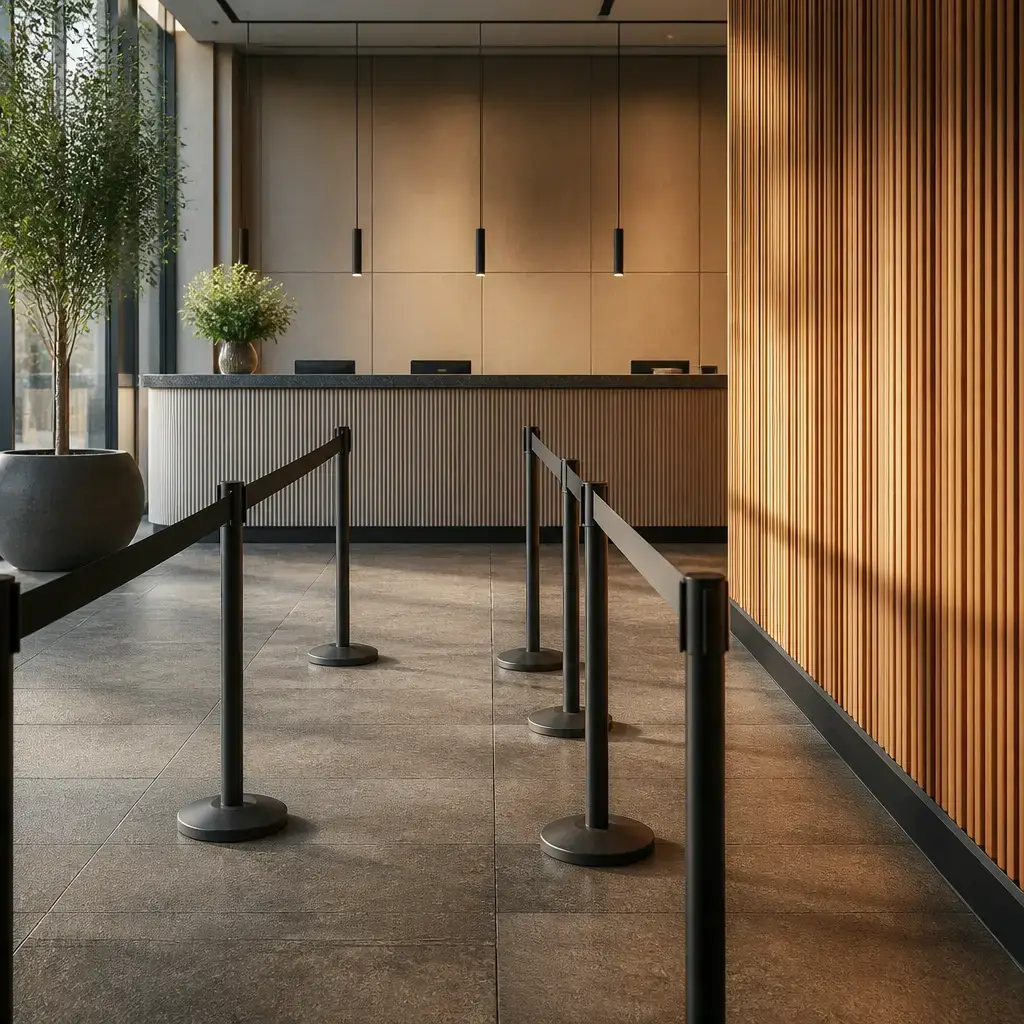
Skranken means the specific front desk or counter in ‘hen til skranken’ and ‘Er skranken længere fremme?’. It names the desk the line leads to and the desk whose location is being checked.
længere
In ‘længere fremme’, længere means farther, as part of asking whether the desk is farther ahead. Reuse the expression ‘længere fremme’ to refer to a location farther ahead.
fremme
In ‘længere fremme’, fremme means ahead or up front, completing the location expression with længere. The phrase ‘længere fremme’ is useful when asking or saying that something is farther ahead.
Vi
In ‘Vi kan se den herfra’ and ‘Vi kan vente lidt længere’, Vi means ‘we’ and refers to the speaker and the other person together. A reusable pattern is ‘Vi kan + verb’ when describing something the group is able to do.
kan
In ‘Vi kan se den’ and ‘Vi kan vente lidt længere’, kan says that the speakers are able to do something. It is followed by the verb action, as in the reusable pattern ‘Vi kan + verb’.
se
In ‘kan se den’, se means ‘see’ the front desk from the current place. Reuse ‘se + object’ when saying what someone sees.
herfra
In ‘Vi kan se den herfra’, herfra means ‘from here’ and identifies the speakers’ current viewpoint or starting point. Reuse herfra after an action to say that it is possible from the current place.
Skal
In ‘Skal jeg stille mig bag dig?’, Skal asks whether the speaker should do the proposed action. A reusable question pattern is ‘Skal jeg + verb?’ when asking what the speaker ought to do.
jeg
In ‘Skal jeg stille mig bag dig?’, jeg means ‘I’ and identifies the person who may stand behind the other person. It commonly appears after Skal in the reusable pattern ‘Skal jeg + verb?’.
stille
In ‘stille mig bag dig’, stille contributes the action of positioning oneself in the line. After Skal, it appears in the reusable pattern ‘stille mig + place’.
mig
In ‘stille mig bag dig’, mig refers to the speaker as the person who will be positioned. It is part of the reusable expression ‘stille mig + place’.
bag
In ‘bag dig’, bag means ‘behind’ and describes the position relative to the other person. Reuse the pattern ‘bag + person or place’ to describe something located behind someone or something.
dig
In ‘bag dig’, dig means ‘you’ and identifies the person the speaker will stand behind. Reuse ‘bag + person’ when describing a position behind someone.
Bliv
In ‘Bliv tæt på’, Bliv is a direct instruction to remain or stay in a nearby position. A new example is ‘Bliv her’, meaning ‘Stay here’.
tæt
In ‘tæt på’, tæt contributes the idea of closeness; together with på, the expression means ‘near’ or ‘close to’. Reuse the full pattern ‘tæt på + person or place’.
på
In ‘tæt på’, på completes the expression that means being near or close to someone or something. Reuse ‘tæt på + person or place’ rather than treating this use as a standalone translation.
der
In ‘der er ikke meget plads’, der introduces the statement about whether space is available; it does not point to a particular physical place here. The reusable pattern ‘der er + noun phrase’ states that something exists or is present.
ikke
In ‘der er ikke meget plads’, ikke negates the amount of available space and makes the statement negative. It comes before ‘meget plads’ in this sentence.
meget
In ‘ikke meget plads’, meget means ‘much’ and describes the amount of space. Reuse ‘meget + amount noun’ when referring to a large amount of something.
plads
In ‘der er ikke meget plads’, plads means room or physical space available for people to stand. The reusable phrase ‘meget plads’ refers to a large amount of room.
Køen
In ‘Køen går langsomt’, Køen means the specific line or queue that the speakers are waiting in. It is the form of kø used when referring to that particular line as the subject.
langsomt
In ‘Køen går langsomt’, langsomt describes the slow manner in which the line moves. Reuse the pattern ‘gå langsomt’ to say that something moves or proceeds slowly.
vente
In ‘Vi kan vente lidt længere’, vente means ‘wait’ and describes what the speakers are able to continue doing. After kan, it fits the reusable pattern ‘kan vente + duration or time expression’.
lidt
In ‘lidt længere’, lidt means ‘a little’ and makes the additional waiting time small. Reuse ‘lidt længere’ when saying that something will continue for a little more time.