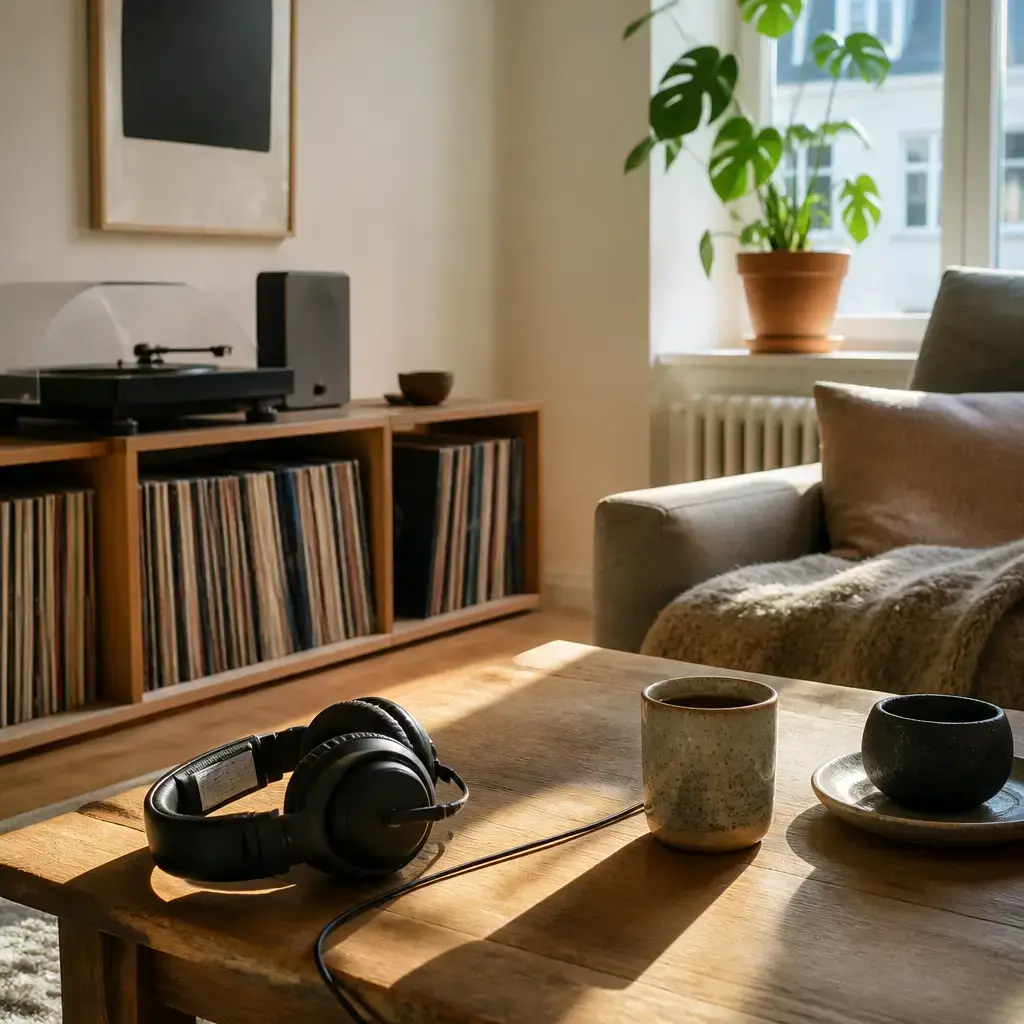
About This Lesson
Use Listening to Music in Free Time to practice Danish conversation, pronunciation, vocabulary, grammar, and quizzes.
Dialogue
A
Lytter du til musik?
LÜD-uh doo tehl moo-SEEK? Do you listen to music?
B
Jeg lytter i min fritid.
yai LÜD-uh ee men free-TEETH. I listen in my free time.
A
Hvilken slags musik kan du lide?
VIL-kuhn SLEHS moo-SEEK kan doo LEE-thuh? What kind of music do you like?
B
Jeg kan lide langsomme sange.
yai kan LEE-thuh LAHNG-saw-muh SENG-uh. I like slow songs.
A
Bruger du høretelefoner?
BROO-uh doo HUR-uh-teh-leh-FOH-nuh? Do you use headphones?
B
Jeg bruger dem, når jeg gerne vil slappe af.
yai BROO-uh dehm, nawr yai YAIR-nuh vehl SLA-buh EH. I use them when I want to relax.
A
Må jeg høre noget?
maw yai HUR-uh NOH-uhth? Can I hear something?
B
Jeg spiller et roligt nummer.
yai SBEH-luh eht ROH-lee NOM-uh. I'll play a quiet track.Word by Word
Lytter
Lytter means “listen” here, in “Lytter du til musik?”; the same written form appears as lowercase “lytter” in “Jeg lytter i min fritid.” This form is used with “til” before what is being listened to, and it is useful when asking or answering about someone’s listening habit.
du
du means “you” here and is the person being asked in “Lytter du til musik?” It appears after the verb in this question pattern and is useful when speaking directly to someone.
til
til means “to” here and forms the listening expression in “Lytter du til musik?” It connects the listening action with the thing being listened to, so it comes before the music or audio being heard.
musik
musik means “music” here and is the thing being listened to in “Lytter du til musik?” It follows “til” in this expression, which is useful when discussing listening habits.
Jeg
Jeg means “I” here and marks the speaker in “Jeg lytter i min fritid.” It comes before the verb in this statement pattern and is useful for saying what you do.
i
i means “in” or “during” here in the time phrase “i min fritid.” It introduces the time period when the action happens, so it is useful before a time expression.
min
min means “my” here in “min fritid,” identifying the speaker’s free time. It comes before the noun and is useful when talking about something belonging to or associated with yourself.
fritid
fritid means “free time” in “i min fritid.” Together with “i min,” it names the time when the speaker listens, and it is useful when talking about activities done in free time.
Hvilken
Hvilken means “which” or “what kind of” here, opening “Hvilken slags musik kan du lide?” It asks the listener to identify a category, and “Hvilken slags” is useful when asking what type of something someone prefers.
slags
slags means “kind” or “type” here and specifies the category in “Hvilken slags musik.” It works with “Hvilken” before the noun being categorized, so the full expression is useful for asking what type of something someone likes.
kan
In “kan du lide”, kan is part of the common Danish expression meaning “like”; here it helps form the question about music preference. Reuse “kan du lide” with the thing being asked about when asking whether someone likes it.
lide
In “kan du lide”, lide is the part that expresses liking, so the whole expression means “do you like”. It can be reused with an object, as in “kan lide langsomme sange”, when stating a preference.
langsomme
langsomme means “slow” here and describes the songs in “langsomme sange.” It comes before the noun in this phrase and is useful for describing the character or pace of music.
sange
sange means “songs” here, the music items liked in “Jeg kan lide langsomme sange.” It follows the describing word “langsomme” and is useful when naming songs as the object of a preference.
Bruger
Bruger means “use” here in the question “Bruger du høretelefoner?”; the same verb appears as lowercase “bruger” in “Jeg bruger dem”. It is used before the object in these sentences, and the question pattern is useful for asking whether someone uses an item.
høretelefoner
høretelefoner means “headphones” here, the item asked about in “Bruger du høretelefoner?” It follows the verb as the object and is useful when talking about equipment used for listening.
dem
dem means “them” here and refers back to høretelefoner in “Jeg bruger dem”. It replaces the already mentioned item after the verb, so it is useful when you do not want to repeat that item.
når
når means “when” here and introduces “når jeg gerne vil slappe af.” It links the use of headphones to the time or condition for wanting to relax, and it is useful for introducing a when-clause.
gerne
gerne adds the sense of willingly or being glad to in “gerne vil slappe af”; with vil, the phrase expresses wanting to relax. Reuse “gerne vil” before an action when describing something you would like to do.
vil
vil means “want to” here in “gerne vil slappe af.” It comes before the action expression and is useful when stating a desire to do something.
slappe af
“slappe af” is the complete two-part expression meaning “relax” here. “slappe” supplies the relaxing action and “af” completes the expression; in “gerne vil slappe af”, it names what the speaker wants to do. Use the whole expression when talking about resting or unwinding.
Må
Må means “may I” or “can I” here in “Må jeg høre noget?” and makes the request for permission. The pattern “Må jeg” followed by an action is useful when politely asking whether you may do something.
høre
høre means “hear” here in “Må jeg høre noget?” It follows “Må jeg” and takes “noget” as what may be heard, so the question is useful when asking to hear something.
noget
noget means “something” here and is what the speaker asks to hear in “Må jeg høre noget?” It can stand after “høre” when the specific thing is not named.
spiller
spiller means “play” here, referring to playing the track in “Jeg spiller et roligt nummer.” It is followed by the thing being played, and the phrase is useful when offering or describing music playback.
et
et means “a” or “an” here and introduces the non-specific track in “et roligt nummer.” It comes before the noun phrase when introducing one item.
roligt
roligt means “quiet” or “calm” here and describes the track in “et roligt nummer.” It comes before the noun and is useful for describing the character of a track.
nummer
nummer means “track” here in the music context of “et roligt nummer.” It is the thing being played after “spiller”, so the phrase is useful when offering a track to play.
Grammar Points
Hvilken slags + substantiv
Hvilken slags musik kan du lide?
VIL-kuhn SLEHS moo-SEEK kan doo LEE-thuh?What kind of music do you like?
Hvilken slags means “what kind of” and comes before the noun. In a question, kan comes before du.
Danish Vocabulary
bruger
verb
BROO-uh
use
Bruger
dem
pron
DEHM
them
fritid
noun
free-TEETH
free time
gerne
adv
YAIR-nuh
would like to
hvilken
det
VIL-kuhn
which
Hvilken
høretelefoner
noun
HUR-uh-teh-leh-FOH-nuh
headphones
kan lide
phrase
kan LEE-thuh
like
kan du lide
langsomme
adj
LAHNG-saw-muh
slow
lytter
verb
LÜD-uh
listen
musik
noun
moo-SEEK
music
sange
noun
SENG-uh
songs
slags
noun
SLEHS
kind
Quiz
Word Order
Arrange the words in the correct order.
Do you listen to music?
Show Answer
Lytter du til musik?I listen in my free time.
Show Answer
Jeg lytter i min fritid.What kind of music do you like?
Show Answer
Hvilken slags musik kan du lide?Spelling
Tap the letters to spell the word.
free time
Show Answer
fritidwhich
Show Answer
Hvilkensongs
Show Answer
sangeuse