Er
In “Er madlavning din hobby?”, “Er” means “is” and begins the question about whether cooking is someone’s hobby. A reusable question pattern is “Er ...?” followed by the person or thing being described.
madlavning
In “Er madlavning din hobby?”, “madlavning” means cooking as an activity. It is used here as the activity that may be someone’s hobby, as in “madlavning er ...” in a new example.
din
In “din hobby”, “din” means “your” and shows that the hobby belongs to the person being addressed. It can be reused before the thing that belongs to the listener, as in “din opskrift” in a new example.
hobby
In “din hobby”, “hobby” means a hobby or activity someone enjoys. The expression “Er ... din hobby?” asks whether an activity is the listener’s hobby.
Jeg
In “Jeg kan godt lide...”, “Jeg” means “I” and identifies the speaker as the person who likes or does something. It is commonly used at the start of a sentence about the speaker’s action or preference.
kan
In “Jeg kan godt lide...”, “kan godt lide” is the Danish expression for liking; “kan” is part of this expression and does not mean ability by itself here. The expression is reused before the thing or activity liked, as in “Jeg kan godt lide at lave...”.
godt
In “kan godt lide”, “godt” is part of the expression meaning “like” in this dialogue. Keep it together with “kan” and “lide”, and place the liked thing or activity after the expression.
lide
In “kan godt lide”, “lide” contributes to the Danish expression for liking. The complete pattern “Jeg kan godt lide at lave...” expresses that the speaker likes making or cooking something.
at
In “at lave enkel mad”, “at” marks the following verb as an infinitive, giving the meaning “to make” or “to cook”. A reusable pattern is “at” followed by an action, as in “at følge en opskrift” in a new example.
lave
In “at lave enkel mad”, “lave” means to make or cook, specifically preparing food here. It can be reused with the thing being prepared, as in “at lave suppe” in a new example.
enkel
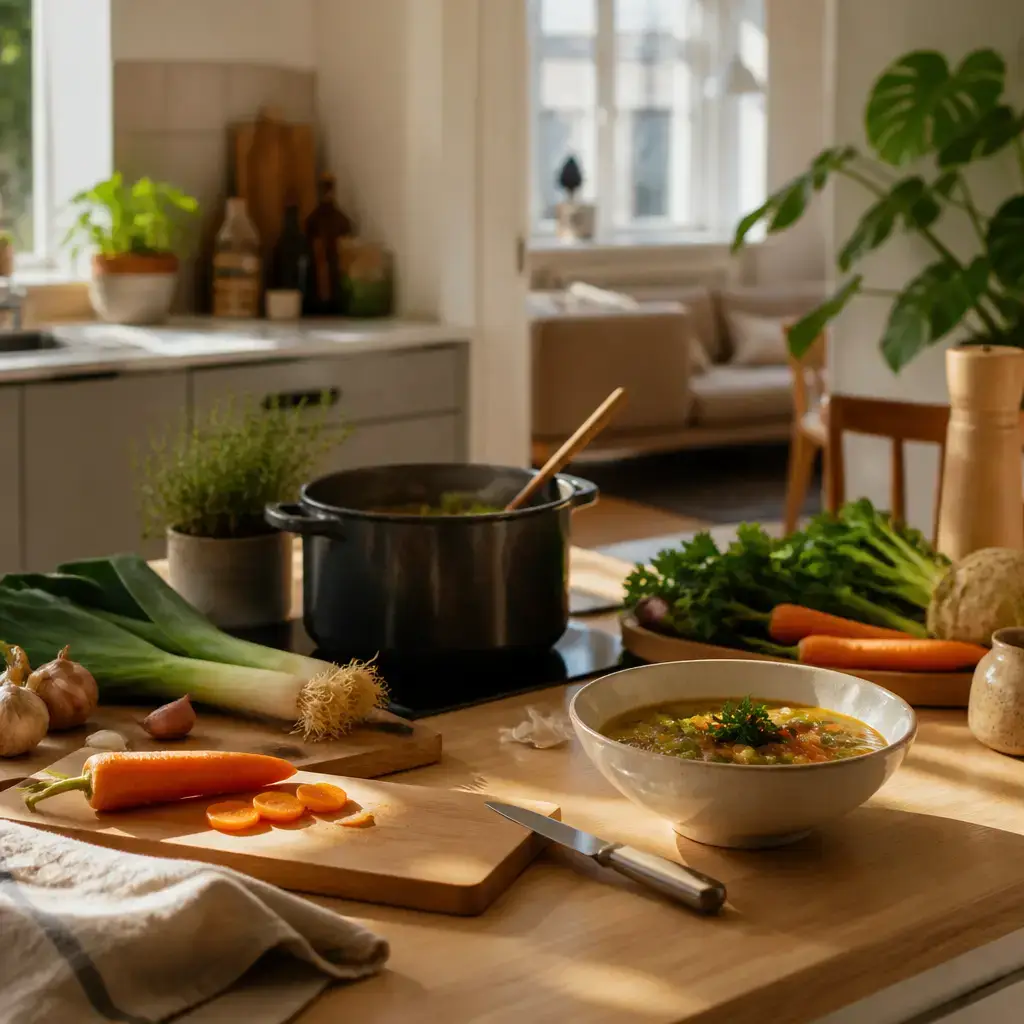
In “enkel mad” and “en enkel suppe”, “enkel” means simple. It describes the food or soup and is placed directly before the noun it describes.
mad
In “enkel mad”, “mad” means food. It refers generally to the food the speaker likes making, and it can be used after a describing word such as “enkel”.
derhjemme
In “lave enkel mad derhjemme”, “derhjemme” means at home. It gives the place where the cooking happens and can be placed after the action or activity being described.
Hvad
In “Hvad kan du godt lide at lave?”, “Hvad” means “what” and asks which thing the listener likes to make. A reusable question pattern is “Hvad ...?” followed by the action or preference being asked about.
du
In “kan du godt lide...”, “du” means “you” and refers to the person being addressed. It is used as the person who has the preference or performs the action in the question.
laver
In “Jeg laver ofte en enkel suppe”, “laver” means makes or cooks. It is used with the prepared item after it, as in “Jeg laver ofte...” followed by food or another object.
ofte
In “Jeg laver ofte en enkel suppe”, “ofte” means often and shows that the action happens regularly. It is placed before the thing being made and can be reused with other repeated activities.
en
In “en enkel suppe”, “en” means “a” and introduces one unspecified soup. It is placed before the describing word and noun in the phrase “en enkel suppe”.
suppe
In “en enkel suppe”, “suppe” means soup. It is the food being prepared, and it can be used after “lave” or “gemmer”, as in “lave suppe” or “gemmer noget suppe”.
Bruger
In “Bruger du en opskrift?”, “Bruger” means use and asks whether the listener uses a recipe. A reusable question pattern is “Bruger du ...?” followed by the thing being used.
opskrift
In “en opskrift”, “opskrift” means recipe. Here it is the thing that may be used and followed for cooking, as in “følger en opskrift”.
følger
In “Jeg følger en nem opskrift”, “følger” means follows, referring to following the instructions in a recipe. It can be reused before the thing or set of instructions being followed, as in “følger en opskrift”.
nem
In “en nem opskrift”, “nem” means easy. It describes the recipe and is placed before the noun in the phrase “en nem opskrift”.
vil
In “Jeg vil gerne prøve den”, “vil gerne” expresses that the speaker would like to do something. It is followed by the infinitive action “prøve”, giving the reusable pattern “Jeg vil gerne” plus an action.
gerne
In “vil gerne prøve den”, “gerne” helps express the speaker’s wish to do the action. Together with “vil”, it is placed before the infinitive, as in “vil gerne prøve”.
prøve
In “vil gerne prøve den”, “prøve” means try. It is followed by “den”, the thing the speaker wants to try, so the reusable pattern is “prøve” plus an object.
den
In “prøve den” and “når den er klar”, “den” means it or the one already understood from the conversation. It refers to the prepared item being discussed and can be reused as the object of an action, as in “prøve den”.
når
In “når den er klar”, “når” means when and introduces the time at which something is ready. A reusable pattern is “når” followed by the event or condition that determines the timing.
klar
In “den er klar”, “klar” means ready. It describes the prepared item after “er”, and the phrase can be reused when saying that something is ready.
gemmer
In “Jeg gemmer noget suppe til dig”, “gemmer” means saves or keeps, here meaning that the speaker reserves some soup. It can be reused with the thing being kept, as in “gemmer noget ...”.
noget
In “noget suppe”, “noget” means some and refers to an unspecified amount of soup. It is placed before the food or substance being reserved, as in “noget suppe”.
til
In “til dig”, “til” means for and marks the intended recipient of the saved soup. The reusable pattern “noget ... til” plus a person expresses something being kept for that person.
dig
In “til dig”, “dig” means you and identifies the person for whom the soup is being saved. It follows the preposition “til” in the expression “til dig”.