Er
Er means “is” in the question Er der et ledigt studierum? It is the present form of være and is used here with the existential expression Er der ...? to ask whether something is available. A reliable reuse pattern is Er der ...? when asking whether something exists or is available.
der
Der is the existential placeholder in Er der et ledigt studierum? and Der er et ledigt nu., helping introduce what is or is not available. In the pattern Der er ..., it does not refer to a specific place. Use Der er ... to say that something is present or available.
et
Et means “a” in et ledigt studierum and represents “one” in et ledigt nu., where the room noun is omitted. Before studierum, it is the indefinite article used with this neuter noun, and ledigt has the matching form. A reliable reuse pattern is et + an available neuter noun.
ledigt
Ledigt means “available” or “free” in et ledigt studierum and et ledigt nu. It is the neuter form of ledig, matching the neuter noun studierum or the omitted room understood in the reply. Use it before a neuter noun when describing something that is available.
studierum
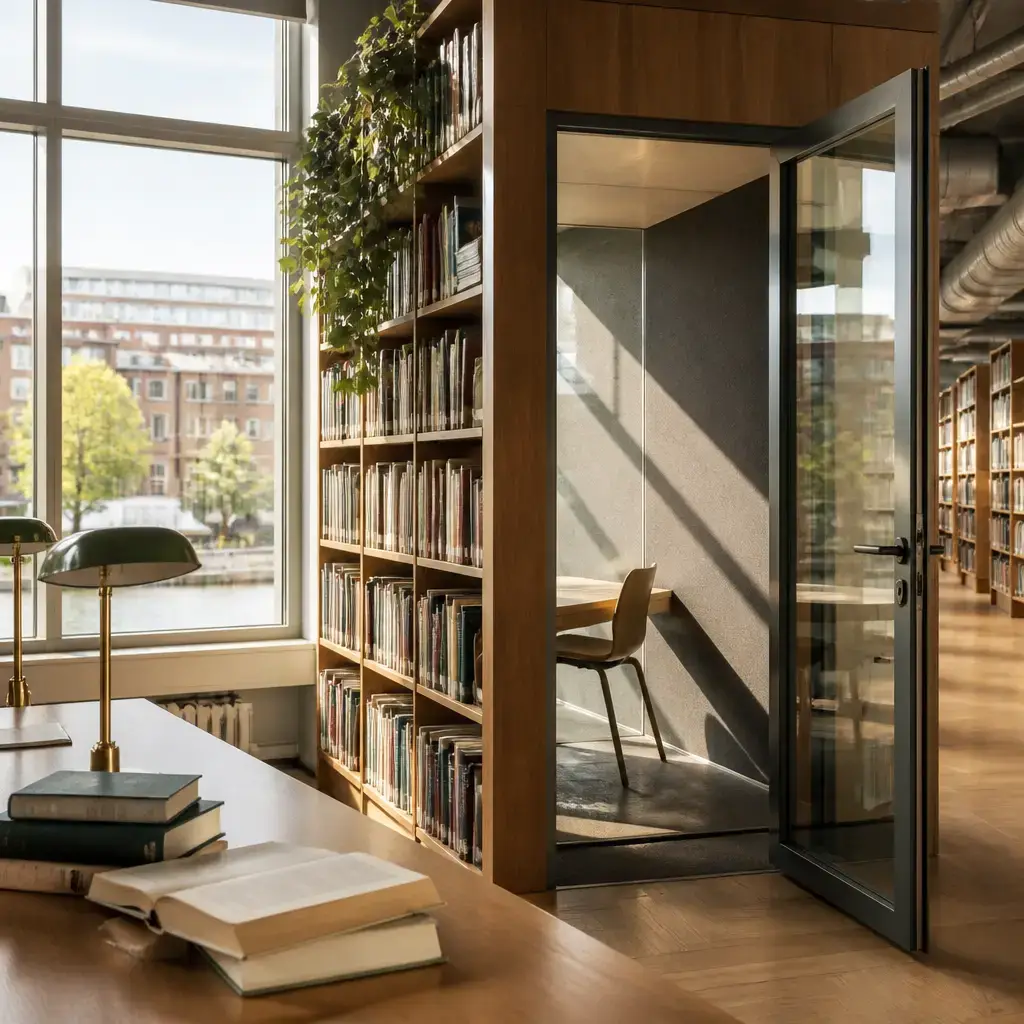
Studierum means “study room” in et ledigt studierum, the room being asked about in the library. It is a compound noun referring to a room intended for studying or quiet reading. Use studierum after a determiner or adjective when naming this type of room.
Må
Må means “may” or “am I allowed to” in Må jeg læse derinde? It is the present form of måtte and is used here to ask for permission. A reliable reuse pattern is Må jeg + verb? when politely asking whether you may do something.
jeg
Jeg means “I” in Må jeg læse derinde? and is the subject of the question. It is the subject form used for the person asking permission. Use jeg before the verb when saying what you do or asking what you may do.
læse
Læse means “read” in Må jeg læse derinde? and til at læse. It is the infinitive form after the modal Må and after at. A reliable reuse pattern is læse + an object when saying what you read, or Må jeg læse ...? when asking permission to read.
derinde
Derinde means “in there” in Må jeg læse derinde? and Bliver der stille derinde? It points to the inside of the study room already mentioned. Use derinde when referring to an interior place that is understood from the conversation.
Du
Du means “you” in Du kan bruge det til at læse og lukke døren. It is the subject addressing the person asking about the room. Use du before the verb when giving information or instructions to one person.
kan
Kan means “can” or “are able to” in Du kan bruge det ... It is the present form of kunne and expresses permission or possibility here. A reliable reuse pattern is kan + infinitive, as in kan bruge.
bruge
Bruge means “use” in Du kan bruge det til at læse og lukke døren. It is the infinitive after kan and takes det as the thing being used. Use bruge det til at ... when saying what something can be used for.
det
Det means “it” in Du kan bruge det ... and Efterlad det rent ... In the first line it refers to the study room, and in the second it is the thing that should be left clean. Use det for this neuter referent when referring back to the room.
til
Til means “for” in til at læse and introduces the purpose of using the room. Together with at and læse, til at læse means “for reading” or “to read”; the purpose comes from the whole construction. A reliable reuse pattern is til at + verb for a purpose.
at
At is the infinitive marker in til at læse. It introduces læse after til, and the coordinated verb lukke is understood within the same purpose construction. Use at before an infinitive when introducing an action such as at læse.
og
Og means “and” in læse og lukke døren. It joins the two actions that the person may carry out in the room. Use og to connect two verbs, objects, or other equivalent parts of a sentence.
lukke
Lukke means “close” in lukke døren. It is the action coordinated with læse in the instruction about using the room and closing its door. A reliable reuse pattern is lukke + a door or other object that is being closed.
døren
Døren means “the door” in lukke døren. It is the definite form of dør and identifies the specific door of the study room. Use the definite form when the listener can identify which door is meant.
Bliver
Bliver asks whether the room will become or remain quiet in Bliver der stille derinde? It is the present form of blive, which here describes a change or continuation into a quiet state rather than naming a simple location. A reliable reuse pattern is Bliver der ...? when asking whether a state will arise or continue.
stille
Stille means “quiet” in Bliver der stille derinde? and describes the state expected inside the room. It is used with blive to ask about the room becoming or staying quiet. Use blive stille when referring to becoming quiet.
Væggene
Væggene means “the walls” in Væggene holder det meste af støjen ude. It is the definite plural form of væg and refers to the walls of the room. Use the definite form when the walls are identifiable from the setting.
holder
Holder means “keeps” in holder det meste af støjen ude. It is the present form of holde, and together with ude it expresses blocking something from entering: holder ... ude. A reliable reuse pattern is holde + something + ude when saying that something is kept out.
meste
Meste means “most” or “the greatest part” in det meste af støjen. The complete phrase det meste af støjen identifies the largest part of the noise that the walls block. Use det meste af + a noun when referring to most of something.
af
Af means “of” in det meste af støjen and connects meste with the thing being measured. In the pattern det meste af støjen, it introduces what most refers to. Use af after expressions such as det meste af when specifying the relevant part of something.
støjen
Støjen means “the noise” in det meste af støjen. It is the definite form of støj and identifies the noise coming from outside the room. Use the definite form when the noise is understood from the situation.
ude
Ude means “out” or “away” in holder det meste af støjen ude. It completes holder ... ude and shows that the noise is kept outside the room. Use ude with holde ... ude when describing something being blocked from entering.
her
Her contributes the meaning “this” in Det her rum. Together with det, it points to the particular room being considered, rather than simply saying “here.” A reliable reuse pattern is det her + noun when identifying a nearby or currently discussed thing.
rum
Rum means “room” in Det her rum and refers to the study room under discussion. It is the noun identified by det her. Use rum after a determiner or adjective when naming a room.
passer
Passer means “suits” or “works for” in Det her rum passer mig. It is the present form of passe and says that the room meets the speaker’s needs. A reliable reuse pattern is something + passer mig when saying that something suits me.
mig
Mig means “me” in Det her rum passer mig. It is the object form referring to the person whose needs the room suits; the subject form is jeg. Use mig after verbs or prepositions when I am the person affected.
Efterlad
Efterlad means “leave” in the instruction Efterlad det rent til andre. It is the imperative form of efterlade and asks the listener to leave the room in a clean condition. Use Efterlad + object + description when giving an instruction about the condition in which something should be left.
rent
Rent means “clean” in Efterlad det rent til andre. It describes the condition in which det, referring to the room, should be left, and it is the neuter form of ren. Use leave-object patterns with rent when asking someone to keep a neuter thing clean.
andre
Andre means “other people” or “others” in Efterlad det rent til andre. It identifies the people who will use the room after the current speaker. A reliable reuse pattern is til andre when referring to something intended or left for other people.