Jeg
“Jeg” means “I” here and names the person who feels tired. It is used before the verb in “Jeg føler mig træt.” A new example is “Jeg arbejder her” for saying “I work here.”
føler
“føler” means “feel” in “Jeg føler mig træt,” describing the speaker’s state. It is used together with “mig” and an adjective such as “træt.” A new example is “Jeg føler mig bedre” for saying “I feel better.”
mig
“mig” means “myself” or “me” in the expression “føler mig træt.” It shows that the feeling described by “træt” applies to the speaker. A new example is “Hun føler sig glad,” where the corresponding reflexive form refers to her.
træt
“træt” means “tired” in both “Jeg føler mig træt” and “mindre træt.” It describes the speaker’s condition after “føler mig.” A new example is “Jeg er træt” for saying “I am tired.”
ved
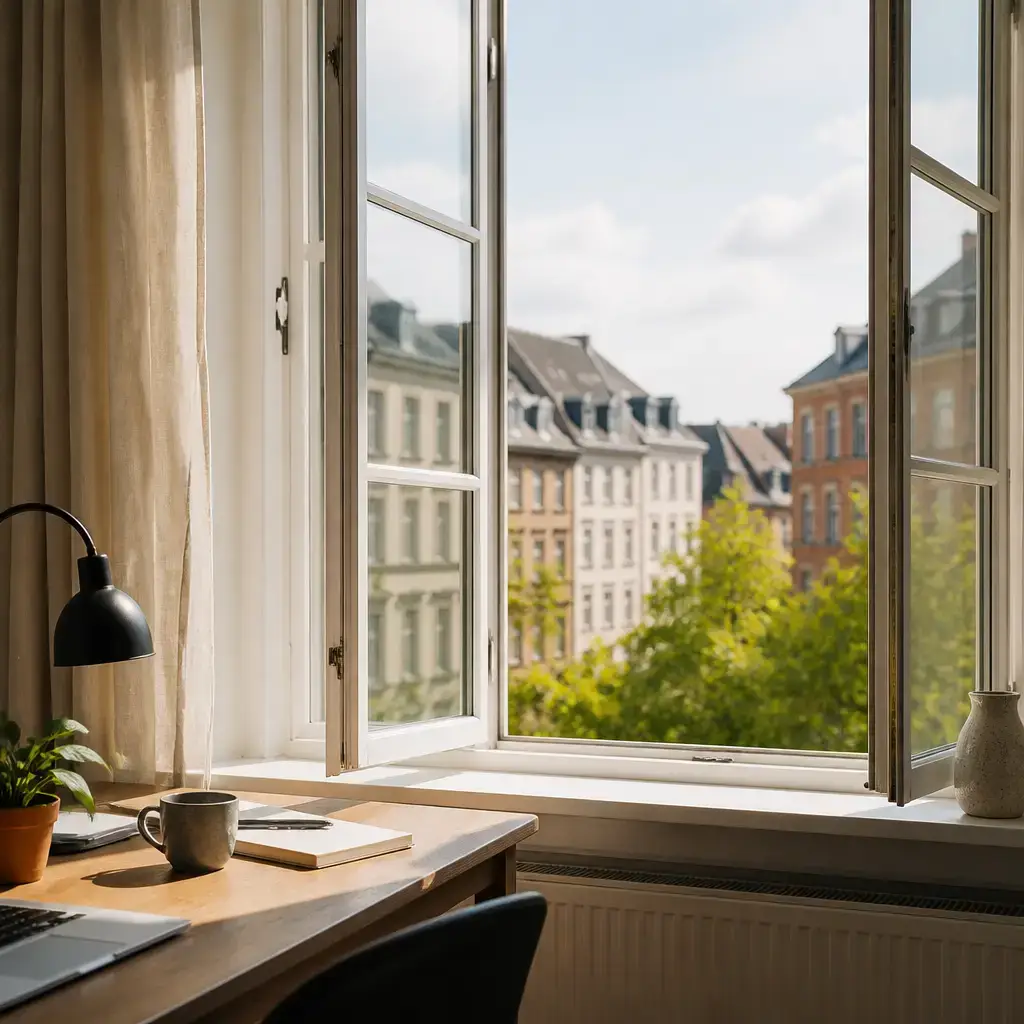
“ved” means “at” or “by” in “ved mit skrivebord,” locating the speaker next to the desk. It is used before a place, person, or thing to express being nearby. A new example is “Hun sidder ved vinduet” for saying “She is sitting by the window.”
mit
“mit” means “my” before “skrivebord” in “mit skrivebord.” This is the form used with the noun in this possessive phrase. A new example is “mit hus” for saying “my house.”
skrivebord
“skrivebord” means “desk” in “mit skrivebord,” the place where the speaker is sitting or working. It follows the possessive “mit” in this phrase. A new example is “Jeg arbejder ved mit skrivebord” for saying “I work at my desk.”
Lad
“Lad” is the first word in “Lad os åbne vinduet,” which means “let’s open the window.” Together with “os” and a verb, it introduces a suggestion involving the speakers. A new example is “Lad os spise” for suggesting “Let’s eat.”
os
“os” means “us” in “Lad os åbne vinduet.” With “Lad,” it makes the suggestion include the speaker and the listener. A new example is “Hun hjælper os” for saying “She helps us.”
åbne
“åbne” means “open” in “Lad os åbne vinduet.” It is the action proposed after “Lad os.” A new example is “Kan du åbne døren?” for asking “Can you open the door?”
vinduet
“vinduet” means “the window” in “åbne vinduet,” the object being opened. The exact form includes the definite ending used for “the window.” A new example is “Vinduet er åbent” for saying “The window is open.”
et
“et” means “a” or “one” in “et øjeblik,” meaning “for a moment.” It is the indefinite article placed before “øjeblik.” A new example is “et hus” for saying “a house.”
øjeblik
“øjeblik” means “moment” in “et øjeblik,” referring to a short amount of time. It is used after “et” in this time expression. A new example is “Vent et øjeblik” for saying “Wait a moment.”
har brug for
“har brug for” is the expression meaning “need” in “Jeg har brug for lidt frisk luft.” “har” contributes “have,” “brug” contributes the idea of need or use, and “for” connects the expression to what is needed. A reusable pattern is “Jeg har brug for + thing,” such as the dialogue form “Jeg har brug for lidt frisk luft.”
lidt
“lidt” means “some” or “a little” in “lidt frisk luft,” indicating a small amount of air. It is placed before the noun phrase it describes. A new example is “Jeg vil have lidt vand” for saying “I want a little water.”
frisk
“frisk” means “fresh” in “frisk luft,” describing the air the speaker needs. It comes before the noun “luft.” A new example is “frisk brød” for describing fresh bread.
luft
“luft” means “air” in “frisk luft,” the thing the speaker needs. It follows the adjective “frisk” in this noun phrase. A new example is “Der er luft her” for talking about air in a place.
Luften
“Luften” means “the air” in “Luften udenfor,” referring to the air outside. The exact form is the definite form used as the subject of “føles kølig.” A new example is “Luften er varm” for saying “The air is warm.”
udenfor
“udenfor” means “outside” in “Luften udenfor,” specifying where the air is. It is placed after “Luften” to describe the air’s location. A new example is “Jeg venter udenfor” for saying “I am waiting outside.”
føles
“føles” means “feels” in “Luften udenfor føles kølig,” describing how the outside air is experienced. It is followed by “kølig,” which describes the air. A new example is “Stolen føles hård” for saying “The chair feels hard.”
kølig
“kølig” means “cool” in “føles kølig,” describing the temperature of the outside air. It follows “føles” in this description. A new example is “Vandet er køligt” for saying “The water is cool.”
Kan
“Kan” means “can” at the start of “Kan vi hvile os ved vinduet?” and asks whether something is possible. A common pattern is “Kan + subject + verb,” as in the dialogue form “Kan vi hvile os.” A new example is “Kan du hjælpe?” for asking “Can you help?”
vi
“vi” means “we” in “Kan vi hvile os ved vinduet?” and refers to the speaker and the listener together. It comes after “Kan” in this question. A new example is “Vi arbejder her” for saying “We work here.”
hvile
“hvile” means “rest” in “hvile os,” referring to taking rest by the window. It is used after “Kan vi” to ask about this activity. A new example is “Jeg vil hvile” for saying “I want to rest.”
holde
“holde” means “take” in “holde en kort pause,” the Danish expression for taking a short break. It is used before the noun phrase “en kort pause.” A new example is “Vi holder en pause” for saying “We are taking a break.”
en
“en” means “a” in “en kort pause,” introducing one unspecified break. It comes before “kort pause.” A new example is “en stol” for saying “a chair.”
kort
“kort” means “short” in “en kort pause,” describing the length of the break. It is placed between “en” and “pause.” A new example is “en kort samtale” for describing a short conversation.
pause
“pause” means “break” in “en kort pause,” referring to a short rest from work. It follows “en kort” in this noun phrase. A new example is “Jeg tager en pause” for saying “I am taking a break.”
her
“her” means “here” in “holde en kort pause her,” identifying the place where they can take the break. It usually comes after the activity or clause it locates. A new example is “Kom her” for saying “Come here.”
mindre
“mindre” means “less” in “mindre træt,” showing that the speaker is tired to a smaller degree now. It comes before the adjective “træt.” A reusable pattern is “mindre + adjective,” as in the dialogue form “mindre træt.”
nu
“nu” means “now” in “Jeg føler mig mindre træt nu,” marking the present time of the changed feeling. It is placed at the end of this sentence. A new example is “Jeg kommer nu” for saying “I am coming now.”
snart
“snart” means “soon” in “snart gå tilbage på arbejde,” indicating that the return to work will happen in a short time. It can be placed before the verb phrase it describes. A new example is “Vi ses snart” for saying “See you soon.”
gå
“gå” means “go” in “gå tilbage på arbejde,” referring to moving back to work. It follows “Lad os snart” in the suggestion. A new example is “Lad os gå hjem” for suggesting “Let’s go home.”
tilbage
“tilbage” means “back” in “gå tilbage på arbejde,” showing that they will return to work. It comes after “gå” in this movement expression. A new example is “Kom tilbage” for saying “Come back.”
på
“på” is part of the expression “på arbejde,” meaning “to work” in “gå tilbage på arbejde.” Together with “arbejde,” it identifies work as the destination or activity. A new example is “Hun går på arbejde” for saying “She goes to work.”
arbejde
“arbejde” means “work” in “på arbejde,” the place or activity they will return to. It follows “på” in this fixed expression. A new example is “Jeg er på arbejde” for saying “I am at work.”