Ich
"Ich" identifies the speaker as the person making the statement, meaning "I" here. It is used as the subject in patterns such as "Ich wollte erwähnen" and "Ich kann den Bass leiser stellen". Use it whenever you speak about your own action, opinion, or experience.
wollte
"wollte" expresses the speaker's intention in "Ich wollte erwähnen", meaning "I wanted to mention". It is the past form of wollen used here to introduce a point in a relatively gentle way. The reusable pattern is "Ich wollte" followed by an infinitive, as in "Ich wollte erwähnen".
erwähnen
"erwähnen" means to mention or bring something up in "Ich wollte erwähnen". It follows "wollte" as the infinitive and introduces the information after it. Use it when raising a topic or fact without presenting it as a full complaint.
dass
"dass" introduces the content of what the speaker wanted to mention: "dass deine Musik deutlich durch die Wand zu hören ist". It connects a main clause with a subordinate clause, whose finite verb appears at the end. This pattern is useful after verbs such as "erwähnen" when stating what was mentioned.
deine
"deine" means "your" and identifies the music as belonging to the person being addressed in "deine Musik". It agrees with the noun that follows in this expression. Use it before something belonging to or associated with the person you address informally.
Musik
"Musik" refers to the music that can be heard through the wall. In the dialogue, it is the subject of "deine Musik deutlich durch die Wand zu hören ist" and is later referred to by "sie". Use this noun when discussing music as a sound or activity.
deutlich
"deutlich" means clearly or distinctly in "deutlich durch die Wand zu hören". It describes how clearly the music can be heard, not how loud it is. It can be reused with verbs of perception when something is easy to recognize or hear.
durch
"durch" indicates movement or transmission through something in "durch die Wand". Here it shows that the music is heard on the other side through the wall. A useful pattern is "durch" followed by the thing through which something passes or can be perceived.
die
"die" is the article in "die Wand" and also in "die Lautsprecher". In the first phrase it introduces the wall, and in the second it introduces the speakers being moved. Its exact form depends on the noun phrase it introduces.
Wand
"Wand" means wall and names the surface through which the music carries in "durch die Wand". It is the object after "durch" in that phrase. Use it when referring to an interior or exterior wall in a building.
zu
"zu" marks the infinitive in "zu hören". Together with "durch die Wand" and "ist", the construction "durch die Wand zu hören ist" means that the music can be heard through the wall; it does not express movement toward the wall. This infinitive pattern is used after certain structures to describe what is possible to perceive.
hören
"hören" means hear in "durch die Wand zu hören". With "zu" and "ist", it describes the music as perceptible through the wall. Use it for hearing a sound, especially when combined with information about where or how clearly it can be heard.
ist
"ist" links the music with the description "durch die Wand zu hören" in the subordinate clause. In "dass deine Musik deutlich durch die Wand zu hören ist", the finite verb is placed at the end because the clause begins with "dass". It is useful for describing a current state or condition.
hatte
"hatte" helps express an earlier past situation in "Ich hatte nicht gemerkt". Together with "gemerkt", it means that the speaker had not noticed something before the current conversation. This pattern is useful when explaining what you had or had not realized earlier.
nicht
"nicht" negates the noticing in "Ich hatte nicht gemerkt", meaning the speaker had not realized it. Its position directly negates the action expressed by "gemerkt" in this sentence. Use it to state that an action or awareness did not occur.
gemerkt
"gemerkt" means noticed or realized in "Ich hatte nicht gemerkt". It combines with "hatte" to describe something the speaker had not become aware of before. The reusable pattern is "etwas merken" when saying that you notice or realize something.
sie
"sie" refers back to "deine Musik" and means "it" in "dass sie bis zu dir durchdringt". It is the thing reaching the other person's side, not a female person. Pronouns such as "sie" are useful for avoiding repetition when the referred noun is already clear.
bis
"bis" marks the endpoint in "bis zu dir", meaning as far as or up to you. It shows how far the music reaches in "bis zu dir durchdringt". A reusable pattern is "bis zu" followed by a person or place that marks the endpoint.
dir
"dir" means "to you" in "bis zu dir" and identifies the person whose side the music reaches. It is the informal form used when addressing one person directly. Use this form when referring to something reaching or being given to the person addressed.
dringt
"dringt" describes the music penetrating or reaching through to the other side in "bis zu dir durchdringt". The expression presents the sound as gradually passing through a barrier. It can be reused with a sound or smell and a path or endpoint.
Man
"Man" gives a general, impersonal meaning like "one" or "people" in "Man hört sie". It avoids naming a particular person who hears the music. Use it when describing what people generally perceive or do in a situation.
hört
"hört" means hears or can hear in "Man hört sie". Together with "Man", it states generally that the music is audible. It can be reused with a sound as the object of hearing.
vor
"vor" appears in both "vor allem" and "vor Arbeitstagen". In "vor allem" it contributes to the fixed expression meaning especially, while in "vor Arbeitstagen" it means before workdays. Its meaning here depends on the expression it forms with the following words.
allem
"allem" is part of the fixed expression "vor allem", which means especially in "Man hört sie vor allem spät in der Nacht". It helps emphasize the time when the music is most noticeable. Use "vor allem" to highlight one point or circumstance as particularly important.
spät
"spät" means late and gives the time in "spät in der Nacht". It describes when the music is especially noticeable. Use it with a time expression when an event happens near the end of a period.
in
"in" places the time expression inside the period named by "der Nacht" in "in der Nacht". Here it means during the night rather than movement into a place. It is commonly used with time expressions to say when something happens.
der
"der" is the article in "der Nacht", the expression meaning "the night" in this sentence. It belongs to the noun phrase that follows "in". Learn it as part of the time expression "in der Nacht".
Nacht
"Nacht" means night in "spät in der Nacht". It identifies the period when the building is quiet and the music becomes more noticeable. Use it in time expressions such as "in der Nacht" when referring to nighttime.
wenn
"wenn" means when in "wenn es im Gebäude ruhig ist". It introduces the condition or time setting in which the music is especially noticeable, and the finite verb comes at the end of the clause. Use it to connect an event with a recurring time or condition.
es
"es" functions as the impersonal subject in "wenn es im Gebäude ruhig ist", meaning that it is quiet in the building. It does not refer to a specific object there. This pattern is useful for describing general conditions such as whether a place is quiet.
im
"im" means "in the" in "im Gebäude" and identifies the building as the place where the quiet condition applies. It is the contracted form used in this expression. Use it before a place when describing a state or event occurring inside it.
Gebäude
"Gebäude" means building in "im Gebäude". It names the shared place whose quietness affects how noticeable the music is. Use it when referring to a building as a whole rather than to one particular room.
ruhig
"ruhig" means quiet in "wenn es im Gebäude ruhig ist". It describes the condition of the building, so the music stands out more clearly. Use it after "sein" to describe a place or situation as quiet.
kann
"kann" expresses ability or a possible adjustment in "Ich kann den Bass leiser stellen". It tells the neighbor that the speaker is able and willing to make the change. It commonly appears with an infinitive, which remains at the end of the clause.
den
"den" is the article in "den Bass" and introduces the sound control being adjusted. It belongs to the object phrase of "leiser stellen". Its exact form is determined by the noun phrase in this sentence.
Bass
"Bass" refers to the low-frequency part of the music in "den Bass leiser stellen". It is the specific sound element the speaker offers to reduce. Use it when discussing the low tones of music or the corresponding control on audio equipment.
leiser
"leiser" means quieter or lower in "den Bass leiser stellen". It describes the desired change in the bass level rather than naming a separate object. The pattern "etwas leiser stellen" is useful for asking or saying that a sound should be reduced.
stellen
"stellen" means set or adjust in "den Bass leiser stellen". Together with "leiser", it means to set the bass to a quieter level, not simply to place it somewhere. Use this pattern when changing a setting or level.
und
"und" joins the two practical adjustments in "den Bass leiser stellen und die Lautsprecher von der Wand abrücken". It shows that both actions are part of the proposed solution. Use it to connect actions, objects, or clauses of equal importance.
Lautsprecher
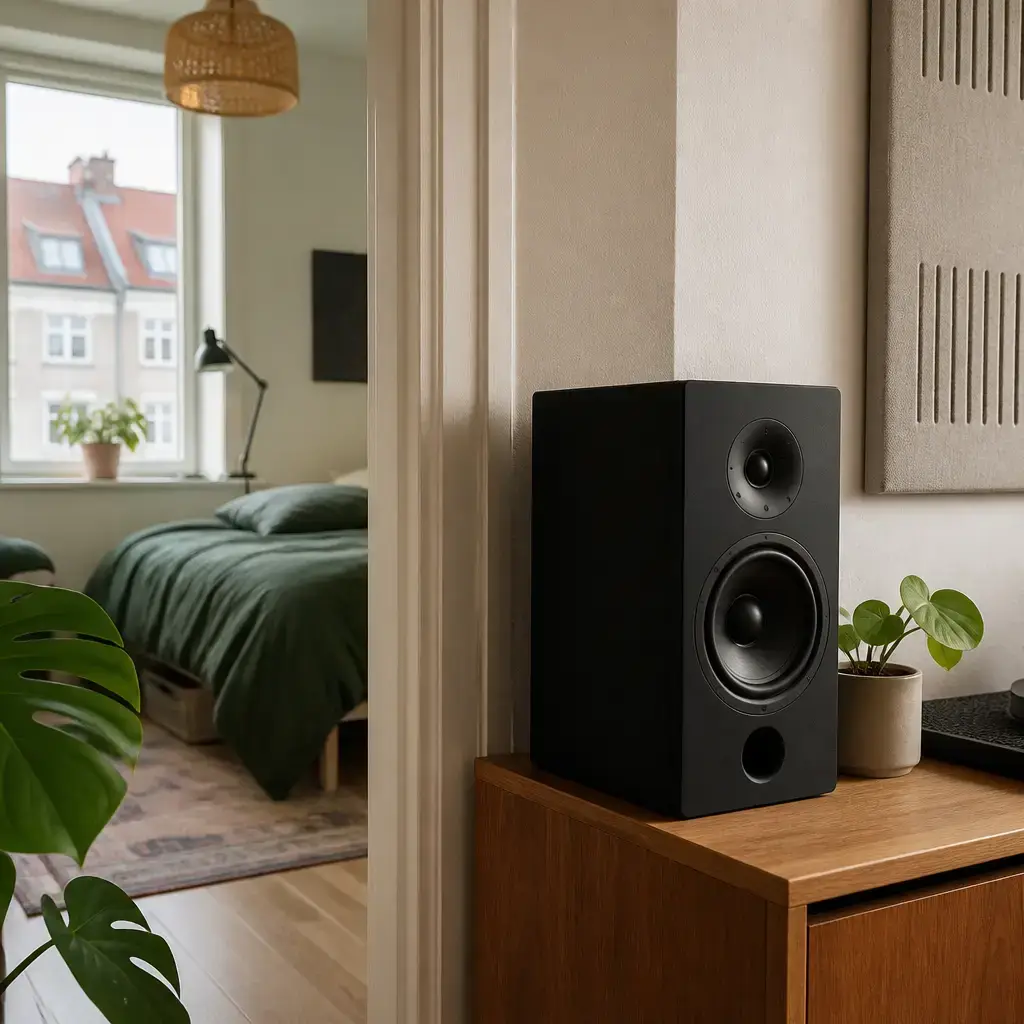
"Lautsprecher" means speakers in "die Lautsprecher von der Wand abrücken". It names the equipment that will be moved away from the wall to reduce the transmitted sound. Use it when discussing speakers as audio equipment.
von
"von" marks the point away from which the speakers are moved in "von der Wand abrücken". It identifies the wall as the starting reference for the movement. A useful pattern is "von" followed by the object or place someone moves away from.
abrücken
"abrücken" means move away in "die Lautsprecher von der Wand abrücken". With "von der Wand", it describes increasing the distance between the speakers and the wall. This is a useful verb pattern for moving an object away from a reference point.
Das
"Das" refers to the proposed adjustments in "Das würde helfen", meaning that this would help. The capital letter marks its position at the beginning of the sentence. It can refer back to an action, suggestion, or situation already mentioned.
würde
"würde" expresses a hypothetical result in "Das würde helfen", meaning that the adjustment would help. It presents the effect as expected or conditional rather than as an already observed fact. The reusable pattern is "Das würde" followed by an infinitive, as in "Das würde helfen".
helfen
"helfen" means help in "Das würde helfen". It describes the proposed changes as reducing the problem. Use it after a subject naming an action or measure when explaining that it would improve a situation.
besonders
"besonders" means especially in "besonders an Abenden vor Arbeitstagen". It emphasizes that the adjustment would be particularly helpful at that time. Use it before the part of a sentence that deserves special emphasis.
an
"an" introduces the time expression "an Abenden vor Arbeitstagen", meaning on evenings before workdays. Here it connects the helpfulness of the change with particular evenings. Use it with a time expression when referring to occasions or days on which something happens.
Abenden
"Abenden" means evenings in "an Abenden vor Arbeitstagen". It identifies the repeated evening occasions when quiet is especially important. Use it with a time expression such as "an Abenden" when referring to several evenings.
Arbeitstagen
"Arbeitstagen" means workdays in "vor Arbeitstagen". The phrase refers to evenings that come before days on which people work. Use it when distinguishing workdays from other days in a schedule.
Sag
"Sag" means tell or say and is used as a direct request in "Sag mir bitte". It addresses one person informally and asks that person to provide information. Use this imperative pattern when asking someone to tell you something.
mir
"mir" means "to me" in "Sag mir bitte" and identifies the person who should receive the information. It is used with the verb "sagen" in this request. The reusable pattern is "Sag mir" followed by the information or condition to be reported.
bitte
"bitte" makes "Sag mir bitte" a polite request, meaning "please tell me". It softens the direct imperative without changing the requested action. Use it in requests when you want to sound courteous.
Änderung
"Änderung" means change and refers to the adjustments to the bass and speaker position in "die Änderung". It names the practical measure being evaluated. Use it when discussing a modification to an arrangement, setting, or situation.
ausreicht
"ausreicht" means is enough or suffices in "wenn die Änderung nicht ausreicht". It asks whether the change is sufficient to solve or reduce the noise problem. A useful pattern is "etwas reicht aus" when evaluating whether a measure is sufficient.
weiß
"weiß" means appreciate or value in the expression "Ich weiß es zu schätzen", rather than simply meaning know on its own. The full construction expresses gratitude for the other person's willingness. Use "Ich weiß es zu schätzen" when acknowledging something positively.
schätzen
"schätzen" means appreciate or value in "Ich weiß es zu schätzen". Together with "weiß es zu", it forms the expression used to thank someone for a helpful attitude or action. Use this construction when expressing sincere appreciation.
du
"du" means "you" and identifies the person who is willing to discuss the issue in "dass du bereit bist". It is the informal singular subject form. Use it when addressing one person with whom informal address is appropriate.
bereit
"bereit" means willing or ready in "du bereit bist, darüber zu sprechen". Here it describes the person's willingness to discuss the matter, not physical readiness. It commonly appears with "zu" and an infinitive to say what someone is willing or ready to do.
bist
"bist" means "are" in "du bereit bist" and links "du" with the description "bereit". Because the phrase is inside a clause introduced by "dass", it appears at the end of that clause. Use it with "du" to describe the person's state or willingness.
darüber
"darüber" means about it in "darüber zu sprechen" and refers to the noise issue already under discussion. It replaces a repeated phrase with "über" when the topic is clear. Use it with "sprechen" to refer back to an issue being discussed.
sprechen
"sprechen" means talk or speak in "darüber zu sprechen". With "darüber", it describes discussing the noise issue. The reusable pattern is "über etwas sprechen" or, when the topic is already known, "darüber sprechen".
besser
"besser" means better in "Es ist besser, das zu klären". It evaluates the proposed action as preferable to allowing the problem to continue. Use the pattern "Es ist besser, ... zu" when recommending one course of action.
klären
"klären" means sort out or clarify in "das zu klären". It refers to resolving the noise issue through discussion before it becomes a larger problem. With "zu", it forms an infinitive construction after "Es ist besser".
bevor
"bevor" means before and introduces the later event in "bevor sich daraus Spannungen entwickeln". It sets a time limit for clarifying the matter. Use it to connect an action with something that should happen before a possible consequence.
sich
"sich" is part of the reflexive expression "sich ... entwickeln" in "sich daraus Spannungen entwickeln". Together with "entwickeln", it describes tensions coming into existence or growing. Its meaning should be understood as part of that whole construction, not as an independent translation.
daraus
"daraus" means from this or as a result of this in "sich daraus Spannungen entwickeln". It refers back to the unresolved noise issue and identifies it as the source of the tensions. Use it to connect a consequence with a previously mentioned situation.
Spannungen
"Spannungen" means tensions in "sich daraus Spannungen entwickeln". It refers to growing interpersonal strain between the neighbors if the issue is not addressed. Use it when describing conflict or strained relations that develop between people.
entwickeln
"entwickeln" means develop in "sich daraus Spannungen entwickeln". Together with "sich" and "daraus", it describes tensions gradually arising from the unresolved situation. This pattern is useful for explaining how a consequence grows out of an earlier problem.