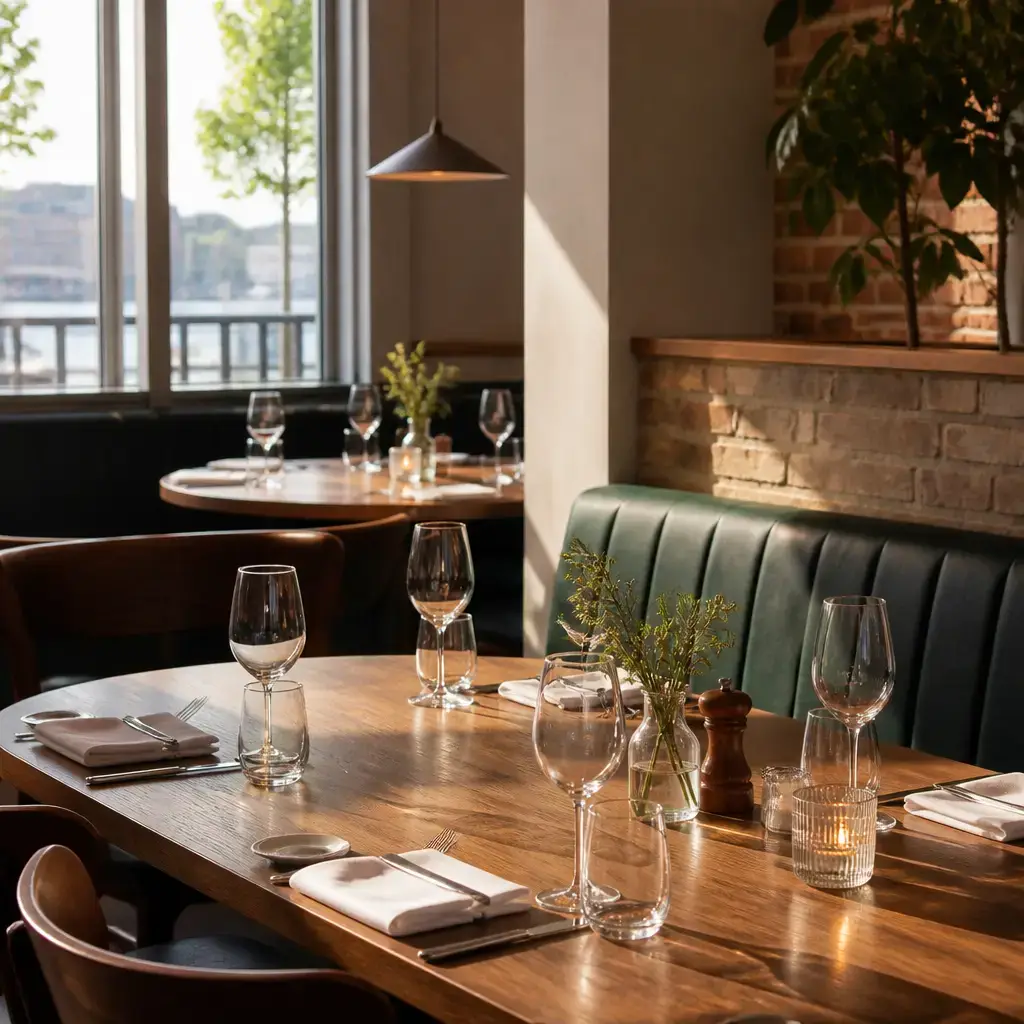
Wir
“Wir” means “we” and is the subject referring to the guests in “Wir haben einen ruhigen Tisch reserviert”. It is used as the subject before a verb when speaking for yourself and at least one other person, especially when explaining a group’s request in a restaurant.
haben
“haben” means “have” here and helps form the completed statement “Wir haben einen ruhigen Tisch reserviert”. It appears before the other verb form in this construction and is useful when reporting something your group has already done.
einen
“einen” means “a” in “einen ruhigen Tisch”. It is the article used here before the masculine noun phrase “ruhigen Tisch”, and the same article pattern can introduce one specific item being requested or described.
ruhigen
“ruhigen” means “quiet” and describes the requested table in “einen ruhigen Tisch”. Its ending fits the noun phrase after “einen”; use it before a noun when describing the desired quiet quality of a place.
Tisch
“Tisch” means “table”, specifically the restaurant table the guests reserved. In “einen ruhigen Tisch” it names the object of “reserviert”, and it can be used when discussing a reservation or asking about seating.
reserviert
“reserviert” means “reserved” in “Wir haben einen ruhigen Tisch reserviert”. Together with “haben”, it reports a completed reservation; this pattern is useful when explaining what was arranged in advance.
aber
“aber” means “but” and introduces the contrast between the quiet table that was reserved and the louder area in “aber dieser Bereich ist viel lauter als erwartet”. Use it to connect an expectation with a problem or limitation.
dieser
“dieser” means “this” and points to the area being discussed in “dieser Bereich”. It identifies something nearby or currently under discussion, which is useful when pointing out a particular section of a restaurant.
Bereich
“Bereich” means “area” or “section” in “dieser Bereich”. It refers to a defined part of the restaurant rather than the whole place, and it is useful when describing where a table or service area is located.
ist
“ist” means “is” and states the current condition of the area in “dieser Bereich ist viel lauter als erwartet”. It links the subject to a description and is useful for reporting a present condition politely.
viel
“viel” means “much” here and strengthens the comparison in “viel lauter als erwartet”. It comes before the comparative description to show that the difference is substantial, which is useful when explaining that a problem is greater than expected.
lauter
“lauter” means “louder” and compares the current area with what the guests expected in “viel lauter als erwartet”. It is used with “als” to compare two sound levels or conditions.
als
“als” means “than” in “lauter als erwartet”. It introduces the standard of comparison, and the pattern is useful when describing something as more or less than expected.
erwartet
“erwartet” means “expected” in “lauter als erwartet”. It refers to the anticipated level without stating who expected it, and the expression is useful when comparing an actual situation with a prior expectation.
Es
“Es” is the introductory pronoun in the apology “Es tut mir leid”; it does not refer to a separate object here. The whole expression is used to apologize, especially when acknowledging a guest’s inconvenience.
tut
“tut” contributes the verb form in the fixed apology “Es tut mir leid”. Its meaning is understood as part of that whole expression rather than as a standalone “does”, so use “Es tut mir leid” when expressing an apology.
mir
“mir” means “to me” in “Es tut mir leid”. It identifies the person experiencing the regret within the apology, and the full expression is useful when a staff member responds courteously to a complaint.
leid
“leid” expresses regret or sorrow in “Es tut mir leid”. It completes the apology rather than naming a separate object, so the reusable expression for acknowledging inconvenience is “Es tut mir leid”.
war
“war” means “was” and describes the earlier condition in “dieser Bereich war früher voll belegt”. It reports a past state, which is useful when explaining why a seating arrangement changed.
früher
“früher” means “earlier” in “war früher voll belegt”. It places the condition at an earlier time and is useful when explaining the timing of a restaurant section filling up.
voll
“voll” means “full” in “voll belegt”. Together with “belegt”, it describes a section with no available seating, and it is useful when explaining why a particular area could not be used.
belegt
“belegt” means “occupied” or “taken” in “voll belegt”. It describes the section as already filled with guests, and the phrase is useful when giving a reason that a reserved arrangement cannot be provided exactly as planned.
hatten
“hatten” means “had” in the subordinate clause “als wir erwartet hatten”. It appears at the end of that clause and helps describe what had been expected before the situation was explained.
An
“An” means “at” in “An diesem Tisch”. It introduces the table where the group would sit and is useful when describing the conditions or difficulty associated with a particular table.
diesem
“diesem” means “this” in “An diesem Tisch”, referring to the table currently being considered. Its form belongs to this prepositional phrase, and the phrase is useful when pointing out a specific seating location.
wird
“wird” means “will” in “wird es für unsere Gruppe schwierig sein”. Together with “sein”, it presents the difficulty as a future result of sitting at this table, which is useful when explaining a likely consequence.
für
“für” means “for” and marks the group affected by the difficulty in “für unsere Gruppe”. It is useful when explaining who will experience a problem or benefit from a proposed change.
unsere
“unsere” means “our” in “unsere Gruppe”. It identifies the group as belonging to or consisting of the speakers, and it is useful when describing a shared need or situation.
Gruppe
“Gruppe” means “group” in “unsere Gruppe”. It refers to the people dining together, and it is useful when explaining seating, communication, or service needs for several people.
schwierig
“schwierig” means “difficult” in “wird es für unsere Gruppe schwierig sein”. It describes the expected problem rather than making an absolute complaint, and it is useful for raising a concern politely.
sein
“sein” means “to be” and completes the future expression “wird es für unsere Gruppe schwierig sein”. It stays at the end of this construction and is useful when describing what a future situation will be like.
einander
“einander” means “each other” in “einander zu hören”. It shows that the members of the group need to hear one another, and it is useful for describing a reciprocal action among people.
zu
“zu” marks the infinitive in “einander zu hören”. It connects the action of hearing to the description of what will be difficult, and this pattern is useful after an adjective such as “schwierig”.
hören
“hören” means “hear” in “einander zu hören”. With “einander”, it describes mutual listening within the group, and it is useful when explaining that noise is interfering with conversation.
Ich
“Ich” means “I” and is the subject in “Ich kann Sie an einen Ecktisch umsetzen”. It identifies the staff member offering the solution and is useful when personally offering to take action for a guest.
kann
“kann” means “can” and expresses the staff member’s ability or offer in “Ich kann Sie an einen Ecktisch umsetzen”. It is followed by the infinitive “umsetzen”, a useful pattern when offering a possible service action.
Sie
“Sie” means formal “you” as the object of “umsetzen” in “Ich kann Sie an einen Ecktisch umsetzen”. The capitalized form addresses the guests respectfully, which is appropriate in a restaurant interaction.
Ecktisch
“Ecktisch” means “corner table” and names the alternative table in “an einen Ecktisch umsetzen”. It is useful when offering a specific seating location with a different layout or atmosphere.
umsetzen
“umsetzen” means “to move” or “to reseat” the guests in “Ich kann Sie an einen Ecktisch umsetzen”. It describes moving people to another table, and the pattern is useful when a restaurant offers a seating change.
um
“um” means “around” in “um den herum”. It introduces the space surrounding the corner table and is useful for describing how much room there is around an object.
den
“den” is the article in the spatial phrase “um den herum”, referring back to “Ecktisch”. It helps identify the table around which the extra space exists, and the whole phrase is useful when describing surrounding space.
herum
“herum” completes the expression “um den herum”, meaning “around it”. It emphasizes the space surrounding the table and is useful when describing room around a person or object.
mehr
“mehr” means “more” in “mehr Platz”. It indicates a greater amount of space than at the current table, and it is useful when comparing seating arrangements.
Platz
“Platz” means “space” or “room” in “mehr Platz”. It refers to the open area around the corner table, and it is useful when discussing comfort, movement, or seating capacity.
Das
“Das” means “that” or “it” in “Das würde helfen” and refers to the proposed move rather than to a separate noun. It is useful for responding to a suggestion by evaluating the whole proposal.
würde
“würde” means “would” in “Das würde helfen”. It presents the benefit as a conditional or polite expectation, which is useful when accepting a proposed solution without making an absolute claim.
helfen
“helfen” means “help” and completes “Das würde helfen”. It states that the suggested change would improve the situation, and the pattern is useful when explaining why an offered solution is acceptable.
solange
“solange” means “as long as” and introduces the condition in “solange unser Kellner mit uns Schritt halten kann”. It is useful when accepting a proposal while making continued service an important condition.
unser
“unser” means “our” in “unser Kellner”. It identifies the server responsible for the group, and it is useful when referring to the staff member already serving a particular group.
Kellner
“Kellner” means “server” or “waiter” in “unser Kellner”. It identifies the restaurant employee expected to continue serving the group, and it is useful when discussing responsibility for service.
mit
“mit” means “with” in the expression “mit uns Schritt halten”. It links the server’s pace to the group’s needs, and it is useful in expressions describing keeping pace with people.
uns
“uns” means “us” in “mit uns Schritt halten”. It refers to the dining group as the people whose pace or requests the server must follow, and it is useful after “mit” when referring to the group.
Schritt halten
“Schritt halten” means “keep up with” in “mit uns Schritt halten kann”. “Schritt” contributes the idea of pace or step, while “halten” contributes the idea of maintaining it; together they describe keeping pace with the group’s service needs. The reusable pattern shown here is “mit uns Schritt halten”.
Derselbe
“Derselbe” means “the same” in “Derselbe Kellner”. It emphasizes that the identical server, not a different one, covers the alternative table, and it is useful when reassuring someone that responsibility will remain unchanged.
bedient
“bedient” means “serves” or “attends to” in “Derselbe Kellner bedient diesen Ecktisch”. It describes the server’s responsibility for the table, and it is useful when explaining who will look after guests in a particular area.
diesen
“diesen” means “this” in “diesen Ecktisch”. It points to the specific corner table being offered, and it is useful when identifying a particular table or location in the restaurant.
daher
“daher” means “therefore” or “so” and introduces the consequence in “daher sollte der Service weiterhin reibungslos laufen”. It is useful for connecting the fact that the same server covers the table with the expected service result.
sollte
“sollte” means “should” in “sollte der Service weiterhin reibungslos laufen”. It expresses a reasonable expectation or reassurance rather than an absolute guarantee, which is useful when responding to a customer’s concern.
der
“der” is the definite article before “Service” in “der Service”. It identifies the specific service being discussed at the restaurant, and the phrase is useful when evaluating how service will continue.
Service
“Service” means “service” in “der Service”. It refers to the restaurant’s ongoing attention to the guests, and it is useful when discussing whether a seating change will affect the quality or continuity of service.
weiterhin
“weiterhin” means “still” or “continuing” in “weiterhin reibungslos laufen”. It shows that the service is expected to continue in the same successful way after the move, and it is useful when describing continuity.
reibungslos
“reibungslos” means “smoothly” or “without problems” in “reibungslos laufen”. It describes service proceeding without disruption, and it is useful when reassuring guests that a change will not create practical difficulties.
laufen
“laufen” literally means “run”, but in “der Service weiterhin reibungslos laufen” it means that the service will proceed smoothly. This usage is useful for describing how an operation or process is going.
Dann
“Dann” means “then” and moves the conversation from agreement to action in “Dann wechseln wir den Tisch”. It is useful for announcing the next step after a condition or decision has been accepted.
wechseln
“wechseln” means “change” or “switch” in “Dann wechseln wir den Tisch”. With “den Tisch”, it describes changing to another table, and this pattern is useful when agreeing to a seating change.
bevor
“bevor” means “before” and introduces the time condition in “bevor sich alle hinsetzen”. It is useful when arranging an action before another event takes place.
sich
“sich” is the reflexive pronoun in “sich alle hinsetzen”. It shows that the people in “alle” sit themselves down, and it is useful with “hinsetzen” when describing people taking their seats.
alle
“alle” means “everyone” or “all” in “bevor sich alle hinsetzen”. It refers to every member of the group, and it is useful when an action should happen before the whole group settles down.
hinsetzen
“hinsetzen” means “sit down” in “sich alle hinsetzen”. It is used with “sich” for people taking their seats, and the phrase is useful when coordinating a seating change before guests sit down.
lasse
“lasse” means “I have” or “I arrange” in “Ich lasse den Tisch jetzt neu eindecken”. It shows that the speaker will cause another person to reset the table, and this construction is useful when arranging a task to be done by staff.
jetzt
“jetzt” means “now” in “den Tisch jetzt neu eindecken”. It marks the immediate timing of the action, and it is useful when assuring guests that the table will be prepared without delay.
neu
“neu” means “anew” or “again” in “neu eindecken”. It shows that the table will be set up again for the new seating arrangement, and it is useful when describing a fresh setup after a change.
eindecken
“eindecken” means “set the table” in “den Tisch jetzt neu eindecken”. With “neu”, it means setting the table again, and the full pattern is useful when staff arrange a table for guests after moving them.