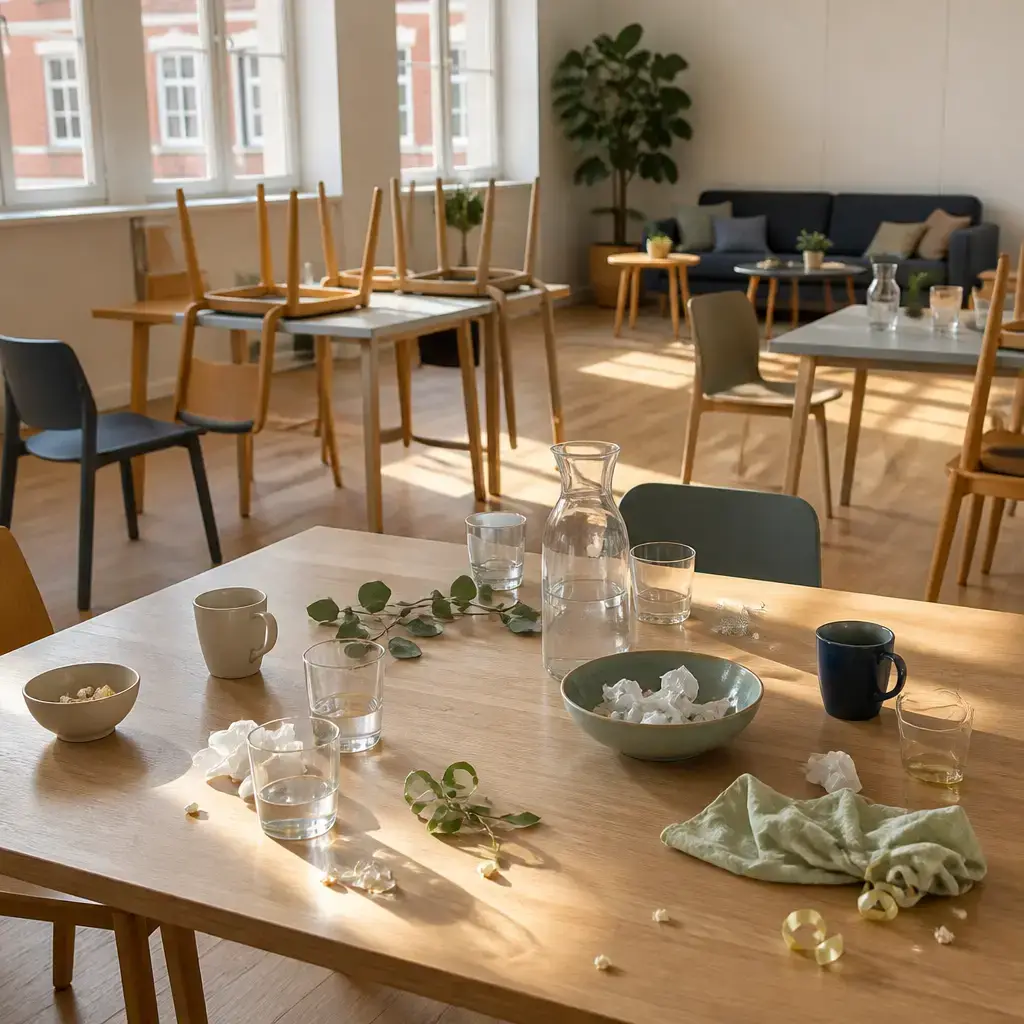
Der
“Der” means “the” in “Der Gemeinschaftsraum” and marks the specific common room as the subject. The lowercase form “der” also appears in “nach der Veranstaltung”, where it introduces the specific event after which the action takes place.
Gemeinschaftsraum
“Gemeinschaftsraum” means common room, a room shared by several people or groups. It is used here in “Der Gemeinschaftsraum” as the place being cleaned and reset.
sieht
In “sieht nach der Veranstaltung unordentlich aus”, “sieht” contributes the meaning “looks”. It is the finite form of aussehen, whose full meaning is expressed together with “aus”.
nach
In “nach der Veranstaltung”, “nach” means “after”. In “schaue auch nach”, it is part of the expression for checking or looking for something.
Veranstaltung
“Veranstaltung” means event, such as an organized meeting or activity. “nach der Veranstaltung” places the cleanup after that specific event.
unordentlich
“Unordentlich” means messy or untidy in “sieht nach der Veranstaltung unordentlich aus”. It describes the condition in which the room appears.
aus
In “sieht nach der Veranstaltung unordentlich aus”, “aus” is the separated second part of aussehen and helps express “looks”. The meaning comes from the whole verb construction “sieht ... aus”, not from “aus” alone.
Wir
“Wir” means “we” and refers to the two people cleaning the room. It is the subject in “Wir müssen ihn sauber machen” and appears with an initial capital letter because it begins the sentence.
müssen
“Müssen” means “must” or “need to” in “Wir müssen ihn sauber machen”. It is followed by the infinitive construction “ihn sauber machen” to state the required action.
ihn
“Ihn” means “him” or “it” here and refers back to the masculine noun Gemeinschaftsraum. In “ihn sauber machen”, it is the room that needs to be made clean.
sauber
“Sauber” means clean in “ihn sauber machen”. Together with “machen”, it describes making the room clean; the complete meaning comes from “sauber machen”.
machen
“Machen” means make or do, and in “sauber machen” it means to make something clean or clean it. A reusable pattern is “etwas sauber machen”, with the object before the expression.
weil
“Weil” means because and introduces the reason in “weil wir ihn reserviert haben”. In this subordinate clause, the verb forms come at the end.
reserviert
“Reserviert” means reserved in “wir ihn reserviert haben”. It describes the completed reservation, while “haben” helps form the verb phrase.
haben
“Haben” is the auxiliary verb in “reserviert haben”, referring to the completed act of reserving the room. It appears at the end of the weil-clause.
Lass
“Lass” means “let” in “Lass uns eine Checkliste benutzen” and is used to suggest an action that the speakers will do together. The citation form is lassen; the exact dialogue form is “Lass”.
uns
“Uns” means “us” in “Lass uns eine Checkliste benutzen”. The pattern “Lass uns ...” is used to make a suggestion for joint action.
eine
“Eine” means “a” or “an” before “Checkliste” in “eine Checkliste benutzen”. It introduces one checklist that has not been specified earlier.
Checkliste
“Checkliste” means checklist, a list used to make sure that tasks are completed. In “eine Checkliste benutzen”, it is the tool the speakers use during cleanup.
benutzen
“Benutzen” means use in “eine Checkliste benutzen”. A reusable pattern is “etwas benutzen”, with the thing being used as the object.
damit
“Damit” means so that and introduces the purpose in “damit wir nichts übersehen”. The clause explains why the checklist is being used.
nichts
“Nichts” means nothing or anything in the negative expression “nichts übersehen”. It functions as the object of the action that the speakers want to avoid missing.
übersehen
“Übersehen” means overlook or miss in “nichts übersehen”. It can be reused with an object for something that should not be missed, such as an item on a checklist.
Ich
“Ich” means “I” and identifies the speaker who will check for forgotten belongings. It is the subject at the beginning of “Ich schaue auch nach”.
kann
“Kann” means can in “Ich kann den Müll einsammeln”. It expresses that the speaker is able or willing to take responsibility for this task and is followed by the infinitive “einsammeln”.
den
“Den” means “the” in “den Müll” and introduces the specific trash being collected. It is the article used with this object in the dialogue.
Müll
“Müll” means trash or rubbish. In “den Müll einsammeln”, it is the material that the speaker will collect.
einsammeln
“Einsammeln” means collect or pick up, especially separate items or waste. The pattern “den Müll einsammeln” is a natural way to describe collecting trash.
und
“Und” means and and links the two cleanup tasks in “Ich kann den Müll einsammeln, und du kannst die Stühle wieder hinstellen”. It connects the two clauses without expressing a contrast.
du
“Du” means “you” when addressing one person informally. Here it is the subject of “du kannst die Stühle wieder hinstellen”, the second assigned task.
kannst
“Kannst” means can in “du kannst die Stühle wieder hinstellen”. It is the form used with “du” and is followed by the infinitive “hinstellen”.
die
“Die” means “the” in “die Stühle” and introduces the specific chairs that need to be put back. The capitalized form “Die” also appears at the beginning of “Die nächste Gruppe”.
Stühle
“Stühle” means chairs in “die Stühle wieder hinstellen”. It identifies the furniture that should be returned to its place.
wieder
“Wieder” means back or again in “wieder hinstellen”. Here it shows that the chairs should be placed back after having been moved.
hinstellen
“Hinstellen” means put or place something in a position, here putting the chairs back. The reusable pattern is “etwas hinstellen”, with the item being placed as the object.
Sollen
“Sollen” means should in the question “Sollen die Tische wieder so stehen wie vorher?”. It asks whether returning the tables to their previous position is the expected action.
Tische
“Tische” means tables. In “die Tische wieder so stehen”, it refers to the tables whose position is being checked.
so
“So” means in this way or like that in “so stehen wie vorher”. It points to the position described by the following comparison.
stehen
“Stehen” means stand or be positioned in “die Tische wieder so stehen”. With furniture, it describes how the tables are positioned in the room.
wie
“Wie” means as or like in “so stehen wie vorher”. The pattern “so ... wie ...” compares the current or intended arrangement with another one.
vorher
“Vorher” means before or previously in “wie vorher”. It refers to the arrangement that existed earlier, before the event or cleanup.
nächste
“Nächste” means next in “Die nächste Gruppe”. It identifies the group that will use the room after the current speakers finish.
Gruppe
“Gruppe” means group. In “Die nächste Gruppe”, it refers to the people arriving after the event who will use the room.
wird
“Wird” helps express the future in “Die nächste Gruppe wird den üblichen Aufbau erwarten”. It is followed by the infinitive “erwarten” at the end of the clause.
üblichen
“Üblichen” means usual or customary in “den üblichen Aufbau”. It describes the setup that the next group normally expects.
Aufbau
“Aufbau” means setup or arrangement, especially the way furniture or equipment is arranged. In “den üblichen Aufbau”, it refers to the familiar room arrangement.
erwarten
“Erwarten” means expect in “den üblichen Aufbau erwarten”. A reusable pattern is “etwas erwarten”, with the expected thing as the object.
schaue
In “Ich schaue auch nach”, “schaue” contributes the meaning “look” or “check”. It is the finite form of the separable verb nachschauen, whose full meaning is expressed together with “nach”.
auch
“Auch” means also in “Ich schaue auch nach”. It adds this checking task to the other cleanup tasks already mentioned.
ob
“Ob” means whether or if and introduces the question in “ob jemand persönliche Sachen liegen gelassen hat”. It is used when checking whether something is true or has happened.
jemand
“Jemand” means someone or anyone in “ob jemand persönliche Sachen liegen gelassen hat”. It refers to an unspecified person who may have left belongings behind.
persönliche
“Persönliche” means personal in “persönliche Sachen”. It describes belongings that belong to an individual rather than to the shared room.
Sachen
“Sachen” means things or items. In “persönliche Sachen”, it refers generally to personal belongings that may have been left in the room.
liegen
In “liegen gelassen hat”, “liegen” contributes the idea that the items were left lying in a place. Together with “gelassen”, the construction expresses leaving something behind.
gelassen
In “liegen gelassen hat”, “gelassen” contributes the meaning left. It is the participle of lassen and works with “liegen” to describe items that someone did not take with them.
hat
“Hat” is the auxiliary verb in “liegen gelassen hat”, helping express the completed action of someone leaving items behind. It appears at the end of the subordinate clause after the participle phrase.
Ladegeräte
“Ladegeräte” means chargers. It is one of the types of personal items that people can accidentally leave behind.
Notizbücher
“Notizbücher” means notebooks. In the dialogue, it is listed with chargers as an item that can easily be forgotten.
vergisst
“Vergisst” means forgets in “vergisst man leicht”. It describes the action that people can easily perform with chargers and notebooks.
man
“Man” refers to people in general or one in “vergisst man leicht”. It is useful for making a general statement without naming a particular person.
leicht
“Leicht” means easily in “vergisst man leicht”. It describes how readily people may forget chargers and notebooks.
Raum
“Raum” means room. In “Der Raum ist jetzt wieder bereit”, it refers to the common room after it has been cleaned and reset.
ist
“Ist” means is in “Der Raum ist jetzt wieder bereit”. It links the room with its current state of being ready.
jetzt
“Jetzt” means now and places the statement at the current point after the cleanup. In “ist jetzt wieder bereit”, it highlights the room’s present condition.
bereit
“Bereit” means ready in “Der Raum ist jetzt wieder bereit”. It describes the room as prepared for the next use.
Wenn
“Wenn” means if or when and introduces the condition in “Wenn wir den Raum sauber hinterlassen”. Here it states the condition under which booking the room again should become easier.
hinterlassen
“Hinterlassen” means leave something in a particular condition or place. In “den Raum sauber hinterlassen”, it forms a construction meaning leave the room clean.
sollte
“Sollte” means should in “sollte es leichter sein”. It expresses the expected result that booking the room again will be easier.
es
“Es” is the formal subject in “sollte es leichter sein”. The expression as a whole says that something will be easier, namely booking the room again.
leichter
“Leichter” means easier in “leichter sein”. It compares the effort or difficulty of booking the room again with the situation before the room was left clean.
sein
“Sein” means be in “leichter sein”. It follows “sollte” and completes the expression describing the expected condition.
zu
“Zu” marks the infinitive construction in “ihn wieder zu buchen”. It connects the action of booking with the expression “leichter sein”.
buchen
“Buchen” means book or reserve in “ihn wieder zu buchen”. A reusable pattern is “etwas buchen”, with the room or another service as the object.