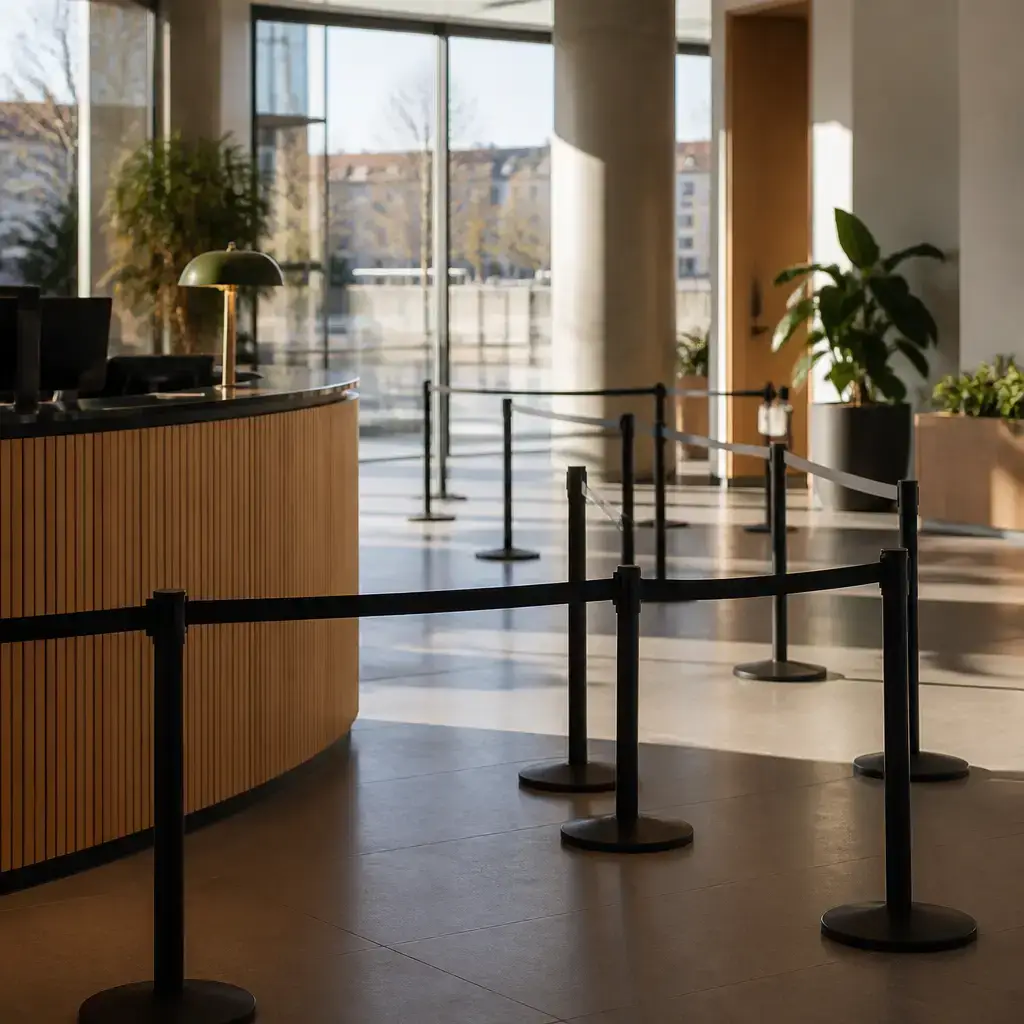
Entschuldigung
Entschuldigung is a polite way to get someone’s attention before asking for help. It is useful when approaching staff or another person in a public service area.
ist
Ist means “is” in the question ist das hier die Schlange. It links the subject das hier with die Schlange and is the present form used to ask what something is.
das
Das means “this” or “that” in ist das hier die Schlange and refers to the line being indicated. The same word appears as Das at the start of Das passiert oft, where it refers to the situation just described.
hier
Hier means “here” and points to the place where the speaker is standing. In ist das hier die Schlange, it helps identify this particular line.
die
Die is the definite article in die Schlange and identifies the specific line being discussed. It is reused with a noun such as die Schlange when the listener can identify which one is meant.
Schlange
Schlange means “queue” or “line” in this service-area context, not an animal. The dialogue reuses it in für ausführliche Anliegen and in in der falschen Schlange warten to describe different lines.
für
Für means “for” and identifies the purpose or type of service connected with a line, as in die Schlange für Hilfe. It commonly comes before the person, thing, or service that something is intended for.
Hilfe
Hilfe means “help” in die Schlange für Hilfe bei einem komplizierten Anliegen. It names the assistance the person is looking for and can be used after für to identify a service.
bei
Bei means “with” or “in the case of” in Hilfe bei einem komplizierten Anliegen. Here it introduces the matter for which help is needed, so the reusable pattern is Hilfe bei einem Anliegen.
einem
Einem means “a” or “an” in bei einem komplizierten Anliegen. Together with bei, it introduces one unspecified matter that requires help.
komplizierten
Komplizierten means “complicated” and describes the request in einem komplizierten Anliegen. It is useful before a noun when explaining that a matter needs more detailed assistance.
Anliegen
Anliegen means a request, matter, or concern brought to a service office. In einem komplizierten Anliegen and ausführliche Anliegen, it refers to the customer’s specific matter rather than a general question.
Diese
Diese means “this” and identifies the particular line being discussed in Diese Schlange. It is used directly before a noun when pointing out one specific thing.
einfache
Einfache means “simple” and describes the questions handled by this line in einfache Fragen. It contrasts with ausführliche Anliegen in the dialogue, so it helps distinguish the type of service available.
Fragen
Fragen means “questions” in einfache Fragen. It refers to straightforward things customers want to ask and is used after einfache to describe their type.
nicht
Nicht means “not” and excludes ausführliche Anliegen from the service offered by this line. It is placed before the phrase that is being rejected or negated, as in nicht für ausführliche Anliegen.
ausführliche
Ausführliche means “detailed” or “extensive” and describes the Anliegen or Hilfe that needs more attention. In ausführliche Hilfe and ausführliche Anliegen, it identifies service or matters that are not simple.
Schild
Schild means “sign” in Das Schild ist verwirrend and weil das Schild nicht sehr deutlich ist. It refers to the posted information that should tell people where to wait.
verwirrend
Verwirrend means “confusing” and describes the effect of the sign on the person trying to choose a line. It can describe information, instructions, or another thing that makes the correct choice difficult.
deshalb
Deshalb means “therefore” or “so” and connects the confusing sign with the speaker’s uncertainty. In deshalb war ich nicht sicher, it introduces the result of the situation just mentioned.
war
War means “was” and describes the speaker’s past uncertainty in war ich nicht sicher. It is the past form used here with sicher to say that the speaker did not know where to wait.
ich
Ich means “I” and identifies the person speaking in ich war nicht sicher and Ich möchte nicht warten. It is used as the subject when the speaker describes their own situation, intention, or action.
sicher
Sicher means “sure” or “certain” in war ich nicht sicher. The pattern nicht sicher sein expresses uncertainty about a decision or location, here where to wait.
wo
Wo means “where” and introduces the place the speaker is unsure about in wo ich warten soll. It is useful for asking or describing a location, followed here by a clause explaining the intended action.
warten
Warten means “wait” in wo ich warten soll and in in der falschen Schlange warten. It is used for remaining in a place until service is available, especially with an expression such as in der Schlange.
soll
Soll means “should” in wo ich warten soll and asks what the speaker is expected or advised to do. With an infinitive such as warten, it forms a question about the correct action.
stellen
Stellen means “place” or “put,” but in stellen Sie sich in die Schlange it is part of the instruction to get into the line. The reusable construction is sich in die Schlange stellen.
Sie
Sie means formal “you” in stellen Sie sich in die Schlange. Here it addresses one person politely and appears as the subject of a direct instruction.
sich
Sich refers back to the person addressed in stellen Sie sich in die Schlange. Together with stellen, it forms the expression for taking one’s place in a queue.
beim
Beim means “at the” or “near the” in beim Hauptschalter. It is a shortened form used before a place or service point, and here it identifies the location of the correct line.
Hauptschalter
Hauptschalter means “main desk” or “main counter” in die Schlange beim Hauptschalter. It identifies the central service point near which the person should wait.
am
Am means “at the” in am Empfang fragen and identifies the reception area as the place where the speaker should ask. It is commonly used before a named place or service point.
Empfang
Empfang means “reception” in am Empfang. It refers to the front desk or reception area where a person can ask for directions or assistance.
bevor
Bevor means “before” and introduces the action that should happen first in bevor ich in eine andere Schlange wechsle. It connects two actions in time, with the asking occurring before the change of line.
eine
Eine means “a” or “an” in eine andere Schlange. It introduces one non-specific line that is different from the line where the speaker is currently waiting.
andere
Andere means “another” or “different” in eine andere Schlange. It marks the new line as distinct from the current one and commonly appears before a noun when changing from one option to another.
wechsle
Wechsle means “switch” or “change” in ich in eine andere Schlange wechsle. It describes moving from the current queue to a different one, and the pattern in eine andere Schlange wechseln expresses that change.
Sagen
Sagen means “tell” or “say” in the formal instruction Sagen Sie ihnen, was Sie brauchen. With Sie, it tells someone politely to communicate information to another person.
ihnen
Ihnen or ihnen means “to them” in Sagen Sie ihnen, was Sie brauchen and “to you” in the formal address Ihnen den richtigen Platz zeigen. In Sagen Sie ihnen, it identifies the people who should be told what the speaker needs.
was
Was means “what” in was Sie brauchen and introduces the information that should be communicated. The pattern sagen, was jemand braucht is useful for explaining a person’s needs.
brauchen
Brauchen means “need” in was Sie brauchen. It describes the service or assistance a person requires and is used here with was to specify that need.
können
Können means “can” or “be able to” in Sie können Ihnen den richtigen Platz zeigen. It expresses that the reception staff have the ability to guide the person, followed by an infinitive such as zeigen.
den
Den is the definite article in den richtigen Platz and identifies a particular place that is correct for the person. It appears directly before the adjective and noun in the phrase den richtigen Platz zeigen.
richtigen
Richtigen means “right” or “correct” in den richtigen Platz and identifies the suitable place for the person’s request. It is useful before a noun when distinguishing the appropriate option from other possible places.
Platz
Platz means “place” or “spot” in den richtigen Platz zeigen. Here it means the correct location to go to, and the pattern jemandem den richtigen Platz zeigen describes directing someone there.
zeigen
Zeigen means “show” or “point out” in Sie können Ihnen den richtigen Platz zeigen. It is used with a person and a destination or object when indicating where someone should go.
möchte
Möchte means “would like” or expresses a polite wish in Ich möchte nicht in der falschen Schlange warten. It is followed by an infinitive to state what the speaker wants or does not want to do.
der
Der is the definite article in in der falschen Schlange and identifies the particular line being discussed. Together with in, it marks the place where the speaker does not want to wait.
falschen
Falschen means “wrong” in in der falschen Schlange warten. It describes the line as unsuitable for the speaker’s request and contrasts with the correct line mentioned later.
passiert
Passiert means “happens” in Das passiert oft. It describes the occurrence of choosing or waiting in the wrong line and is used with Das to refer to the whole situation.
oft
Oft means “often” and says that the situation happens frequently in Das passiert oft. It is a common adverb for describing how regularly something occurs.
weil
Weil means “because” and introduces the reason the problem happens in weil das Schild nicht sehr deutlich ist. It connects an event with its explanation, placing the reason after the main statement.
sehr
Sehr means “very” and strengthens deutlich in nicht sehr deutlich. It is used before an adjective or adverb when describing a high degree of a quality.
deutlich
Deutlich means “clear” in das Schild nicht sehr deutlich ist. It describes whether the sign communicates its instructions easily enough for people to choose the correct line.
frage
Frage means “ask” in Ich frage zuerst nach. Here it is part of the separable expression frage ... nach, meaning that the speaker will ask for information first.
zuerst
Zuerst means “first” and shows that asking will happen before joining the correct line in Ich frage zuerst nach. It is useful for setting the order of actions.
nach
Nach is the separated verb particle in Ich frage zuerst nach, where frage ... nach means “ask about” or “inquire.” The complete pattern is nach etwas fragen, with the topic of the question following nach in the sentence structure.
und
Und means “and” and links the two planned actions in Ich frage zuerst nach und stelle mich dann in die richtige Schlange. It is useful for presenting related actions in sequence.
stelle
Stelle means “put” or “place,” but in stelle mich in die richtige Schlange it belongs to the reflexive expression for joining a line. The pattern sich in die Schlange stellen describes taking a place in a queue.
mich
Mich means “me” and refers back to the speaker in stelle mich in die richtige Schlange. Together with stelle, it forms the reflexive construction meaning that the speaker places themself in the line.
dann
Dann means “then” and marks the second action in the sequence: after asking, the speaker will join the correct line. It is useful for describing what happens next.
So
So means “that way” or “so” in So können Sie zusätzliche Wartezeit vermeiden. It refers to the method just described and introduces the resulting benefit.
zusätzliche
Zusätzliche means “extra” or “additional” in zusätzliche Wartezeit. It describes waiting beyond the amount that would be necessary if the correct line were chosen initially.
Wartezeit
Wartezeit means “waiting time” in zusätzliche Wartezeit. It refers to the time spent waiting for service, and the phrase zusätzliche Wartezeit vermeiden describes preventing unnecessary extra time.
vermeiden
Vermeiden means “avoid” in zusätzliche Wartezeit vermeiden. It is used after können to express that asking first can help prevent extra waiting.