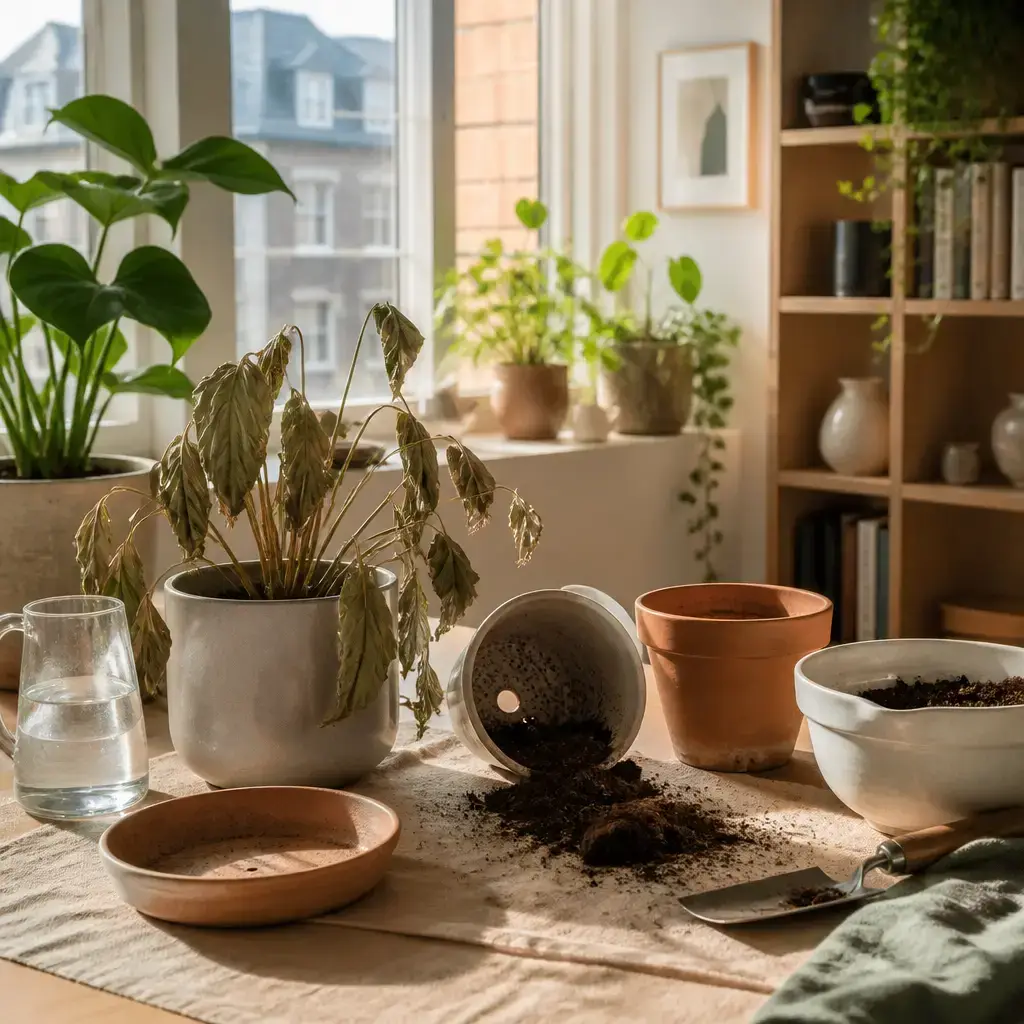
Meine
Meine means “my” here and belongs with the feminine noun Pflanze in Meine Pflanze. It identifies the plant as belonging to or being associated with the speaker.
Pflanze
Pflanze means “plant” here and is the noun in Meine Pflanze. It is useful for describing the plant whose water, light, or soil is being discussed.
welkt
Welkt means “is wilting” and describes the plant’s current condition in Meine Pflanze welkt. Welkt is the form used with a singular subject such as Pflanze.
obwohl
Obwohl means “although” or “even though” in obwohl ich sie oft gieße. It introduces a fact that contrasts with the main statement and places the verb at the end of its clause.
ich
Ich means “I” and is the subject performing the watering in obwohl ich sie oft gieße. Use ich when the speaker is the person doing the action.
sie
Sie means “it” here and refers back to the feminine noun Pflanze as the object of gieße. The same form can refer to a feminine noun when that noun is being acted on.
oft
Oft means “often” and describes how regularly the speaker waters the plant in ich sie oft gieße. It commonly appears with an action to state its frequency.
gieße
Gieße means “water” here and is the form used for the speaker’s action in ich sie oft gieße. In the subordinate clause, the verb appears at the end after the object sie.
hat
Hat means “has” in Sie hat vielleicht and states what condition or amount the plant has. It is the form used with the singular subject Sie referring to the plant.
vielleicht
Vielleicht means “perhaps” and makes the diagnosis in Sie hat vielleicht less certain. It is useful when presenting a possible explanation rather than a definite fact.
eher
Eher means “rather” in eher zu viel als zu wenig. It indicates that one possibility is considered more likely than the other.
zu
Zu means “too” in zu viel and zu wenig, showing an excessive or insufficient amount. It also introduces an infinitive in sich zu erholen and zu ändern, so its meaning depends on the construction around it.
viel
Viel means “much” in zu viel Wasser and refers to a large amount of water. The pattern zu viel + an uncountable noun expresses that the amount is excessive.
als
Als means “than” in eher zu viel als zu wenig. It links the two alternatives being compared in the pattern eher A als B.
wenig
Wenig means “little” in zu wenig Wasser and refers to a small amount of water. With an uncountable noun, it describes an insufficient quantity.
Wasser
Wasser means “water” and is the substance being discussed in zu viel Wasser and zu wenig Wasser. It can be combined with quantity words such as viel, mehr, or weniger.
dachte
Dachte means “thought” and introduces the speaker’s earlier belief in Ich dachte, mehr Wasser würde ihr helfen. Dachte is the past form used to report what the speaker previously believed.
mehr
Mehr means “more” in mehr Wasser and indicates a greater amount than before. The pattern mehr + noun is useful when discussing an increased quantity.
würde
Würde means “would” in mehr Wasser würde ihr helfen and presents an expected or imagined result. It appears with the infinitive helfen to express what the extra water was expected to do.
ihr
Ihr means “to it” here and refers to the plant as the beneficiary of helfen in würde ihr helfen. The verb helfen is used with the person or thing that receives the help in this form.
helfen
Helfen means “help” in würde ihr helfen. It is the infinitive after würde and can be used with a recipient, as in ihr helfen.
sich
Sich is the reflexive pronoun in sich zu erholen and refers back to the plant. Together with erholen, it expresses the plant recovering itself.
erholen
Erholen means “recover” in sich zu erholen. It appears as a zu-infinitive after helfen and is used with the reflexive pronoun sich in this expression.
Überprüfe
Überprüfe means “check” and gives a direct instruction in Überprüfe den Wasserabfluss. This is the form used when addressing one person with du.
den
Den is the definite article in den Wasserabfluss. It marks Wasserabfluss as the object of the instruction Überprüfe.
Wasserabfluss
Wasserabfluss means “drainage” or “water runoff” and is the thing to check in den Wasserabfluss. It names the way water leaves the plant pot.
und
Und means “and” and links the two instructions Überprüfe den Wasserabfluss and lass die Erde etwas trocknen. It joins actions that belong to the same advice.
lass
Lass means “let” in lass die Erde etwas trocknen and tells the listener to allow something to happen. The pattern lass + object + infinitive is used here with die Erde and trocknen.
die
Die is the definite article in die Erde and identifies Erde as the object of lass. Here it accompanies the feminine noun Erde.
Erde
Erde means “soil” in die Erde and is the material that should dry a little. In plant-care discussions, it refers to the soil in the pot.
etwas
Etwas means “a little” in die Erde etwas trocknen and limits the degree of drying. It softens the instruction by indicating only a small amount.
trocknen
Trocknen means “dry” in lass die Erde etwas trocknen. It is the infinitive after lass, with die Erde as the thing that becomes dry.
Der
Der is the definite article in Der Topf and marks Topf as the singular subject of the sentence. Here it accompanies the masculine noun Topf.
Topf
Topf means “pot” in Der Topf hat unten kein Loch. It refers to the container holding the plant.
unten
Unten means “at the bottom” and locates the missing hole in unten kein Loch. It specifies the lower part of the pot.
kein
Kein means “no” or “not any” in kein Loch and negates the noun Loch. The pattern kein + noun states that something is absent.
Loch
Loch means “hole” in kein Loch and refers to the opening that the pot does not have. It is used here to identify the missing drainage opening.
was
Was means “which” in was das Problem sein könnte and introduces a clause referring to the preceding fact that the pot has no hole. The clause gives a possible consequence or explanation.
das
Das is the definite article in das Problem and identifies Problem as the thing being discussed. Here it accompanies the neuter noun Problem.
Problem
Problem means “problem” in das Problem sein könnte. The pattern das Problem sein identifies something as the possible cause of the difficulty.
sein
Sein means “be” in das Problem sein könnte. It is the infinitive used with könnte to say that something might be the problem.
könnte
Könnte means “might” or “could” in das Problem sein könnte and expresses possibility rather than certainty. It combines with the infinitive sein in this statement.
Wurzeln
Wurzeln means “roots” and names the plant parts that can suffer in Die Wurzeln können leiden. The plural form refers to the roots collectively.
können
Können means “can” in Die Wurzeln können leiden and presents suffering as a possible result. It is followed by the infinitive leiden.
leiden
Leiden means “suffer” in können leiden and describes the possible effect of trapped water on the roots. It is the infinitive after können.
wenn
Wenn means “when” or “if” in wenn das Wasser nirgendwo abfließen kann. It introduces the condition under which the roots may suffer and places the verb at the end of the clause.
nirgendwo
Nirgendwo means “nowhere” in nirgendwo abfließen kann. It says that the water has no place to flow away.
abfließen
Abfließen means “flow away” or “drain” in das Wasser nirgendwo abfließen kann. It is the infinitive used with kann to describe water leaving the pot.
Soll
Soll means “should” in Soll ich sie auch näher ans Fenster stellen? and asks whether the speaker ought to take another action. Its capital letter is required because it begins the question.
auch
Auch means “also” or “too” and adds moving the plant to the window to the other possible care changes. It signals that this is an additional action.
näher
Näher means “closer” in näher ans Fenster and compares the plant’s proposed position with its current position. It describes a shorter distance to the window.
ans
Ans means “to the” and is the contraction of an das in ans Fenster. It marks the window as the destination toward which the plant would be placed.
Fenster
Fenster means “window” in ans Fenster and identifies the place near which the plant may be positioned. The pattern ans Fenster stellen describes placing something by the window.
stellen
Stellen means “put” or “place” in sie näher ans Fenster stellen. It is the infinitive after Soll and describes moving the plant into a position.
Versuche
Versuche means “try” in Versuche, immer nur eine Sache zu ändern. It is a direct instruction to one person addressed with du.
immer
Immer means “always” in immer nur eine Sache and makes the advice apply consistently each time. It strengthens the repeated rule of changing only one thing.
nur
Nur means “only” in immer nur eine Sache and restricts the number of changes to one. It emphasizes that other factors should not be changed at the same time.
eine
Eine means “one” or “a” in eine Sache. Together with nur, it specifies exactly one thing as the object of ändern.
Sache
Sache means “thing” in eine Sache zu ändern and refers to one adjustable factor in the plant-care experiment. The pattern eine Sache ändern means to change one thing.
ändern
Ändern means “change” in eine Sache zu ändern. It is the infinitive after zu and names the action being tried.
damit
Damit means “so that” in damit du erkennst, was hilft and introduces the purpose of changing only one thing. The clause explains the intended result of the advice.
du
Du means “you” and is the subject of erkennst in damit du erkennst. It addresses one person directly in the informal form used throughout the dialogue.
erkennst
Erkennst means “recognize” or “tell” in damit du erkennst, was hilft. It expresses being able to identify which change is helpful.
hilft
Hilft means “helps” in was hilft and refers to the change that produces a helpful result. It is the singular form used with was in this clause.
Dann
Dann means “then” in Dann werde ich sie umtopfen and signals the next action after the advice. It connects the decision to what was just discussed.
werde
Werde means “will” in werde ich sie umtopfen and helps form the future with the infinitive umtopfen. It is the form used with the first-person subject ich.
umtopfen
Umtopfen means “repot” in sie umtopfen and describes moving the plant into another pot or fresh potting arrangement. It is the infinitive used after werde.
diese
Diese means “this” in diese Woche and identifies the particular week in which the watering change will happen. It belongs with the noun Woche.
Woche
Woche means “week” in diese Woche and gives the time period for the planned change. The phrase diese Woche refers to the current or relevant week.
weniger
Weniger means “less” in weniger gießen and indicates reduced watering. It is placed with the action gießen to say that watering will be reduced.
Bei
Bei means “in” or “with regard to” in Bei der Pflanzenpflege and frames the topic or context. It is the preposition used before the area of activity being discussed.
Pflanzenpflege
Pflanzenpflege means “plant care” in Bei der Pflanzenpflege. It names the general activity that includes observing the plant and making small adjustments.
geht
Geht is the verb used in the construction Bei der Pflanzenpflege geht es vor allem um ... . Together with es and um, this construction states what a topic is about; geht does not carry that complete meaning alone.
es
Es is the placeholder subject in geht es vor allem um Beobachtung und kleine Anpassungen. With geht and um, it helps introduce the topic being described.
vor
Vor contributes to the fixed expression vor allem, meaning “above all” or “mostly”. In the dialogue, it emphasizes the main focus of plant care.
allem
Allem appears with vor in vor allem, meaning “above all” or “mostly”. The expression highlights observation and small adjustments as the primary focus.
um
Um is the preposition in geht es vor allem um Beobachtung und kleine Anpassungen and introduces the subject being discussed. The full meaning comes from the construction geht es um, not from um alone.
Beobachtung
Beobachtung means “observation” in um Beobachtung und kleine Anpassungen and names one part of plant care. It refers to paying attention to the plant’s condition before changing its care.
kleine
Kleine means “small” in kleine Anpassungen and describes the adjustments as limited in scale. It modifies the plural noun Anpassungen.
Anpassungen
Anpassungen means “adjustments” in kleine Anpassungen and refers to practical changes in plant care. The phrase kleine Anpassungen describes making limited changes rather than changing everything at once.